Curved & Custom-Shaped LED Display: Buyer Guide for Non-Rectangular Screens
A curved LED display begins where the standard 16:9 cabinet stops. Cylindrical columns, spherical centrepieces, ribbon-shaped ceilings, stair balustrades, and logo outlines all need a screen that follows a non-planar path. The quote for that screen depends on three numbers most briefs leave out: minimum radius, closest viewing distance, and the total pixel map. This guide covers the module types, geometry limits, 2026 cost ranges, pitch selection, specification checklist, and installation sequence for cylindrical, spherical, and free-form screens.
Short answer: A curved LED display is a screen built from flexible modules or angle-locked cabinets along an arc, cylinder, sphere, or free-form surface. Cylindrical builds typically cost 20–35% more than an equivalent flat screen (XOBLED, 2026), while indoor LED spheres run $1,500–$5,000/m² for the screen body depending on pitch (KSZLED, 2025). The decisive inputs are minimum radius, closest viewing distance, and whether content can be mapped to the geometry. Specify those three before comparing quotes.
What Is a Curved LED Display and When Do You Need One?
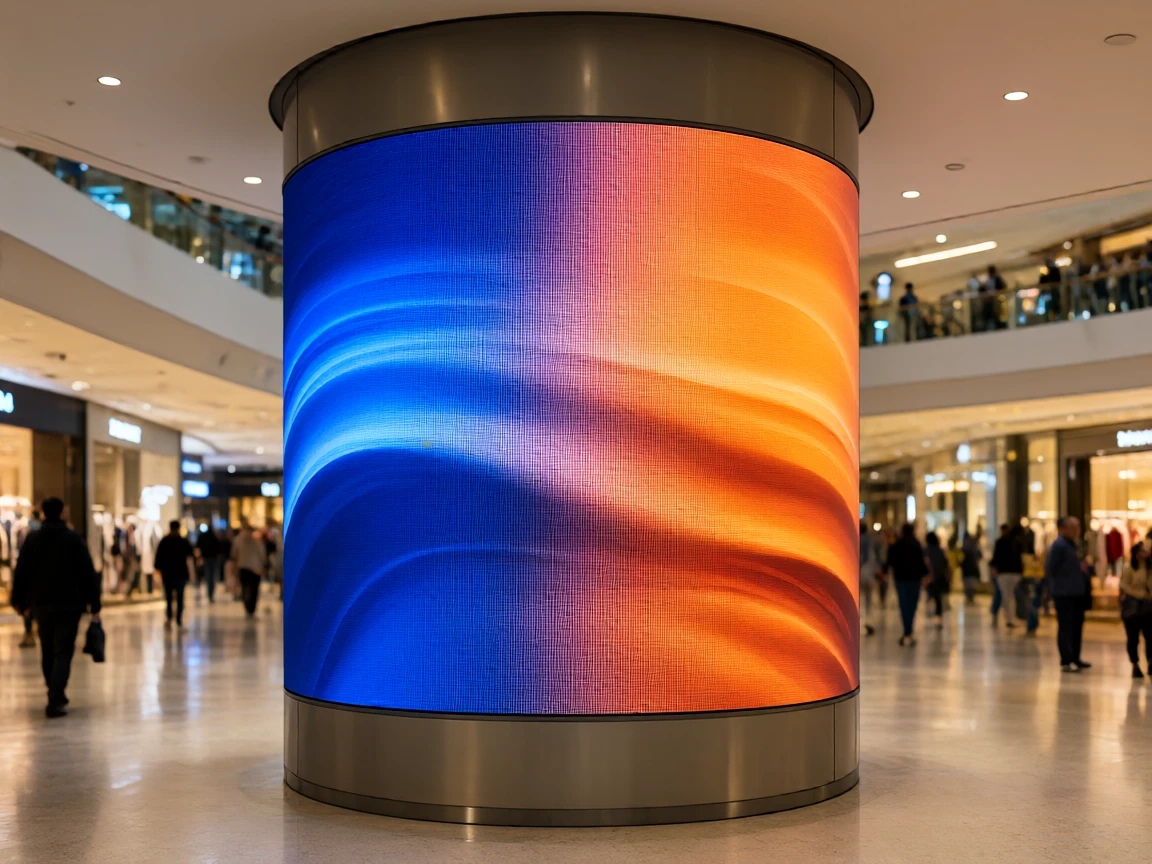
A curved LED display is a display assembled from flexible modules or angle-locked cabinets so the active surface follows an arc, cylinder, sphere, or other non-planar path. The curve can be concave, convex, full-circle, or compound; module, cabinet, frame, and content map are designed for the geometry, not bent on site.
Several product types sit under the curved label:
- A cylindrical LED display wraps a full or partial circle around a column, bar, or atrium feature, usually 0.5–3 m in diameter (XOBLED, 2026).
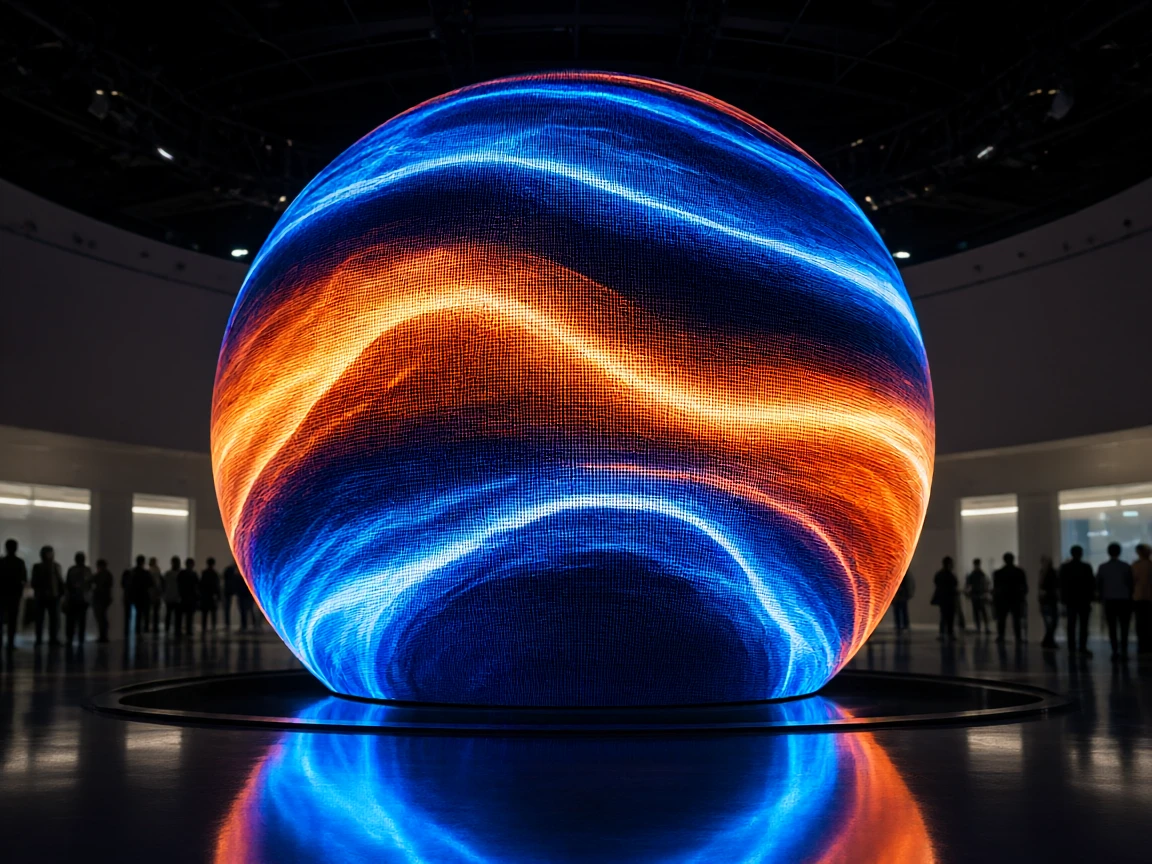
- An LED sphere display is a fully enclosed 360° screen built from trapezoidal modules on a spherical steel frame; Legidatech offers P1.56–P6.
- A flexible LED display uses bendable modules for tight radii, waves, and organic shapes where a rigid cabinet cannot follow.
- A custom-shaped LED display is built to a project drawing — cube, stair, dome, logo, or cutout — with custom masks and cabinets.
Curved screens earn their cost when the audience wraps around the display. EventStectnology (2026) puts the threshold at roughly 60–70° of audience arc; below that, a flat wall is simpler. Cylindrical bar features use the shape for 360° visibility, with 2–3× exposure against a flat screen (XOBLED, 2026).
What Is a Cylindrical LED Display?
A cylindrical LED display is a curved screen that forms a full or partial tube, usually from flexible modules on a round frame or angle-locked cabinets arranged in chords. It suits columns, island bars, and atrium features. The P2.5 creative cylindrical LED screen case shows the construction.
What Is an LED Sphere Display?
An LED sphere display is a fully enclosed spherical screen assembled from trapezoidal modules. The frame matters as much as the LEDs: if it is not precise, flatness and seams fail. Legidatech’s LED sphere display page lists P1.56–P6, custom diameters, and a 1.2 m P2 sphere at 4.52 m² and 100 kg; the LED ball screen exhibition case shows the format.
Curved LED Display vs Flat LED Wall: What Changes on Site?
A curve changes the module, frame, viewing geometry, and content.
| Attribute | Flat LED wall | Curved LED display | LED sphere display |
|---|---|---|---|
| Viewing angle | 120–160° (XOBLED, 2026) | Arc-dependent, up to 360° | 360° |
| Module type | Rigid cabinet | Flexible module or angle-locked cabinet | Custom trapezoidal modules |
| Minimum radius | Not applicable | 1.5–2 m for rigid cabinets; tighter with flexible modules (EventStectnology, 2026) | Set by sphere diameter and module tooling |
| Content | 16:9 or custom flat canvas | Warped or zoned to the arc | 360° mapped, often 3D |
| Cost reference | Baseline | +20–35% over flat (XOBLED, 2026) | $1,500–$5,000/m² body (KSZLED, 2025) |
Five key differences decide the project:
- Geometry sets the module. A curve uses narrower cabinets or bendable modules; the flat-panel BOM cannot simply be bent.
- Radius sets the cabinet width. Narrower chords follow a tight arc with less stepping.
- Content is designed before fabrication. The pixel map, not the video file, determines how the image wraps.
- Structure and access outweigh the LEDs. Curved steel, anchoring, and service reach often cost more than the extra modules.
- Tolerances tighten. A 0.5 mm step invisible on a flat wall becomes a visible line on a cylinder.
Which Curved LED Display Module Type Should You Choose?
Use flexible modules for tight radii, waves, and organic shapes. Use angle-locked rigid cabinets for large arcs and rental screens; the Legidatech AF500 locks from -5° to +5° and weighs 8 kg, making it practical for a curved rental LED display fleet. Use trapezoidal modules for spheres and domes, where the geometry changes in two directions. The flat LED panels vs flexible LED panels comparison covers the material trade-offs.
How Is a Curved LED Display Built for Cylinders, Spheres, and Free-Form Shapes?
Four routes cover most non-rectangular projects; the choice depends on radius, size, weight, and transport.
Flexible modules are built on a bendable PCB and mounted with magnets or clips. They suit P1.25–P4 indoor work, tight columns, ribbons, and wave walls. Every module has a minimum bend radius, and repeated flexing can damage solder joints. The flexible LED display and flexible LED display modules pages list the pitches.
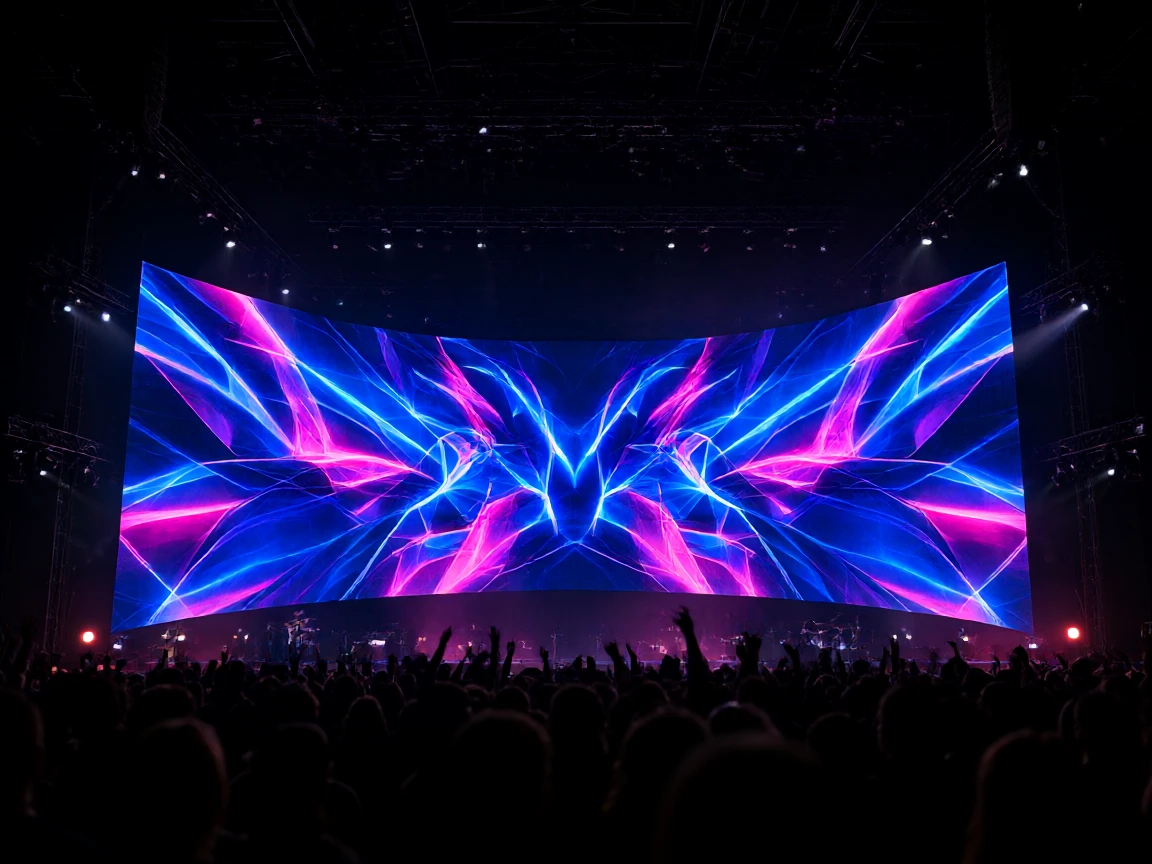
Angle-locked cabinets approximate an arc with straight chords. MUXWAVE (2025, updated 2026) recommends 250–300 mm chords, staggered seams, and flatness within 0.5 mm. Rental systems add quick-lock curve adjustment; the Legidatech video shows ±15° on a stage cabinet, while the fixed AF500 uses a -5° to +5° lock.
Spherical and dome screens use trapezoidal modules on a precision frame. The module count runs from 2 to 30 or more, and each new geometry carries a development cost (Legidatech, 2026). Large spheres are pre-assembled, split for transport, and rebuilt on site; frame tolerance decides whether the seams close.
Free-form outlines — cubes, stairs, logos, cutouts — combine custom cabinets, masks, and edge tiles. The mask hides partial pixels, controls off-axis light, and gives the shape a clean dark reveal. The custom LED display and creative LED screen ranges cover these, including the magic cube LED display and stair LED display.
What Control System Does a Custom-Shaped Curved LED Display Need?
A curved or spherical screen needs a controller that maps pixels onto a non-rectangular canvas, not a standard scaler. The special-shape LED controller and the creative LED controller support sphere, ring, dome, and curved-wall mapping; the creative LED display control guide explains the workflow. Specify the canvas, content source, and day/night calibration in one brief.
What Does a Curved LED Display Cost in 2026?
Curved pricing has two layers: the screen body and the geometry cost. The body is a flat screen of the same pitch plus a premium for flexible modules or angle-locked cabinets. Geometry cost sits in the frame, labor, content mapping, and tooling.
| Screen type | 2026 cost reference | What drives the number |
|---|---|---|
| Cylindrical, concave, or convex fixed screen | +20–35% over an equivalent flat screen (XOBLED, 2026) | Flexible modules, curved frame, registration time |
| Curved or custom installation labor | $700–$2,500/m², 20–40% of budget (OneDisplayGroup, 2026) | Custom trussing, specialist crews, access |
| Indoor LED sphere, P2 | $3,000–$5,000/m² body (KSZLED, 2025) | 250,000 dots/m², tighter splicing tolerance |
| Indoor LED sphere, P2.5 | $2,000–$3,500/m² body (KSZLED, 2025) | 160,000 dots/m², the common indoor choice |
| Indoor LED sphere, P3 | $1,500–$2,500/m² body (KSZLED, 2025) | 111,111 dots/m², long-view or budget projects |
| Rental curved panel | Quoted per panel; reused across events | Quick-lock curve, flight case, labor |
| Custom logo, ribbon, or new module geometry | Project quote plus tooling/NRE | New module, mask, frame, and pixel map |
The table prices the screen body only. Control, steel, installation, freight, and content mapping sit on top; installation alone can reach $2,500/m² on a complex wall (OneDisplayGroup, 2026). Two sphere examples: a 1.2 m P2.5 sphere has 4.52 m² of surface, so the body runs about $9,040–$15,820; a 2 m P3 sphere has 12.56 m², or about $18,840–$31,400 (KSZLED, 2025; Legidatech, 2026). A cylinder is the flat price plus 20–35%.
How Much Does a Cylindrical LED Display Cost?
Price the flat screen of the chosen pitch first, then add 20–35% for the cylindrical build (XOBLED, 2026). A 6.3 m² cylinder (1 m diameter × 2 m high) costs the same as 6.3 m² of flat screen plus the premium, frame, controller, and installation. The premium is lower on a large-radius arc.
How Much Does an LED Sphere Display Cost per Square Meter?
Indoor LED spheres run $3,000–$5,000/m² at P2, $2,000–$3,500/m² at P2.5, and $1,500–$2,500/m² at P3 for the screen body (KSZLED, 2025). The price excludes the frame, control, installation, and freight; custom diameters add tooling. Weight is another input: about 30 kg/m² for the body, 100 kg for a 1.2 m P2 sphere, and 400 kg for a 2 m P2.5 sphere (Legidatech, 2026).
How Do You Choose the Pixel Pitch for a Curved LED Display?
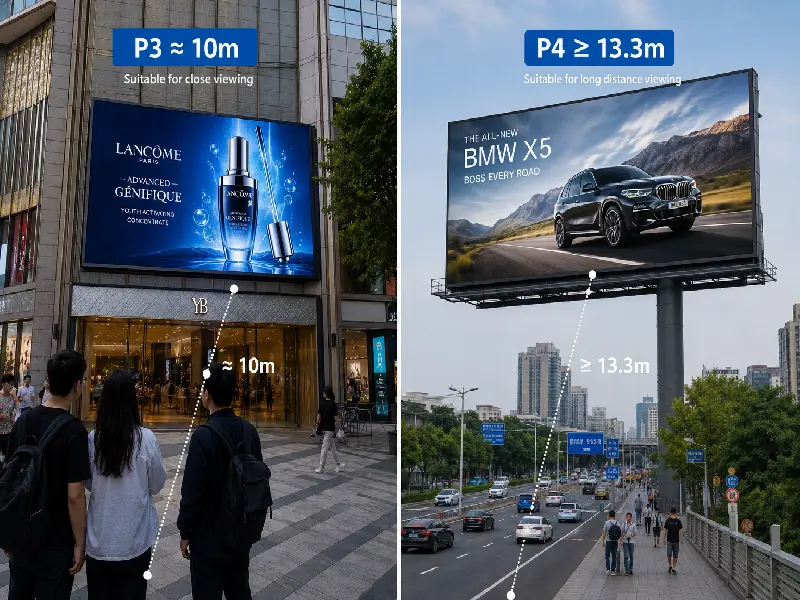
Pitch follows the closest comfortable viewing distance, not the average. On a curve, viewers approach from several directions, so the nearest point sets the pitch unless content is zoned. MUXWAVE (2025) uses the rule that pitch in millimeters approximates the minimum viewing distance in meters; EventStectnology (2026) puts P2.6 at 3–8 m event viewing.
| Closest viewing distance | Working pitch | Typical curved use |
|---|---|---|
| Under 2 m | P1.5–P1.8 | Museum interactives, retail columns, close brand features |
| 2–5 m | P2.5–P3.9 | Bars, lobbies, exhibition booths, stage backdrops |
| 5–10 m | P4–P6 | Atriums, large stages, architectural features |
| Above 10 m | P6–P10 | Large creative structures, outdoor landmarks |
For spheres, the same rule applies around the equator. Legidatech lists indoor P2–P4 and outdoor pitches above P5; a P2 sphere suits close viewing, while P3–P4 suits a 5–10 m ring. Finer pitch raises cost and calibration difficulty, so do not buy P2 for an atrium where the nearest viewer stands 8 m away.
How Do You Map Content onto a Curved LED Display?
Map content to the pixel canvas, not to a 16:9 frame. Build a flat pixel map of the unrolled surface, mark the seams and viewing orientations, and give the map to the content team before production. Standard video can be warped for a gentle arc, but a full cylinder or sphere usually needs custom-resolution content, a 360° loop, or 3D mapping. Plan text in rendered pixels — 60–80 px at 3–5 m and 90–120 px at 6–10 m (MUXWAVE, 2025) — and replace 1 px hairlines with 2–3 px strokes. Keep day and night LUTs separate.
How Do You Specify a Custom-Shaped Curved LED Display?
A curved-screen RFQ needs more than a size and a pitch. Use this checklist to make quotes comparable:
- Geometry: CAD surface with true radius, arc angle, height, diameter, and seams.
- Module type: flexible, angle-locked, or trapezoidal; minimum radius and cabinet width.
- Pixel map: columns, rows, partial edge pixels, and native canvas resolution.
- Pitch: based on the closest viewing distance, with viewing directions marked.
- Content: source format, warping method, 360° or zoned layout, and calibration.
- Structure: steel design, anchoring, wind or seismic load, and building interface.
- Service: front or rear access, module removal path, and spare storage.
- Control: mapper or special-shape controller, receiving-card layout, and backup source.
- Acceptance: dead-pixel limit, uniformity, seam spec, and camera test.
What Tolerances Should a Curved LED Display Quote Include?
Write the tolerances into the contract. MUXWAVE (2025) recommends flatness within 0.5 mm and joint skew within 0.3 mm across module boundaries for custom-shaped work, with uniform module rotation of 0.5–1° only where the mechanical design allows it. Add a seam-stagger plan, a color-uniformity target after calibration, and a spare-parts list of 2–5% modules plus one cabinet per geometry. Without those lines, a curve that looks acceptable in the factory can show joint lines on site.
How Is a Curved LED Display Installed and Maintained?
Installation follows the geometry. The survey confirms floor load, rigging points, power, and access. The frame is set to the true radius, modules are mounted from a datum line, data and power run through the frame, the controller maps the canvas, and calibration balances brightness and color. A simple concave backdrop takes 4–8 hours; a full cylinder or multi-curve install can take 1–2 days (EventStectnology, 2026).
Permanent creative projects follow the same sequence with more steel work. A column screen wraps a round frame and is usually front-service; a sphere is pre-built in sections, lifted, and re-assembled around the structure. Stair and cube projects add custom masks and edge tiles, so mask registration is a separate step. The creative LED display for shopping mall and creative LED display for bars pages show the formats.
How Is a Curved LED Display Serviced on a Column or Sphere?
Service access is a design decision. A column screen normally uses front-service magnetic modules so a technician can reach the surface from a lift; a sphere needs an internal route or removable section, plus a documented module map so replacements go back in order. Keep spares for every geometry, because an equator module will not fit the pole. For rental screens, the rental LED display half-panel format reduces lift-and-lock cycles on large curved walls.
What Are the Common Mistakes in Curved LED Display Projects?
Most failures on non-rectangular screens happen before the hardware arrives. These are the recurring ones:
- Designing in 2D and expecting the curve to follow. Without a pixel map and true-radius drawing, cabinet count and content aspect are guesses.
- Choosing pitch at the average distance. The closest viewer sees the pixel structure first; pitch for that person.
- Using standard 16:9 content on a 360° surface. The image stretches or leaves dead zones; mapping belongs in scope.
- Underestimating structure and access. Curved steel, anchoring, and service reach can cost more than the display.
- Buying custom modules without spares. New trapezoidal modules have tooling lead time; one failure can leave a hole for weeks.
- Skipping the camera test. Moiré and scan lines appear on phone footage even when the eye sees a clean image.
For a flat-wall baseline and the flexible alternative, the LED video wall and P2.5 flexible LED display pages show the conventional starting points. The transparent LED screen range covers the see-through option for curved glass features.
Which Sources Support This Curved LED Display Buyer Guide?
The cost and engineering figures come from published 2026 manufacturer data and project guides:
- XOBLED (2026): cylindrical premium of 20–35%, diameter range 0.5–3 m+, 120–160° flat viewing angle, and 2–3× exposure estimate.
- KSZLED (2025): indoor sphere body prices at P2, P2.5, and P3; pixel density, weight, and power figures.
- EventStectnology (2026): configuration types, minimum radii, P2.6 viewing distance, and installation durations.
- MUXWAVE (2025, updated 2026): chord widths, flatness and skew tolerances, module rotation, refresh, content rules, and spare-parts planning.
- OneDisplayGroup (2026): curved and custom installation labor at $700–$2,500/m².
- Legidatech (2026): sphere pitch range, 1.2 m and 2 m sphere data, AF500 curve lock and weight, and Mooncell special-shape controllers.
Frequently Asked Questions About Curved LED Display
What is a curved LED display?
A curved LED display is a screen built from flexible modules or angle-locked cabinets along an arc, cylinder, sphere, or free-form surface. Module, frame, pixel map, and content are designed for the geometry from the start.
How much does a curved LED display cost in 2026?
A cylindrical or curved cabinet screen costs 20–35% more than an equivalent flat screen (XOBLED, 2026), plus installation labor of $700–$2,500/m² (OneDisplayGroup, 2026). Indoor LED spheres run $1,500–$5,000/m² for the body depending on pitch (KSZLED, 2025).
What is the minimum radius for a curved LED display?
Rigid cabinets typically need a radius of 1.5–2 m; tighter curves require flexible modules (EventStectnology, 2026). The exact limit depends on cabinet width and module type, so confirm it in writing.
Can any LED display be curved?
No. Standard rigid cabinets can only form an arc through angle-locked joints, and the minimum radius is limited. Flexible modules bend further, and spheres need trapezoidal modules. A supplier that quotes a curve without asking for radius is guessing.
How do you choose pixel pitch for a curved LED display?
Use the closest viewing distance: under 2 m points to P1.5–P1.8, 2–5 m to P2.5–P3.9, 5–10 m to P4–P6, and above 10 m to P6–P10. On a 360° screen, pitch for the nearest viewers unless content is zoned.
Can a curved LED display show standard 16:9 video?
Yes on a gentle arc, where the content can be warped. A full cylinder or sphere needs custom-resolution or 360° content; standard 16:9 will stretch, repeat, or leave dead zones. Plan the pixel map and content format before fabrication.
Final Word: How Do You Buy a Curved LED Display That Fits?
Start with the geometry, then the closest viewing distance, then the content. Those three inputs decide whether you need flexible modules, angle-locked cabinets, or trapezoidal modules, and they explain most of the price gap between quotes. A cylindrical screen carries a 20–35% premium over flat hardware; an indoor sphere runs $1,500–$5,000/m² for the body; installation adds $700–$2,500/m² on complex curves. Buy from an LED screen manufacturer that asks for the radius, pixel map, and service plan before quoting — and compare proposals on those same three lines.