Creative LED Displays with Mooncell: Sphere, Floor, Dome, 3D & KTV Control Systems Explained (2026)
If you are searching for a creative LED display controller — whether for a sphere LED screen, an interactive LED floor tile screen, a dome, a ring, a 3D wall or a KTV room — you will quickly hit the same wall: most LED control systems are built for rectangles. Mooncell is the exception. This guide explains how Mooncell control systems drive every major creative display shape, which controller fits which shape, and how the screen gets delivered as a working project.
Quick answer: the B1200S (BS series) handles sphere, dome, disc and ring geometries; the MB400S adds networked playback for custom shapes; floor screens pair a standard processor with Mooncell’s linkage tools; KTV and bar venues use the K series plus the MC-C2 server; and glasses-free 3D runs on the M40 class. Mooncell’s credentials in this niche are not marketing copy — it supplies the display control system for the CCTV Spring Festival Gala and contributed to the Beijing 2022 Winter Olympics opening ceremony.
Why Creative Screens Need Different Control
A standard LED wall is a perfect rectangle: the content is a rectangle, the sending card slices it by rows, and each receiving card renders a rectangular block. A sphere, dome, floor or horn-shaped screen breaks every one of those assumptions:
- Pixel geometry — the physical layout does not match the video raster, so the controller must re-map rows, columns and individual pixels to the physical position.
- Module cropping — at the edges of a sphere or dome, standard rectangular modules must be cut or skipped, and the controller must know which pixels no longer exist.
- Content alignment — standard rectangular content should play “straight” on a curved or circular surface without custom media production.
- Load balancing — pixel load is calculated on the actual pixel count, not on a rectangular bounding box.
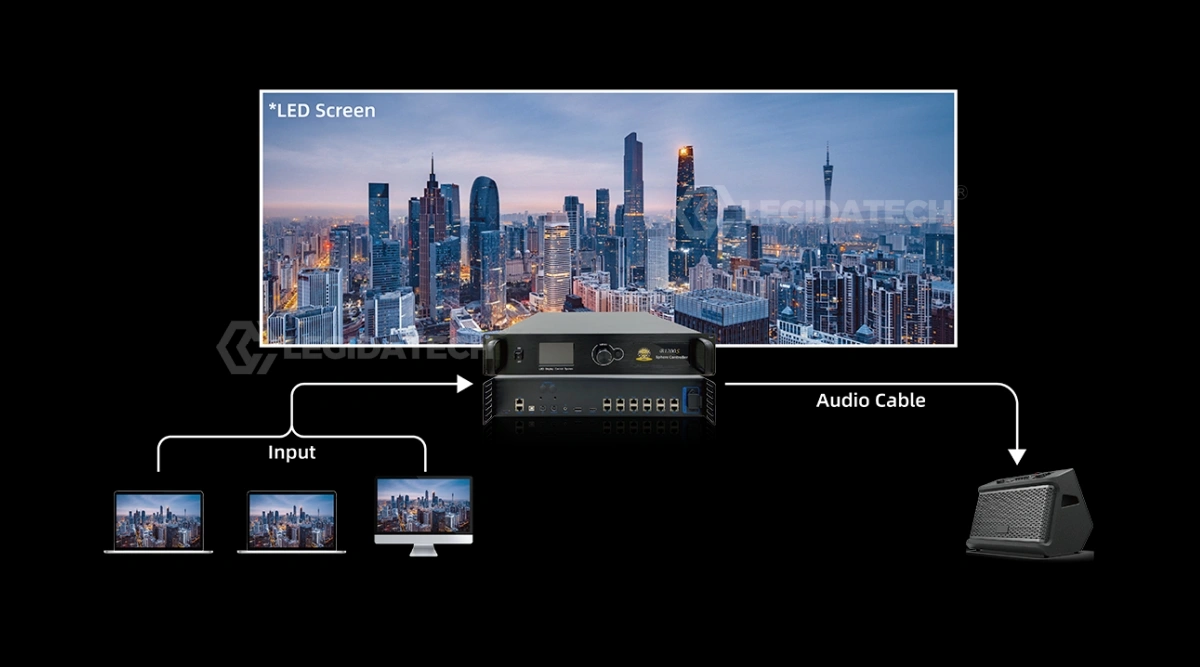
How a BS-series controller re-maps a video raster onto a non-rectangular LED geometry — interpolation, cropping and load balancing happen inside the controller.
This is exactly where Mooncell differs from the generic approach: its creative controllers solve these four problems in hardware and software, instead of leaving them to an integrator with a spreadsheet. The result matters in money terms — on a sphere or dome project, native geometry handling typically saves days of mapping work and removes the most common failure point on site.
The Mooncell Creative Controller Family
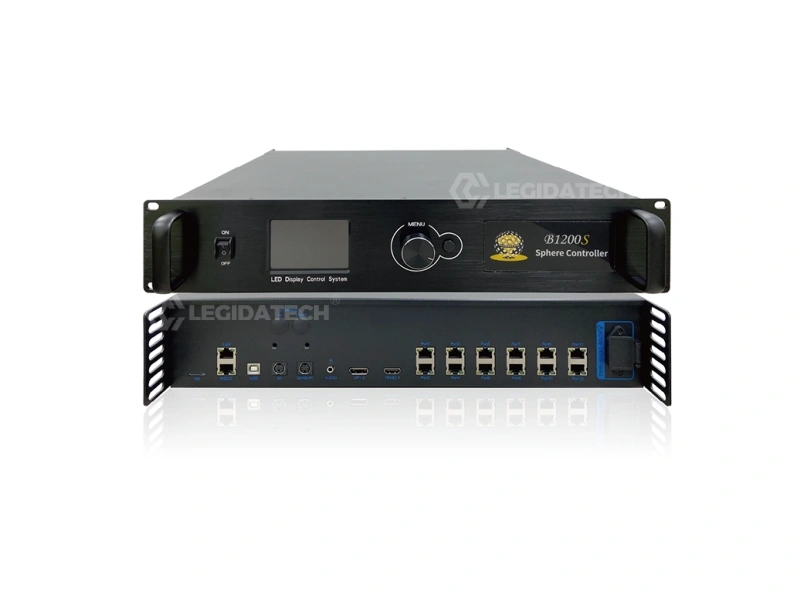
The B1200S — Mooncell’s dedicated creative controller for irregular LED shapes.
- Mooncell B1200S (BS series) — multiple Gigabit Ethernet outputs, the dynamic interpolation algorithm for spheres and domes, irregular module cropping, and 8K content support (official BS series page).
- Mooncell MB400S (MBS series) — a networked special-shape player with an 8-core CPU: content publishing and playback for custom shapes without a PC (official MBS page).
- B2000ES-G — the larger BS sibling for complex 4K dome and immersive builds.
- KT series — entertainment two-in-one processors (KT160: 16 outputs, 10.4M px) for venues that mix standard walls and creative elements (official KT page).
- V series splicer — card-based video splicing with HDR, 18-bit+ fine grayscale and RGB independent gamma correction, used for narrow-pixel-pitch creative walls (official V series page).
At ISE 2025, Mooncell demonstrated the B2000S on a complex LED dome — the controller category in action, filmed by rAVe Publications.
Scenario 1: Sphere & Hemisphere LED Screens
A sphere screen is the hardest classic shape: content wraps 360° horizontally and converges at the poles, so the pixel map is fundamentally different from a rectangle. The BS series controller’s dynamic interpolation algorithm keeps the image seamless across the sphere, while irregular module cropping lets the screen be built from standard modules with free row, column and pixel extraction — no custom module tooling (official hemisphere/sphere solution).
Setting up configuration files for a Mooncell-driven LED sphere, start to finish.
For a sphere project, the controller is a B1200S-class unit, the receiving cards stay in the standard A series, and the configuration file does the geometry. The same technology powers Mooncell’s CCTV Spring Festival Gala stage sets, where creative shapes change every year.
Scenario 2: Disc, Circular & Ring Screens
Disc and ring screens are common in retail atriums, stages and bars. Mooncell’s disc solution handles 360° program rotation with precise rectangular alignment — standard rectangular content plays directly on the ring without custom material production — and a primary-backup mode switches over automatically during unexpected events (official disc solution, circular solution).
For a ring on stage, the Mooncell MB400S is the practical pick: networked publishing means the ring can be updated from a control room, and the 8-core CPU handles the rotation and mirroring logic that ring screens need when modules are mounted at any angle.
Scenario 3: Interactive Floor LED Screens
A floor tile screen control system has two jobs: drive the display and react to interaction. Mooncell’s floor solution combines its standard synchronous chain with the video linkage player — the unit that switches content in response to pressure sensors or motion — plus multi-fold display support for floors that wrap across steps and walls (official outdoor/interactive solution page).
Mooncell’s own demo: interactive floor LED driven with the video linkage player, including a three-fold floor-to-wall setup.
Most floor projects also involve a stage or a wall in the same room — which is why we ship floor screens as part of complete rental LED display packages where the floor and the main wall share one control ecosystem.
Scenario 4: Horn-Shaped & Custom Geometry
Horn-shaped screens, stair wraps, faceted walls — anything that is not a flat rectangle — use the same machinery as spheres: irregular cropping plus row, column and pixel extraction. Mooncell’s horn solution adds unified control of multiple screens from a single server, with scheduled program playback and power on/off scheduling (official horn solution).
Custom geometry is also where the A-series receiving cards earn their keep: cards like the A712 load multiple module shapes, so one cabinet type can serve every section of an irregular screen. On the screen side, see how we build stair LED displays — the most common “irregular” project buyers start with.
Scenario 5: KTV, Bars & Entertainment Venues
KTV rooms are a category of their own: the screen, the lighting and the music must switch scenes together. Mooncell’s KTV solution supports up to 12 independent windows per room, DMX512 channels for synchronized lighting effects (color changes, rotation at any angle, window tiling), and dynamic/karaoke scene modes that switch as the party changes (official KTV solution).
Mooncell’s KTV room control system in action — screens, scenes and effects switching together.
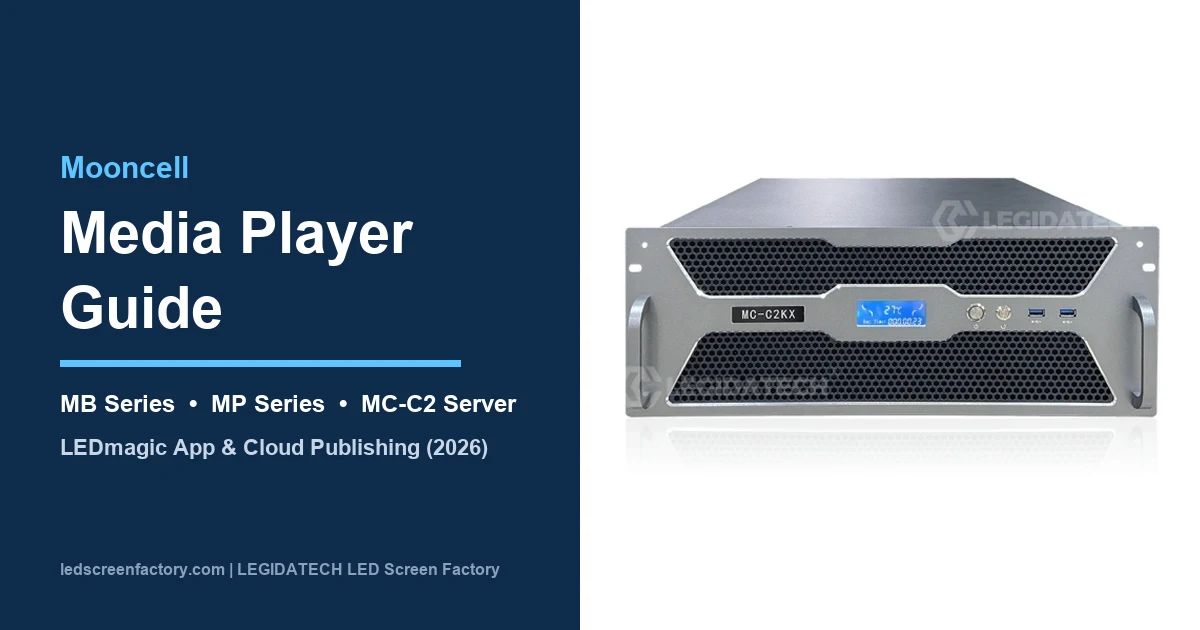
The hardware behind it: the K series linkage player (the K3100 uses a multi-core processor to auto-switch scene materials and unify lighting, music and screen scheduling — official K series page) and, for multi-room chains, the MC-C2 multimedia server broadcasting synchronized content to every room.
We build complete KTV LED packages — screen, controller and scene integration. See our KTV/Club LED screen page and the KTV LED screen solutions guide for the screen-side options.
Scenario 6: Glasses-Free 3D LED Displays
Naked-eye 3D walls — the curved corner screens in city squares — need a control system that does pixel-to-pixel 4K processing and active 3D support. Mooncell’s 3D solution calculates network-port loading on actual pixel count rather than rectangular area, and the main controller integrates the 3D interface for plug-and-play playback (official 3D solution).
On the hardware side, the M40 handles 3D at scale (26M px, multi-layer), and the A10X receiving card supports active 3D with a 3D emitter — a combination that scales from a corner display to a full immersive hall. For the screen technology itself, see our 3D LED display complete guide.
What a Creative Screen Control System Costs
Honest answer: creative controllers like the B1200S and MB400S are project hardware — there is no stable public retail price the way there is for standard parts (A10X ≈$27, MVB12E ≈$865 in our lineup guide). Creative projects are quoted as complete systems: screen modules, steel structure, controller, configuration and commissioning — because the controller cost alone tells you nothing without the geometry work that goes with it. The realistic budget question for a sphere or floor project is the total system, and that is exactly how we quote it.
How We Build Creative LED Screens at the Factory
At LEGIDATECH, creative screens are a regular production item, not a special request: 13 years of LED manufacturing, in-house R&D, and engineering teams that have shipped creative displays to 108+ countries. A typical project pairs a standard processor for the main wall — say the MVB12E — with a B1200S or MB400S for the specials, all configured in our Mooncell software workflow before shipping. Browse our stage screen and LED display solutions pages, or tell us the shape — sphere, floor, ring, KTV or 3D — and we will spec the control chain that fits it. If you are still deciding between control brands, start with our Mooncell vs NovaStar vs Colorlight comparison.
FAQ: Mooncell Creative LED Control
What controller do I need for a sphere LED screen?
A BS-series creative controller — the B1200S class — with the sphere configuration file. Its dynamic interpolation keeps content seamless around the sphere, and irregular module cropping lets standard modules form the sphere.
How does Mooncell handle spherical interpolation?
The BS series’ dynamic interpolation algorithm re-maps the video raster onto the sphere’s physical pixel layout, with free row, column and pixel extraction. Standard rectangular content plays correctly on the curved surface without custom media production.
Can an interactive floor LED screen run on Mooncell?
Yes. Mooncell’s floor solution uses its synchronous chain plus the video linkage player for sensor-driven content switching, with multi-fold support for floors that wrap across steps and walls — demonstrated in Mooncell’s own video above.
What is the K series for KTV rooms?
The K series linkage player (K3100) auto-switches scene materials and unifies screen, lighting and music scheduling in one device. Combined with the KTV solution’s 12 independent windows and DMX512 lighting control, it is the standard Mooncell KTV stack.
Can NovaStar or Colorlight drive creative screens too?
Yes, but through manual mapping and workarounds — their creative tooling is not their focus. Mooncell’s BS/MBS controllers and ready-made sphere/dome/disc/KTV solutions do the geometry natively, which usually saves days of on-site mapping. See our three-brand comparison for the full trade-off.
Does Mooncell support glasses-free 3D displays?
Yes. The official 3D solution provides pixel-to-pixel 4K processing with active 3D support; the M40 processor and A10X receiving card (with 3D emitter) form the hardware chain.
Can standard rectangular content play on a ring or sphere?
Yes — on disc and circular screens, Mooncell’s rectangular alignment plays standard content directly without custom material preparation, and sphere solutions do the same through interpolation.
Do creative screens need special receiving cards?
Not usually. Standard A-series cards (A10X, A712) do the pixel driving; the geometry lives in the BS/MBS controller. The A712’s multi-module loading helps when one cabinet type must serve every section of an irregular screen.
How much does a creative LED screen cost?
Creative screens are quoted as complete systems — modules, structure, controller, configuration and commissioning. There is no meaningful “controller only” price for creative projects; the honest number is the total project quote.
Does LEGIDATECH build creative LED screens?
Yes. Sphere, dome, ring, floor, KTV and 3D projects are regular production items, shipped pre-configured from our factory with 24-hour remote support. Tell us the shape and the venue, and we spec the complete system.
Sources & References
- Mooncell official website — CCTV Spring Festival Gala supplier, solutions overview
- Mooncell BS series official page
- Mooncell MBS series official page
- Mooncell KT series official page
- Mooncell V series official page
- Mooncell K series official page
- Mooncell hemisphere/full sphere solution
- Mooncell disc (circular) screen solution
- Mooncell circular screen solution
- Mooncell horn-shaped screen solution
- Mooncell KTV room solution
- Mooncell 3D display solution
- Mooncell official tutorial videos
Explore the Mooncell LED Control System Hub
For the complete Mooncell picture — product overview, comparison table, applications, selection logic and FAQs — visit the Mooncell LED Control System: Complete Guide & Product Hub.