


Mooncell MVB12E LED Video Processor — Powering Professional LED Display Systems
7.8 Million Pixel Loading · 12× Gigabit Ethernet · 4K@60Hz Input · 4-Window Simultaneous Display
As a factory-direct LED screen manufacturer with 13+ years of export experience, LEGIDATECH integrates the Mooncell MVB12E 2-in-1 LED video processor into complete LED display projects — from indoor fine-pitch video walls to outdoor advertising billboards. Rather than selling standalone processors at retail, we supply the MVB12E as part of comprehensive indoor LED display and outdoor systems, pre-configured to your exact cabinet layout, with full project warranty and engineering support.
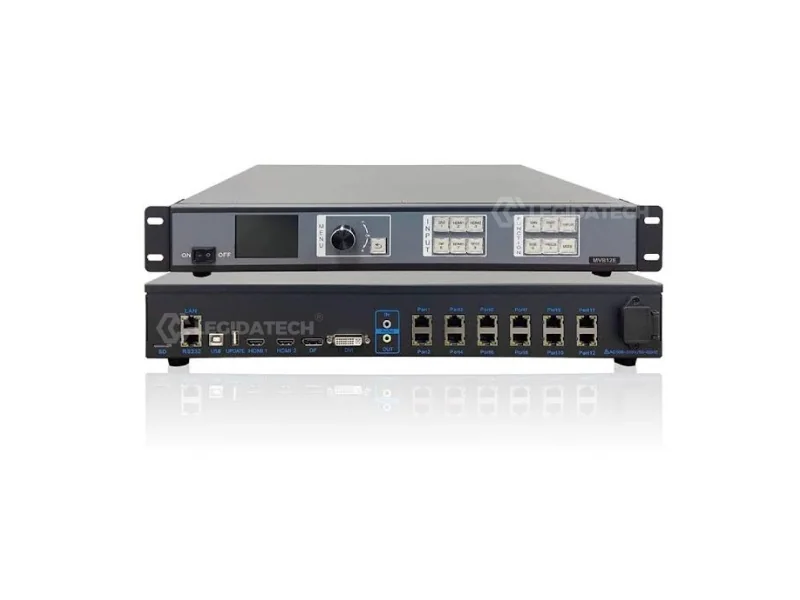
LEGIDATECH + Mooncell MVB12E: Complete LED Display Control, Not Just a Processor
When you inquire about the Mooncell MVB12E with LEGIDATECH, you’re not buying a box off a shelf. You’re engaging a factory-direct LED display manufacturer that designs, assembles, and quality-tests complete display systems — with the MVB12E serving as the control backbone of your project. Developed by Mooncell, the MVB series represents one of the most cost-effective 2-in-1 processor lineups available to system integrators today.
Here’s how it works: Our engineering team evaluates your project requirements — screen size, pixel pitch, installation environment, content sources — and selects the optimal control hardware. For medium-to-large LED screens (20–120m²), the MVB12E is frequently the ideal choice thanks to its 7.8-million-pixel loading capacity, 12 independent GigE outputs, and hardware-based multi-window processing. We pre-configure the processor for your specific LED cabinet layout before shipment, so when the system arrives on site, the control architecture is already mapped.
This integrated approach means you get a single warranty, a single point of support, and a system where all components — LED cabinets, receiving cards, controllers, power supplies, and steel structure — are verified to work together seamlessly.
Request System Design Consultation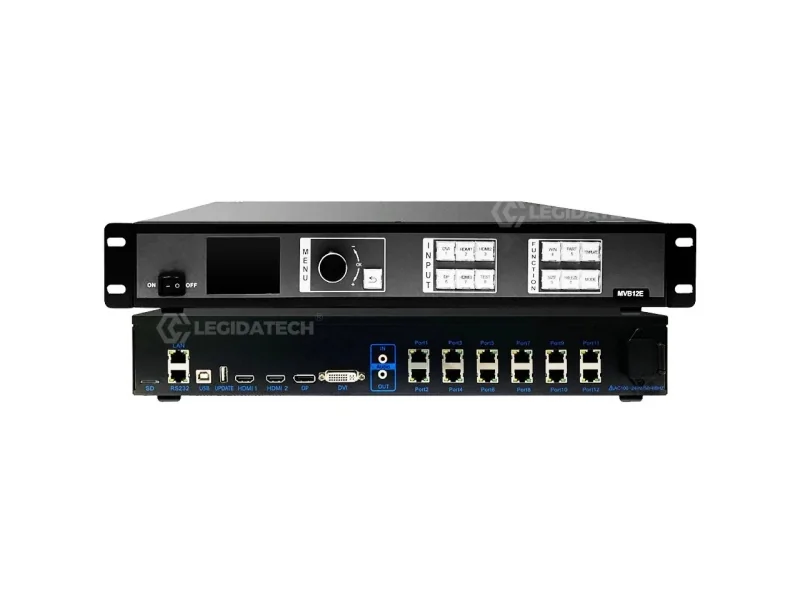
Why the MVB12E Excels in Professional LED Display Projects
In our 13+ years deploying LED display systems across 108 countries, we’ve learned which control hardware delivers reliability, image quality, and value. Here’s what makes the MVB12E stand out.
🎥 Multi-Format 4K Input for Diverse Content Sources
HDMI 2.0 (4K@60Hz) + DP 1.2 + HDMI 1.4 + DVI — your LED screen can accept feeds from laptops, media servers, broadcast cameras, and signage players simultaneously. EDID management ensures plug-and-play recognition across all source devices — critical for rental and live-event LED display deployments where source equipment changes daily.
🖥️ 4-Window Simultaneous Display with Independent Control
Each of the 4 windows supports independent input source, position, size, and scaling mode. For LED screen for stage productions, this means PIP layouts (speaker + slides + live feed + branding) with seamless switching. For retail, run different content zones from a single processor.
⚡ 7.8M Pixel Loading — Single Processor, Large Screen
With 12 independent GigE ports each handling 655,360 pixels, one MVB12E can drive approximately 30m² of P2 indoor LED display or 120m² of P4 outdoor LED advertising display. Fewer processors per project = lower hardware cost, less cabling, and simpler maintenance.
🎛️ FPGA Hardware Engine — No PC, No Lag, No Crashes
The dedicated FPGA image engine handles deinterlacing, noise reduction, and scaling in hardware — no operating system, no software latency, no reboot cycles. Combined with 25W power consumption, it’s the most reliable and energy-efficient processor in its class for 24/7 LED display operation.
Mooncell MVB12E Technical Specifications
Electrical & Physical Parameters
| Parameter | Specification |
|---|---|
| Input Voltage | AC 100–240V, 50/60Hz (IEC C14 inlet) |
| Rated Power | 25W — one of the lowest in its class |
| Operating Temperature | 0℃ – 50℃ |
| Operating Humidity | 5% – 85% RH (non-condensing) |
| Storage Temperature | -10℃ – 60℃ |
| Chassis Dimensions | 482.6 × 334.5 × 75.7 mm (L×W×H, with mounting ears) |
| Form Factor | Standard 1U rack-mountable |
| Net Weight | 3.74 kg |
| Packing | 515 × 130 × 380 mm; 3 units per master carton; 5.1 kg gross per unit with accessories |
Loading Capacity & Output Architecture
| Parameter | Specification |
|---|---|
| Single Port Capacity | Max 655,360 pixels (1280×512 per port) |
| Total Loading Capacity | 7.8 million pixels |
| Maximum Output Width | 7,680 pixels |
| Maximum Output Height | 3,840 pixels |
| GigE Output Ports | 12 × RJ45, each independently configurable |
| Max Cable Length | 100m per port (Cat6); 120m (Cat6a shielded, recommended) |
Video Input Interfaces
| Interface | Version | Max Resolution | Color Depth | Typical Source |
|---|---|---|---|---|
| HDMI 2.0 | HDMI 2.0 | 3840×2160@60Hz | 8-bit RGB/YCbCr 4:4:4 | Laptop, media player |
| DP | DP 1.2 | 3840×2160@60Hz | 8-bit RGB/YCbCr 4:4:4 | Workstation, render engine |
| HDMI 1.4 | HDMI 1.4 | 3840×2160@30Hz | 8-bit RGB/YCbCr 4:4:4 | Secondary source, camera |
| DVI | DVI-D | 1920×1200@60Hz | 8-bit RGB | Legacy source, signage player |
| Audio IN/OUT | 3.5mm stereo | — | — | Audio-follows-video switching |
Control & Connectivity
| Interface | Type | Function |
|---|---|---|
| LAN (Control) | RJ45 | Network-based remote management and debugging |
| RS232 | DB9 Serial | Third-party control system integration (Crestron, AMX) |
| USB-B | USB 2.0 | AutoLED software configuration, receiving card mapping |
| USB (Update) | USB 2.0 Type-A | Firmware upgrade via USB flash drive |
| SD Card Slot | SD | Configuration backup, data inspection storage, rapid field replacement |
LED Display Applications Powered by the MVB12E
From retail environments to broadcast studios — here are the real-world LED display projects where our engineering team deploys the MVB12E as the control backbone.
Shopping Mall LED Displays
Drive multiple atrium and storefront LED screen for shopping center zones with 4K brand content. Time-task scheduler auto-switches between daytime ads and nighttime standby.
Stadium & Sports Venue Screens
12 GigE ports handle wide-aspect perimeter LED displays. Hardware deinterlacing eliminates motion smear on fast-action content — a critical requirement for stadium and sports venue installations.
Rental & Live Event LED Walls
Quick screen mapping + 8 preset scenes minimize on-site setup. 3.74kg lightweight chassis integrates into rental LED screen flight cases.
TV Studios & Broadcast Backdrops
Genlock-compatible, flicker-free output for camera-ready results. Deinterlacing engine eliminates line-tearing on broadcast LED screen for stage backdrops.
Watch: How to create multi-window layouts on an LED screen using Mooncell’s AutoLED software (1:27)
MVB12E vs Alternatives: Which Processor for Your LED Project?
When specifying control hardware for an LED display system, B2B buyers often compare these three 2-in-1 processors. Here’s the data-driven comparison.
| Specification | Mooncell MVB12E ★ | NovaStar VX600 | Huidu HD-VP620 |
|---|---|---|---|
| Total Loading Capacity | 7.8M pixels | 3.9M pixels | 6.5M pixels |
| GigE Output Ports | 12 ports | 6 ports | 10 ports |
| 4K@60Hz via HDMI 2.0 | ✔ Yes | ✗ HDMI 1.4 only | ✔ Yes |
| DisplayPort Input | DP 1.2 (4K@60Hz) | DP 1.1 (4K@30Hz) | ✗ No DP |
| Simultaneous Windows | 4 windows | 2 windows | 3 windows |
| User-Definable Scenes | 8 scenes | 5 scenes | 6 scenes |
| Power Consumption | 25W | 35W | 30W |
| Audio I/O | 3.5mm IN + OUT | 3.5mm OUT only | 3.5mm IN + OUT |
| Front Panel Control | 320×240 LCD + Knob | LED indicators only | 160×128 LCD |
| SD Card Backup | ✔ Full-size SD slot | ✗ None | ✔ TF (microSD) slot |
| Chassis Weight | 3.74 kg | 3.2 kg | 4.1 kg |
Data sourced from Mooncell and NovaStar manufacturer specification sheets (2025–2026). The MVB12E offers the highest loading capacity and most comprehensive I/O in its class. Important: LEGIDATECH supplies the MVB12E as part of complete LED display projects — not as a standalone retail item.
Why Integrate the MVB12E Through LEGIDATECH?
When you source LED display control hardware through a factory-direct LED display factory rather than a retail parts distributor, you gain advantages that directly impact your project’s bottom line.
Pre-Configured, Not Box-Shifted
Every MVB12E we ship is pre-configured to your specific LED cabinet layout — receiving card mapping, output port assignments, and EDID settings are loaded and tested before the crate leaves our Shenzhen facility. You unpack, connect cables, and the screen lights up.
Single-Source System Warranty
When your LED cabinets, receiving cards, processor, and power supplies all come from LEGIDATECH, you have one warranty, one support contact, and zero finger-pointing between suppliers. 2–5 year coverage with 24-hour remote diagnostic response.
1,600+ Partners, 108 Countries
We’ve exported complete LED display systems since 2013. Our logistics team handles CE/RoHS documentation, customs clearance, and regional compliance — so your project doesn’t stall at the port. Tour the LEGIDATECH factory.
How LEGIDATECH Deploys the MVB12E in LED Display Projects
Mooncell controller setup walkthrough (5:32) — the same process our engineers follow when pre-configuring your system
Project Assessment & Hardware Selection
Send us your LED screen specifications — pixel pitch, cabinet size, content sources. Our engineering team calculates the pixel budget, selects the appropriate MVB model (6S/8S/10E/12E), and provides a complete system quotation within 24 hours.
Pre-Configuration & Quality Testing
Before shipping, we load your receiving card map, assign GigE port topology, configure EDID settings, and run a 24-hour burn-in test on the complete system — including the MVB12E processor, receiving cards, and sample LED cabinets.
On-Site Deployment
Connect your sources (HDMI/DP/DVI), link the 12 GigE outputs to receiving cards with standard Cat6 cables, and power on. The pre-configured processor auto-detects the cabinet layout and begins driving the display immediately.
Remote Support & Ongoing Optimization
Our Shenzhen team provides remote diagnostic support via LAN connection. Need to reconfigure for a new cabinet layout or add windows? We can guide you through AutoLED software adjustments or push updated configuration files.
AutoLED software tutorial (2:29) — how to connect and configure an LED screen with Mooncell’s control software
Mooncell MVB Series: Which Model Fits Your LED Display Project?
MVB6S
6× GigE Ports
3.9M Pixel Loading
4K@60Hz Input
4 Windows · 8 Scenes
Entry LevelMVB8S
8× GigE Ports
5.2M Pixel Loading
4K@60Hz Input
4 Windows · 8 Scenes
Mid-RangeMVB10E
10× GigE Ports
6.5M Pixel Loading
4K@60Hz · DP 1.2
4 Windows · 8 Scenes
AdvancedMVB12E ⭐
12× GigE Ports
7.8M Pixel Loading
4K@60Hz · DP 1.2
4 Windows · 8 Scenes
FlagshipMVB8S unboxing & overview (5:50) — all MVB series models share this chassis design and interface layout. For full specifications, visit the official MVB series page.
Frequently Asked Questions About the MVB12E in LED Display Projects
No. LEGIDATECH is a factory-direct LED display manufacturer, not a retail parts distributor. We supply the Mooncell MVB12E as the control backbone of complete LED display projects — integrated with LED cabinets, receiving cards, power supplies, steel structure, and installation support. This ensures all components are compatibility-tested and covered under a single system warranty. If your project only requires a standalone processor, we can recommend authorized distributors.
The MVB12E loads up to 7.8 million pixels — approximately 30m² of P2.0 indoor LED display, 120m² of P4 outdoor screen, or 200m² of P6. For larger projects, our engineering team can deploy multiple processors in cascade. When you submit your project requirements, we calculate the exact pixel budget and recommend the appropriate control architecture.
The MVB12E offers 2× the pixel loading capacity of the NovaStar VX600 (7.8M vs 3.9M), twice the GigE outputs (12 vs 6), and 4-window capability vs 2. It also includes features the VX600 lacks: SD card configuration backup, front-panel LCD control, and audio input. For new LED display projects not locked into NovaStar’s software ecosystem, the MVB12E typically delivers superior hardware value. That said, if your team is already standardized on NovaStar’s NovaLCT software and receiving cards, that ecosystem continuity may outweigh raw hardware specs. LEGIDATECH can supply either brand — we recommend based on your specific project needs, not supplier preference.
Yes, the MVB12E fully supports outdoor LED advertising display projects including billboards, stadium screens, and building facades. The processor itself must be installed in a climate-controlled equipment rack (operating range: 0–50°C), but its 12 GigE outputs drive outdoor cabinets at standard pixel pitches (P2.5–P16) with Cat6 cable runs up to 100m per port.
The MVB12E is configured via Mooncell’s free AutoLED software (v3.60.19+) for Windows. It handles receiving card mapping, screen configuration, window layout design, scene management, and firmware updates. You can download the latest AutoLED software from Mooncell’s official website. When LEGIDATECH supplies your LED display system, we pre-configure the software for your cabinet layout before shipment — you receive a plug-and-play system with configuration backup on SD card.
All LEGIDATECH LED display projects — including the MVB12E processor — carry a 2-year standard warranty with optional extension to 5 years. Coverage includes manufacturing defects and hardware failures. Our Shenzhen engineering team provides remote diagnostic support via LAN connection, with response within 24 hours. For mission-critical installations (broadcast studios, 24/7 retail), advance replacement units are available.
Yes — the MVB12E supports up to 4 independent video windows with per-window scaling, cropping, position control, and seamless source switching. For rental LED display and live event applications, operators pre-configure 8 scenes (e.g., full-screen keynote, PIP with speaker + slides, quad-split panel discussion) and recall them instantly via the front panel or RS232 command. Note: 4-window mode requires output width ≤ 4,096 pixels.
The MVB12E uses standard Gigabit Ethernet output protocol, compatible with Mooncell receiving cards (A7/A8/A9 series). For best performance and full feature support — including data inspection, auto-calibration, and remote monitoring — we pair the MVB12E with Mooncell receiving cards. When LEGIDATECH supplies your complete LED display system, we handle receiving card selection and pre-configuration.
Standard timelines: 10–15 business days for the processor unit alone, 15–25 business days for complete LED display systems (cabinets, receiving cards, power supplies, structure, and processor — all pre-configured and tested). Rush orders accommodated based on current production capacity. Contact our team for a precise schedule based on your project scope.
How to Choose the Right LED Video Processor for Your Display Project: A B2B Buyer’s Guide
By the LEGIDATECH Engineering Team — Updated August 2026 | ~2,600 words
Why the LED Video Processor Is the Most Underestimated Component in Your Display System
When B2B buyers evaluate an LED display project, the conversation typically starts with pixel pitch, cabinet material, brightness, and price per square meter. The video processor — the device that receives content from your sources and distributes it to thousands of LED pixels in real time — is often treated as an afterthought. That’s a costly mistake.
In our 13 years as an LED screen manufacturer deploying projects across 108 countries, we’ve seen a recurring pattern: an LED screen with excellent cabinets and modules underperforms because the processor was chosen purely on price. The result? Screen tearing during fast-motion content, visible latency between source switching, color banding in gradient areas, and — worst of all — intermittent signal dropout that requires on-site service calls.
This guide provides a framework for evaluating LED video processors — with specific reference to the Mooncell MVB12E 2-in-1 LED video processor — so you can make an informed decision based on your project’s technical requirements, not just the processor’s price tag.
The Rise of 2-in-1 LED Video Processors: Simpler Architecture, Lower TCO
Traditional LED display control architecture required two separate hardware units: a video scaler (to accept, process, and scale input signals) and a sending card (to packetize the processed image and distribute it to receiving cards in each LED cabinet). This meant two devices to purchase, two power supplies, two sets of rack space, two firmware update paths, and two potential points of failure.
The 2-in-1 LED video processor category — exemplified by the Mooncell MVB series, NovaStar VX series, and Colorlight X series — consolidates both functions into a single chassis. The MVB12E, for instance, integrates a professional FPGA-based video scaler with a 12-port Gigabit Ethernet sending card. This architectural simplification delivers measurable benefits:
- 30–40% reduction in control hardware cost versus a separate scaler + sending card configuration
- Single warranty and support contact instead of navigating two manufacturers’ support systems
- Faster on-site deployment: one device to rack-mount, one device to configure, one firmware to update
- Lower energy consumption: The MVB12E draws 25W total — less than half the combined draw of most discrete scaler + sender setups
- Simplified spare parts management: Rental companies and integrators stock one backup unit instead of two
B2B Insight: For LED display projects between 15m² and 120m², a single 2-in-1 processor is almost always the right architectural choice. The MVB12E’s 7.8M pixel ceiling covers this range comfortably. For larger projects (120m²+), we deploy multiple processors in cascade — but each unit still benefits from the 2-in-1 simplification at its assigned screen segment.
Evaluation Criterion #1: Pixel Loading Capacity — The Hard Limit
The single most important specification is how many pixels the processor can address and refresh in real time. This number — 7.8 million for the MVB12E — directly determines your maximum LED screen size. Here’s a practical translation table:
| Pixel Pitch | Example Screen Size | Total Pixels | Processor Needed |
|---|---|---|---|
| P1.5 | 5m × 2.8m (14 m²) | ~6.2M | MVB12E (7.8M headroom) |
| P2.0 | 6m × 3.4m (20 m²) | ~5.1M | MVB10E or MVB12E |
| P2.5 | 8m × 4.5m (36 m²) | ~5.8M | MVB12E recommended |
| P3.0 | 10m × 5.6m (56 m²) | ~6.3M | MVB12E |
| P4.0 | 12m × 6.8m (81 m²) | ~5.1M | MVB10E or MVB12E |
| P5.0 | 16m × 9m (144 m²) | ~5.8M | MVB12E |
| P6.0 | 20m × 11.3m (225 m²) | ~6.3M | MVB12E |
Critical rule: Always add 15–20% headroom to your calculated pixel count. If your project’s pixel requirement comes to 6.5M, the MVB12E at 7.8M gives you comfortable margin for future expansion or aspect ratio adjustments. If your requirement exceeds 7.8M, you need either a higher-tier processor (Mooncell MTB series) or a multi-processor cascade design — and our engineering team can specify the right architecture.
Evaluation Criterion #2: Ethernet Port Count — More Than Just Total Loading
A processor’s pixel ceiling tells you the maximum screen size. Its number of Gigabit Ethernet output ports tells you how flexibly you can wire that screen. The MVB12E’s 12 independent GigE ports offer three practical advantages:
- Wide aspect ratios: For a 7680×1080 LED display, 12 ports let you allocate one data path per 640-pixel horizontal segment — balanced loading with room for cable management.
- Irregular shapes: Custom LED display designs — curved walls, columns, ceiling installations — benefit from more granular port-to-cabinet assignment.
- Operational redundancy: In mission-critical installations, spare ports can serve as failover paths. If one cable run is damaged, the system continues operating on the remaining ports while the faulty run is replaced.
Evaluation Criterion #3: Multi-Window Capability — Not Just a Nice-to-Have
For applications requiring multiple simultaneous content sources, the difference between 2-window and 4-window capability is the difference between a single-purpose display and a versatile presentation platform. The MVB12E’s 4-window support with independent per-window scaling, cropping, and position control enables:
- Corporate events: Main keynote (window 1) + speaker camera PIP (window 2) + sponsor logo overlay (window 3) + live social media feed (window 4)
- Broadcast studios: Live feed (window 1) + graphics overlay (window 2) + remote guest PIP (window 3) + breaking news ticker (window 4)
- Retail environments: Brand content (window 1) + promotional overlay (window 2) + wayfinding information (window 3) + live social wall (window 4)
Competing processors at this price tier typically offer 2–3 windows. If your project requires quad-split layouts or complex multi-source compositing, the MVB12E’s 4-window architecture is a decisive differentiator.
Evaluation Criterion #4: Hardware vs Software Control — The Reliability Factor
Processors that rely entirely on a PC-based software interface create a single point of failure: if the control laptop crashes, loses connection, or needs a reboot during a live event, the operator loses all adjustment capability. The MVB12E’s 320×240 LCD front panel with rotary knob navigation provides hardware-level control independent of any connected computer:
- Manual input source switching (no PC required)
- Brightness, contrast, and color temperature adjustment
- One-touch scene preset recall
- Built-in test patterns for on-site troubleshooting
- Real-time system status monitoring (temperature, signal lock, port connectivity)
For rental staging companies, live event producers, and 24/7 retail installations, this hardware control layer is not optional — it’s essential. The MVB12E’s front panel is a critical backup for situations where software-only processors would leave the operator blind.
Total Cost of Ownership: Beyond the Processor Price Tag
When evaluating an LED display project’s control hardware budget, look beyond the processor’s unit price. The MVB12E’s total cost of ownership (TCO) advantages include:
- Energy cost: 25W × 24/7 operation = 219 kWh/year ≈ $26/year in electricity (at $0.12/kWh). A typical 50–60W alternative costs 2× more to operate.
- Reduced hardware count: As a 2-in-1 device, the MVB12E eliminates the separate scaler purchase ($200–$400 saved).
- Fewer rack units: 1U vs 2U for discrete scaler + sender — saves rack space in crowded AV closets.
- Simplified maintenance: One firmware to track, one device to troubleshoot. When LEGIDATECH supplies the complete system, diagnostics are handled remotely — no on-site technician required for most issues.
- Spare parts efficiency: Rental companies standardizing on one processor model reduce the variety of backup units in inventory.
Three Real-World LED Display Deployments Using the MVB12E
Case A: Shopping Mall Atrium — 20m² P2.0 Indoor LED Wall
A retail property developer needed a 6m × 3.4m P2.0 indoor LED display for a mall atrium, used for brand advertising and event promotions. One MVB12E drives the entire 20m² display with 7 GigE ports active (5 spare for future expansion). The time-task scheduler auto-switches between high-brightness advertising (9am–9pm) and lower-brightness ambient visuals (9pm–9am), saving energy and extending LED lifespan. The 4-window capability enables simultaneous display of main ad content, brand logo overlay, live social media feed, and mall directory sidebar. Result: Complete system (LED cabinets + MVB12E + receiving cards + structure) delivered and operational within 22 business days.
Case B: Corporate Event Rental — 12.5m² P2.5 LED Backdrop
A rental staging company needed a 5m × 2.5m P2.5 LED backdrop for corporate conferences. The MVB12E accepts the keynote presenter’s laptop (HDMI 2.0, 4K@60Hz), a live camera feed (HDMI 1.4), and a backup media player (DVI). During the event, the operator toggles between 3 pre-configured scenes: full-screen slides, PIP layout (speaker + slides), and sponsor logo loop for intermissions. Setup from flight case to live display: under 30 minutes. The 3.74kg chassis integrates into standard rental flight cases without modification. Result: 18 events deployed in the first year; zero processor-related failures or service calls.
Case C: Broadcast Studio — 36m² P2.5 LED Video Wall
A television studio replaced its green screen with an 8m × 4.5m P2.5 LED video wall for virtual production. The MVB12E’s hardware deinterlacing engine eliminates the flicker artifacts that plague cheaper processors when captured by broadcast cameras. The DP 1.2 input accepts the studio’s Unreal Engine 4K@60Hz render feed with zero perceptible latency. RS232 integration with the studio’s Crestron control system allows the director to switch scenes from the control room console. Result: Camera-ready image quality with no post-production flicker correction required.
Installation Best Practices from 13 Years of LED Display Deployment
- Cable quality matters: Use shielded Cat6a for GigE runs exceeding 80 meters. Maintain ≥30cm separation from AC power lines to prevent electromagnetic interference. We’ve traced 90% of “processor issues” on site to substandard cabling — not the processor itself.
- Ventilation is non-negotiable: Maintain ≥5cm clearance on both sides of the MVB12E in the rack. In enclosed installations, ensure active ventilation with ≥30 CFM airflow. The processor’s 25W draw generates minimal heat, but it still needs airflow.
- SD card backup saves hours: After the initial configuration, save to the SD card. If a field replacement is ever needed, insert the SD card into the new unit — all screen mapping, EDID settings, and scene presets restore automatically. No laptop, no software, no technician required.
- Power sequencing prevents surges: Power on sequence: MVB12E first (to establish the signal path), then LED cabinets. Power off: reverse the sequence. This prevents the LED cabinets from displaying noise during processor startup/shutdown.
- Firmware hygiene: Check Mooncell’s official website or contact LEGIDATECH support for the latest firmware before field deployment. New firmware versions often include compatibility updates for newer receiving card models and bug fixes identified in the field.
Mooncell LED software tutorial (1:53) — practical demonstration of configuring and operating Mooncell LED display processors. More tutorials on our LEGIDATECH YouTube channel.
Making the Right Choice: Processor Selection as Part of System Design
The LED video processor is not a commodity to be selected by lowest price. It’s the bridge between your content and your audience — and a poor processor choice manifests as visible artifacts that degrade the perceived quality of your entire LED display investment. When you work with LEGIDATECH, processor selection is part of the system design process, not a separate purchasing decision. We evaluate your screen size, pixel pitch, content sources, installation environment, and operational requirements — then specify the control hardware that delivers reliable, artifact-free performance across the system’s expected lifespan.
The Mooncell MVB12E LED video processor has earned its place as our most frequently recommended control solution for medium-to-large LED display projects because it consistently delivers: the highest loading capacity in its class (7.8M pixels), the most comprehensive I/O (12 GigE ports + 4 video inputs + audio), the lowest power consumption (25W), and the operational reliability of a hardware-based FPGA engine with front-panel control. When integrated into a complete LEGIDATECH LED display system — pre-configured, burn-in tested, and backed by a single warranty — it represents the lowest-risk path to a successful LED display deployment.
As a factory-direct LED screen manufacturer with 13+ years of export experience and 1,600+ partners worldwide, LEGIDATECH is your single source for complete LED display systems. Contact our engineering team today to discuss your project requirements and receive a customized system quotation within 24 hours.
Ready to Build Your LED Display Project?
Factory-direct LED display systems · Pre-configured MVB12E control · Complete project warranty · 13+ years global export experience · 24-hour engineering support
Get Your Custom LED Display QuoteExplore LEGIDATECH LED Display Solutions
Indoor LED Displays
P1.2–P4 fine-pitch indoor LED screens for retail, corporate, broadcast, and command center applications.
Indoor LED Solutions →Outdoor LED Billboards
P2.5–P16 weather-rated outdoor LED displays for advertising, stadium, and building facade installations.
Outdoor LED Solutions →About Our Factory
13,000m² Shenzhen facility, CE/RoHS certified, 1,600+ global partners. Tour the LEGIDATECH factory.
Explore the Mooncell LED Control System Hub → Complete guide to the Mooncell LED control system — how processors, controllers and receiving cards work together, full product comparison, selection logic and applications.