


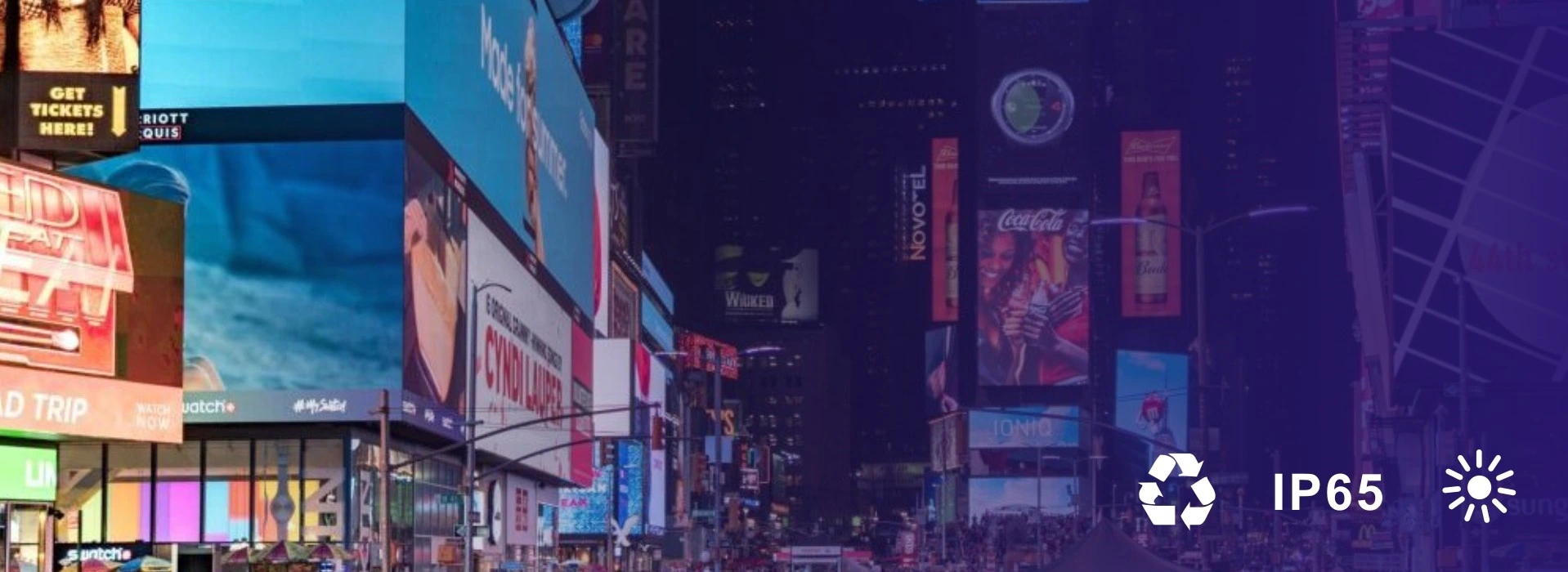
Choosing the Right Outdoor LED Display: Advertising vs. Events
If you need to find an outdoor LED screen supplier, please do not leave this page; we provide you with complete guidance.
Selecting the ideal outdoor LED screen depends on your specific application.
If you need a permanent installation for high-traffic roadside branding, our Outdoor Advertising LED Displays offer maximum brightness and 24/7 durability.
On the other hand, for concerts and tours that require frequent setup and teardown, our Outdoor Rental LED Screens prioritize lightweight cabinets and quick-lock systems. Explore our categories below to find the technology that fits your project goals.
The Comparison Table ↓
| Feature | Outdoor Advertising Display | Outdoor Rental & Stage Display |
| Primary Use | Fixed Billboards, DOOH, Building Facades | Concerts, Festivals, Corporate Events |
| Installation | Permanent steel structure / Wall-mounted | Temporary hanging or stacking (Truss) |
| Cabinet Material | Iron or Die-cast Aluminum (Heavy Duty) | Magnesium or Aluminum Alloy (Ultra-light) |
| Maintenance | Front or Rear Access (Fixed) | Quick-access Tool-free Maintenance |
| Brightness | 6,000 – 10,000 nits (Sunlight readable) | 4,500 – 6,000 nits (Adjustable) |
| Key Priority | Long-term stability & weather resistance | Portability & seamless fast assembly |
Outdoor LED Display Types
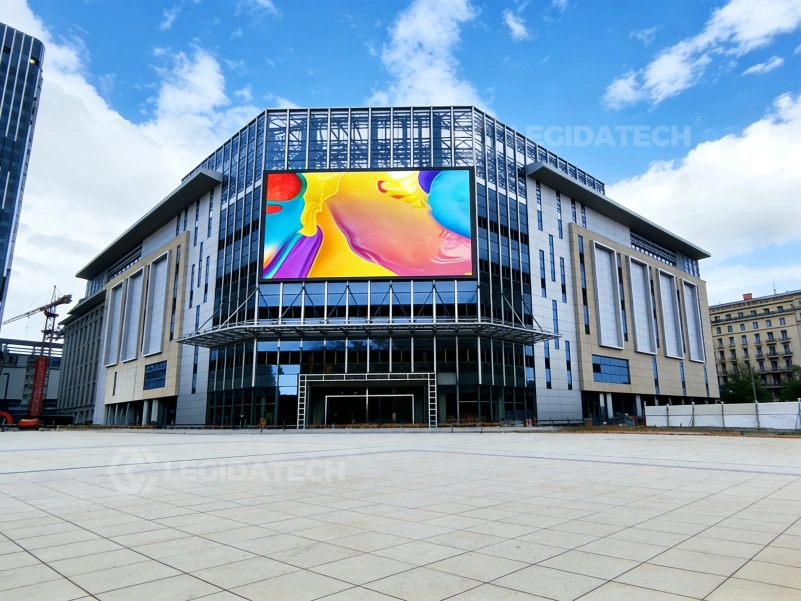
A high-performance, fixed-installation display designed for outdoor public spaces, featuring high brightness, high definition, and a high refresh rate. It ensures stable operation under diverse climatic conditions while fulfilling critical functions such as media presentation, information broadcasting, and traffic guidance.
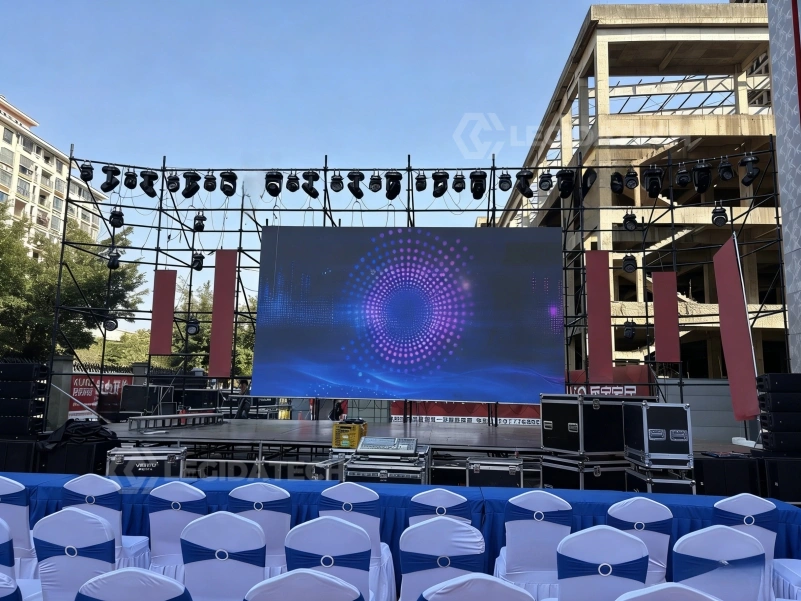
A rental LED display designed for outdoor environments, widely used in stage performances, cultural activities, and exhibitions requiring quick installation and disassembly. It supports flexible splicing in any direction, size, and shape, making it ideal for venues such as theme parks, bars, auditoriums, and theaters.

Outdoor LED displays are widely used in sports arenas, such as displaying scores, stadium fence screens, and real-time broadcast screens, etc.
High-brightness screens can better restore colors, and the game content and scores can be clearly seen even from a distance.

Front maintenance outdoor LED display allows maintenance personnel to replace the outdoor LED module from the front of the display using a front maintenance tool, without disassembling the entire screen. This design greatly facilitates maintenance work, saving time and labor costs, while improving overall display efficiency and reducing downtime.
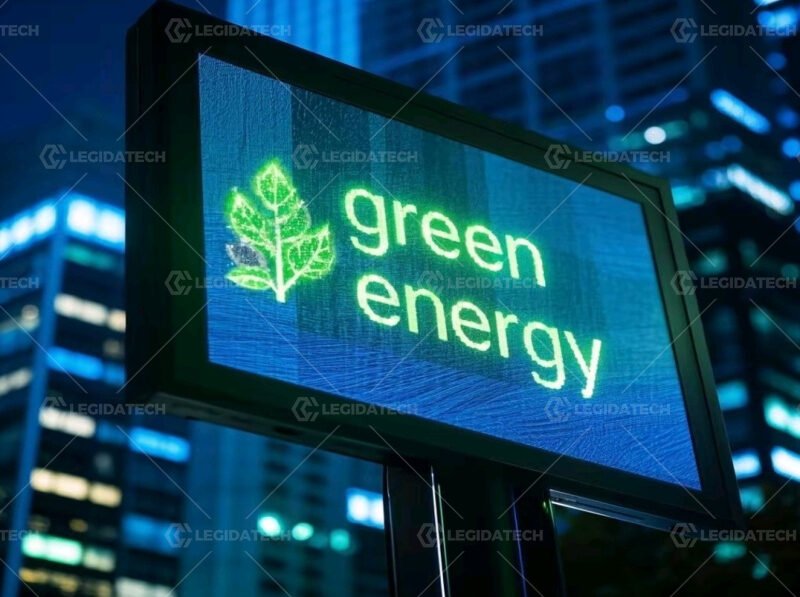
An outdoor LED display engineered for low power consumption, utilizing advanced energy-saving technology to significantly reduce electricity usage without compromising brightness or display performance. Its efficient design lowers overall operating costs, making it an ideal choice for long-term, large-scale outdoor deployments.
Pixel Pitch of Outdoor Screen
| Pixel Pitch | Viewing Distance | Application |
|---|---|---|
| P4–P5 | 4–20 m | Roadside, Small Billboard |
| P6–P8 | 10–40 m | Large Outdoor Advertising |
| P10 | 20m+ | Highway, Long-distance |
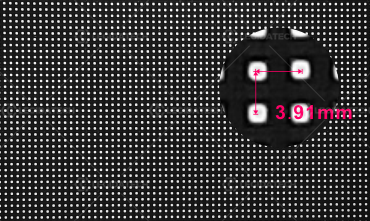
P3.91 outdoor LED display delivers approximately 256,000 pixels per square meter, with an optimal viewing distance of 3–7 meters and a suitable viewing distance of 7–15 meters. Its high pixel density makes it ideal for short-term outdoor activities requiring close-range visual impact.
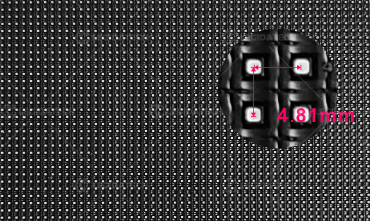
P4.81 outdoor LED display features a 4.81mm dot pitch with standard cabinet sizes of 500×500mm and 500×1000mm. It is widely used for large temporary stages and is also suitable for permanent fixed advertising installations.
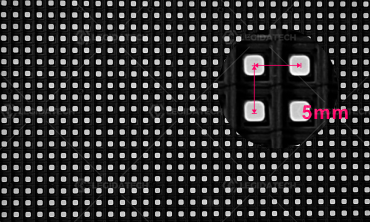
P5 outdoor display is designed for medium- to long-distance viewing, commonly used in commercial advertising and public information displays. With higher brightness and stronger protection performance, it serves as a reliable professional outdoor advertising LED screen.
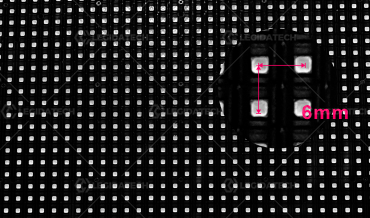
P6 outdoor LED display is usually suitable for use at a longer viewing distance. The best viewing distance is more than 6 meters, suitable for use in urban streets, squares, stadiums, and other places.
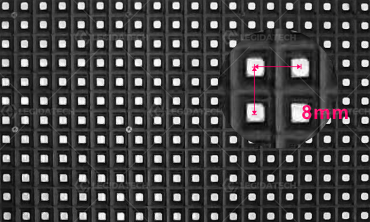
The P8 has an 8mm pixel pitch, making it suitable for larger screens and viewing at greater distances. It’s a compromise between the P5 and P10.
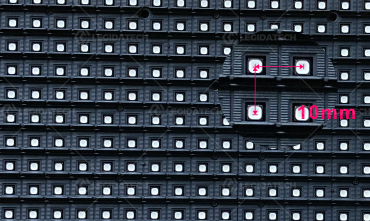
The P10 has a large pixel pitch, which can eliminate graininess when viewed from a far distance, making it suitable for large-screen and 3D screens.
Outdoor Rental LED Display

A mid-to-high-end stage rental LED screen for outdoor activity backgrounds, using high-quality materials for high-requirement projects.
- Cabinet: 500×500mm & 500×1000mm; pixel pitch: P3.91 & P4.81
- Non-black screen design shares current between cabinets — display stays on even if individual cabinets fail
- Critical reliability for live stage use

A cost-effective outdoor stage LED screen with high refresh rate and high contrast for excellent image quality under any lighting.
- Front and rear dual maintenance for flexible stage adaptability
- Corner protection prevents collision damage during transport
- Supports curved and right-angle installation — no separate curved components needed, reducing costs

A stage rental screen built for fast deployment and reliable performance.
- Plug-in detachable power supply for quick failure replacement
- 1.6mm HUB board for stability and heat dissipation
- Positioning pins for faster installation; 500mm & 1000mm cabinets seamlessly splice
- Hoisting holes for hanging beams or trusses, wider viewing angle
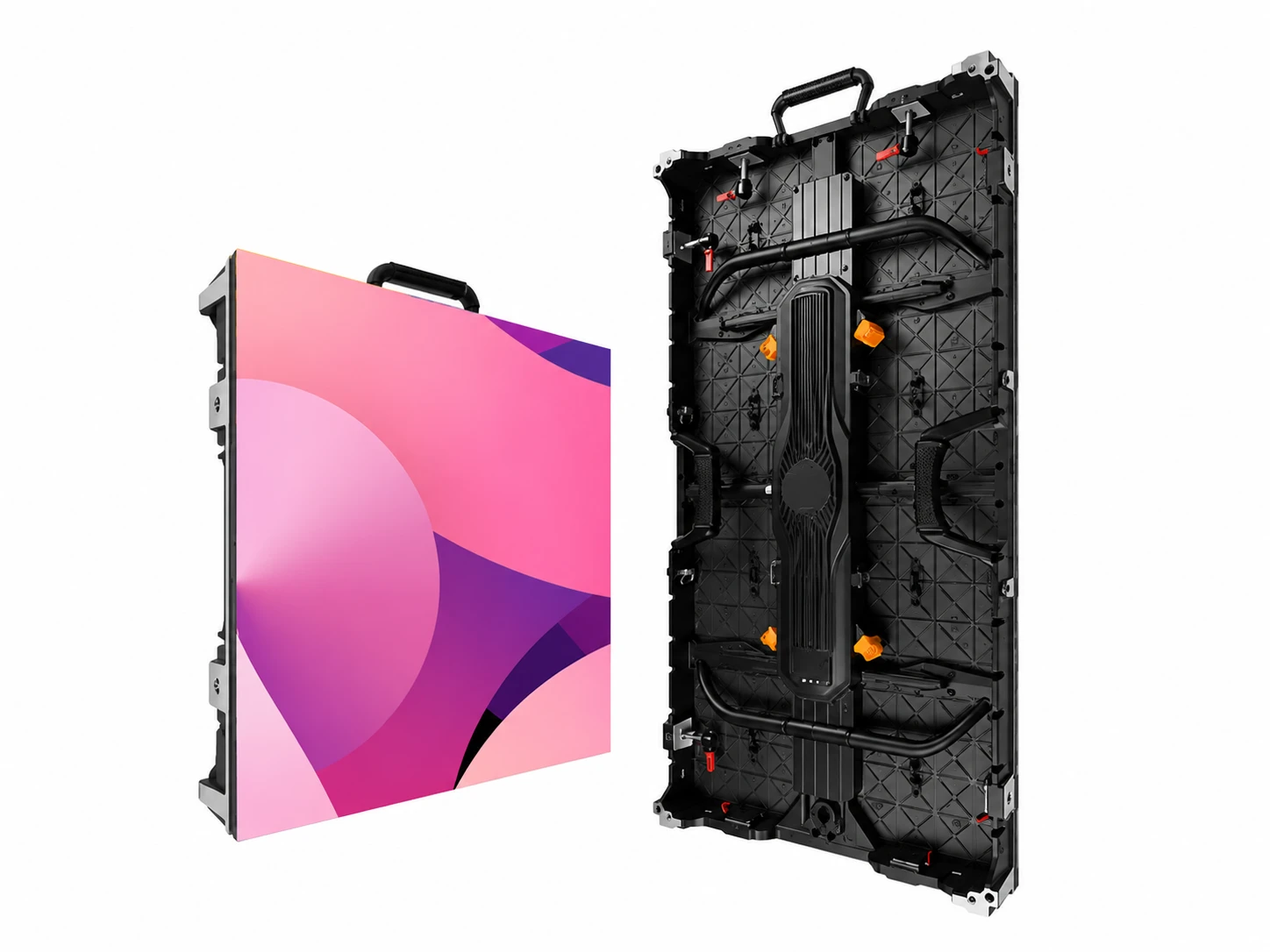
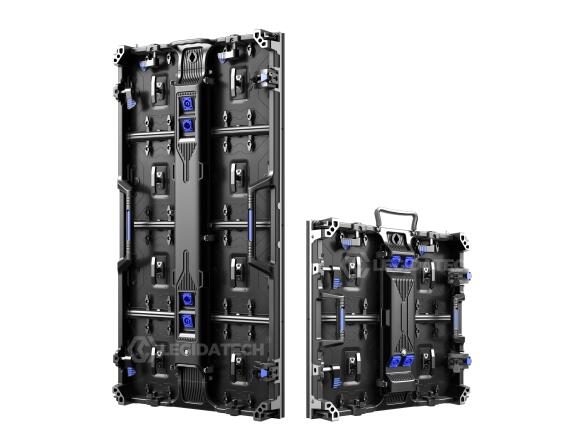
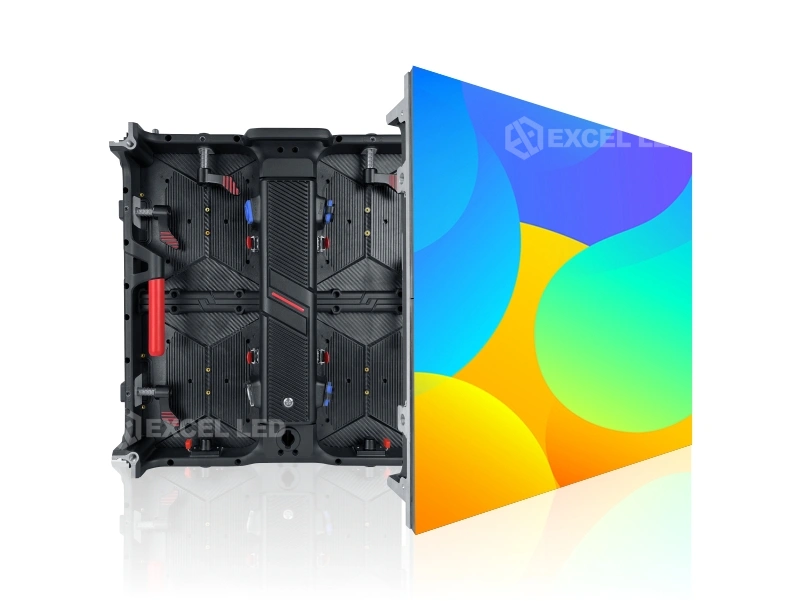
Outdoor Fixed LED Billboard

A cost-effective outdoor advertising screen with high brightness and vivid colors — clear display in direct sunlight, no flickering or uneven light.
- Pixel pitch: P5, P6, P8, P10; cabinet: 960×960mm
- Aluminum-magnesium alloy construction — durable and lightweight
- Ideal for outdoor advertising and stadium displays
A high-end outdoor advertising screen built for extreme environments — ideal for seaside, desert, and cold-region projects.
- Module: 480×320mm; cabinet: 960×960mm; custom sizes available
- Supports curved and 3D designs; excellent color reproduction
- Aluminum cabinet; front and rear dual maintenance
- Withstands high heat, severe cold, salinity, and humidity
A P10.667mm large-format screen designed for long-distance viewing with superior brightness.
- Recommended minimum size: 20㎡ for optimal viewing effect
- Cabinet: 640×960×95mm or 1280×960×95mm; module: 320×320mm
- Iron cabinet for enhanced stability
- Three-in-one DIP lamp beads for clear display in direct sunlight

Suitable for column advertising, stadium screens, shopping mall promotions, and most outdoor advertising scenarios.
- Built-in exhaust valve regulates air pressure and improves heat dissipation
- Die-cast aluminum module with strong fireproof performance
- Stable and non-deforming at high temperatures, extending product service life
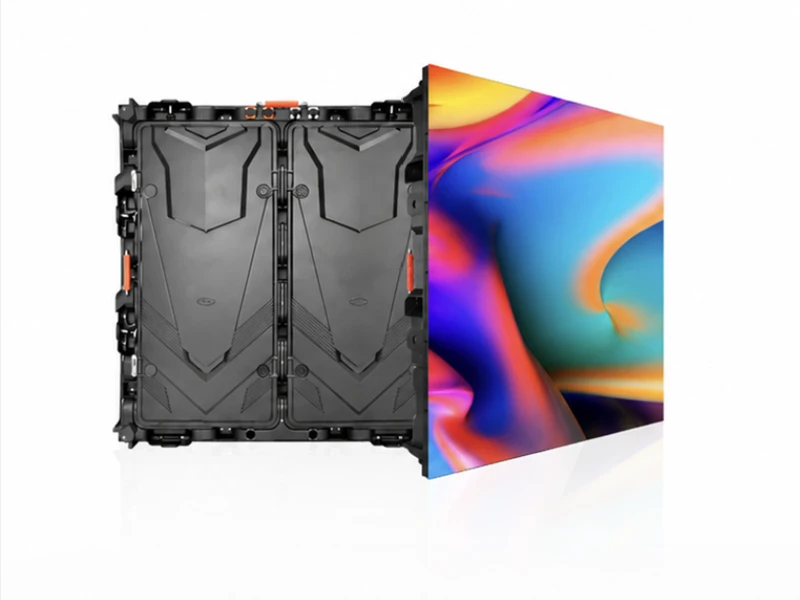
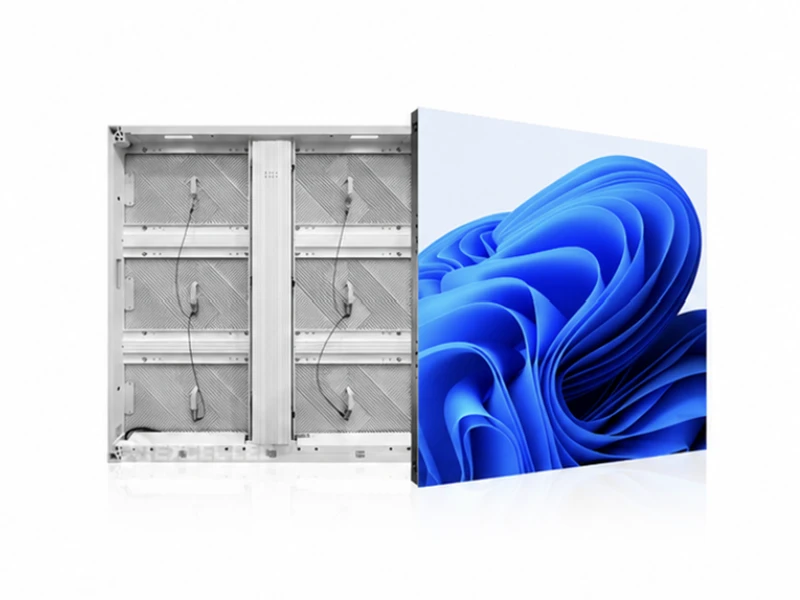
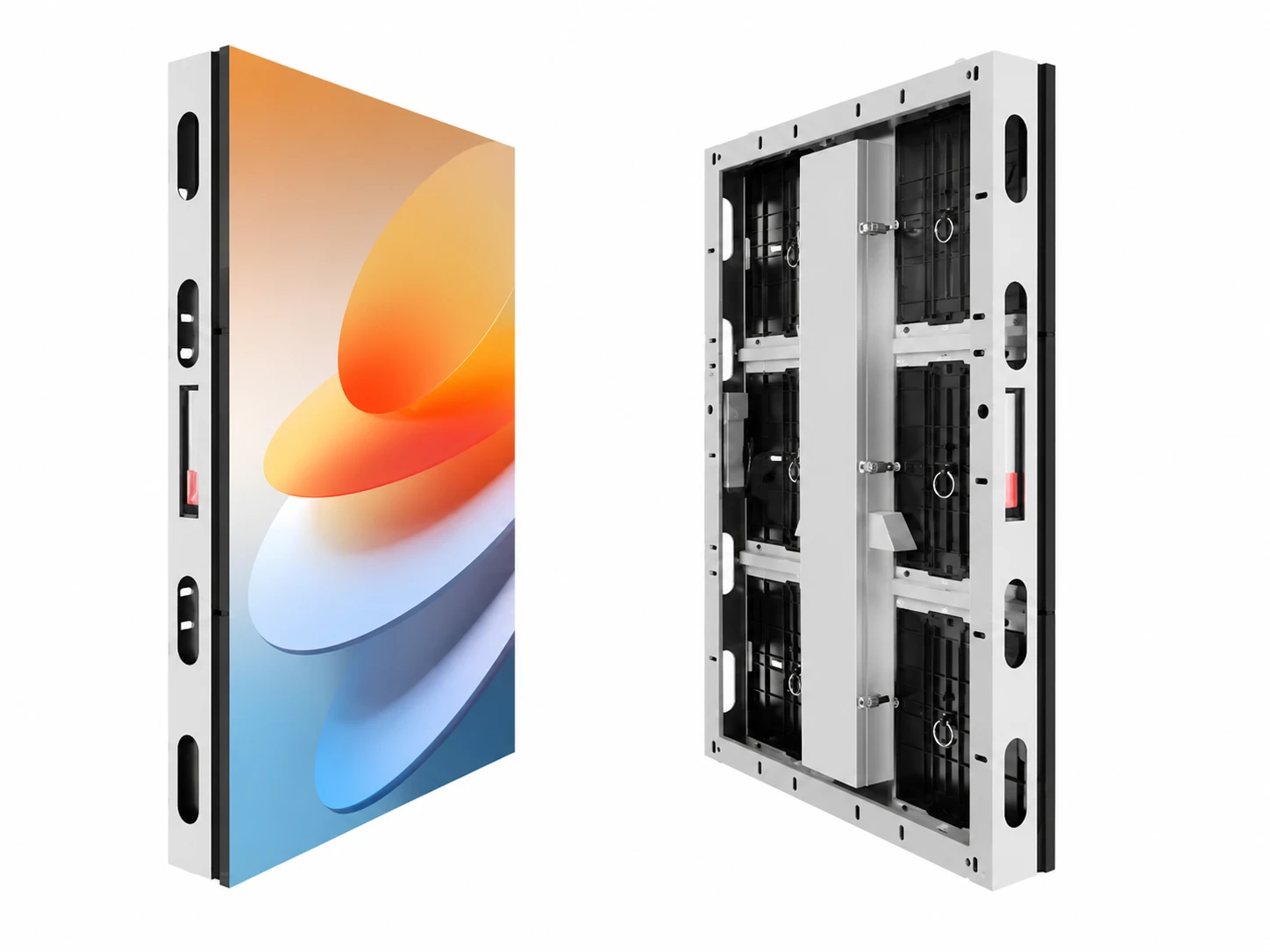

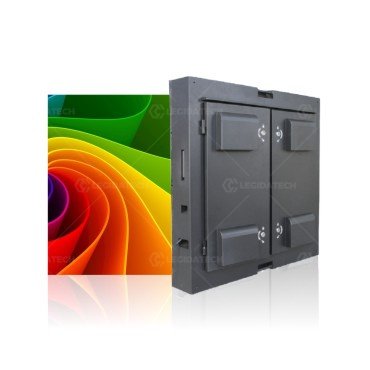
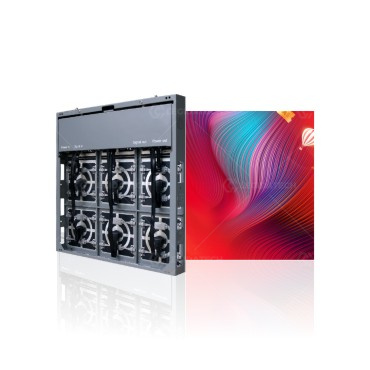

3D Outdoor LED Screen
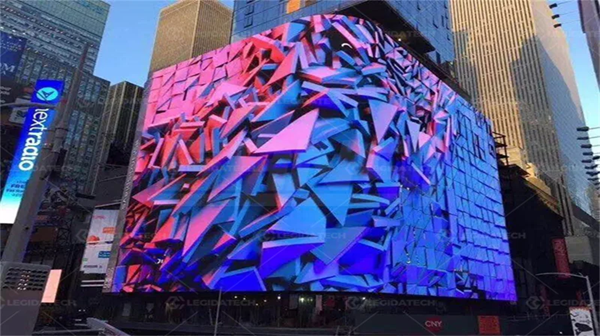
3D outdoor LED screen is a new type of display technology that presents images and videos in a three-dimensional effect, thereby attracting viewers’ attention. The design principles of 3D outdoor LED displays are primarily based on stereoscopic vision and optical effects.
3D displays are typically large in size, employing right-angled or curved shapes, and are paired with video content featuring 3D effects. They are usually equipped with special optical lenses or filters to achieve better light distribution and a wider viewing angle.
Outdoor Stage Concerts
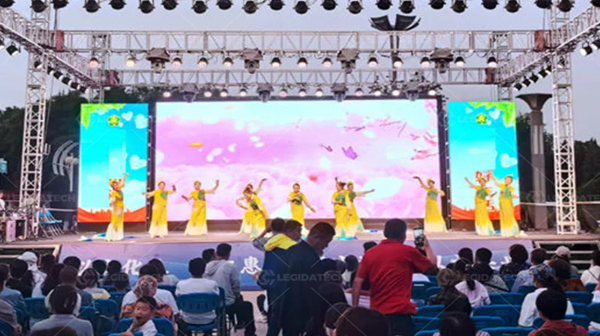
Outdoor LED display screens are also commonly used in event stage scenes, especially outdoor stage screens, which are easy to carry and disassemble. P3.91 and P4.81 are good choices with excellent displays.
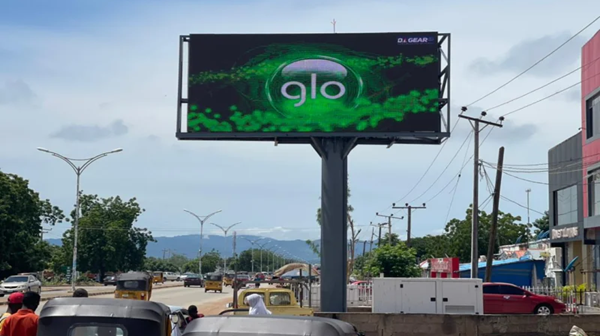
Digital Billboards on Pillars
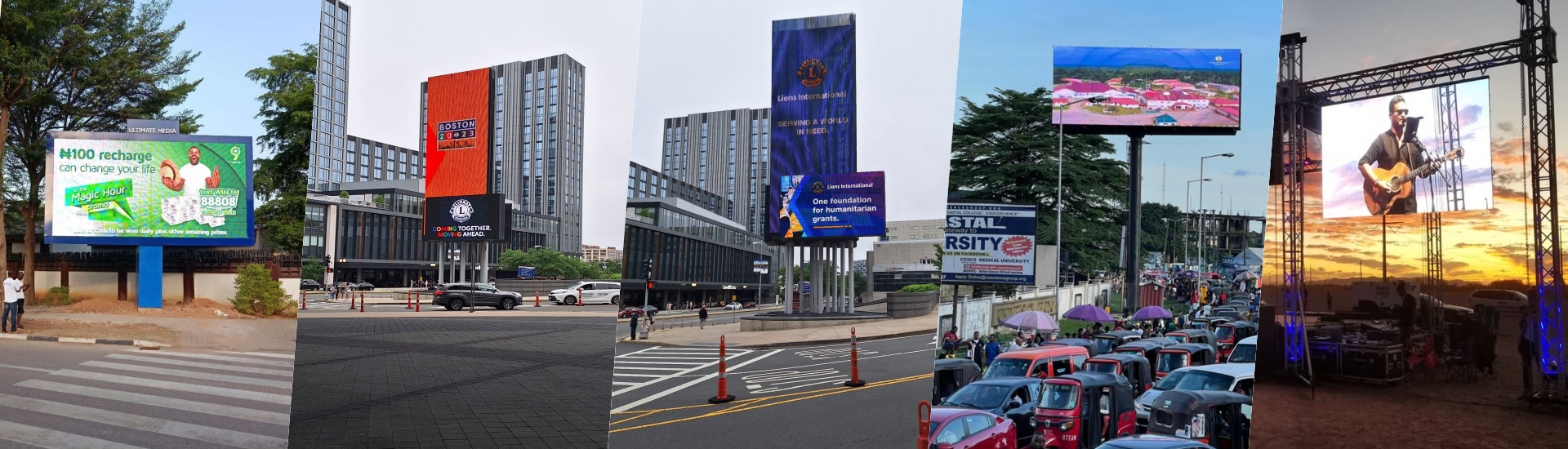
The outdoor LED display can be installed by pillars, which can effectively improve the field of view and save space and is beautiful but also reduces wind resistance and increases safety.
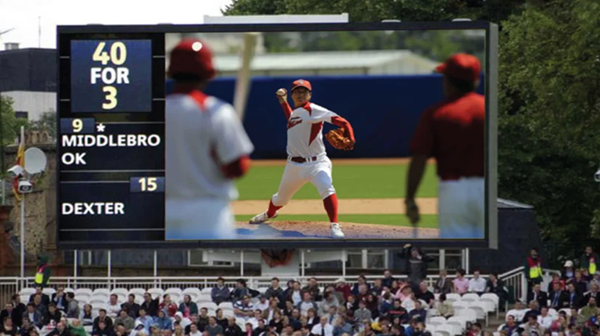
Outdoor Stadium LED Screens
Outdoor LED displays are widely used in sports arenas, such as displaying scores, stadium fence screens, real-time broadcast screens, etc.
High-brightness screens can better restore colors, and the game content and scores can be clearly seen even from a distance.
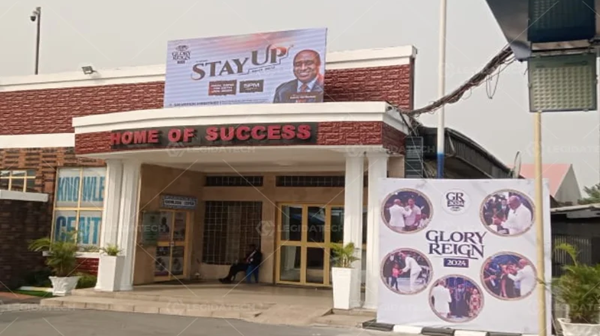
Church Outdoor LED Display
Through the outdoor LED display, the church can timely release important event information, gospel content, and charity event previews so that more people can understand the church’s dynamics and care.
It can generally be installed at the door of the church or on the doorhead or roof of the church.
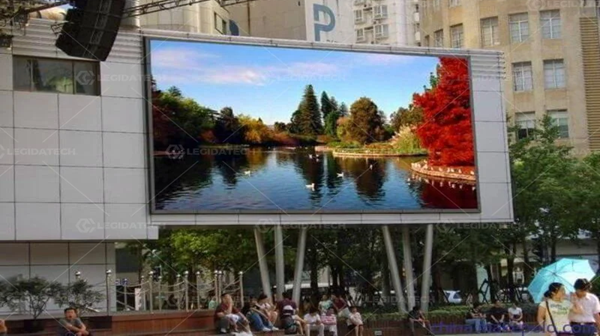
Wall-mounted Advertising LED Screens
The outdoor LED display screen can effectively attract more passers-by and tourists from farther away through wall-mounted installation, expand its publicity coverage, and enhance brand exposure.
Outdoor LED Screen Cabinet Types
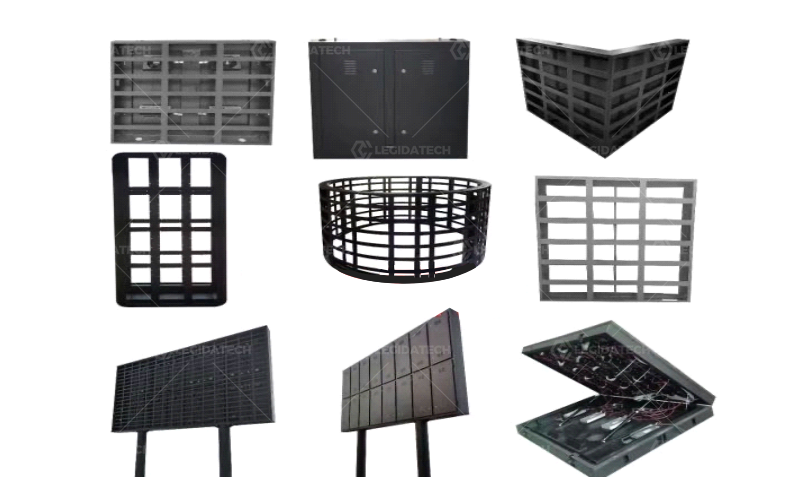
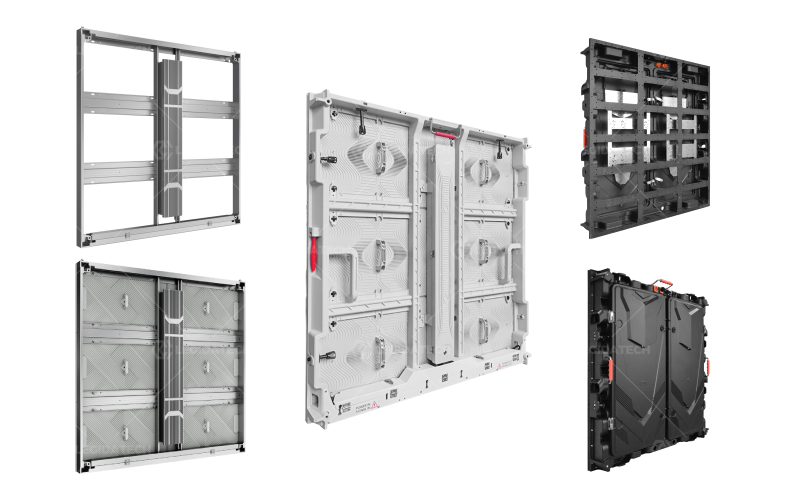
2.1 Sturdy and durable iron cabinet
The LED display screen produced by LEGIDATECH is made of 1.5 mm thick galvanized iron plate. The advantage is low manufacturing cost, and it can be customized to produce outdoor LED display screens of different shapes according to the needs of different scenes, such as outdoor cylindrical LED display screens, spherical LED display screens, etc. This means that the size of such LED display screens can be freely customized.
2.2 Final aluminum cabinet
Die-cast aluminum cabinets are often used in outdoor LED display screens. They are characterized by high strength and precision, light weight, and more importantly, seamless splicing, which can have better effects on screen display. The die-cast aluminum LED display screen adopts one-time molding of the mold, and the flatness of the cabinet is more guaranteed, which basically solves the problem of cabinet joints; the humanized design is more convenient and lighter to install, and the cabinet joints and connecting wires are more reliable; the weight is light, and the hoisting structure is adopted, which is more convenient and firm to install; the signal and power connection between the cabinets adopts concealed connection, and no traces of connecting wires can be seen after installation. (OK, series cabinet pictures can be placed)
2.3 Magnesium-aluminum alloy cabinet
Magnesium alloy is an alloy composed of magnesium and other elements. The characteristics of outdoor LED display screens made of magnesium-aluminum alloy are low density, high strength, good heat dissipation, good shock absorption, greater impact load-bearing capacity than aluminum alloy, and good resistance to organic and alkali corrosion. Magnesium alloy is used as outdoor LED display cabinet with high cost performance, easy installation, and excellent heat dissipation, which makes the product more market-advantaged. The disadvantage is that the cost of a magnesium alloy cabinet is also higher than other cabinets.
Lamp Type of Outdoor LED Display
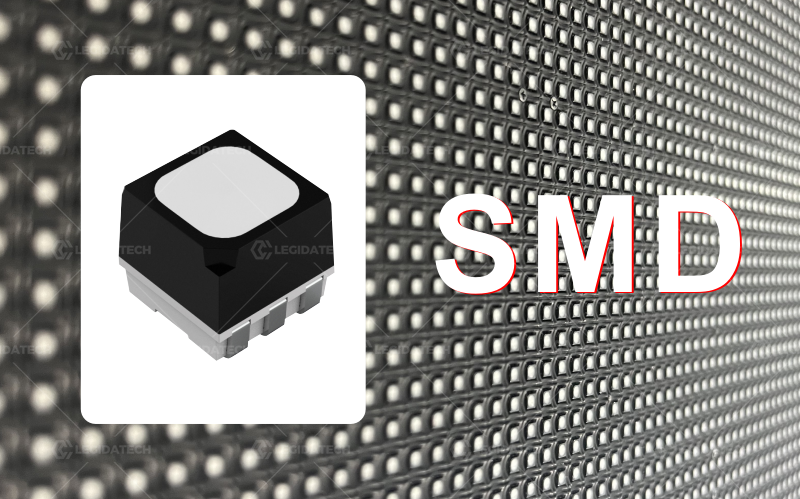
SMD lamp beads (surface mount diode) are an ideal choice for high-definition display screens due to their high integration and color reproduction. They are small in size, high in density, energy-saving, and environmentally friendly. They are widely used in public places such as stadiums and billboards to enhance visual experience and information dissemination.
With the advancement of technology, the application areas of SMD lamp beads are constantly expanding, covering advertising, stage special effects, smart homes, etc.
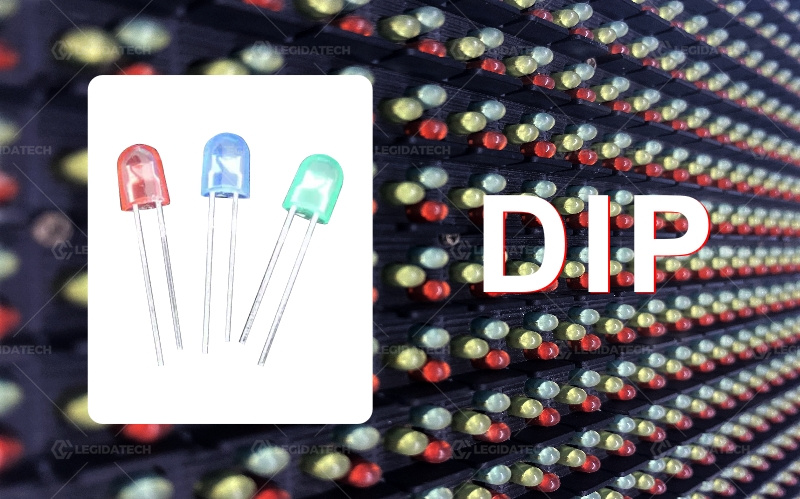
DIP outdoor LED display lamp beads (through-hole diodes) have high brightness and good color reproduction ability and are widely used in stadiums, outdoor squares, and other occasions. Not only can they be clearly seen under direct sunlight, but they also have wind and rain resistance to ensure stable operation in various climatic conditions.
DIP outdoor LED display has a long service life and low maintenance cost, making it an ideal choice for many large occasions.
Components of Outdoor LED Screens
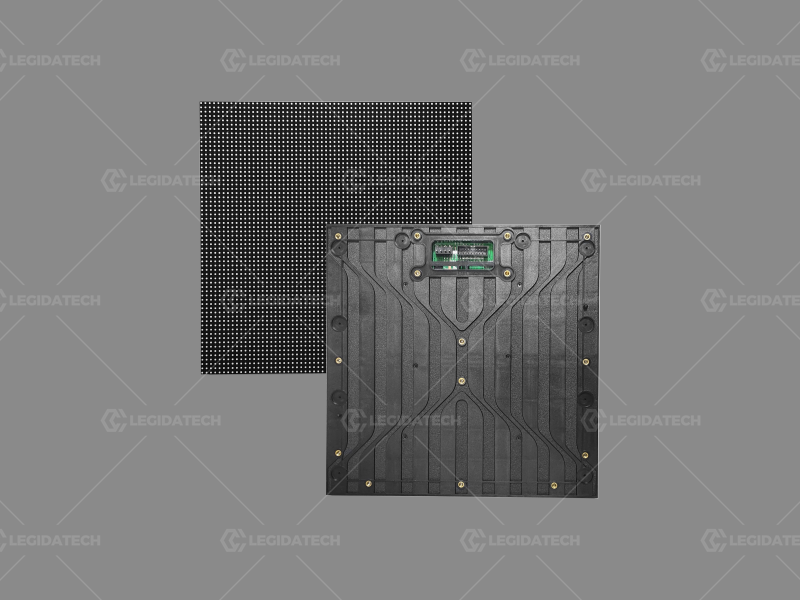
The core unit of an outdoor LED screen directly determines image clarity and color performance. Available in various pixel pitches to suit different viewing distances and installation requirements.
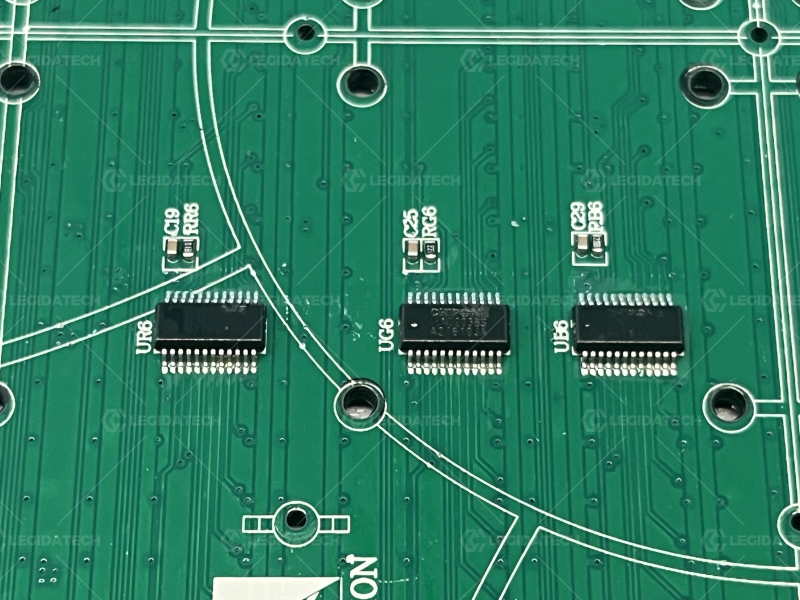
A key component that controls LED brightness and switching speed, ensuring a smooth, flicker-free display. High refresh driver ICs deliver stable image output even under high-speed camera capture.
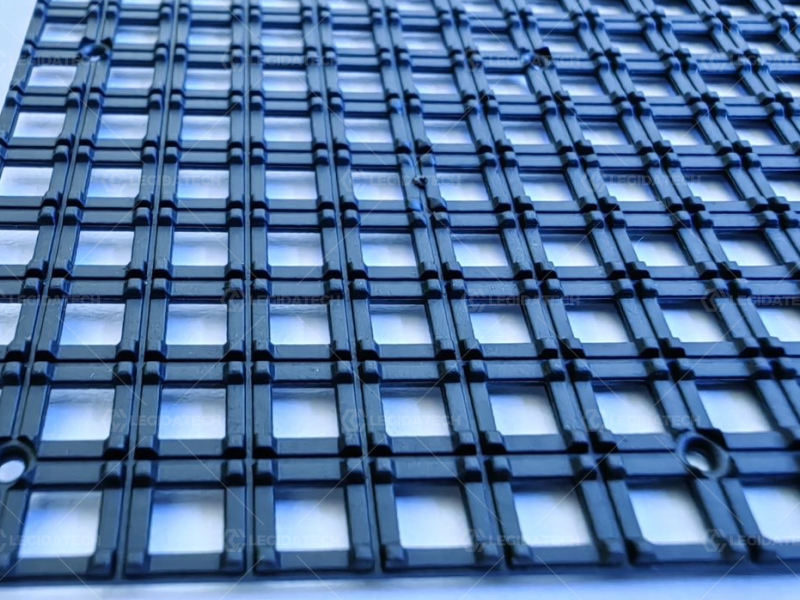
Fitted over the LED surface to absorb ambient light and reduce glare, significantly improving contrast and color vibrancy in bright outdoor environments.
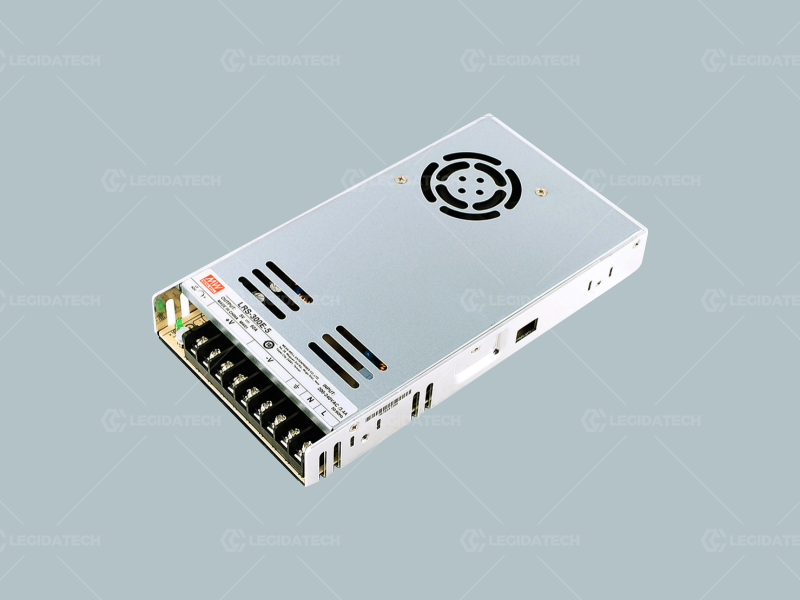
Provides stable, continuous power to the LED screen, supporting reliable operation under various weather and temperature conditions. Designed for high efficiency and low energy consumption.
The light-emitting core of every LED screen determines brightness, color accuracy, and lifespan. Outdoor LED lamps are built for high brightness and long-term stable performance in harsh environments.

Manages content playback, brightness adjustment, and screen monitoring for outdoor LED displays. Supports remote control and real-time diagnostics for efficient daily operation.
Resources of Outdoor LED Display
- Blogs
- Pages
How to Measure LED Screen Size
5 Steps to Teach You How to Clean LED Screen Correctly
What are the advantages of outdoor LED advertising screen?
Double Sided Outdoor LED display Screen
Factors causing the large price gap between outdoor LED display panels
Outdoor P3.9 LED Display:What You Need to Know
A Detail Guide Of Outdoor P6 LED Screen For Advertising
Best Guide: How to Protect Your Outdoor LED Display from Humidity
How to make outdoor LED billboard screen longer lifespan?
Outdoor LED Display Buying Guide
LED display resolution revealed: from standard definition to 8K
The Impact Of LED Display Working At High Temperature
LED Screen display Basic Knowledge Guide
LED Video Wall Controller: Everything You Need To Know
LED Advertising Screen-AD Series / Outdoor LED Screen-B series
Outdoor LED digital signage – EDS series / Outdoor LED Screen OK Series
Outdoor LED Modules / P4.8 LED Outdoor Modules
P5 LED Screen -Quick guide / P10 LED Display: A Comprehensive Guide
Stadium LED Displays for Sports / LED Screen for Hotel
LED Screen for Stage/Concert / LED Screen for church
LED Screen for shopping center / LED Screen for Airport
Outdoor LED display screens are modular, full-color light-emitting electronic devices that use light-emitting diodes. They can be infinitely and seamlessly spliced to display graphics, text, and videos. They have high brightness, weather resistance, and long viewing distance.
You should consider: brightness (nits), pixel pitch (P-value), viewing distance, weatherproofing (IP rating), maintenance options, and price inclusions.
Pixel pitch refers to the distance (in millimeters) between adjacent LEDs. The smaller the pitch, the more LEDs can be on the screen, resulting in higher resolution and a shorter minimum viewing distance. Pixel pitch for outdoor LED displays is generally between P4 and P10. The farther the viewing distance, the larger the pitch.
Outdoor installations of LED screens typically require IP 65 or higher. The display should meet the protection level for outdoor conditions: waterproof, dustproof, high/low temperature resistant, and moisture resistant.
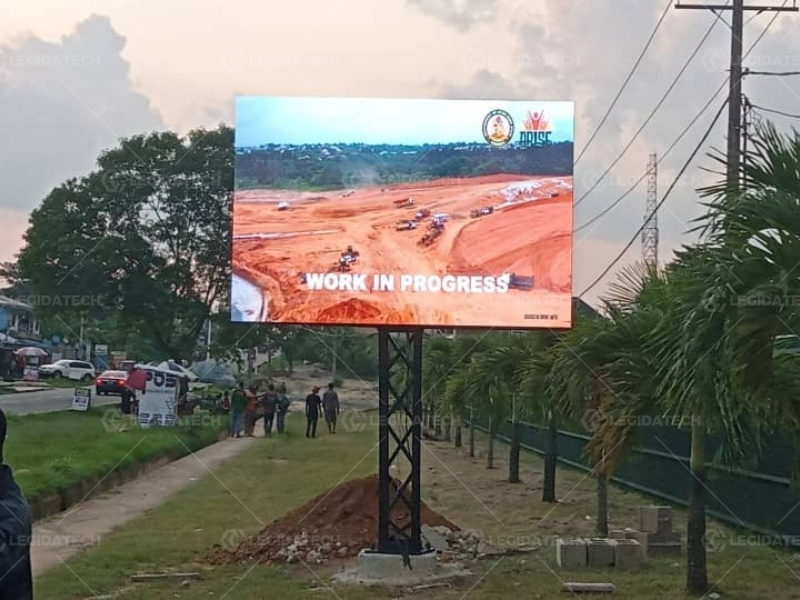
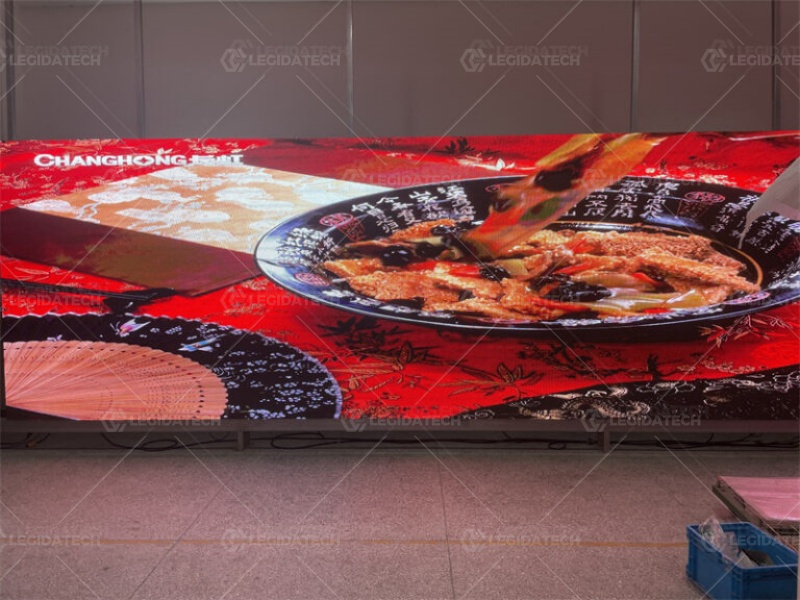
Related Outdoor LED Display Cases


Outdoor LED Display: Complete Buyer’s Guide to Selection, Installation & Maintenance
Whether you are planning a commercial advertising screen, a stadium display, or a stage rental setup, this guide covers everything you need to know before purchasing an outdoor LED display — from key components and installation requirements to technical parameters, quality evaluation, and pricing references.
1. What Is an Outdoor LED Display?
An outdoor LED display is a high-performance display system designed for permanent or temporary installation in outdoor public environments. It is widely used in commercial advertising, traffic guidance, stage performances, sports venues, shopping mall promotions, and public information broadcasting.
LED (light-emitting diode) technology enables these displays to achieve the high brightness levels required for outdoor visibility. For a technical overview of how LED technology works, see the LED Wikipedia entry.
A complete outdoor LED display system consists of six core parts:
- Display cabinet — the main structural and visual unit
- Weak current control system — manages display signals and data
- Strong current control system — provides and converts power supply
- Data transmission cables — connects control room to screen
- Computer and peripherals — generates video and audio content
- Steel structure frame — supports and secures the entire installation
Depending on project requirements, civil construction, steel columns, concrete columns, and wall-mounted steel structure systems may also be included.
2. Key Components of an Outdoor LED Display
2.1 Display Cabinet
The main body of the outdoor LED display. It is composed of outdoor LED modules, a sheet metal or aluminum profile enclosure, LED receiving cards, and switching power supplies. The cabinet is the basic unit of the display body and must meet strict waterproofing and structural requirements.
2.2 Weak Current Control System
Composed of an LED video processor, sending card, and receiving card. This system handles data acquisition, logic processing, buffering, and gray-scale control — functioning as the brain and nervous system of the entire display. Leading control system brands include Novastar and Linsn.
2.3 Strong Current Control System
The power source of the LED display. It converts 220V/380V AC input to the low-voltage 5V DC required by outdoor LED modules via switching power supplies installed within the display cabinet.
2.4 Data Transmission
Display data and control signals are transmitted via Cat6 shielded twisted-pair cables for standard distances. Fiber optic cables are recommended for long-distance installations to ensure low signal loss and strong anti-electromagnetic interference performance.
2.5 Steel Structure & Cabinet Connection
Cabinet connection pieces fix individual cabinets onto the outer steel frame, forming the complete display body. Structural strength and surface flatness are critical during installation and must be carefully managed.
3. Site Survey & Installation Planning
A thorough site survey is the foundation of a successful outdoor LED display project. Key steps include:
3.1 Determine Screen Location and Control Room
Identify the exact mounting position — whether on a wall, under a beam, or between columns — and record the relevant structural reference points. Confirm the location of the control room and its distance from the screen, as this affects cable routing and control system selection.
3.2 Assess Structural Load Capacity
Consult construction and civil engineering drawings, and conduct on-site inspections to confirm that the building structure can safely bear the full weight of the outdoor LED display.
3.3 Plan Cable Routing
Determine the direction, length, and conduit requirements for both power and signal cables. Cable length and routing conditions directly determine the control system solution.
3.4 Locate Supporting Equipment
Confirm installation positions for power distribution cabinets, audio equipment, and the main control console in advance. Placement decisions affect construction difficulty and overall project cost.
4. Environmental Requirements for Outdoor LED Displays
Outdoor LED displays must be designed and selected to withstand a wide range of environmental conditions:
| Environment | Risk |
|---|---|
| High temperature & humidity | Short circuit, component failure |
| Lightning | Strong electrical and magnetic interference |
| Extreme cold | Startup failure, reduced performance |
| Coastal areas | Salt corrosion and moisture damage |
| Desert environments | Sand ingress, high ambient temperature |
| Electromagnetic interference zones | Signal disruption |
| Direct sunlight | Low contrast, unclear display content |
When purchasing outdoor LED displays for extreme environments — such as seaside, desert, or cold regions — the OK Series outdoor LED display is specifically built to handle these conditions, with die-cast aluminum cabinets and full anti-corrosion treatment.
5. Waterproofing & Protection Requirements
Waterproofing is one of the most critical requirements for any outdoor LED display installation. Key standards include:
- The outdoor LED module itself must use waterproof encapsulation, with three anti-coating applied to the back of each module
- The display cabinet must be a fully sealed waterproof enclosure, with internal surfaces treated for anti-corrosion, moisture-proof, and flame-retardant protection
- The joint between the screen body and the building structure must be strictly sealed against water ingress
- Effective drainage measures must be in place so that any accumulated water can be discharged smoothly
- IP65 protection rating or above is required for genuine outdoor waterproof performance
- Waterproof testing should be conducted before shipment and confirmed on-site after installation
IP ratings are defined under the international standard IEC 60529. IP65 means the enclosure is fully dust-tight and protected against water jets from any direction.
6. Heat Dissipation & Temperature Management
Effective heat management directly impacts display reliability and service life:
- Axial fans are installed at the back and top of the cabinet to continuously discharge heat
- Internal screen temperature should be maintained between -10°C and 40°C
- For extreme high-temperature environments, air conditioning units can be installed within the steel frame
- Industrial-grade integrated circuit chips with an operating range of -40°C to 80°C are used to ensure reliable startup in cold climates and stable operation under high heat
- If ambient temperatures are too high and heat dissipation is insufficient, integrated circuits may malfunction or be permanently damaged
For a detailed look at how high temperatures affect display performance over time, see our article on the impact of LED display working at high temperature.
7. Core Technical Parameters
When evaluating outdoor LED displays, the following technical parameters are the most important reference indicators:
| Parameter | Recommended Specification |
|---|---|
| Brightness | ≥ 5,500 cd/m² |
| Refresh Rate | ≥ 1,920 Hz |
| Pixel Density | ≥ 40,000 pixels/m² |
| Waterproof Rating | IP65 or above |
| Operating Temperature | -10°C to 40°C |
| Chip Operating Range | -40°C to 80°C |
| LED Lifespan | 100,000+ hours (SMD LED) |
| Gray Scale | 16-bit data interface recommended |
Factory Aging Process: Reputable manufacturers put every product through a three-stage aging process before shipment:
- 24-hour module-level power aging
- 48-hour single cabinet power aging
- 72-hour full-screen assembly power aging
This process screens out early failures and ensures stable performance on-site.
8. How to Evaluate Outdoor LED Display Quality
Not all outdoor LED displays are manufactured to the same standard. When comparing products, pay attention to these key quality indicators:
Surface Flatness The display surface should be flat within ±1mm. Local convex or concave areas will cause image distortion and dead viewing angles.
Brightness Outdoor full-color displays should achieve a brightness of above 5,500 cd/m² for high-brightness outdoor installations. Insufficient brightness makes display content invisible in direct sunlight.
White Balance Pure white is achieved when the RGB ratio is precisely 1:4.6:0.16. Any deviation causes color cast — typically appearing as a blue or yellowish-green tint.
Color Reproduction The display color should be highly consistent with the source content. Poor color reproduction makes advertisements appear inaccurate and unprofessional.
Dead Pixels & Mosaic Dead pixels are caused by substandard LED chips. Mosaic (small always-lit or always-dark squares) is caused by poor connector quality. Both indicate lower-grade components.
Color Blocks Visible color differences between adjacent modules indicate poor control system performance, low gray-scale levels, or low scanning frequency.
For a full breakdown of what affects LED screen price — including chip brand, cabinet material, and pixel pitch — see our pricing reference page.
9. Outdoor LED Display vs. LCD Display
| Outdoor LED Display | LCD Display | |
|---|---|---|
| Scalability | Unlimited seamless splicing | Difficult at large sizes |
| Lifespan | 5+ years under normal conditions | ~1.5 years before brightness degradation |
| Brightness & Viewing Angle | High brightness, wide viewing angle | Lower brightness, narrower angle |
| Color Performance | Excellent outdoor color reproduction | Good for indoor environments |
| Interactivity | Supports touch screen, cloud management | Limited |
| Best Applications | Outdoor advertising, stadiums, transit hubs | Indoor retail, hotel lobbies, offices |
For outdoor advertising and large-format public display applications, outdoor LED displays consistently outperform LCD screens in brightness, longevity, and scalability. See our full comparison in the advantages of outdoor LED advertising screen.
10. Common Faults & Troubleshooting
10.1 Large Area Black Screen
Check cable and power connections at the first abnormal module. If no power input is detected, inspect the power supply with a multimeter. If color confusion appears, check signal cable connections on the input end of the first abnormal module and replace the ribbon cable if necessary.
10.2 Dead Pixels / Out-of-Control Points
After confirming LED damage through single-light detection, replace the faulty LED lamp bead:
- Front maintenance: Remove the mask from the front, replace the lamp bead, reseal with colloid, and restore the mask
- Rear maintenance: Remove the module from the back of the cabinet, carry out lamp bead replacement on the workbench, then reinstall
10.3 Constant Color Blocks on Module
This typically indicates a faulty driver IC on the circuit board. Replace the IC promptly to restore normal display performance.
10.4 Signal Interference
Use shielded signal cables, maintain physical separation between signal and power cables, and consider fiber optic transmission for long-distance runs.
10.5 Overheating
Ensure axial fans are functioning, check for blocked ventilation paths, and verify that ambient temperature is within the rated operating range.
10.6 Power Fluctuation
Install power filters and voltage regulators to stabilize power input and reduce supply noise — a common cause of display flickering or abnormal operation.
10.7 Electrostatic Damage
Use anti-static measures during installation and maintenance, including static protection devices and static elimination equipment, to prevent damage to LED chips and circuit boards.
For routine upkeep, see our guide on how to clean LED screen correctly and how to extend outdoor LED billboard screen lifespan.
11. Outdoor LED Display Installation: 6 Key Requirements
- Lightning Protection — Install lightning rods on the building. The display must be well grounded, with grounding resistance less than 3 ohms, to safely discharge large currents caused by lightning strikes.
- Waterproofing — The joint between the screen and building must be strictly sealed. Drainage outlets must be installed to allow accumulated water to discharge smoothly. See our guide on how to protect your outdoor LED display from humidity.
- Circuit Component Selection — Use industrial-grade circuit chips rated for -40°C to 80°C to ensure reliable operation across all seasons and climates.
- Ventilation & Cooling — Install axial fans to maintain internal temperatures between -10°C and 40°C. In extreme heat environments, consider air conditioning inside the steel frame.
- Structural Strength — The steel frame must safely support the full weight of the display under wind load and other outdoor conditions. For reference, IEC standards for outdoor electronic displays set out baseline structural and electrical safety requirements.
- Cable Management — Use Cat6 shielded cables for data transmission. For long distances, use fiber optic cables to minimize signal loss and electromagnetic interference.
12. Outdoor LED Display Price Reference
Taking a P10 OK Series outdoor LED display at 9.6m × 5.76m (55.3㎡) as a typical example:
| Item | Cost (RMB) |
|---|---|
| LED screen body (P10, Nationstar LEDs, die-cast aluminum cabinet) | ¥237,772 |
| Control system (sending card + 16 receiving cards) | ¥5,360 |
| Audio system (80W speaker column + 200W amplifier) | ¥1,700 |
| Control computer | ¥3,500 |
| Cooling fans (×3) | ¥1,500 |
| Packaging & spare parts | ¥4,000 |
| Power distribution cabinet (20KW) | ¥6,000 |
| Lightning arrester (OBO Germany) | ¥2,000 |
| Total (excl. steel structure & installation) | ~¥261,832 |
Steel structure, civil construction, and on-site installation costs vary by project and are not included above. For a full breakdown of what drives LED screen price across different pixel pitches and series, see our pricing reference page.
Control System Options:
- Small-area outdoor LED displays → asynchronous control system recommended
- Large-area outdoor LED displays → synchronous control system recommended (e.g., Nova synchronous control system)
13. Get a Free Outdoor LED Display Solution
We provide free outdoor LED display solution consulting for every project, including screen size and pixel pitch recommendation, steel structure design drawings, control system configuration, and a full project quotation plan.
Browse our full range of outdoor commercial LED screens or explore all outdoor LED display solutions. Contact us at our project inquiry page to get a customized solution for your project.