


AF500 Series 500x500mm Rental LED Display — 8kg Die-Cast Cabinet, P1.25 to P5.95
Every rental screen starts with the same two questions: how many people does it take to carry, and how much time does the venue give you? The AF500 is our answer to both. The panel measures 500 × 500 × 84 mm and weighs 8 kg with its modules fitted — one technician lifts it, seats it and shuts the lock with a bare hand. Each cabinet carries four 250 × 250 mm modules in a 2×2 grid and locks on all four edges. Thirteen pixel pitches share that one chassis: eight indoor, P1.25 through P4.81, GOB-coated up to P2.604; five outdoor, P2.604 through P5.95, sealed IP65 on both faces. Refresh holds 3840–7680 Hz across the range, contrast 15000:1, and a ±5° half-arc lock turns the same stock into a flat wall or a curved one.
✓ 8 kg per cabinet
✓ 2×2 module layout
✓ ±5° half-arc lock
✓ 3840–7680 Hz refresh
✓ 5-year warranty
What a 500x500mm Rental LED Display Is — and Why the Size Stuck
The 500x500mm rental LED display is the cabinet the rental trade standardised on. Die-cast aluminum, 500 × 500 × 84 mm, four modules in a 2×2 grid, eight kilos with the modules in place, and a lock on each of the four edges so panels join on every side. Build it, strike it, pack it, do it again next weekend.
The AF500 series is the version we build. One chassis, thirteen pitches — eight indoor from P1.25 to P4.81, five outdoor from P2.604 to P5.95 — plus vertical interlock with the 500x1000mm rental LED display, and a shared pool of locks, handles and modules running through the whole family.
Why did this size win? Because real venues refuse to cooperate. Stairwells are narrow. Docks sit two floors below the stage. Crew lists shrink between the quote and the get-in. A 500 mm panel clears all three. The AF1000 halves your cabinet count on big flat walls; the AF500 is what you reach for when the wall is not big, not flat, or not reachable.
Buyers scoping the whole category can start at our rental LED display hub, where this platform sits beside the US outdoor and UA indoor series. LEGIDATECH has built LED displays in Shenzhen for 19 years and ships to more than 100 countries.
Marketplace listings quote anything from 1920 Hz to 3840 Hz for this cabinet class, and some datasheets print two different figures on facing pages. The AF500 range carries a single stated band — 3840–7680 Hz, all thirteen pitches. That is the number the QC bench measures, and it is the number you get.
Eight Ways a Show Goes Wrong — and How the AF500 Answers Each One
Nothing on this cabinet is decorative. Every feature traces back to a complaint from a crew that had a bad night. Here is the list, problem first.
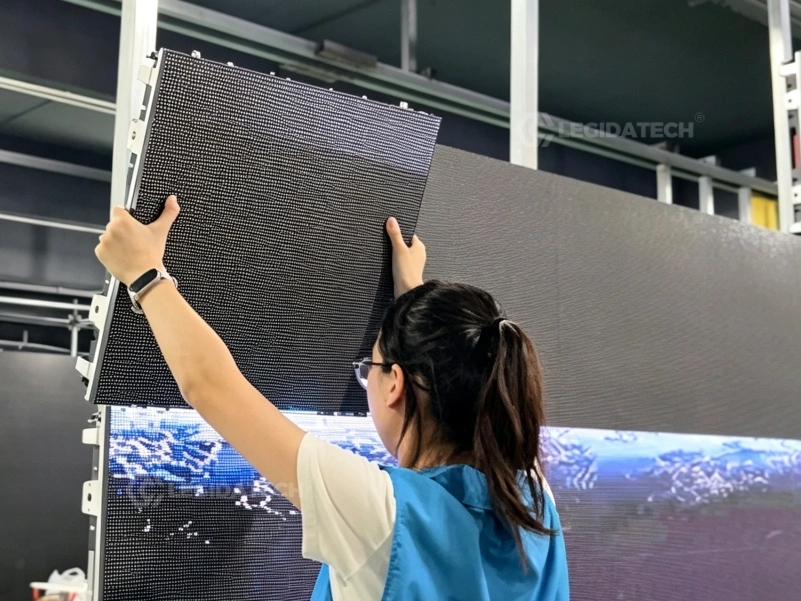
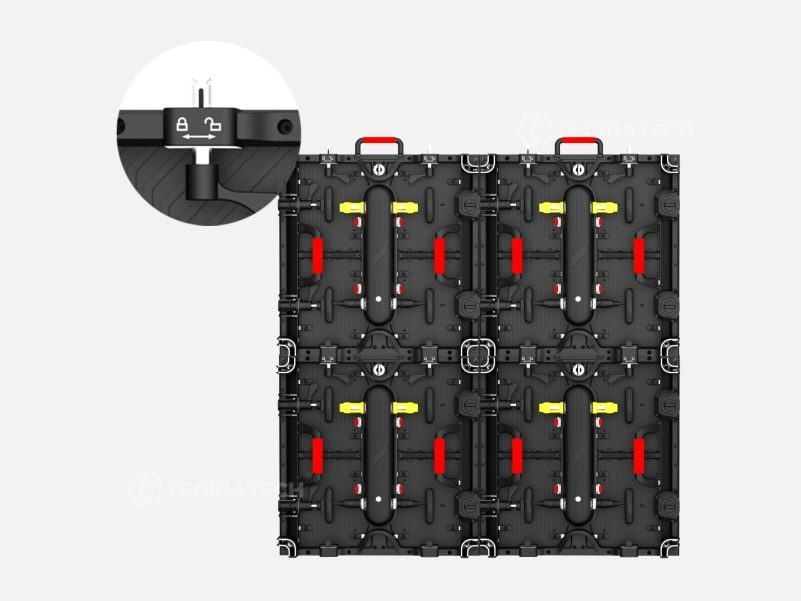
A travel lock shuts in one movement of the wrist. Lift, seat, close, step sideways — the same person repeats it down the row without stopping to hunt for a driver or climb between rows. The cabinet you can carry alone is the cabinet that finishes before the doors open.
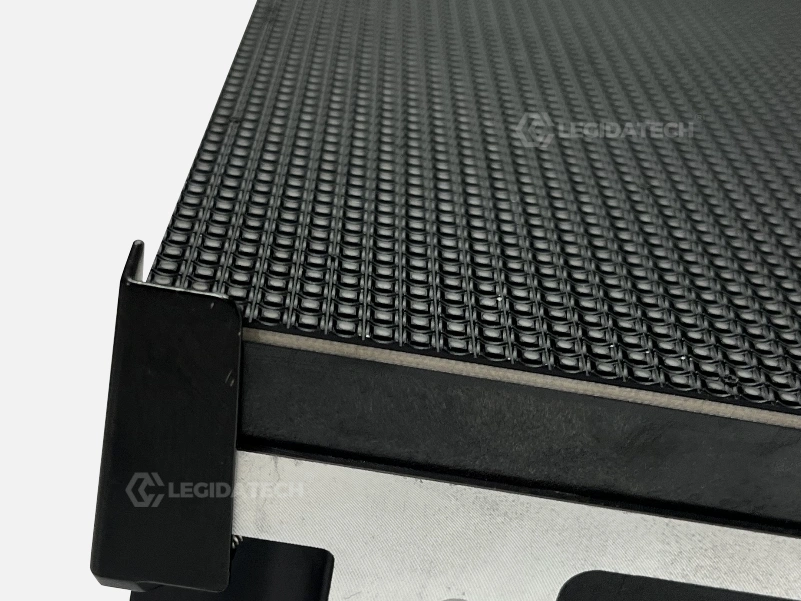
Most rental damage happens nowhere near a stage. It happens at the truck ramp, in the lift, against the door frame. Guards wrap all four edges and a bump strip runs along the base, so the chassis absorbs the scrapes that ground-stacking and case-loading hand out.
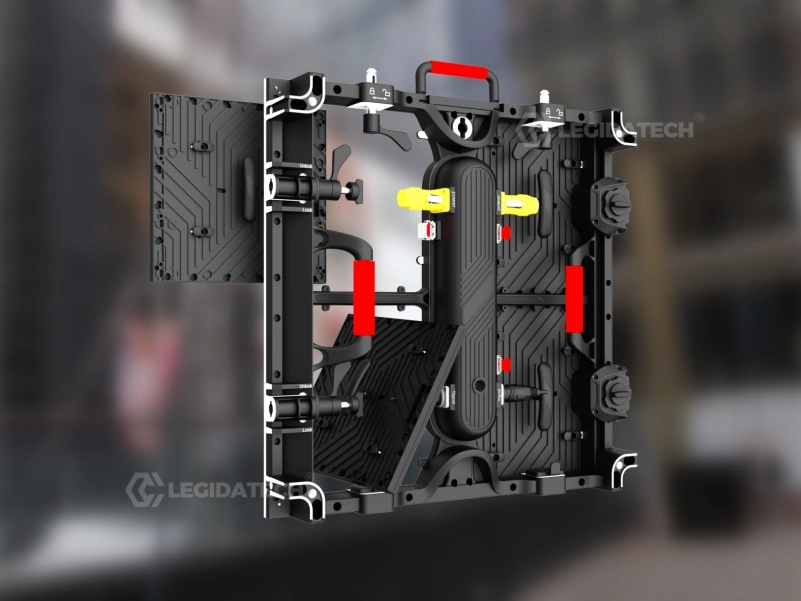
Walls end up pushed against backdrops, windows and venue walls because that is where the design wants them. Maintenance works from either side on every cabinet, so a failed module comes out from the front with the screen still standing — no strike, no re-rig, no gap in the programme.
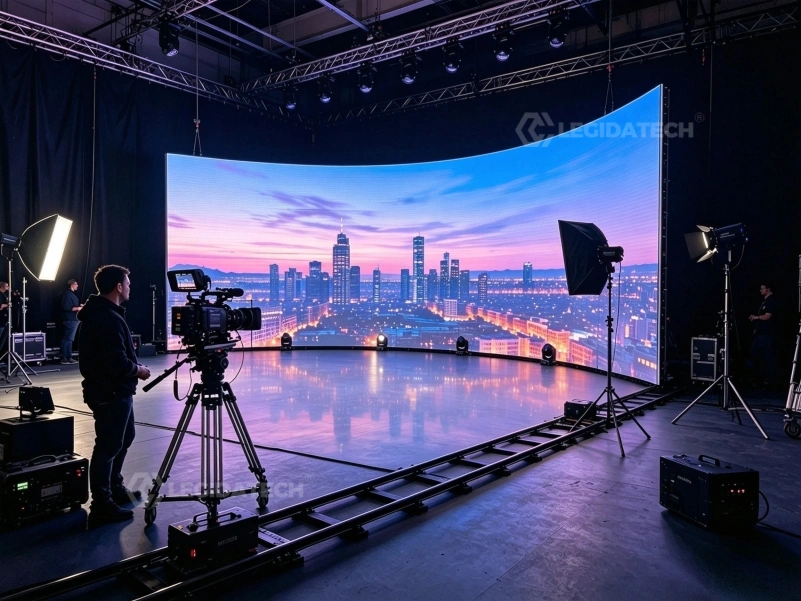
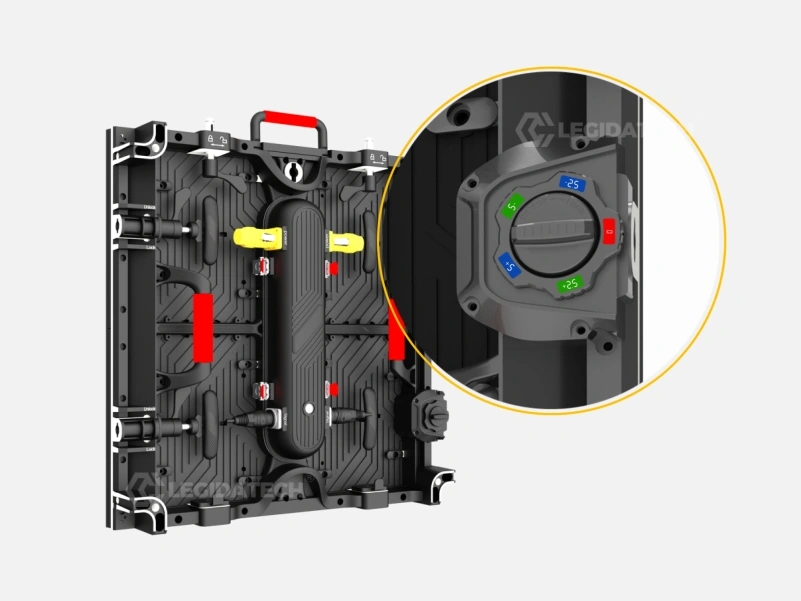
A half-arc lock hides inside each seam and steps through five detents between -5° and +5°, so concave sweeps, convex wraps and inside or outside corners all come out of standard stock. No curved-only cabinets parked in the warehouse waiting for one job a quarter.
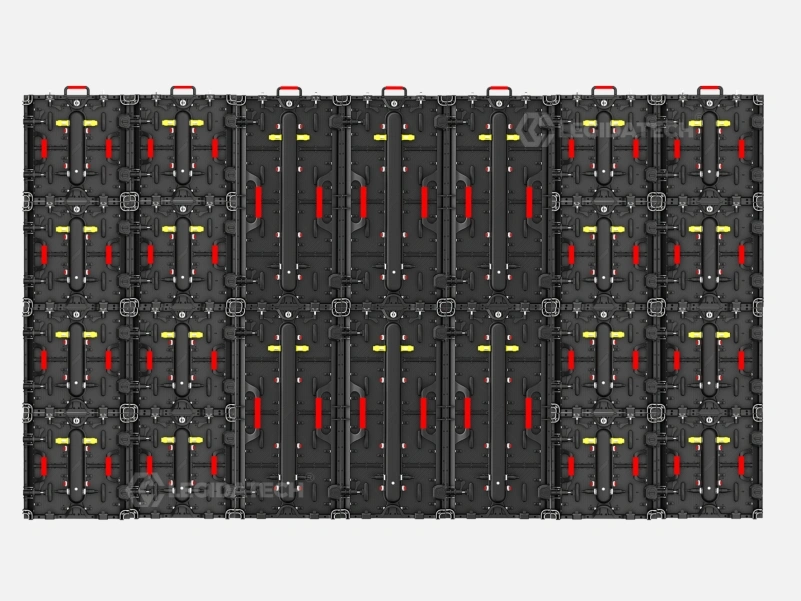
The AF500 stacks vertically onto the AF1000 500x1000mm cabinet on the same frame. Two formats, one drawer of spares, one module SKU. You stop asking clients to pick a size before anyone has walked the venue.
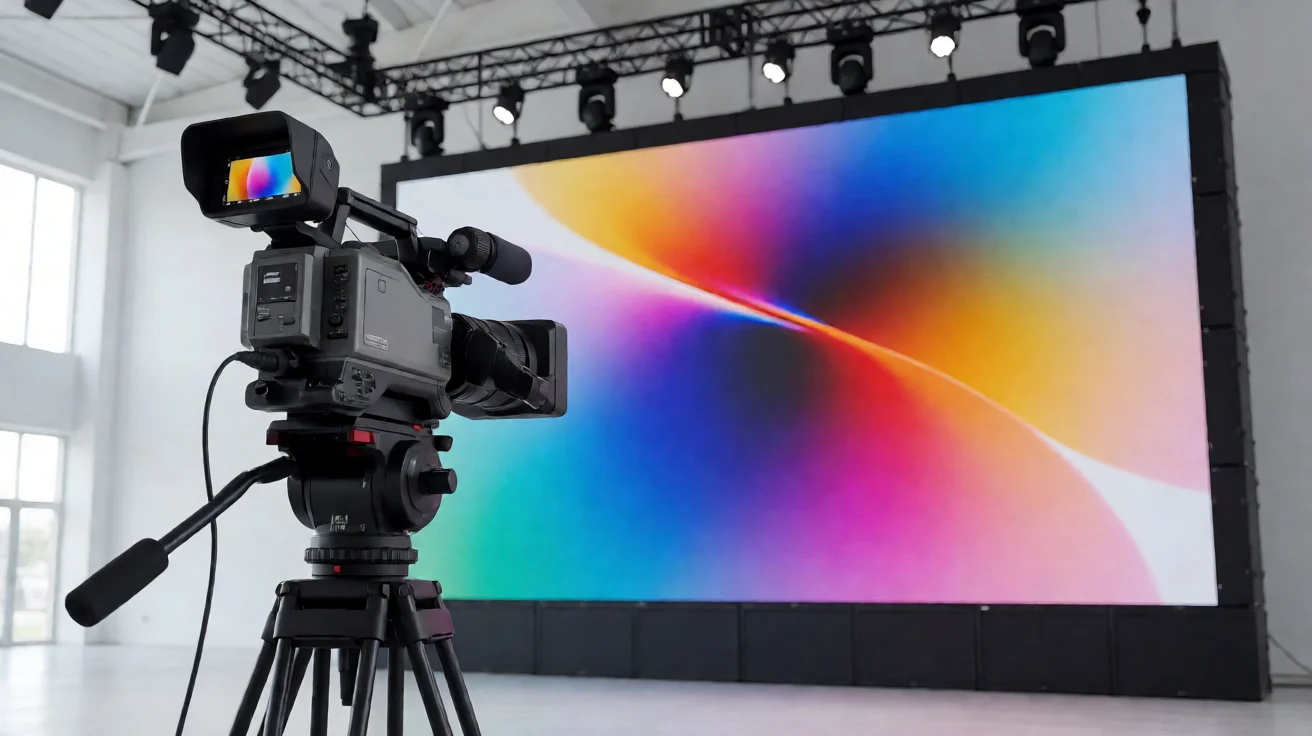
Stand in front of a low-refresh wall and it looks perfect. Put a shutter in front of it and the banding appears. At 3840–7680 Hz with 12–16 bit gray scale, the AF500 holds steady for broadcast rigs, XR volumes and livestreams — a problem you solve on the spec sheet, not in post.
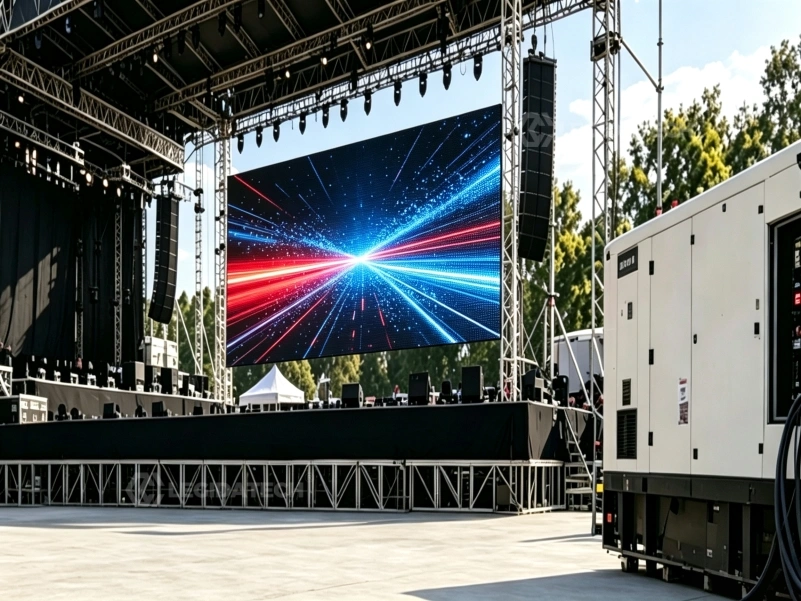
The input accepts AC90-264V at 47–63 Hz, so a supply that sags when the catering kitchen switches on does not take the screen with it. And at 200–300 W/m² average draw, the distribution order stays small enough to fit the box the venue already has.
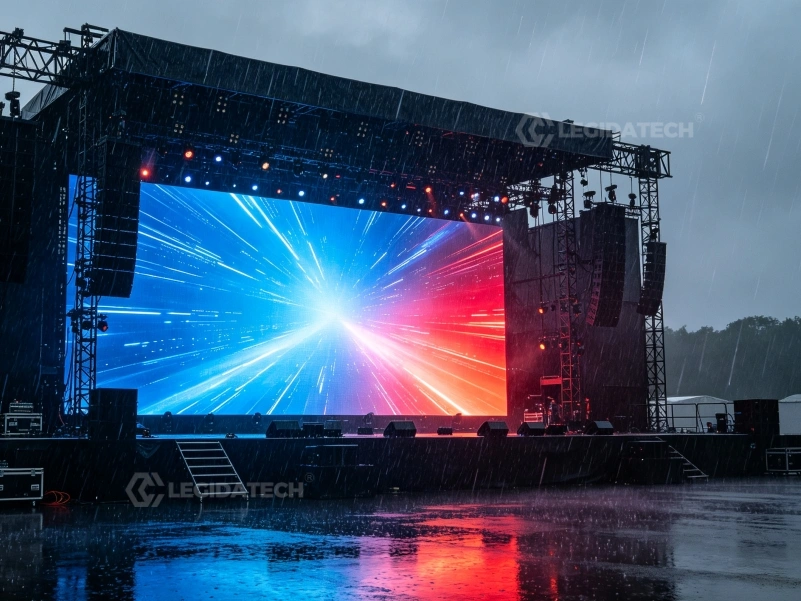
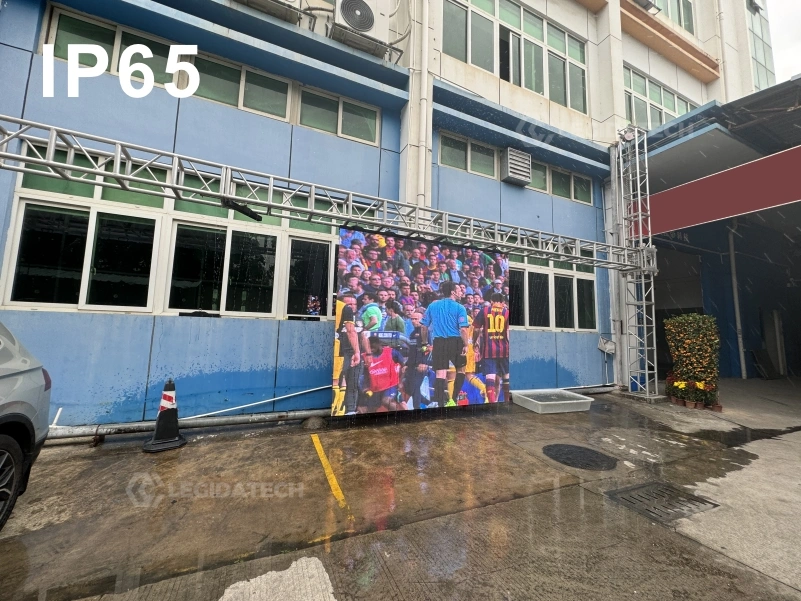
Outdoor pitches seal to IP65 on the front face and the rear cabinet both, rated -20 to 60 °C and 10–85% RH. Rain from the sky and a hose from the deck both stay outside. A festival does not get to reschedule around weather, and this cabinet does not ask it to.
Install Speed: How a 500x500mm Rental LED Display Goes Up
A rental panel earns its money on the get-in, not on the data sheet. So the AF500 was designed around one repeated motion, and everything else was cut away from it. Grip the top handle, drop the cabinet onto the frame or the row beneath it, swing the travel lock shut. Three moves. The next cabinet repeats them.
The lock is doing two jobs at once. Shut it and the tension pulls the cabinet square against its neighbour, so the wall tightens itself as it grows — the load path stays rigid and the face stays flush without anyone shimming a seam. One hand closes it. No hex key, no driver, no climbing back down to fetch a tool.
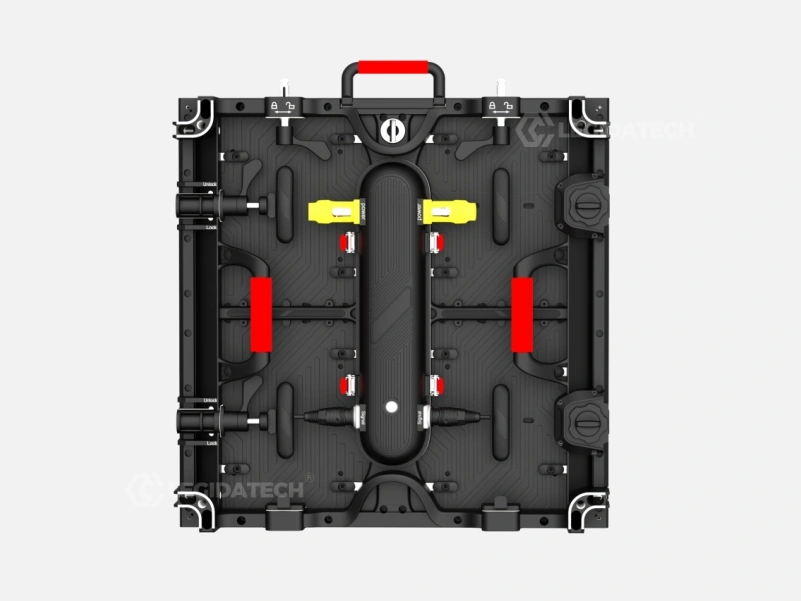
Servicing follows the same logic. Modules release from the front on quarter-turn fasteners. Power and signal run through ring connectors that physically cannot be reconnected the wrong way round. The power box, receiving card and rear cover arrive as one pre-built assembly, so replacing them is a single trained hand’s job rather than a workbench job.
Red-grip handles sit on all four sides for two-handed carrying, and the handle geometry is identical on the AF1000 500x1000mm cabinet. A crew that learns one cabinet has learned both — muscle memory carries across the fleet, and nobody has to re-learn a grip on show day.
Take a 12 m² wall — 4 m wide by 3 m tall. Built from 500 × 500 mm cabinets that is 48 panels. Built from 500 × 1000 mm cabinets it is 24. Same screen, same picture, half the lift-and-lock cycles and half the inter-cabinet connections. That is the only reason the AF1000 exists, and it is also the reason the AF500 still earns its place: not every wall is a flat rectangle that a truck can reach.
Want this math for your own load-in? Send the wall size, pitch and venue, and we will return a cabinet count, a crew estimate and a case plan.
Curved Walls, Cylinders and Corners — Out of Standard Stock
Buyers often assume a curved screen means buying curved cabinets. It does not. The half-arc lock lives inside the seam of every standard AF500 panel and changes the angle of the joint itself.
Five settings sit on the same part: -5°, -2.5°, 0°, +2.5° and +5° per cabinet column. Negative angles bow the face toward the audience. Positive angles wrap it away and around. Zero locks the wall dead flat. Because the angle compounds down a row, a run of panels at -2.5° reads as a gentle cove, while a full -5° builds a noticeably tight curve.
| Lock setting | -5° | -2.5° | 0° | +2.5° | +5° |
| Wall it builds | Concave, tight curve | Concave, gentle sweep | Flat wall | Convex, gentle sweep | Convex, wrap-around |
The same cabinet covers the rest of a creative brief as well. It hangs on lifting rigs, stacks on ground-support seat mounts, and closes into cylindrical columns or inside and outside right-angle corners.
For a rental house the real win is not the curve itself — it is that Tuesday’s curved XR cove and Thursday’s flat conference backdrop come out of the same flight cases. Dedicated curved stock that sits idle eleven months a year is capital doing nothing.
AF500 or AF1000? Choosing Between the Two Rental Cabinets
This is the question we field most often, and most online comparisons get it wrong by framing it as either/or. The two cabinets share modules, locks, handles and power boxes — only the chassis differs. What actually changes is how many lifts your crew makes and what shapes the wall can take.
| Factor | AF500 (500×500 mm) | AF1000 (500×1000 mm) |
| Cabinet weight | 8 kg | 14.5 kg |
| Module layout | 2 × 2 | 2 × 4 |
| Cabinets per 12 m² wall | 48 | 24 |
| Big flat walls | Twice the panels to place | Half the lift-and-lock cycles |
| Creative shapes | Finer curve steps, columns, totems, odd aspect ratios | Fewer joint positions to work with |
| Tight access | Clears stairwells and lifts | Wants a wider path |
| Interlock | AF500 stacks vertically onto AF1000 on the same frame — both sizes can share one wall | |
The practical rule: creative builds, small screens and awkward venues point to the 500×500 mm cabinet; large festival backdrops with a fixed aspect ratio come down faster in 500×1000 mm. Most rental houses we supply stock both and mix them on the same wall — a wide flat field of AF1000 panels, with AF500 filling the column, the doorway gap or the odd edge that the grid does not divide cleanly into.
Because the parts pool is shared, carrying both sizes does not double your spares inventory. One module stock, one receiving-card stock, one power-box stock — two chassis types. The full specification for the larger cabinet lives on the AF1000 500x1000mm rental LED display page.
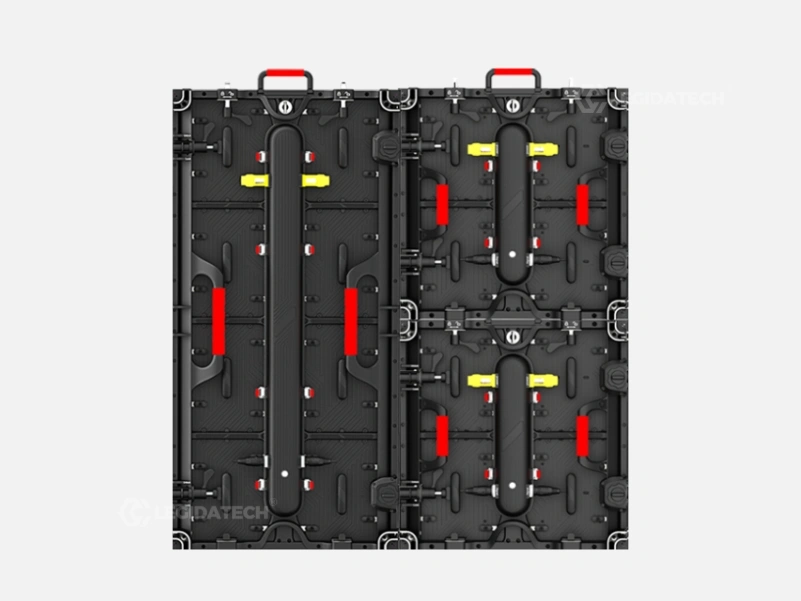
Indoor Build or Outdoor Build? Same Cabinet, Different Spec
The chassis does not change. What changes is the lamp, the sealing and the brightness — and those three decide whether the screen belongs in a ballroom or on a festival field.
Pitch selection is really a viewing-distance decision, and the numbers make it concrete. On the outdoor side a P2.604 wall reads from 3–50 m, a P3.91 from 4–150 m and a P5.95 from 6–200 m. Indoor, the range stretches from 3 m at P1.25 out to 200 m at P2.976 and P3.91. Budget the pitch against the closest paying seat, not the furthest — close-up failure is what ends up in a client’s photo album.
Fixed-install counterparts at these same pitches are documented in our outdoor rental LED display and indoor rental LED screen collections.
When Nothing Is Allowed to Blink: Dual Backup for Studio Walls
A concert crowd forgives a flicker. A live broadcast, an XR volume or a keynote stage does not — there is no second take, and the screen is on camera the entire time. For those builds the AF500 can be ordered with redundancy built into the cabinet, so a failure is absorbed internally instead of appearing on air.
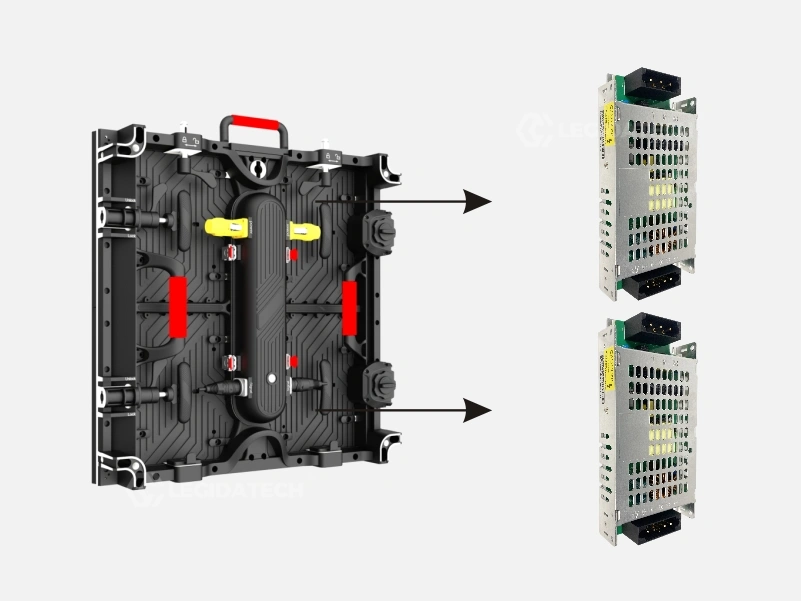
Two supplies split the cabinet’s load in parallel. If one fails, the survivor takes the whole load and the pixels stay lit — no dark frame, no reboot sequence, no apology. The dead unit gets changed in the next service window rather than in front of an audience.
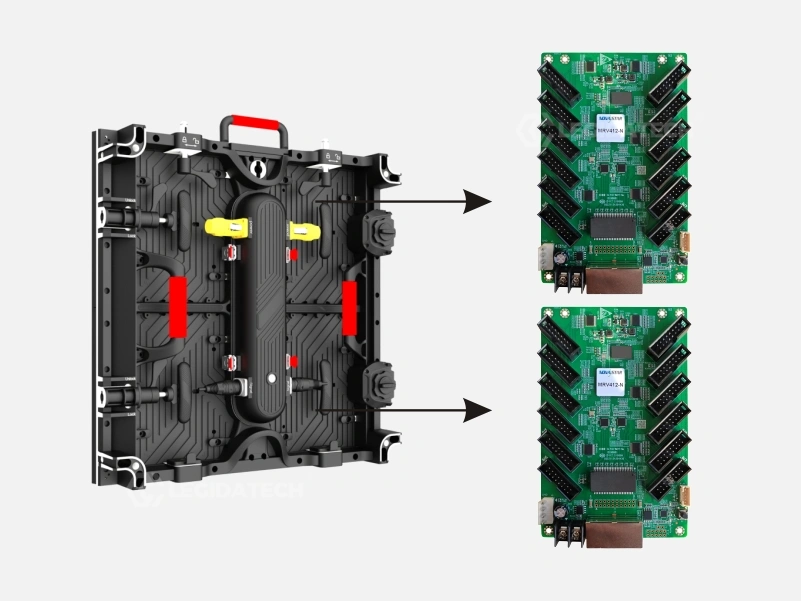
A second receiving card mirrors the data path of the first. If the primary card or its cable drops, the backup closes the loop and the chain carries on. The handover happens behind the image rather than on it.
Both options are specified at order time — add “dual power supply + dual receiving card backup, indoor build” to your enquiry and the parts are itemised separately in the quote. On a wall that lives on a studio calendar, the premium is a fraction of what a single abandoned take costs.
Where the AF500 Earns Its Keep
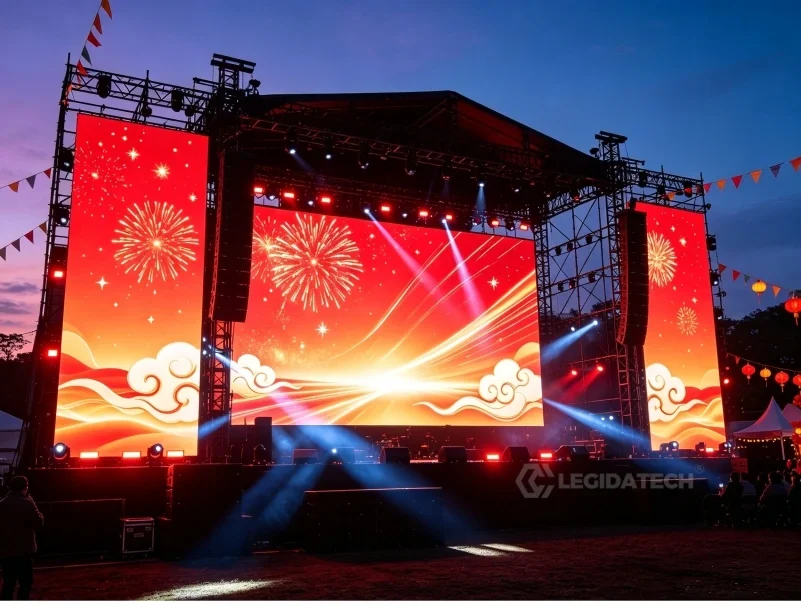
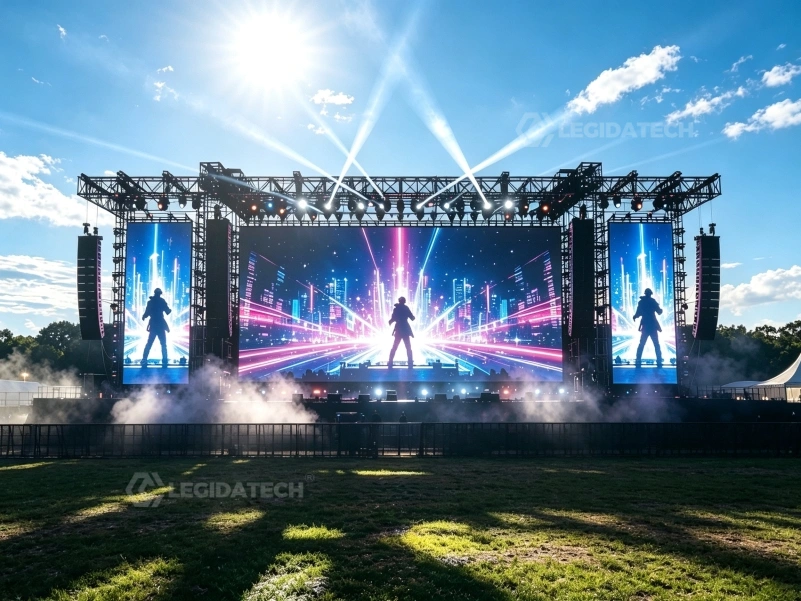
Main-stage backdrops and side IMAG walls, built on P3.91 and P4.81 outdoor pitches that read across 6–150 m sightlines and stand up to whatever the weather window delivers.
Booth walls, conference sets and product launches. Anything from P1.95 to P2.604 holds up for a viewer in the front row, and the single-person locks suit the short changeover windows a show floor allows.
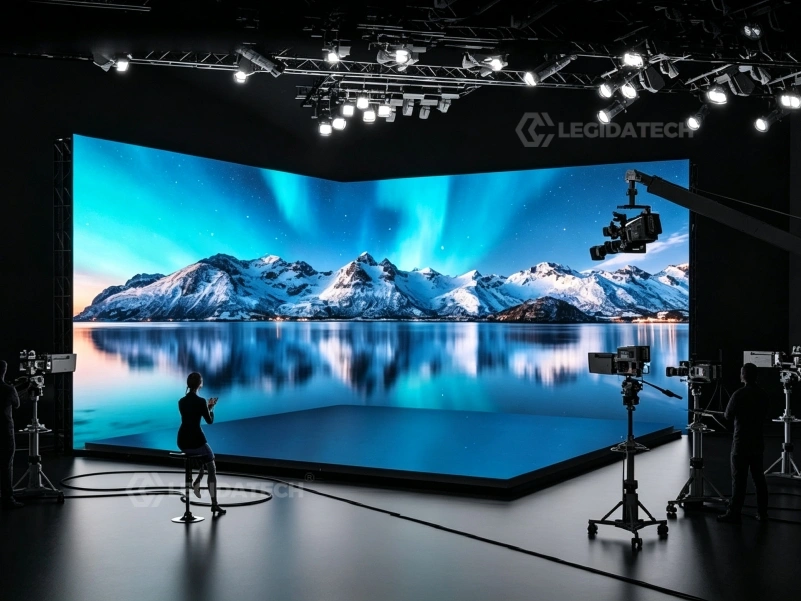
7680 Hz refresh and 15000:1 contrast survive the camera, and the ±5° half-arc lock builds the curved coves that virtual production stages are designed around — with dual backup available for take-critical days.
Cylindrical columns, right-angle returns and rigged flown walls all mount on the same lock points. At 8 kg a cabinet, both the rigging budget and the crew count stay where the production manager wants them.
Who Is the AF500 Built For?
We built the AF500 for one kind of buyer: the team whose screen has to set up fast, travel light and bill every single week. If one of these sounds like your business, this cabinet was designed around your problems.
You run an event or production company. Shows, launches and brand activations land on your calendar back to back, and the crew is never as big as the job list. An 8 kg cabinet with one-hand fast locks means a two-person crew hangs the wall before lunch — and curves, columns and right-angle returns come standard, not as a custom order.
You run an AV rental house. Your wall is an asset that has to bill every week of the season, not wait for summer. The AF500 interlocks with the AF1000 on the same lock points and shares one spares pool, so a single fleet and a single parts budget cover booth walls and main stages alike.
You build exhibition stands. Halls in Frankfurt, Cologne or Birmingham give you overnight windows, and your margin lives in install hours. Booth-scaled flight cases, GOB protection for aisle-close viewing and a wall that strikes in about an hour keep the same stock moving city to city all season.
You run an XR studio or broadcast set. The camera sees closer than any audience ever will. 7680 Hz refresh and 15000:1 contrast hold up in close-ups, ±5° arc locks build the cove, and dual power and receiving-card backup protects take days that cost more per minute than the wall itself.
You are a distributor or AV integrator. You need a rental family you can defend on margin and lead time. Thirteen pitches from P1.25 indoor to P5.95 outdoor ride on one 8 kg platform, priced factory-direct, with spares shared across the whole AF500 / AF1000 family.
See your business here?
Send us your event calendar, booth program or fleet size — we will reply with a cabinet count, a pitch mix and a spares plan built around it.
Where the AF500 Wins Across Europe and North America
Rental walls are not won on brightness numbers alone — they are won where install speed, viewing distance and trucking decide the bid. These are the markets where the AF500 gives our customers a clear edge:
United States — trade shows & church broadcast. Las Vegas, Orlando and Chicago run on overnight changeovers, and church broadcast walls get watched from the front row. P1.95–P2.604 GOB fine pitch, front-service module swaps and booth-scaled flight cases match exactly how this market buys.
Germany — Frankfurt & Cologne exhibition halls. Stand contractors here are billed by install hours. A cabinet one technician can carry, and a wall that strikes before the hall closes, is the difference between winning the season and losing it.
UK & France — Christmas markets & brand activations. London, Paris and Birmingham stage outdoor countdowns and retail takeovers every Nov–Dec. IP65-sealed cabinets, quiet load-ins for city permits and a clean image at two meters win these bookings.
North American XR & broadcast studios — LA, Atlanta, Toronto. Camera coves need ±5° arcs, 7680 Hz refresh and 15000:1 contrast — plus dual backup on the days when a re-shoot is not an option.
Running shows in two or more of these markets? Tell us the mix and the season — we will price a fleet that earns all year instead of one that waits between seasons.
AF500 Series Specifications — 500x500mm Rental LED Display
Every AF500 cabinet is 500 × 500 × 84 mm die-cast aluminum, maintainable from front and rear, and 8 kg with modules fitted. Beyond that, pixel pitch is the only real decision — locate the column that fits your viewing distance and camera plan.
Indoor versions — P1.25 to P4.81
| Parameter | P1.25 | P1.56 | P1.95 | P2.5 | P2.604 | P2.976 | P3.91 | P4.81 |
| LED type | SMD1010 (GOB) | SMD1212 (GOB) | SMD1515 (GOB) | SMD1515 (GOB) | SMD1515 (GOB) | SMD1515 | SMD2020 | SMD2020 |
| Density (dot/m²) | 640,000 | 409,600 | 262,144 | 160,000 | 147,456 | 112,896 | 65,536 | 43,264 |
| Module resolution | 200×200 | 160×160 | 128×128 | 100×100 | 96×96 | 84×84 | 64×64 | 52×52 |
| Cabinet resolution | 400×400 | 320×320 | 256×256 | 200×200 | 192×192 | 168×168 | 128×128 | 104×104 |
| Brightness (nits) | ≥600 | ≥600 | ≥800 | ≥800 | ≥800 | ≥800 | ≥1000 | ≥1000 |
| Viewing distance (m) | 3-50 | 3-50 | 3-100 | 4-150 | 4-150 | 6-200 | 6-200 | 4-100 |
| Scan mode | 1/50 | 1/40 | 1/32 | 1/25 | 1/32 | 1/28 | 1/16 | 1/13 |
| Shared across all eight indoor pitches: cabinet size 500×500×84 mm (P2.976 / P3.91 / P4.81 also available in 500×1000×84 mm) | module size 250×250 mm | module quantity 2×2 | weight 8 kg | die-cast aluminum | front & rear maintenance | colour temperature 5000-12000 K optional | viewing angle 160°/160° | contrast 15000:1 | frame frequency 50/60 Hz | gray scale 12-16 bit optional | refresh 3840-7680 Hz | max power 600 W/m² | average power 200-300 W/m² | IP31 | ||||||||
Outdoor versions — P2.604 to P5.95
| Parameter | P2.604 | P2.976 | P3.91 | P4.81 | P5.95 |
| LED type | SMD1415 | SMD1415 | SMD1921 | SMD1921 | SMD2727 |
| Density (dot/m²) | 147,456 | 112,896 | 65,536 | 43,264 | 28,224 |
| Module resolution | 96×96 | 84×84 | 64×64 | 52×52 | 42×42 |
| Cabinet resolution | 192×192 | 168×168 | 128×128 | 104×104 | 84×84 |
| Brightness (nits) | ≥4500 | ≥4500 | ≥5000 | ≥5000 | ≥5000 |
| Viewing distance (m) | 3-50 | 3-100 | 4-150 | 4-150 | 6-200 |
| Scan mode | 1/32 | 1/28 | 1/16 | 1/13 | 1/7 |
| Shared across all five outdoor pitches: cabinet size 500×500×84 mm or 500×1000×84 mm | weight 8 kg (500×500) / 14.5 kg (500×1000) | die-cast aluminum | front & rear maintenance | colour temperature 5000-12000 K optional | viewing angle 160°/160° | contrast 15000:1 | refresh 3840-7680 Hz | max / average power 800 / 200-300 W/m² | IP65 front & rear | |||||
Operating conditions and standards: power input AC90-264V, 47-63 Hz | working temperature -20 to 60 °C | humidity 10-85% RH | CCC / CE / RoHS / FCC / CB / TUV / IEC. These figures are pre-production references and can change as the product iterates — confirm the final datasheet against your order before signing.
What a 500x500mm Rental LED Display Costs to Run
Electricity is the cost that never appears on the hire sheet, yet it decides whether a venue can take the wall at all. The AF500 draws 200-300 W/m² on average, with a 600 W/m² ceiling indoors and 800 W/m² outdoors, and it accepts AC90-264V — so a 20 m² conference wall sits inside a single standard feed instead of needing a three-phase rig.
| Screen size | Average draw | Peak draw |
| 10 m² indoor (booth) | 2-3 kW | 6 kW |
| 20 m² indoor (conference) | 4-6 kW | 12 kW |
| 50 m² outdoor (stage) | 10-15 kW | 40 kW |
Sizing rule: specify the feed against peak draw, because that is the number the breaker sees. The average figure is what the energy bill sees. Average = 200-300 W/m²; peak = 600 W/m² indoor, 800 W/m² outdoor.
Three more economics notes for fleet owners:
The Factory and QC Behind Every AF500
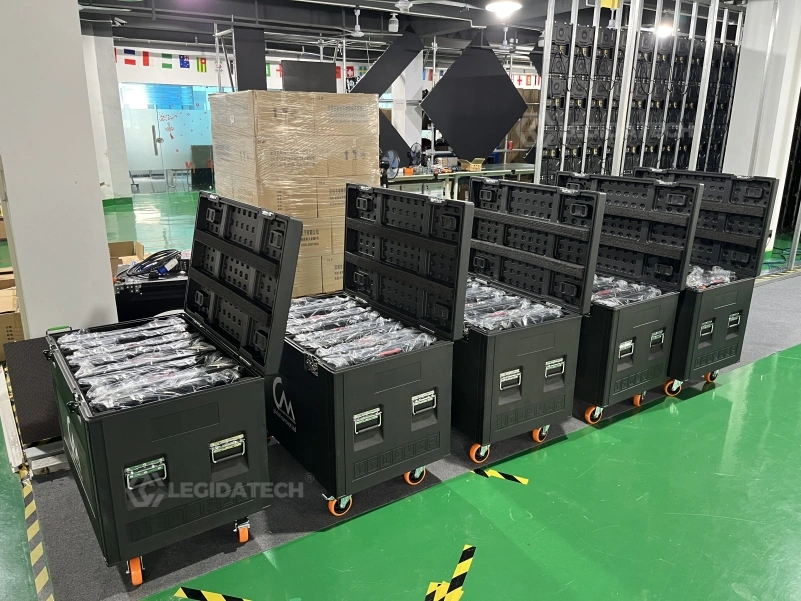
Weak lamps and marginal drivers do not announce themselves on a bench test. They surface at hour forty of a three-day festival. That is why every AF500 order runs a full powered burn-in cycle before packing — cabinets are aged under load so anything marginal fails in our plant rather than at your show.
Brightness and colour are then calibrated batch by batch, so cabinets produced in different runs still sit matched when they end up side by side on the same wall. Mixed-lot walls are the norm in rental, not the exception.
As the manufacturer we quote factory-direct with OEM and ODM service. Branding, case layout, spares holding and pitch mix are set per fleet, not fixed by a catalogue. Every shipment leaves with its certification pack: CCC, CE, RoHS, FCC, CB and TUV test reports — documentation that covers EU and North American rental tenders without re-testing.
More on our operation: factory | certification | about us.
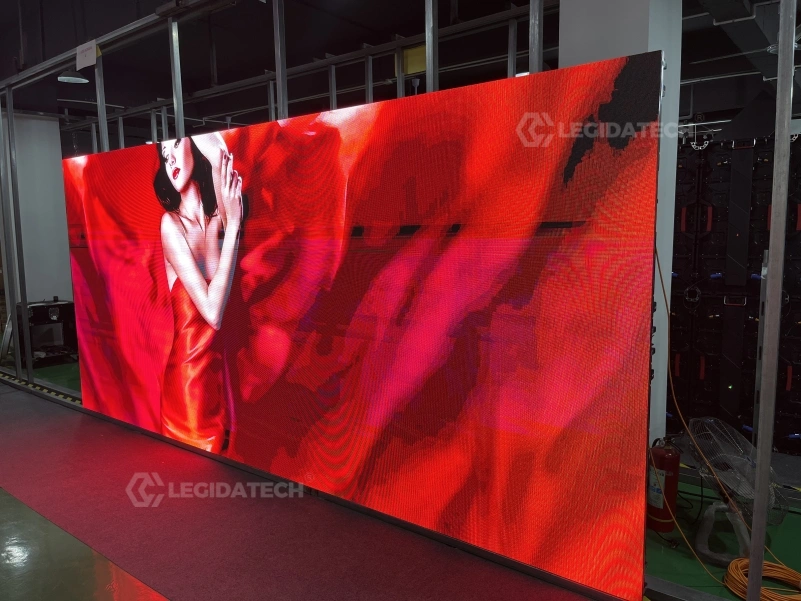
How Much Does a 500x500mm Rental LED Display Cost?
Rental-grade 500x500mm cabinets are priced factory-direct by the square meter. As a broad planning figure, budget on roughly USD 600 to 1,500+ per m² depending on pixel pitch, brightness and driver ICs — the fine-pitch GOB indoor options sit at the top of that band, the coarse outdoor pitches at the bottom. A typical 12 m² indoor wall, including control system, cabling and freight, generally lands in the low five figures.
Send your screen size and pitch for an exact quote.
You will see lower numbers advertised elsewhere. Those listings generally buy generic stock — no GOB coating, no batch calibration, no aging report, no certification pack. The AF500 is quoted against your actual pitch mix, quantity and accessory list, and at like-for-like specification factory-direct pricing is normally the sharper of the two.
Tell us the screen size, the venue type and your pitch preference, and the quote comes back itemised: cabinets, modules, receiving cards, power supplies, flight cases and spares. The LED screen manufacturer builds that list in-house, so every line answers to your tour rather than to a wholesaler’s stock.
Fine pitch P1.25-P2.604, GOB coating, single-phase power.
P2.604-P3.91, mixed AF500 and AF1000 walls, rigging specification.
P3.91-P5.95 outdoor, IP65, flight-case fleet pricing.
To get an AF500 fleet quote, email legidatechled@gmail.com or message WhatsApp +86-191-18802497 with your screen size and pitch — or open the form below. For budget context across the wider catalogue, see our LED screen price guide.
500x500mm Rental LED Display FAQ
As a broad planning band, factory-direct rental-grade cabinets run roughly USD 600 to 1,500+ per m², moving with pixel pitch, brightness and driver ICs. A complete 12 m² indoor wall with control system, cabling and freight generally lands in the low five figures. Send your size and pitch for an itemised quote.
8 kg for a 500 × 500 × 84 mm cabinet with the modules installed. Light enough that one technician can lift, hang and lock it without a second pair of hands — and light enough that a 48-cabinet 12 m² wall comes to 384 kg of LED in total.
The smaller cabinet is the answer for odd screen shapes, tight access routes and anything that has to bend. The larger one takes over when a big backdrop and a short build window matter more. Because they interlock vertically on the same frame, most rental fleets carry both rather than picking one.
Thirteen in total on one chassis. Eight indoor: P1.25, P1.56, P1.95, P2.5, P2.604, P2.976, P3.91 and P4.81. Five outdoor: P2.604, P2.976, P3.91, P4.81 and P5.95.
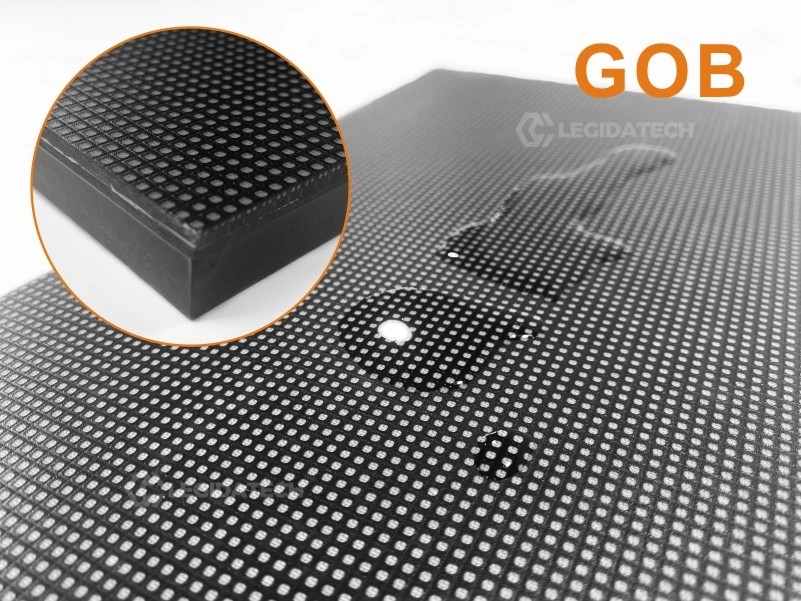
GOB is a transparent epoxy layer poured over the lamp face. On rental screens it is the difference between a module that shrugs off a trolley wheel and one that does not. The AF500 ships GOB as standard on all five indoor pitches P1.25 through P2.604 — exactly where the lamps are smallest and most exposed.
A camera shutter samples the wall in slices. If the panel refreshes too slowly, those slices catch the scan and you get banding. At 3840-7680 Hz the picture stays readable to a camera shutter, on the IMAG feed and on high-speed replays — a difference you notice on the first take rather than in post-production.
Yes. Outdoor pitches seal to IP65 on the front face and the rear cabinet both, so driving rain from the front and hose-down from behind both stay outside the housing.
The 8 kg weight, the four red-grip handles and the one-handed travel lock are all designed around single-person install, strike and maintenance. On very large walls two people simply work faster — but one is enough to build the screen.
Flight-case packing is built to your fleet specification, and the quantity of spare panels, cards and power boxes is set by how hard you run the stock. Give us that calendar and the spares ratio comes back sized to the work the fleet actually does.
Build Your Rental Fleet on the AF500 Platform
Thirteen pixel pitches, one 8 kg cabinet, a ±5° arc lock and 3840-7680 Hz refresh — priced factory-direct, with cases and spares scaled to the calendar you actually run.
Related Rental LED Display Resources
Buying a 500x500mm Rental LED Display: A Fleet Owner’s Guide
Walk the backstage area of any festival, or the loading bay of any exhibition hall, and you will see the same box coming off the truck over and over. The 500 × 500 mm cabinet did not win because a manufacturer decided it should. It won because it is the largest panel one person can handle comfortably and the smallest that still divides cleanly into the aspect ratios clients actually order.
This guide covers what that standard means on a real build, and how to buy a fleet that still earns in year three rather than only on delivery day.
1. Why 500 × 500 mm Became the Default
Three properties made this size stick, and none of them are about image quality.
Weight first. At 8 kg with modules fitted, the cabinet sits inside the range one adult can lift, carry and position repeatedly for hours. That single property removes a second crew member from the wall-building process — and crew is the largest variable cost on any load-in. A 500 × 500 mm wall is not just lighter than a large-panel alternative; it is lighter than the staffing model that large panels require.
Module geometry second. Modules are 250 × 250 mm, four to a cabinet. Common screen ratios — 4:3, 16:9, and the near-square shapes clients ask for at product launches — land close to whole cabinets, which means floors and ceilings rarely need custom cut headers or filler strips. Every filler panel is a part that only fits one job.
Part commonality third. Because the format is close to universal, replacement panels, cards and rigging hardware can be sourced in most markets you tour. The AF500 keeps that logic inside its own family too — it shares its locks, handles, modules and power boxes with the larger 500x1000mm rental LED display.
The 500 × 1000 mm cabinet exists to solve a different problem: it covers twice the area per lift, so a large flat backdrop goes up in half the cycles. The two sizes interlock vertically. Which is why the sensible unit of purchase for a rental business is not a screen — it is a fleet.
2. What’s Inside an AF500 Cabinet
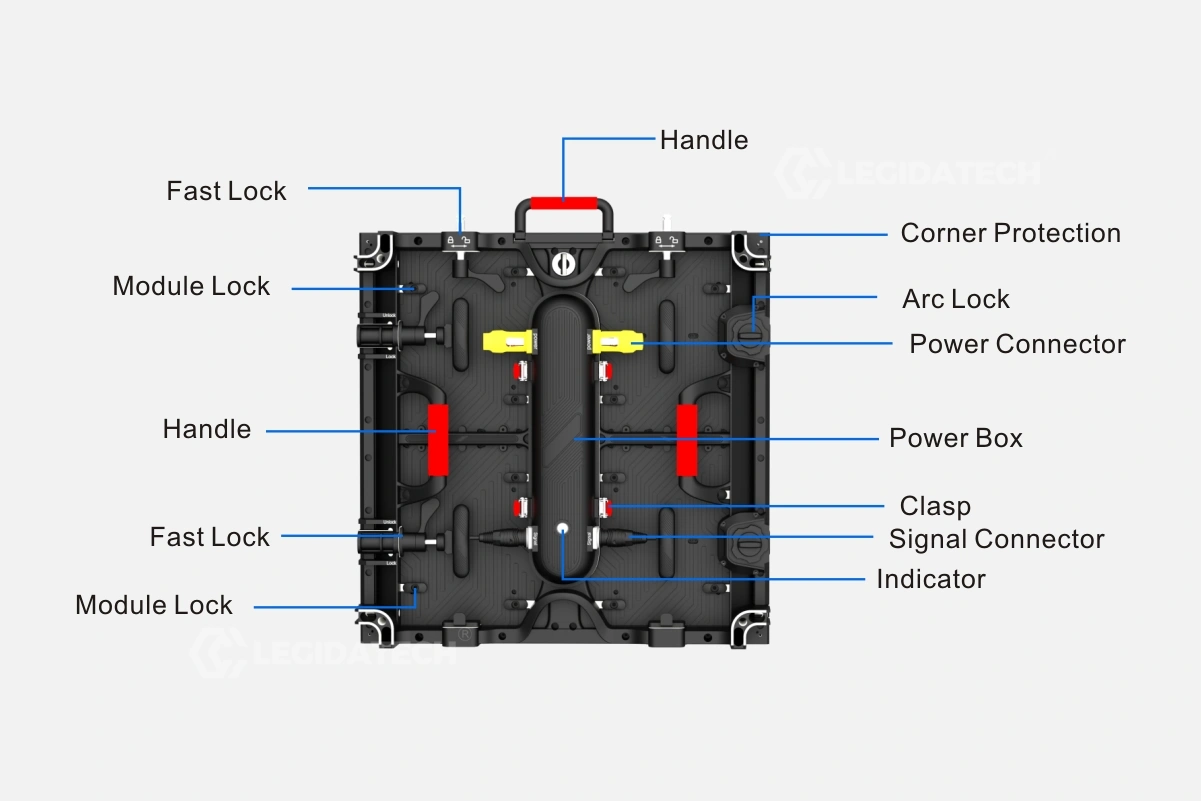
Take the rear cover off an AF500 and the commercial logic becomes visible.
The chassis is die-cast aluminum — not because it sounds impressive on a datasheet, but because it is simultaneously light enough to carry, stiff enough to stay flat, and dimensionally stable enough that cabinets from a batch produced six months apart still meet flush. That last property is the one rental houses underrate. A wall assembled from mixed production lots is the normal case, not the exception.
The locks are travel locks. They close by hand and pull the cabinet square against its neighbour as they do, so the wall tightens itself as it rises. Nobody has to shim a seam or chase a bulge down a row at 2 a.m.
Serviceability is where a rental cabinet either pays for itself or does not. Every module releases from the front on a quarter-turn fastener. Rear cover, receiving card and power box come away together as a single assembly. In practice that means a dead module gets swapped with the screen still hanging against a backdrop, and a whole power box gets changed from behind when there is room to walk back there. A panel back on the shelf the same day can be out earning again by the weekend.
3. Choosing the Right Pixel Pitch
Pitch is a viewing-distance decision. It is not a resolution contest, and buying finer than the room needs is the most common way rental buyers overspend.
Indoor, the AF500 range runs P1.25 to P4.81. P1.25 and P1.56 hold fine detail from 3 m — camera-close conference work and studio sets. P1.95 through P2.604 cover the 3-150 m band where most ballrooms and exhibition halls actually live. P2.976 and P3.91 stretch to 200 m for arena flanks.
Outdoor, the range runs P2.604 to P5.95, trading fine detail for the 4500-5000 nits and IP65 sealing that daylight and weather demand.
Two rules are worth writing into your purchasing policy. First, budget the pitch against the closest paying seat, not the furthest. Distance flatters a screen; proximity exposes it, and proximity is what clients photograph. Second, remember that all thirteen pitches ride on the same chassis. When your work shifts toward finer pitch, you buy module stock — not a new cabinet platform, and not a second spares inventory.
4. Weight, Rigging and Truck Planning
Do the transport arithmetic before you do the screen arithmetic.
A 48-cabinet wall — 12 m² — carries 384 kg of LED at 8 kg per panel. Two people move that in a morning. At 84 mm of depth per cabinet, forty of them occupy 3.36 m of case length in a single layer.
On the rigging side, three things need confirming with the venue before you arrive: the point loads your truss or ground-support frame will carry, the pin compatibility of the hanging frame with what the venue provides, and whether rear access exists at all — because the rear-service case is rare but it is never convenient. The AF500 hangs on lifting rigs and stacks on seat mounts using the same lock points, so one accessory kit covers both configurations.
5. Curves, Cylinders and One-Off Builds
This is where a 500 × 500 mm fleet separates itself from a flat-panel alternative.
The half-arc lock sits in the seam between cabinets and steps through -5°, -2.5°, 0°, +2.5° and +5°. The angle compounds along a row, so a run of panels at -2.5° produces a soft cove while a full -5° builds something noticeably tight. Positive settings wrap the wall away from the audience and around a stage corner. Cylinders and right-angle returns reuse the same positions.
The commercial point is not the curve. It is that the curved job and the flat job come out of the same flight cases. A warehouse full of curved-only cabinets that work eleven days a year is capital sitting still, and rental businesses are punished for capital that sits still.
6. GOB and the Physics of Rental Wear
Rental screens are not killed by electronics nearly as often as they are killed by abrasion. Trolley wheels. Case edges. Cleaning cloths. A guest who cannot resist touching the wall.
GOB is a transparent epoxy layer encapsulating the lamp face, and it is the reason a fine-pitch rental module can survive a season of that treatment. GOB comes as standard across the five indoor pitches P1.25 through P2.604 — the ones where lamps sit smallest and closest, and take the most punishment.
The cabinet layer adds its own armour: corner guards on all four edges and an anti-collision bump strip along the base. Between shows it is the cabinet that takes the punishment, not the wall.
7. Power, Refresh and Certification
Plan the electrical supply on 600 W/m² peak indoors and 800 W/m² outdoors, against an average draw of 200-300 W/m². Size the feed on peak — that is the figure the breaker responds to. The average is what the energy bill reflects.
The AC90-264V input range matters more than it looks. Venue power fluctuates, generators sag, and a cabinet that tolerates the full range rides through conditions that would trip a narrower supply mid-show.
Refresh runs 3840-7680 Hz on every pitch, alongside 15000:1 contrast and 12-16 bit gray scale — the combination broadcast shooters ask for by name. And the certification stack (CCC, CE, RoHS, FCC, CB, TUV, IEC) means EU and North American rental tenders clear without a round of re-testing.
8. A Pre-Purchase Checklist
Before signing for any 500x500mm rental LED display, put these eight questions in writing:
The AF500 series publishes all eight in the specification tables above.
Put plainly: few rental items re-let as reliably, or hold their value as well, as a 500 × 500 mm panel. A single chassis, thirteen pitches, and a wall that reshapes as quickly as the booking calendar turns. The AF500 builds that standard with 8 kg handling, a ±5° arc lock, GOB-protected fine pitches and a 7680 Hz camera-safe face.
Give us your pitch mix and the cabinets, flight cases and spares get sized around the shows you actually run — not around a generic warehouse scenario.