


500x1000mm LED Floor Tile Screen
One cabinet carries two 250×250 mm modules — so a 100 m² floor needs 200 cabinets instead of 400. Half the latches, half the cable runs, half the crew hours, and a lower cost per square meter. With an IP54-rated front face, this is the floor tile screen you can spec for outdoor plazas without apology.
✓ 22.5 kg per cabinet · ✓ IP54 front face · ✓ P1.56–P6.25 · ✓ CE / FCC / CCC · ✓ 3-year warranty
What Is a 500x1000mm LED Floor Tile Screen?
A 500x1000mm LED floor tile screen is a walkable LED video floor built from rectangular cabinets that each measure 500 mm wide, 1000 mm long and 77 mm thick. Each cabinet carries two standard 250×250 mm LED modules side by side, so the floor assembles from twice fewer units than a build based on square 500×500 mm tiles. The cabinet body is stamped sheet metal with a matte black powder-coated finish, and the walkable surface is a load-bearing anti-slip mask rated for 1.5–2.0 tonnes per square meter.
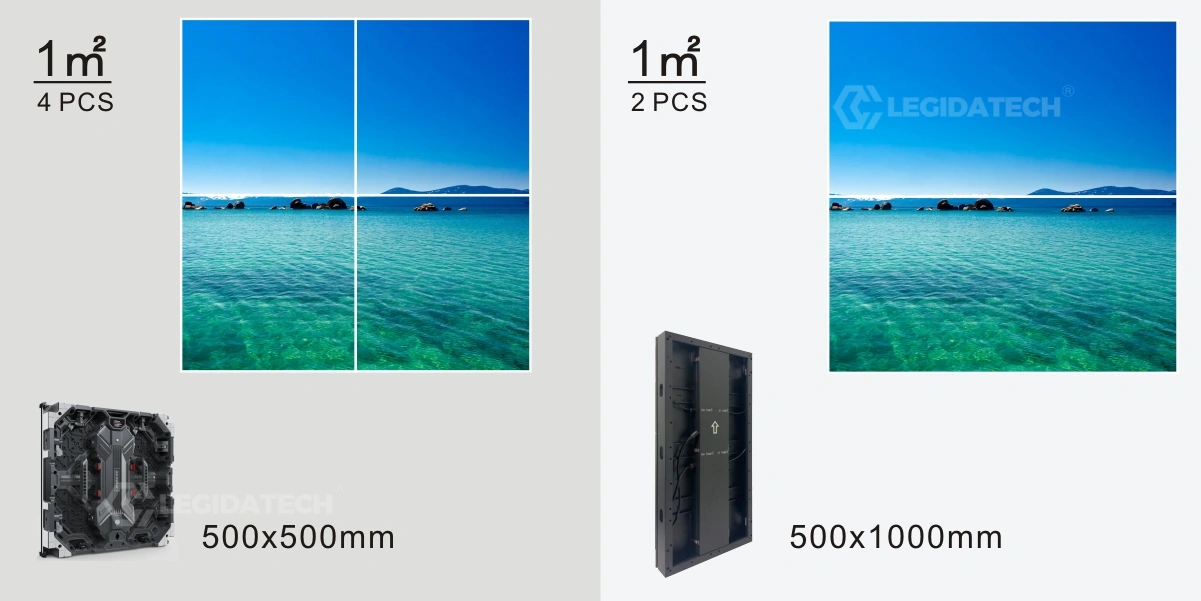
Mechanically, the format matters more than the millimeters. LED floors are assembled one cabinet at a time: place, align, latch, connect power and signal, repeat. Every cabinet you eliminate removes four operations from that cycle. A 100 m² floor at P3.91 needs 200 of these cabinets instead of 400 square tiles — the same LED area and resolution, but half the alignment checks, half the connectors, half the receiving cards, and roughly half the installation labor. That arithmetic is why event companies and exhibition contractors increasingly ask for the 500×1000 format by name.
The 500×1000 mm cabinet is one of the standard LED dance floor sizes recognized across the industry — alongside the 500×500 mm tile and the 1000×1000 mm panel. Seven pixel pitches from P1.56 to P6.25 share the same cabinet, so the format covers everything from a museum floor viewed at arm’s length to a city plaza read from across the street. If you are comparing formats, our 500x500mm floor tile screen page covers the close-viewing square-tile version in depth.
500x1000mm LED Floor Tile Screen Installation Economics: Half the Cabinets, Half the Labor
Nobody buys a 500x1000mm LED floor tile screen one cabinet at a time — but everybody installs it that way. The honest way to compare cabinet formats is to price out a fixed area and count the operations. Here is a 100 m² floor at P3.91, built two ways:
One honesty note: the weight per square meter barely changes — roughly 45 kg/m² either way, because the LED area is the same. What changes is the number of operations. Fewer units means fewer chances to misalign a seam, fewer connectors that can work loose on tour, fewer receiving cards to map, and half the latch cycles for the same floor. On a rental fleet that turns over every week, those saved hours compound across every booking of the season.
The same logic hits your quote: with fewer cabinets, power supplies and receiving cards per square meter, factory cost per m² drops — which is why the 500×1000 format typically prices below the equivalent 500×500 configuration at the same pixel pitch.
The Sheet-Metal Craft Behind the 500x1000mm LED Floor Tile Screen
A 500x1000mm LED floor display lives a harder life than wall screens — it gets stood on, wheeled over, mopped and re-latched at every event. The cabinet body is stamped from one piece of sheet steel, then finished in matte black powder coating that hides scuffs and reads as a clean dark seam line between tiles. Stamp-and-fold construction has a practical advantage for floor use: the cabinet walls act as one continuous structure, so the cabinet resists the twisting that makes seams separate on cheaper multi-part enclosures.
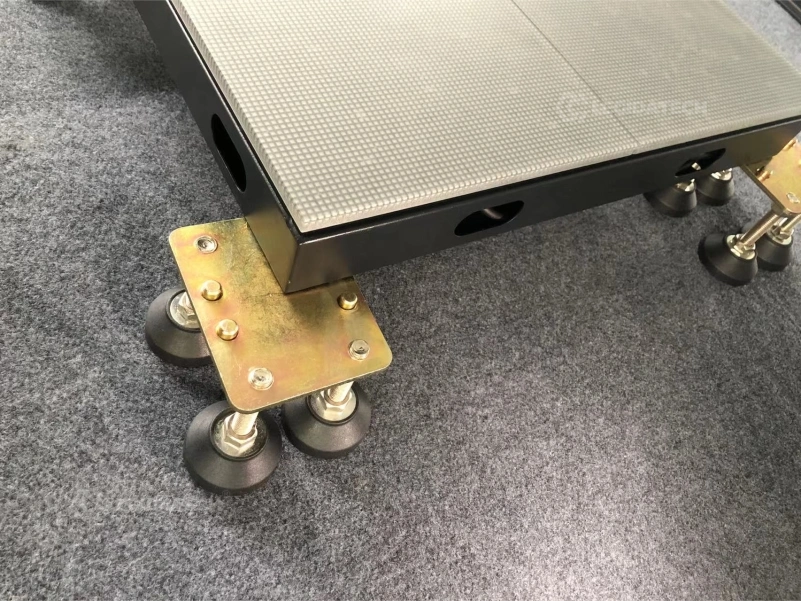
Turn a cabinet over and the details are on the floor side. Each corner carries a gold-toned foot plate with a black rubber adjustable foot — screw the foot up or down to level the cabinet on uneven ground, and the rubber pad grips and absorbs impact. The feet carry the cabinet weight directly into the floor, so the panel surface itself takes no structural load; weight transfers foot-by-foot, which is what keeps a walkable surface flat after hundreds of tramples.
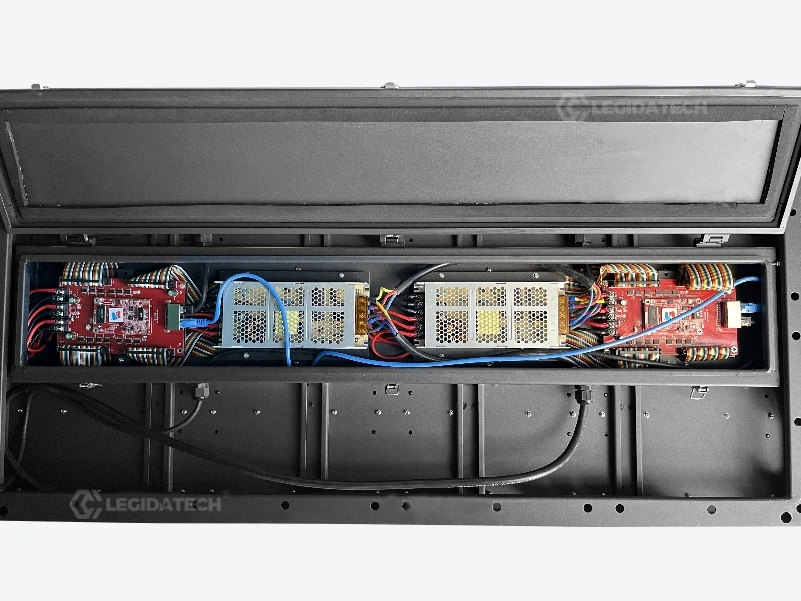
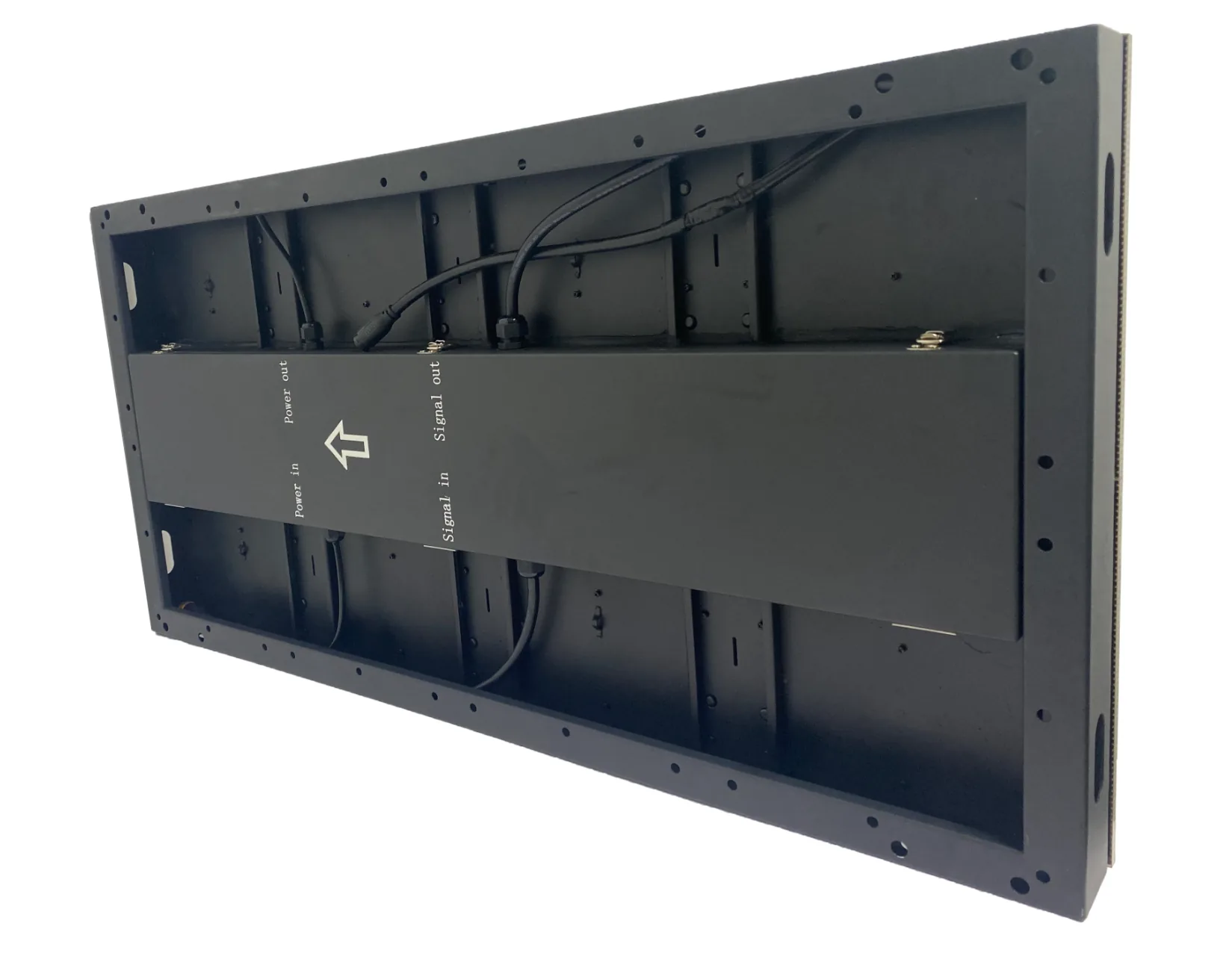
At the rear, a central cable channel runs the length of the cabinet with power and signal in/out ports at both ends. Cables stay inside the cabinet footprint, so nothing sticks up to catch a toe or snag when the next cabinet slides into place — a small detail that speeds up assembly and protects the connectors at the same time.
500x1000mm LED Floor Tile Screen Outdoor Use, Stated Honestly
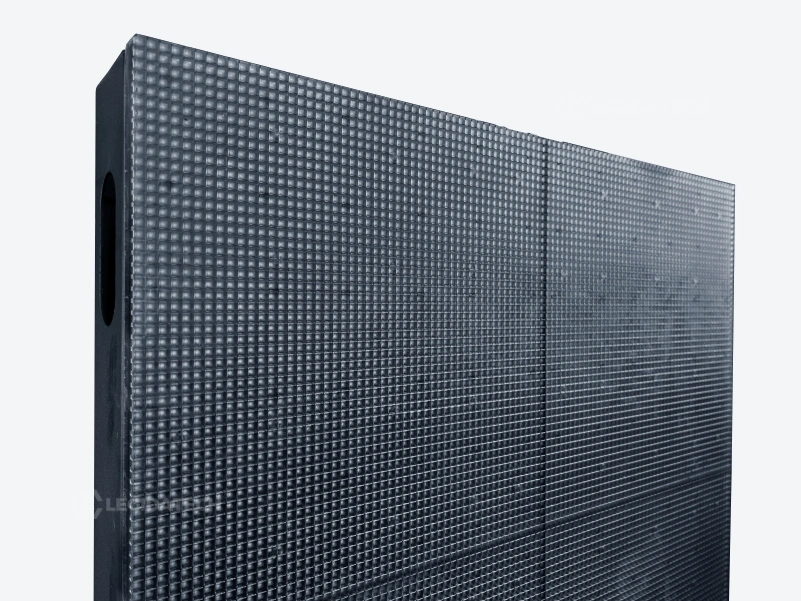
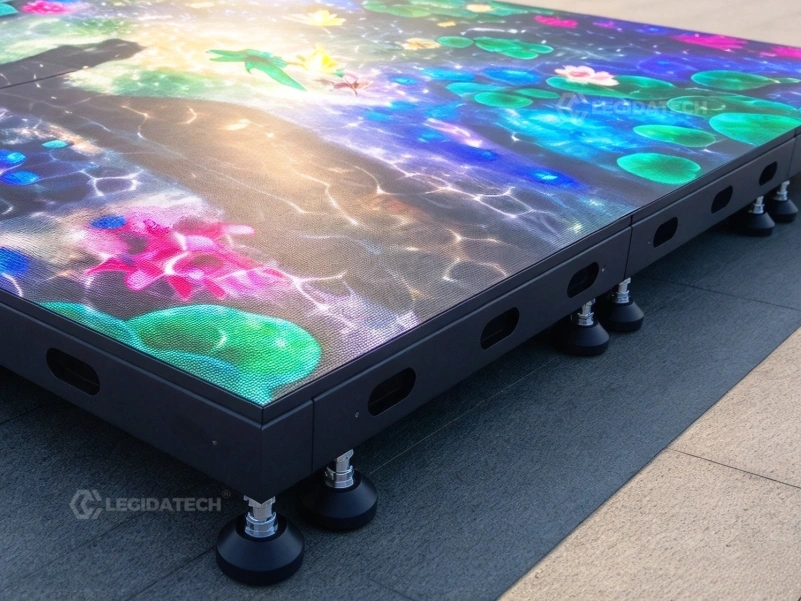
Most LED floor screens quietly avoid the outdoor question. This one, the outdoor LED floor tile screen of the family, answers it with numbers. The front face is sealed to IP54 — protected against dust ingress and water splash from any direction — and the rear of the cabinet carries IP53. In plain terms: rain, sprinklers and hosed-down cleaning are fine; the floor is not a swimming pool. That makes it a genuine outdoor floor for plazas, building entrances and covered event spaces, not a bathroom fixture.
The honest boundaries matter as much as the numbers, so here they are:
Seams are where floors fail outdoors, so the cabinet edges are machined to a tight tolerance and the mask sits flush with the frame. Where a floor meets the weather, we recommend planning a slight grade or drainage gap beneath the structure so washing water has somewhere to go — the same practice any outdoor floor specifier follows.
Optional Interactive Sensing on the 500x1000mm LED Floor Tile Screen
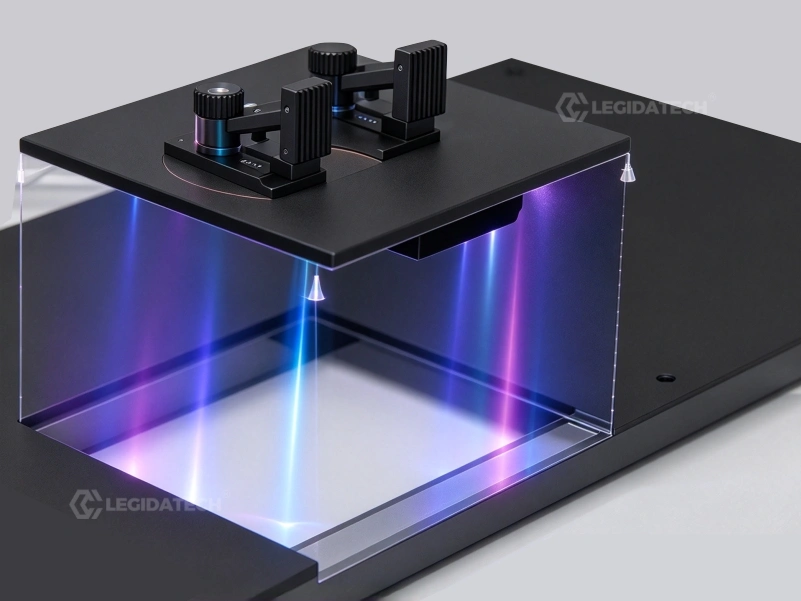
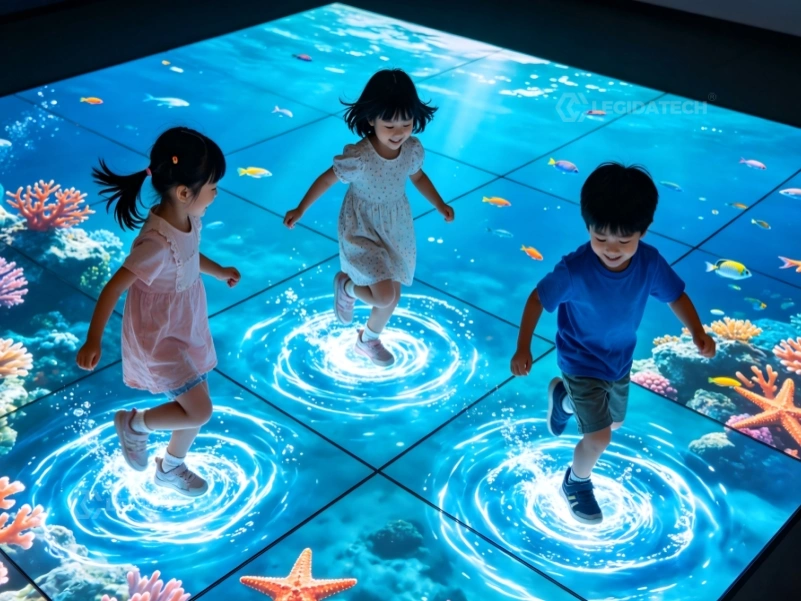
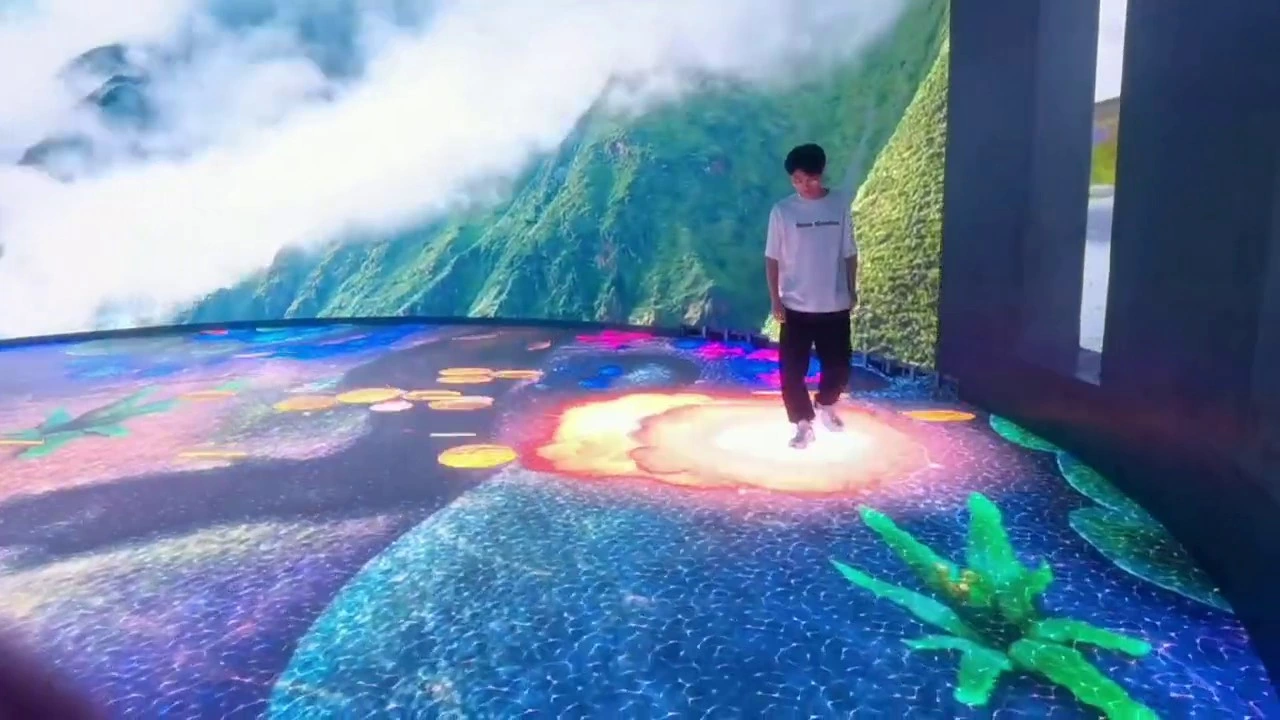
The same cabinet is available as a sensing floor. Add the optional laser or light-magnetic sensor kit and the 500x1000mm cabinet becomes an interactive LED floor screen that tracks footsteps in real time: ripples spread from each step, petals bloom underfoot, fish scatter across a virtual pond. Sensors read position and pressure timing and feed the media server, so content reacts to where people walk — not just whether they walk.
Laser sensing is the robust choice for public installations: it is a non-contact measurement from above the surface, so it keeps working under stage lighting and in daylight plazas where touch-based sensor layers wear out. The sensing hardware is integrated at the factory, which keeps the walkable surface smooth and the IP rating of the front face intact.
If your projects live on stage — nightclubs, concerts, brand activations with heavy interactivity — it is worth stepping up to our dedicated 500x500mm interactive LED dance floor, the flagship sensing version with millisecond-class laser tracking and an award-winning die-cast cabinet. For plaza wayfinding, museum floors and mall activations, this panel’s optional kit covers the brief at a friendlier number.
500x1000mm LED Floor Tile Screen Specifications
Seven pixel pitches share the same 500×1000×77 mm cabinet. Each cabinet carries two 250×250 mm modules arranged in a 2×4 grid, so cabinet resolution is exactly double the module resolution in height. Choose by nearest viewing distance: P1.56 for retail floors viewed at arm’s length, P2.6–P3.91 for exhibitions and events, P5.2–P6.25 for plazas and large outdoor floors.
Refresh rate: 1920 Hz standard, 3840 Hz optional. Brightness adjustable across the full range; use 3500–4000 nits for open-air daylight plazas.
Which Pixel Pitch for Which Viewing Distance?
Pitch should be chosen by how close people get to the floor, not by how sharp the demo looks in a showroom. Minimum comfortable viewing distances for this series:
500x1000mm LED Floor Tile Screen Installation: Three Ways, All Tool-Free
Every mounting option on this cabinet locks together without a single screwdriver. Latches pull adjacent cabinets flush, power and signal daisy-chain through the rear channel, and leveling happens at the feet. Pick the method that matches your venue:
1 · Adjustable feet on flat ground
Lay cabinets directly on a level surface, set the height with the rubber adjustable feet, latch and go. No pit, no rails — the fastest option for event floors and temporary installs.
2 · Rail system
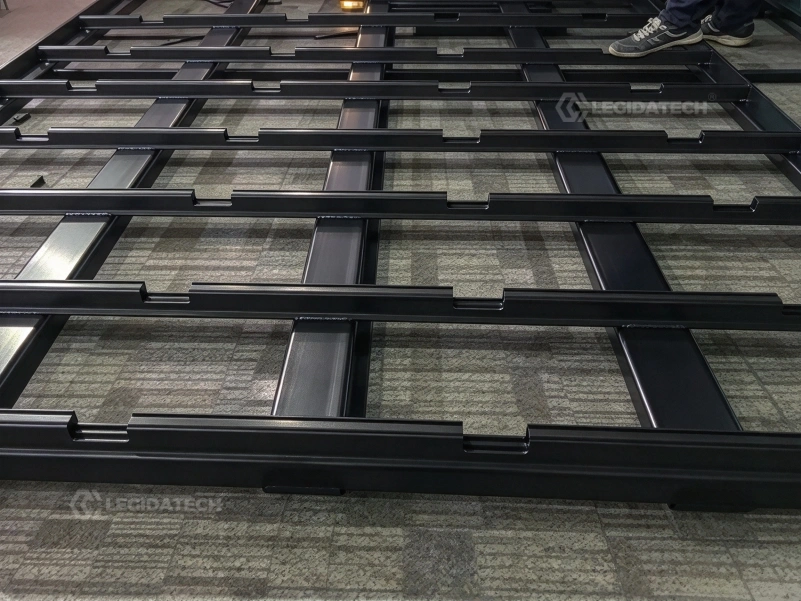
Pre-installed guide rails carry each cabinet row into perfect alignment — 95 mm rail height for the COD mask option, 99 mm for PC. Rails keep seams dead-flat across a large floor and speed up re-installation at repeat venues.
3 · Steel foundation pit
For permanent plazas and atriums, embed a shallow steel structure (typically 300–650 mm deep with a service sump) so the floor sits flush with the surrounding surface and cables service from below.
How long does it really take? A two-person crew assembles a 100 m² floor in 6–8 hours with the rail or feet method — including power and signal routing and a full-image test. The same crew needs 12–16 hours on a 400-cabinet 500×500 build, which is the core of the installation economics above.
Where a 500x1000mm LED Floor Tile Screen Earns Its Keep
The rectangular cabinet and the outdoor rating open scenarios that square indoor tiles cannot serve. A few we build for most often:
Outdoor plazas & entrances
IP54 front face, anti-slip surface and 4000-nit capability keep the floor alive through weather, daylight and foot traffic.
Event & wedding dance floors
200 cabinets instead of 400 means the crew finishes before the banquet manager finishes the table settings — and packs out just as fast.
Exhibition booth floors
Move-in windows are measured in hours. A booth floor that assembles in the morning leaves the afternoon for everything else.
Mall atriums
P1.95–P2.97 close-viewing pitches under a glass roof, with front-service modules so the floor never closes for a repair.
Media facade extension
The same cabinet mounts vertically as a simple facade screen, so a ground floor and the wall behind it can share one system and one visual language.
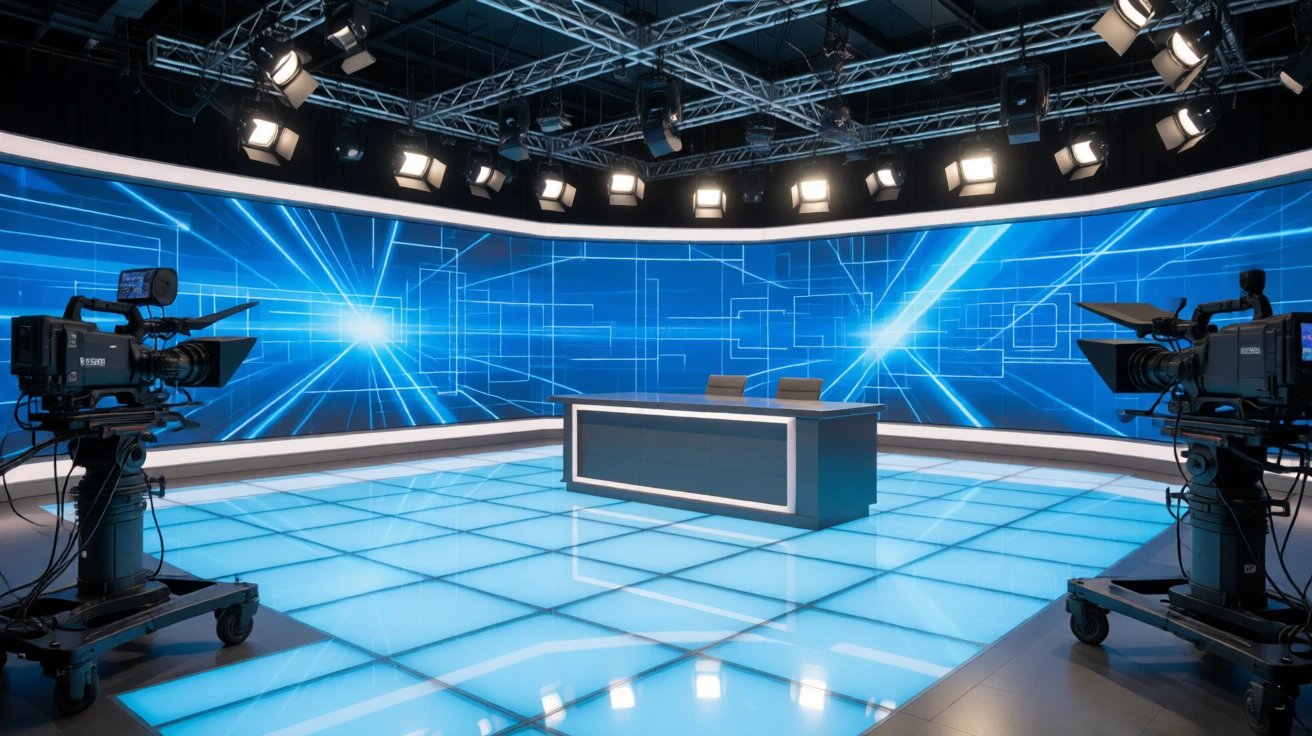
Broadcast & studio floors
3840 Hz refresh (optional) and a matte anti-glare surface keep cameras clean — no scan lines, no hotspots under studio lighting.
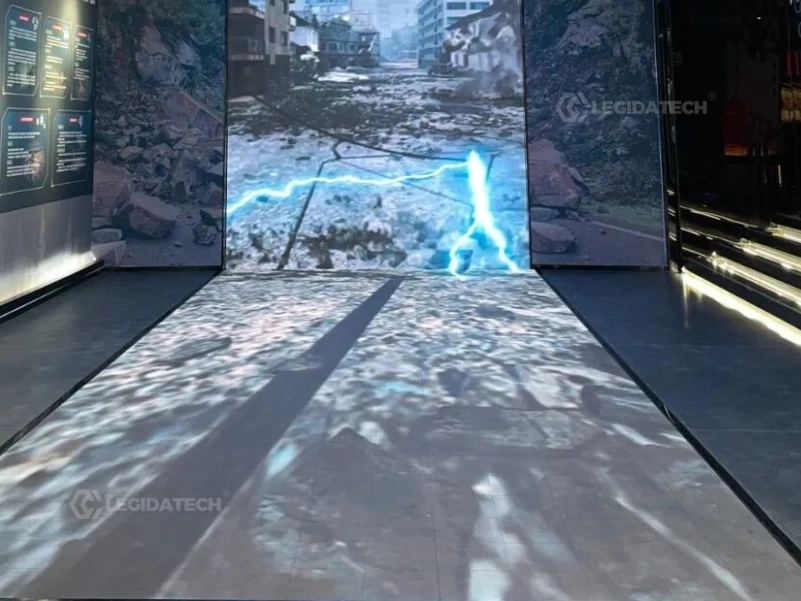
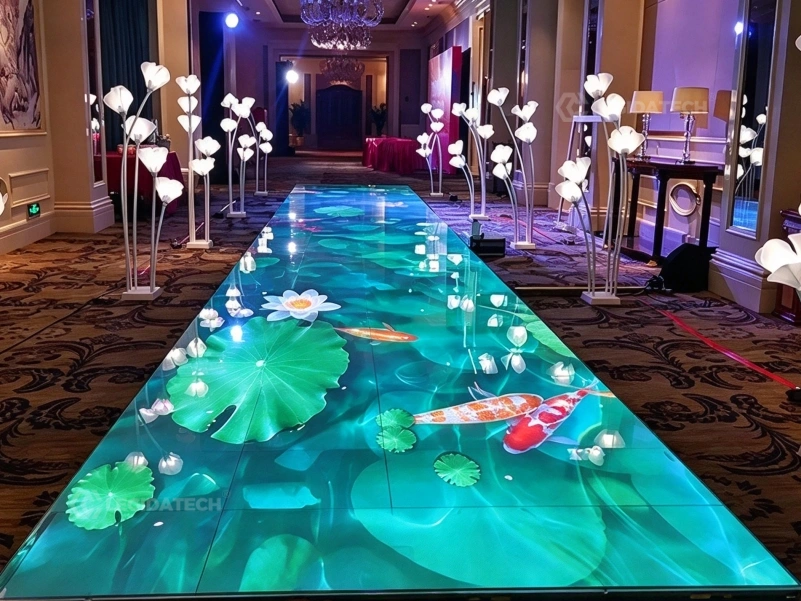
Recent 500x1000mm LED Floor Tile Screen Projects
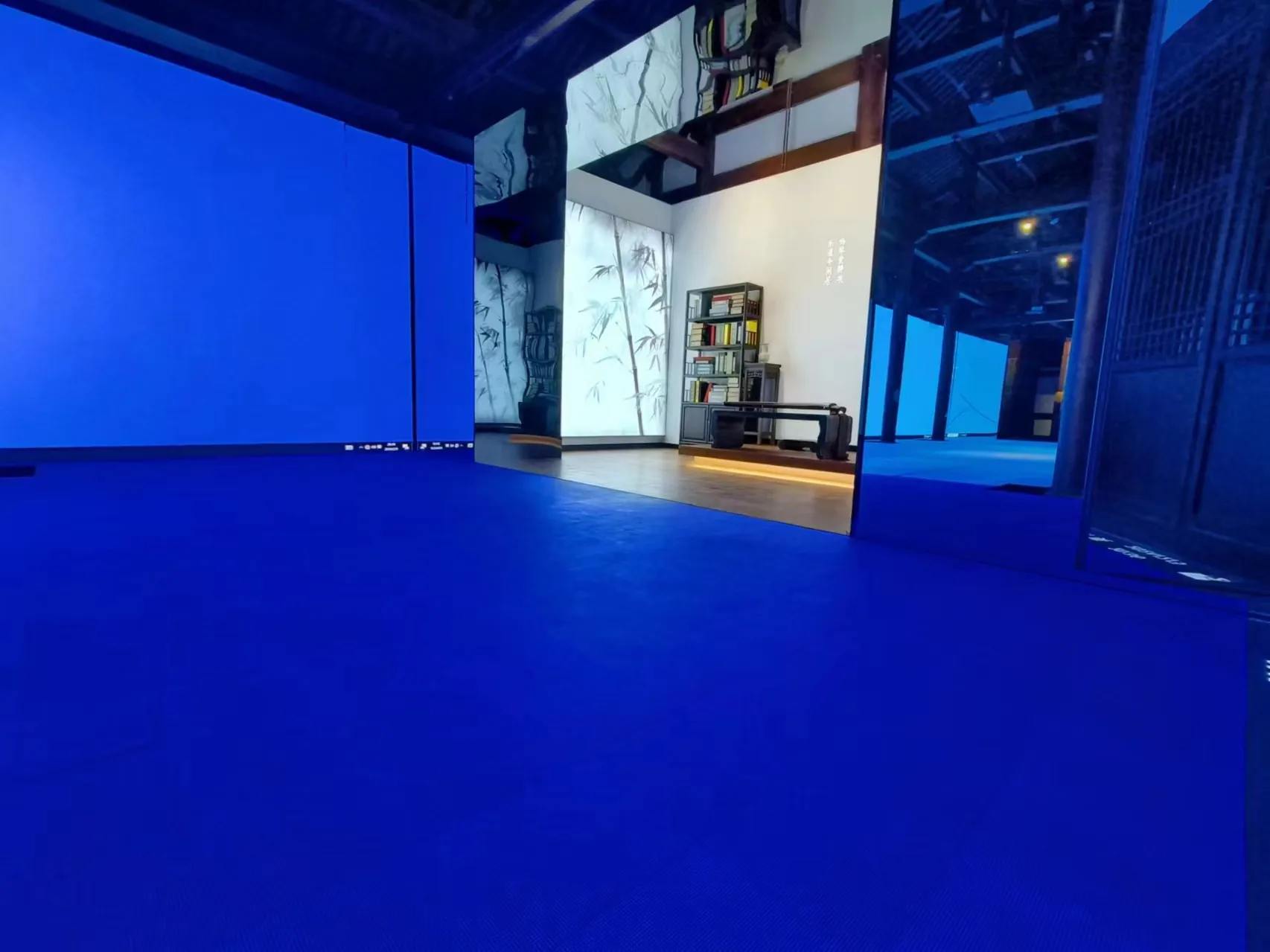
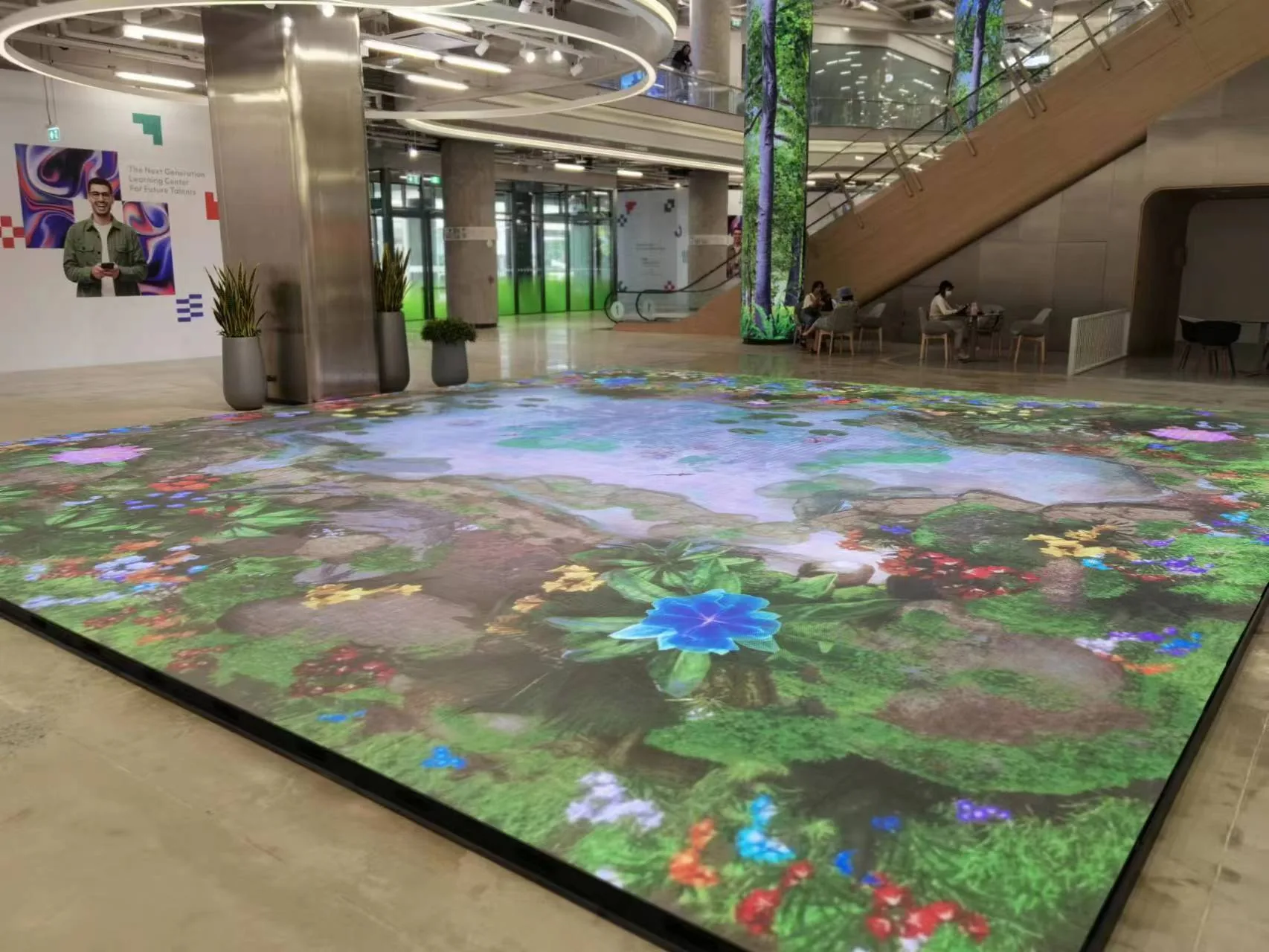
Floor screens from this production line run daily in malls, plazas and broadcast venues. Four recent projects, with the numbers that matter — location, area, pixel pitch:
Who Is the 500x1000mm LED Floor Tile Screen Built For?
Tell us what you do — this screen was built for you.
You run an event production company.
Every event has a load-in window and a crew clock that starts billing the moment the truck doors open. Your floors have to look like a million dollars and assemble like stage risers.
That is exactly what this screen is built for. Half the cabinets means half the load-in hours on every booking — and at 22.5 kg, a cabinet two of your technicians can place without machinery.
You are an exhibition contractor.
Halls give you a move-in slot measured in hours, not days. A floor that eats your whole build window puts every other booth task behind schedule.
That is exactly what this screen is built for. A 100 m² booth floor assembles in half a day with a two-person crew, tool-free — and flies apart just as fast when the show closes.
You own an LED sign company adding floor products.
You sell and install LED displays already, and customers keep asking about floors. You want a first floor product that protects your margin while you learn the category.
That is exactly what this screen is built for. The sheet-metal cost structure prices below die-cast rivals at the same spec, so your first floor project carries a healthy margin — and the standardized cabinet keeps spares and training simple. See the wider dance floor series for the full product ladder.
You operate outdoor plazas or media surfaces.
Your surface faces weather, daylight and thousands of footsteps — and most “indoor-only” floor screens quietly fail that spec sheet.
That is exactly what this screen is built for. An IP54 front face, anti-slip mask and 0–40 ℃ operating window are printed in the table above, not buried in a footnote.
You are an AV rental company.
Your margin lives in turnover: check-in, check-out, truck-pack, and the attrition you eat when mixed cabinet stock goes missing between jobs.
That is exactly what this screen is built for. One large cabinet type means faster counts, simpler truck-packs and fewer SKUs to lose — plus the outdoor rating that gets your floor booked for summer events too.
Where the 500x1000mm LED Floor Tile Screen Wins, Country by Country
LEGIDATECH builds floor screens in Shenzhen and ships them to event, retail and broadcast buyers across Europe, North America, the Middle East and Southeast Asia. Three markets where this specific cabinet keeps winning:
The U.S. trade-show and event market bills labor by the hour, so the installation economics translate directly into your quote: half the cabinets is half the union crew time on every load-in.
Logistics favor the format too — cabinets pack cleanly onto standard 2.4 m × 1.2 m pallets, and our CE/FCC documentation clears venue compliance reviews without friction.
Outdoor plazas, Ramadan activations and National Day events run at night in 25–40 ℃ heat — conditions inside this cabinet’s 0–40 ℃ window with no low-temperature worries.
Brightness up to 4000 nits holds the image against ambient plaza lighting, and the IP54 front face takes the dust and evening humidity in stride.
Mall atrium and government plaza projects here are budget-sensitive — the sheet-metal cost structure wins the same spec for less, which is how our quotes survive head-to-head bids.
Tropical coastal humidity sits inside the 35–85% RH design range, and front-service modules mean the floor keeps running through monsoon season without closing the atrium.
How Much Does a 500x1000mm LED Floor Tile Screen Cost?
Factory-direct pricing for a 500x1000mm floor tile screen typically runs $500 – $1,200 per square meter, depending on configuration. Any supplier who quotes you instantly, before asking what the floor is for, is quoting a guess. Five factors move the number:
- Pixel pitch — P1.56 carries roughly 16× the LED count of P6.25 per m²; pitch is the single biggest cost driver.
- Interactivity — the optional laser/light-magnetic sensing kit and media server add a defined line item; non-interactive floors skip it entirely.
- Refresh rate — 3840 Hz for broadcast or camera-heavy venues is an upgrade over the 1920 Hz standard.
- Mask option — COD or PC surface choice affects both price and rail height (95 mm vs 99 mm).
- Structure & logistics — pit steel, rails or feet, flight cases and freight depend on the venue and order size.
What a Complete Floor System Includes
When you request a quote, ask for it “turnkey” — a complete package for a 20 m² event floor looks like this, and every line is itemized in our offers:
- 40 floor cabinets (500×1000mm) with anti-slip mask and adjustable feet
- Receiving cards + LED controller sized to the cabinet count, pre-mapped before shipment
- Power distribution — sequenced power boxes and phase-split cabling plan
- Rails or steel supports per your mounting method, with the matching 95/99 mm rail heights
- 2 spare modules (5%) plus suction tool and spare latch set, brightness-matched to the batch
- Flight cases — one case carries multiple cabinets with dividers for tour transport
- Cabling kit — power and signal daisy chains cut to your floor plan
- Optional: interactive sensing kit, media server and custom content for ripple/game effects
💡 The buy-vs-rent math: renting an interactive floor runs a meaningful fraction of purchase price per event. If your calendar books the floor six or more times a year, ownership usually pays for itself within the first season — and a 500×1000 fleet reaches break-even faster than a 500×500 fleet, because every install and tear-down between bookings costs half the labor. Ask us for the per-event numbers with your city’s freight and crew rates; the spreadsheet is short and we will send it with the quote.
500x1000mm LED Floor Tile Screen vs 500x500mm: Which Cabinet Should You Choose?
Both formats share the same modules, the same pitches and the same factory. The difference is what happens at install time — and what your floor plan asks the cabinets to do:
Rule of thumb: if the floor is big, rectangular, budget-driven or outdoorsy, choose 500×1000. If it is small, shaped or viewed at arm’s length, choose the 500×500 tile — our 500x500mm floor tile screen page covers that format in full. Many fleets carry both: squares for bespoke retail builds, rectangles for event volume.
And if your project is a fixed installation that doubles as a vertical surface — floor plus wall in one system — see our reinforced 500×1000mm interactive floor system, built around the same footprint for more stable, flatter long-term joints.
Keeping the 500x1000mm LED Floor Tile Screen Running: Front-Service Maintenance
A floor you cannot service is a floor you close for repairs. Every module on this cabinet comes out through the front, magnetically, without tools: lift the module with the suction tool, disconnect the short pigtail, seat the replacement, and the magnets pull it flush. A walking surface that held 132 m² in Guiyang stays open while one module swaps in under a minute.
Order 5% spare modules with the floor. Spares bought with the batch match brightness and color bin exactly — a spare ordered two years later will not, and mismatched bins are visible on a floor long before they would be on a wall.
Every 500 operating hours, run the short checklist: inspect seams for alignment drift, verify connector seating along the rear channel, wipe the anti-slip mask with a neutral cleaner, and check that adjustable feet still sit tight. Fifteen minutes per 100 m² keeps a floor flat and consistent for its ≥100,000-hour design life.
500x1000mm LED Floor Tile Screen — FAQ
How much does a 500x1000mm LED floor tile screen cost per square meter?
Factory-direct pricing typically runs $500–$1,200 per m² depending on pixel pitch, interactivity, refresh rate and mask option. Pixel pitch is the biggest driver. Send your floor size and application for a quote within 24 hours.
Why choose 500x1000mm over 500x500mm cabinets?
Half the cabinets per m² means half the latches, connectors and crew hours — and a lower price per square meter at the same pitch. Choose 500×500 only when you need creative shapes or one-person carrying. The full comparison is in the table above.
Can it be installed outdoors?
Yes, within stated limits: the front face is IP54 (rain and splash rated) and the rear IP53, operating at 0–40 ℃. It suits plazas, entrances and covered venues; plan drainage beneath permanent open-air floors and avoid standing water above the seam line.
How many cabinets per 100 m² and how long does installation take?
100 m² uses 200 cabinets at any pitch. A two-person crew installs a 100 m² floor in 6–8 hours with the feet or rail method, including cabling and a full-image test — roughly half the time of a 400-cabinet 500×500 build.
Is it interactive?
Interactivity is optional: an integrated laser or light-magnetic sensing kit tracks footsteps and drives ripple, petal and game content through the media server. For stage-grade sensing with millisecond-class response, see our dedicated 500x500mm interactive LED dance floor.
What maintenance does it need?
Modules swap magnetically through the front without tools in about a minute. Order 5% spare modules with the batch, and every 500 hours check seams, connectors, mask cleanliness and foot tightness — about 15 minutes per 100 m².
How heavy is one cabinet — can two people carry it?
Each cabinet weighs 22.5 kg with side handles, a comfortable two-person lift — no forklift or suction rigging needed. Per square meter the floor weighs about the same as a 500×500 build; the difference is half the lifting operations.
What is the lead time, warranty and certification?
Typical lead time is 15–25 working days depending on quantity and configuration. Every floor ships with CE, FCC and CCC certification and a 3-year warranty, plus 5% spare modules and lifetime remote technical support.
Send Your 500x1000mm LED Floor Tile Screen Inquiry Today
Send your floor dimensions, venue type and target pixel pitch — a floor layout drawing, a configuration list and a factory-direct quote come back within 24 hours. Shenzhen factory direct, no middleman margin.