


960x960mm Stadium LED Display — ST960 Series Outdoor Perimeter LED Screen
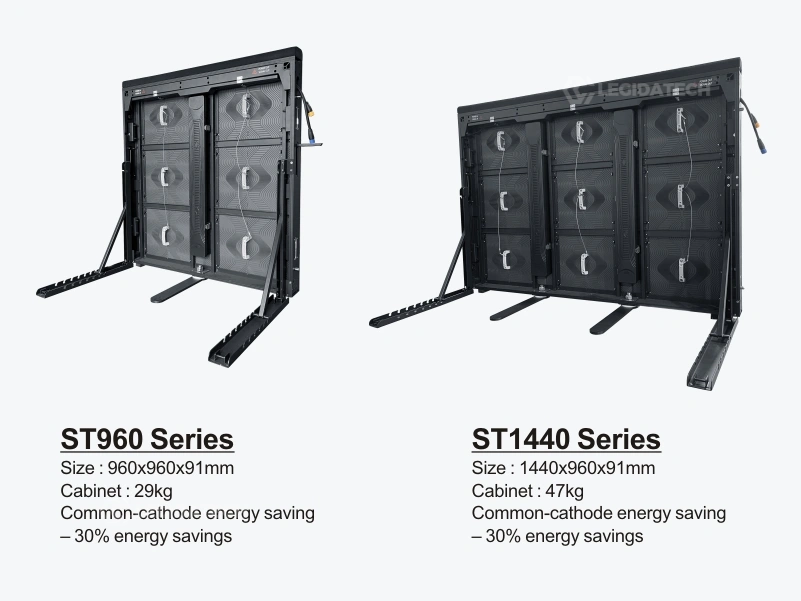
A stadium LED display built on the 960x960mm industry-standard cabinet is the smartest perimeter investment for football stadiums, basketball arenas and multi-sport venues. LEGIDATECH builds the ST960 Series with a 29 kg full die-casting aluminum cabinet (91 mm thin), IP66 front-and-rear sealing, 3840 Hz broadcast-grade refresh at 6500+ nits, and Common Cathode technology that cuts electricity use by more than 30% — plus a soft EVA foam top and rubber mask that meet pitchside athlete safety requirements. Quoted factory-direct with engineering drawings before production.
✓ 960×960 mm standard cabinet
✓ P8 / SMD 2727
✓ Front & rear service
✓ 90°–120° adjustable tilt
✓ 5-year warranty
What Is a Stadium LED Display?
A stadium LED display is an outdoor perimeter screen that runs sponsor branding, live match content and event information along the edges of sports fields. The ST960 uses the 960x960mm cabinet — the most widely used standard size in the outdoor LED screen industry — so venue layouts can be planned around standard parts, not custom fabrication.
The ST960 is P8 (8 mm pixel pitch). Most spectators in the stands sit 8 meters or more from the field edge, and at that distance P8 produces a sharp, clean image that broadcast cameras read without flicker — one reason P8 is the most common pitch for professional sports venues. The cabinet family also scales to the ST1440 (1440×960 mm, 47 kg) when a wider segment is needed.
It is part of the complete outdoor LED display range from LEGIDATECH, a Shenzhen factory-direct manufacturer that ships engineering drawings before production.
ST960 Series product demo — 960x960mm perimeter screen
ST960 Series at a Glance
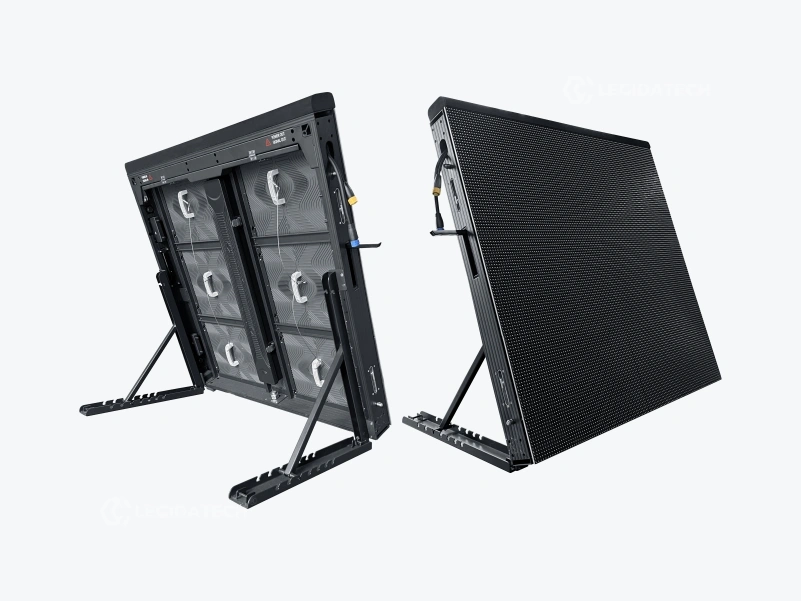
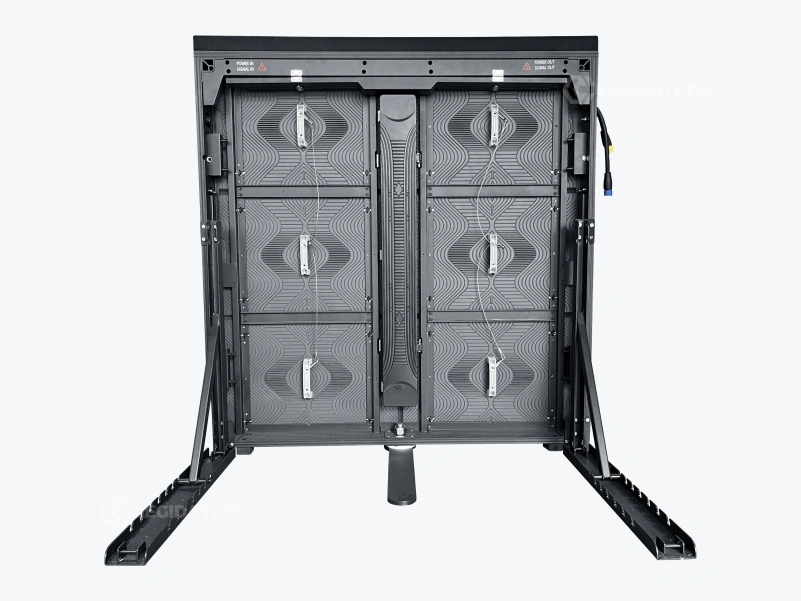
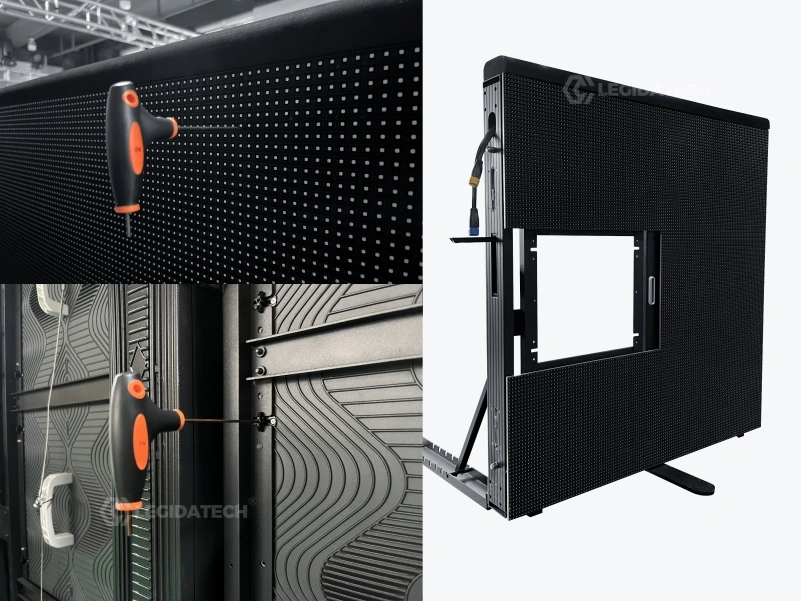
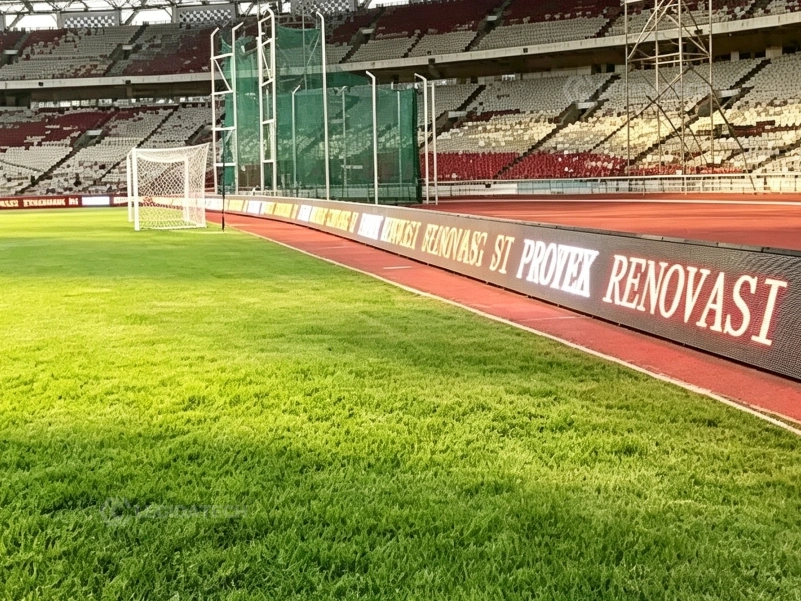
From raw cabinet to pitchside perimeter — real photos of the ST960 in the field.
960x960mm Standard Cabinet — Easy to Configure, No Custom Parts
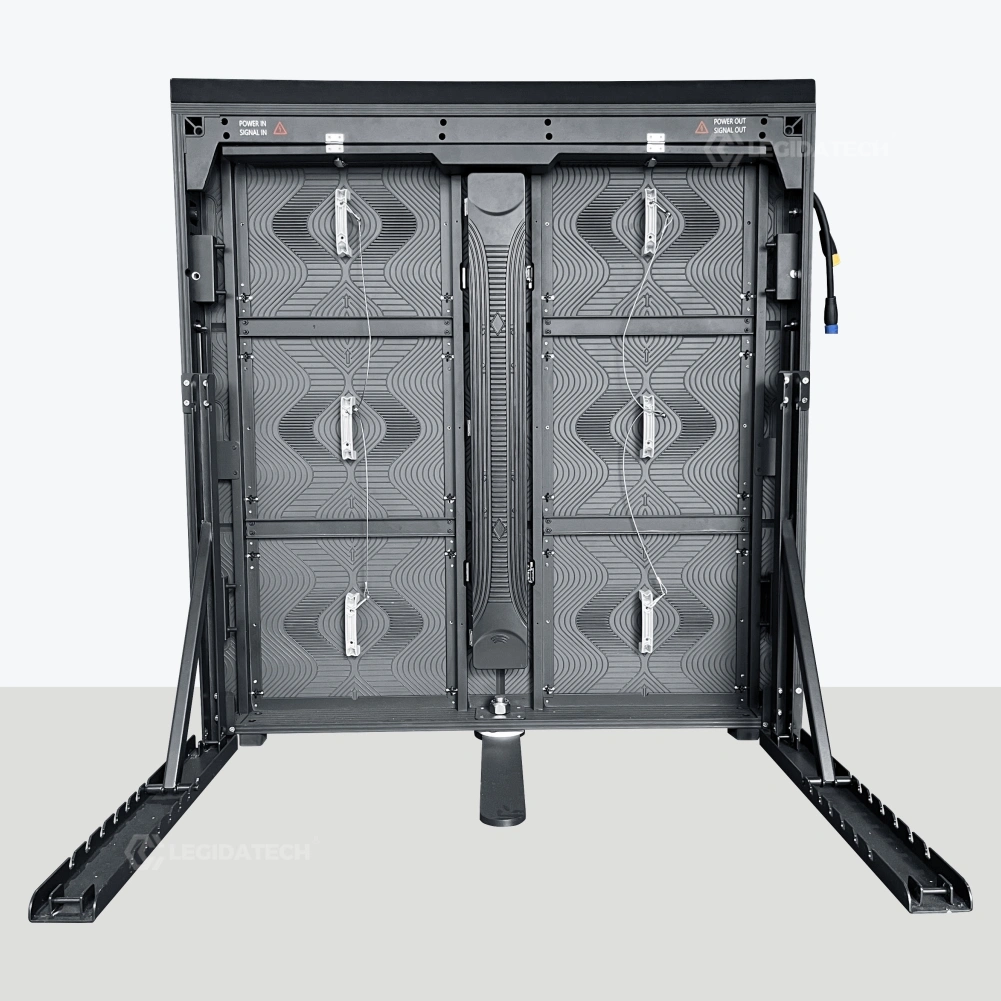
The ST960 uses a 960x960mm cabinet with full die-casting aluminum construction — 29 kg per cabinet and only 91 mm thick. The compact format is easier to transport, store and install in venues with limited perimeter space.
Cabinets tile evenly in both directions, so any screen length can be built from standard units — a short courtside run or a full stadium perimeter — without cutting or custom accessories. Sourcing spares and planning layouts both stay simple.
The same family is also offered as a 960x960mm outdoor advertising screen for billboard networks — see the 960x960mm outdoor advertising screen series for that configuration.
ST960 Series Key Features
Engineered around the four costs that matter at a stadium: energy, maintenance, safety and broadcast quality.
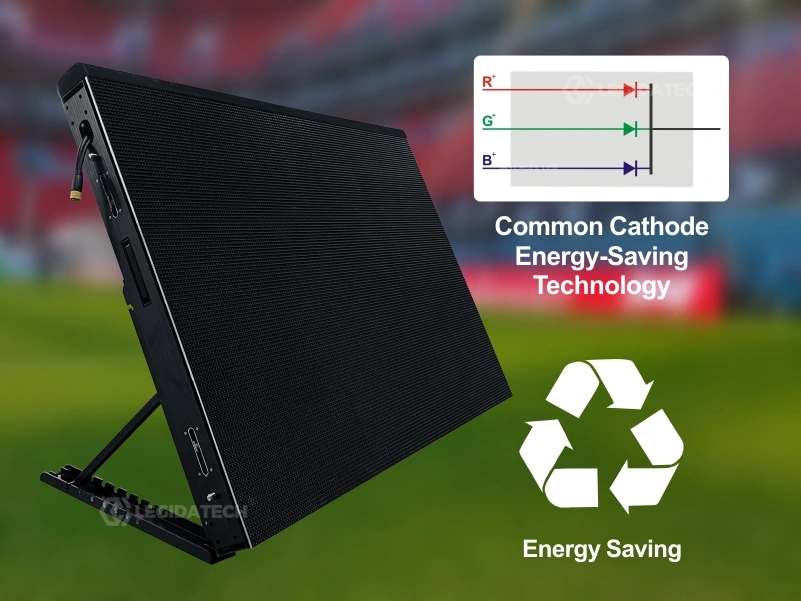
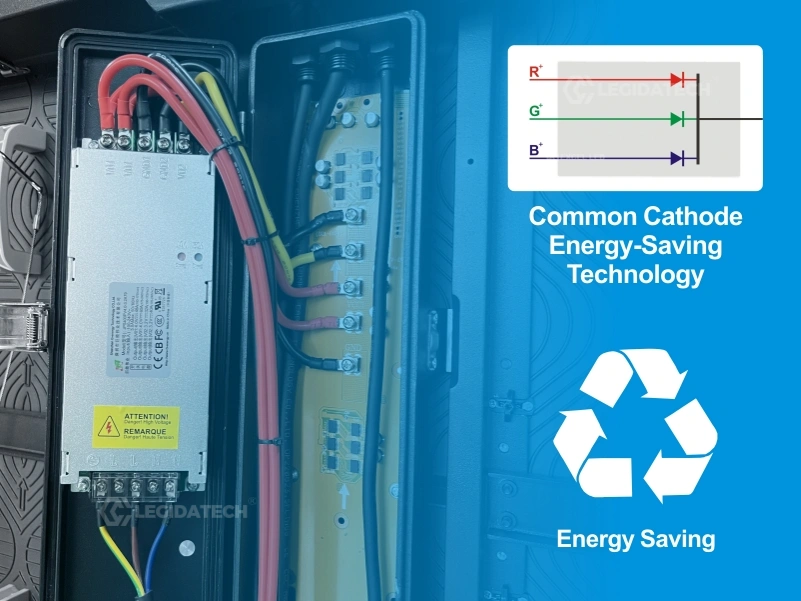
Each LED color channel receives its own voltage, cutting power use by over 30% versus standard designs and running the screen about 15°C cooler — less stress on LEDs, longer service life, lower season-long electricity bills.
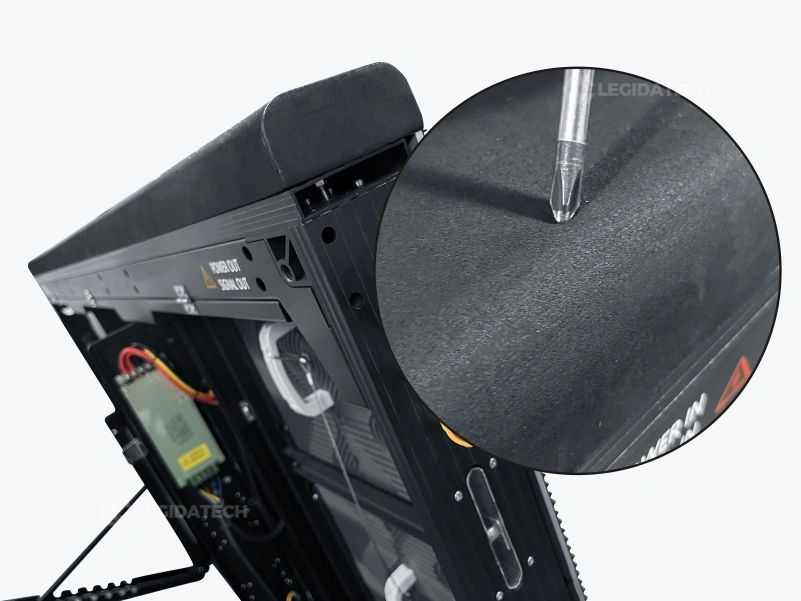
The top edge carries a soft EVA foam cover and the LED surface a rubber mask. If a player runs into the screen, the soft materials absorb the impact, reduce injury risk and protect the LEDs from collision damage — a key requirement for pitchside installation.
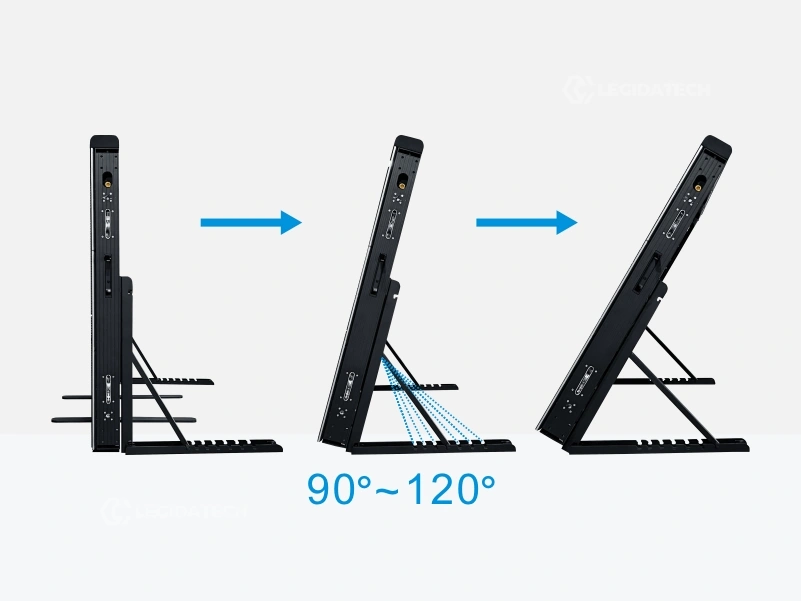
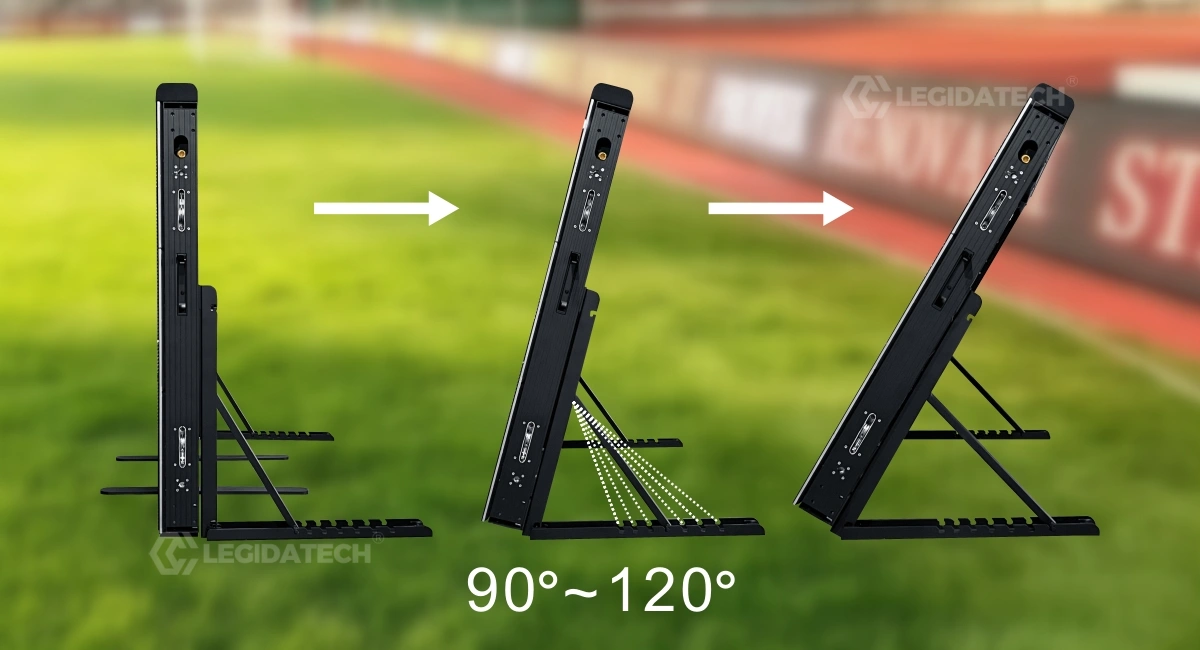
The base opens with a 90° rotation and the screen angle locks into seven positions: 90°, 95°, 100°, 105°, 110°, 115° or 120°. Aim the display at specific seating sections or camera positions; fold it flat for storage between matches.
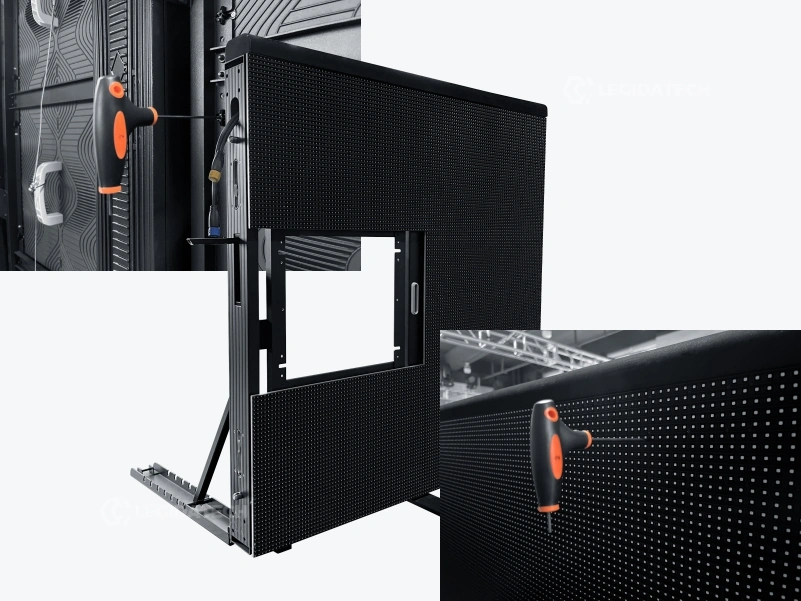
Each 480×320 mm module has a mechanical latch and built-in handle. One technician can swap a module from the front or rear without special tools — critical when rear access at a stadium perimeter is tight.
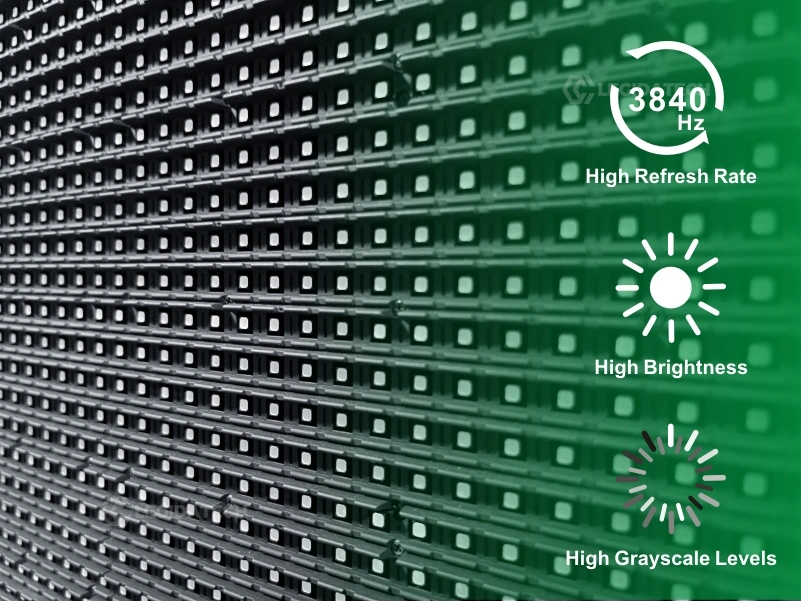
At 3840 Hz with 14–16-bit grayscale, the screen shows no flicker under slow-motion broadcast cameras. Action replays and sponsor ads stay clean and professional on camera — protecting your TV sponsorship revenue.
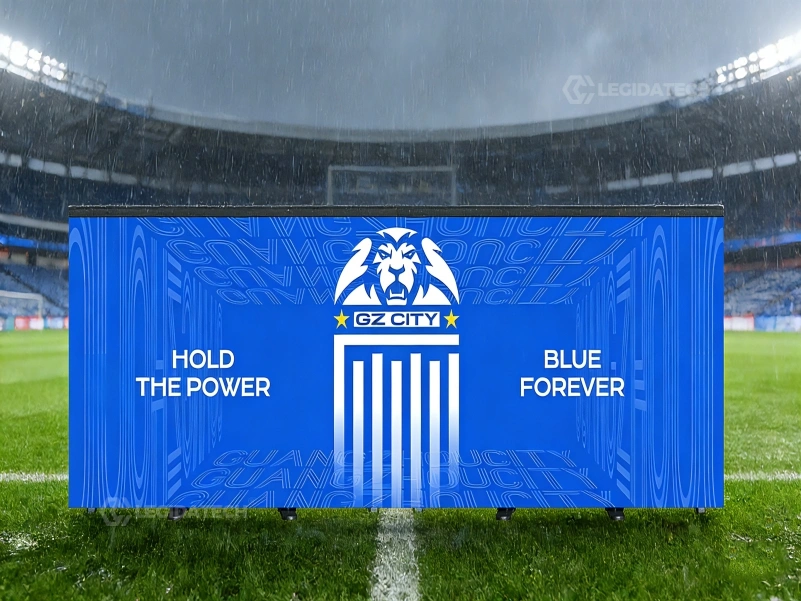
Sealed to IP66 on both front and rear, the cabinet withstands dust and heavy rain with no additional enclosure — built for year-round outdoor installation and rainy match days.
Common Cathode Saves You 30%+ on Stadium Display Electricity
Energy is the second-largest ownership cost of a perimeter LED screen after the hardware itself. The ST960’s Common Cathode driving reduces average power consumption from the conventional profile to roughly 130 W/m² at typical content, and the numbers compound over a season:
* Assumes 200 m² of P8 perimeter screen, 8 h operation per day, 365 days per year. Your actual savings depend on content, brightness and local tariff — send your operating profile with your inquiry and we will include a year-one energy cost comparison in your quote.
ST960 Series Specifications
Full technical data sheet — the same cabinet family also supports the ST1440 (1440×960 mm) format.
Module-level detail on the driving ICs and calibration process is covered in our P8 LED module detailed guidance.
Deployment: Tilt Adjustment, Stability and Rapid Setup
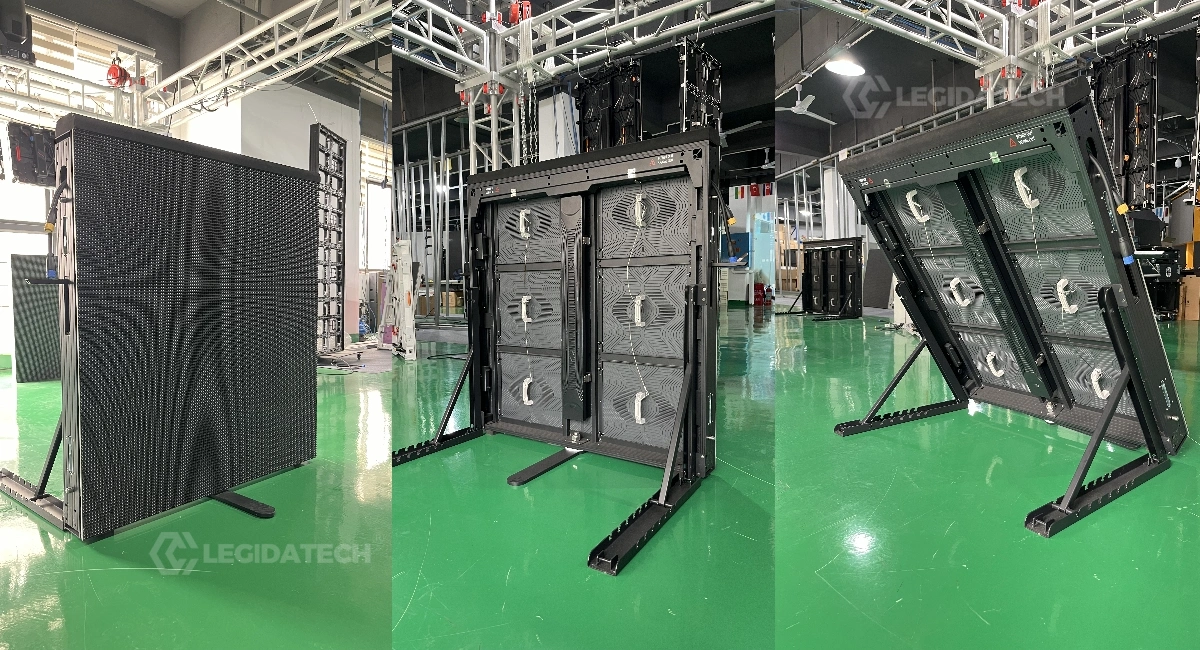
The ST960 base support opens with a 90° rotation for quick setup, then locks the screen into any of seven viewing angles (90°–120°) to aim at seating sections or camera positions. When not in use, the stand folds flat for compact storage.
A steel ground supporter and locking buckles hold the cabinet stable on uneven ground, keeping the picture steady under ball impact and strong wind.
Maintenance Cost Comparison
For stadium perimeters where rear access is tight or blocked by seating, front service keeps downtime measured in minutes — see our LED stadium screens application guide for layout planning.
Applications of the ST960 Stadium LED Display
One cabinet format, every sports perimeter — indoor and outdoor.
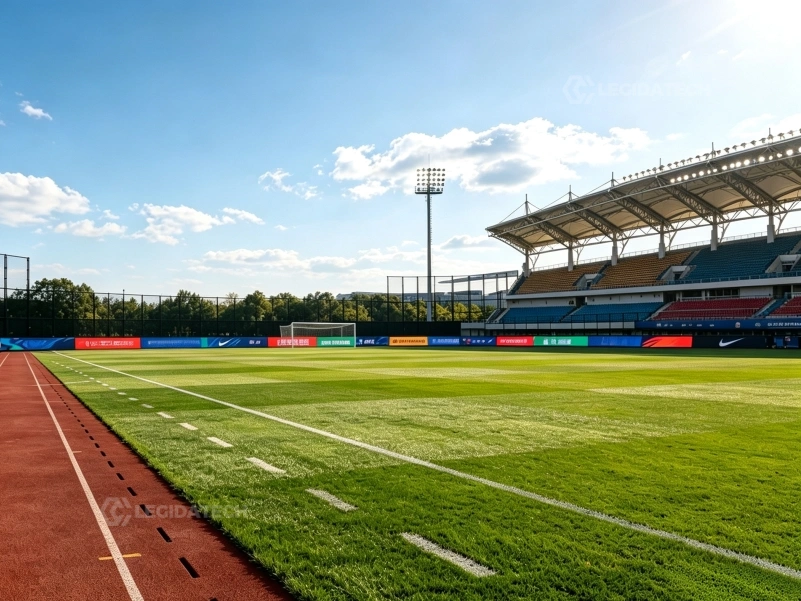
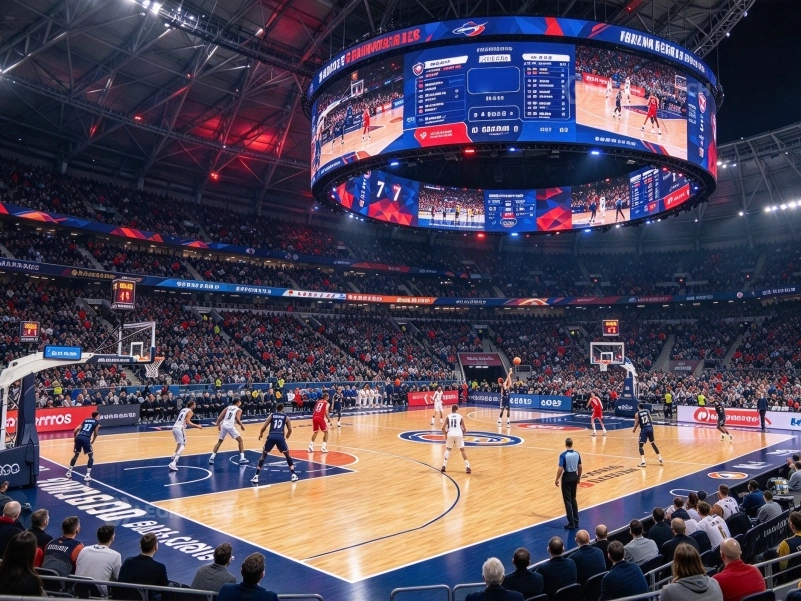
Full-pitch perimeter advertising runs with broadcast-clean 3840 Hz refresh and 6500+ nits under floodlights.
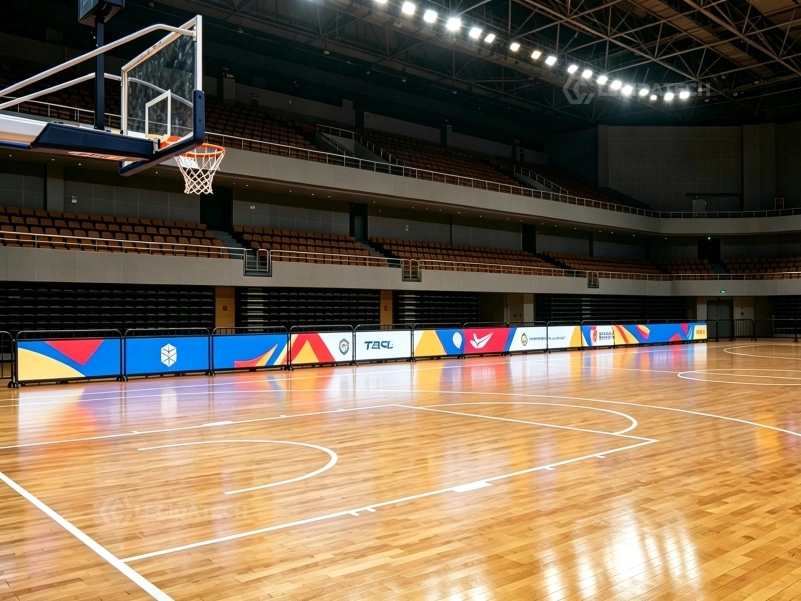
Courtside LED displays in the compact 960×960 mm format fit tight spaces between the court and the first row.
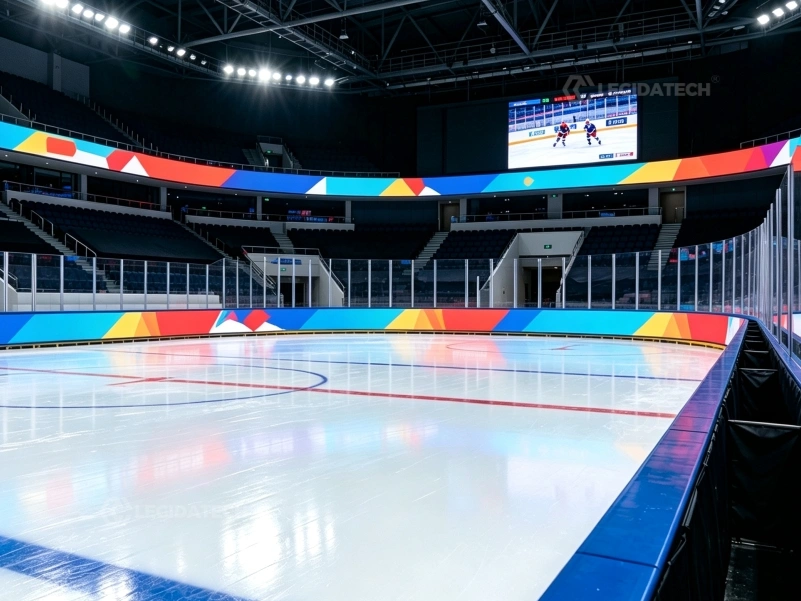
Soft EVA top and rubber mask absorb impacts from players and pucks against the boards.
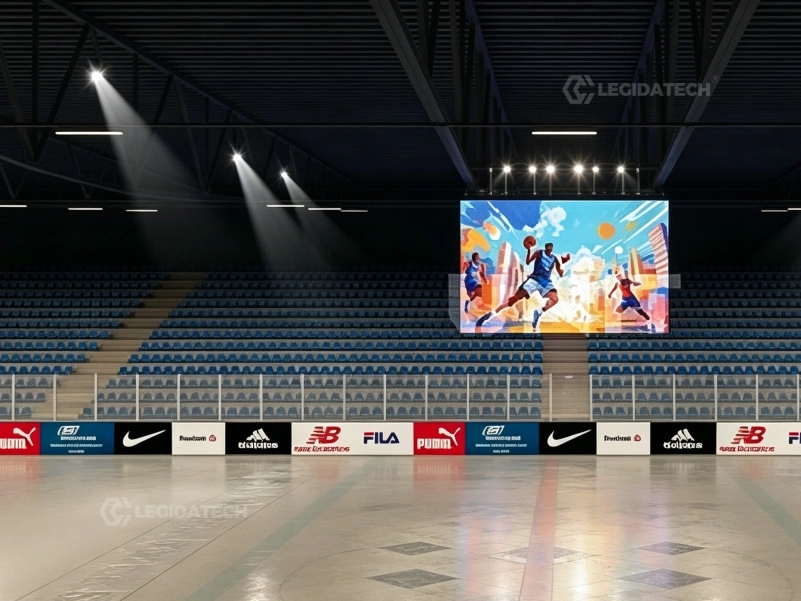
Rugby fields, athletics tracks and outdoor concert venues — one system reconfigures for every event in the calendar.
These applications align with our wider sports LED display portfolio and LED stadium screens case coverage.
3840 Hz Refresh — Broadcast-Clean in Slow Motion
Television money is won on camera. The ST960 runs at 3840 Hz with 14–16-bit grayscale, which means no flicker banding in slow-motion replays — a failure mode that plagues low-refresh perimeter screens during broadcast close-ups.
At 6500+ nits with a 140°/120° viewing angle, sponsor ads and match graphics stay legible from every seating block, in full sunlight or under stadium floodlights.
The same 960x960mm format is used across our outdoor LED screen range, so signal chain, spare modules and control hardware are shared across projects.
Why LEGIDATECH — A Factory You Can Audit
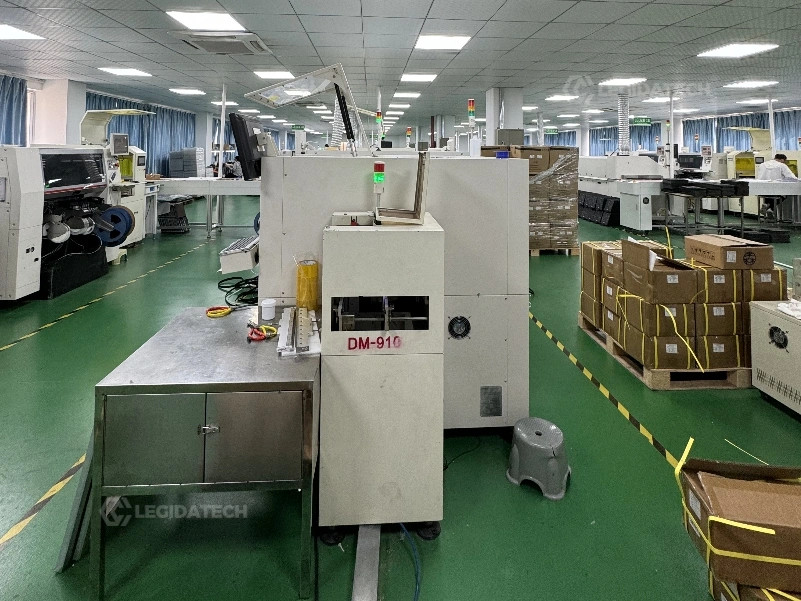
LEGIDATECH is a Shenzhen-based LED screen manufacturer that controls the full production chain — die-casting, SMT, aging and final assembly under one roof. Every ST960 project ships with engineering drawings, a wiring plan and a factory test report before dispatch.
Every module passes a 72-hour aging test before shipment — the single biggest filter for early-life LED failure.
CE, RoHS and FCC compliance on the ST960 series, with test reports available on request. See our certification page for the full list.
Standard 5-year warranty with spare-module pricing locked at order time — no surprise part costs mid-season.
Stadium LED Display FAQs
What is a stadium LED display used for?+
A stadium LED display runs along the edges of sports fields — football stadiums, basketball courts and athletic arenas — to show sponsor branding, live match content and event information. It increases commercial value for the venue while keeping fans engaged throughout the game.
What is the difference between the ST960 and ST1440 cabinet sizes?+
The difference is cabinet width: the ST960 is 960 mm wide (29 kg), while the ST1440 is 1440 mm wide (47 kg). Both share the same 960 mm height, 91 mm thickness, IP66 protection, 3840 Hz refresh and rubber mask safety design. Choose the ST960 when you need more flexible or smaller installation segments.
Can the viewing angle be adjusted for different stadium seating?+
Yes. The foldable rotating support frame adjusts the screen angle from 90° to 120° in seven locked positions (90°, 95°, 100°, 105°, 110°, 115°, 120°), letting you aim the display at both the live audience and TV camera positions.
How much does a stadium LED display cost?+
Cost depends on pixel pitch, cabinet size, brightness, protection level and energy-saving technology. Typical factory-direct projects range from $50,000 for small community venues to $1,000,000+ for large professional stadiums. See our stadium LED display price guide for detailed estimates by venue type.
What maintenance is required for a sports LED display?+
Routine maintenance means checking modules, cleaning the surface and inspecting cables. The ST960’s front and rear service access lets one technician swap a module in seconds with no special tools — so a faulty module never takes the whole perimeter offline.
Is the ST960 compatible with third-party control systems?+
Yes. The ST960 works with mainstream LED control systems. Our engineers advise on compatibility with your existing setup, or recommend a suitable control solution for your project before production.
What pixel pitch should I choose for a stadium perimeter LED screen?+
For perimeter screens where the nearest spectator sits 8 meters or more away, P8 is the standard choice — it delivers a sharp image at that distance and performs cleanly under broadcast cameras. Finer pitches (P6/P4) add cost and are normally reserved for larger or closer-viewing screens.
Is the ST960 safe for athletes during play?+
Yes. The top edge is covered with soft EVA foam and the LED surface uses a soft rubber mask. If a player makes contact at full speed, the materials absorb the impact — reducing injury risk while protecting the LEDs from collision damage.
Ready to Maximize Your Stadium Advertising ROI?
Send your stadium dimensions, viewing distance and environment — you receive a complete spec sheet, engineering drawings and a factory-direct price within 24 hours. Energy-cost comparison included with every Common Cathode quote.
Related Products & Articles
The wider format of the same cabinet family, 47 kg per cabinet, for perimeter runs that need fewer segments.
The same cabinet size configured for billboard networks — see the 960x960mm series page.
The full venue portfolio — from scoreboards to perimeter walls: sports LED display hub.
Browse the complete range of all LED display products, including LED video wall and video gallery.
How Much Does a Stadium LED Display Cost? A 2026 Buyer’s Guide
Buying Guide · Updated 2026 · LEGIDATECH Engineering Team
Buying a stadium LED display is one of the largest single investments a sports venue makes, and the price range in the market is wide enough to confuse even experienced facility managers. This guide breaks the cost down into the components you actually pay for — hardware, structure, installation, control and energy over the screen’s lifetime — using the same data our engineers use when quoting real stadium projects.
What Determines the Price of a Stadium LED Display?
Five variables drive 90% of the price difference between two stadium screens. Knowing them lets you trade cost against quality deliberately instead of accepting whatever the quote says.
1. Pixel pitch. P10 screens use roughly 40% fewer modules per square meter than P6 screens, which makes them significantly cheaper per m² — but they look soft at close range. For a perimeter screen where viewers sit 8 meters or more away, P8 is the cost-performance sweet spot: sharp on camera, and roughly 15–25% cheaper per m² than P6.
2. Brightness and protection. Outdoor stadiums need 6500+ nits to stay visible under direct sunlight, and IP65/IP66 sealing to survive rain and dust for a decade. Both add real cost to the module and cabinet — but a cheaper indoor-grade screen in an outdoor stadium fails within one or two seasons.
3. Cabinet material and format. Die-cast aluminum cabinets (like the ST960’s 29 kg / 91 mm design) cost more than sheet-steel or plastic boxes, but they save on the steel structure behind them — lighter cabinets need lighter, cheaper support frames, and they survive repeated assembly cycles without deforming.
4. Energy technology. Common Cathode (CCT) driving costs more up front than conventional driving. It also cuts power use by over 30% and runs the screen about 15°C cooler — which we quantify in the TCO section below, because over 5 years the electricity saving usually exceeds the price premium.
5. Maintenance access. Screens with front service allow one technician to swap a module in seconds. Screens with rear-only access require 2–3 people, tools and clearance behind the screen — at a stadium perimeter, that space usually doesn’t exist. Maintenance access is the single most under-priced feature in a stadium LED display quote.
6. Component grade. The SMD 2727 lamp and driver IC generation inside the module quietly change the price by 10–30% per m². Modules with premium-brand LEDs, 1/3-scan driver ICs and factory aging (72-hour burn-in) cost more up front and fail measurably less often in years two through five. When a quote looks 20% cheaper, ask which lamp and driver brand it specifies — this is the fastest way to separate a real factory price from a reseller’s lower-spec build.
Stadium LED Display Price Ranges by Configuration
The table below reflects typical factory-direct project pricing for complete perimeter systems including cabinets, control system, power distribution and basic structure. These are planning ranges — exact quotes depend on your dimensions and environment.
A P8 perimeter screen in the 960x960mm format — the configuration the ST960 is built around — lands in the middle of these bands. Per-square-meter pricing on P8 aluminum cabinets typically runs 15–25% below P6 of the same quality, which is why P8 dominates professional football perimeters. For current estimates aligned with these bands, see our stadium LED display price guide and the general LED screen price reference.
A practical rule for pitch selection: minimum comfortable viewing distance in meters is roughly the pixel pitch in millimeters × 1,000. At P8 that is 8 meters — matching the typical gap between the field edge and the first rows of seating, which is exactly why P8 is the default perimeter pitch. At P10 the same rule puts the minimum at 10 meters, so P10 belongs on upper-tier ribbon boards where cameras never get close; at P6 the 6-meter minimum buys sharper close-ups but raises the module count per m² by roughly 40% versus P8. Match the pitch to the closest camera and seating position, not to the marketing pag
Stadium LED Screen Rental vs Permanent Installation
Before committing to a permanent perimeter, decide whether your venue needs to own the screen at all. Rental fleets of stadium LED screens exist for a reason: some venues host a handful of premium matches per year and find that renting perimeter panels costs less than financing a permanent installation plus its steel structure.
The trade-off is straightforward. A permanent installation amortizes over 8–10 years, runs with a fixed structure and locked-in engineering, and generates advertising revenue from day one — but it ties up capital and occupies perimeter space between events. A rental or temporary deployment converts capex into opex, lets you reconfigure the layout per event, and works for multi-venue operators who move screens between stadiums.
The ST960 occupies an uncommon middle ground: a die-cast aluminum cabinet rated for permanent outdoor duty (IP66, 6500+ nits, 3840 Hz) combined with a foldable support frame and 90°–120° tilt that behave like rental hardware. Clubs that run both a league season and summer concerts commonly operate a single ST960 fleet for both — deployed as a permanent perimeter during matches, folded and re-aimed as event staging in the off-season. If you are weighing ownership against rental, send us your match calendar and we will model both options with your numbers.
Installation, Structure and Maintenance Costs
The screen hardware is usually 60–70% of a stadium project budget. The rest is structure, installation and the control chain — and this is where project costs escape their estimates.
Steel structure. Every kilogram of screen weight requires roughly 1.5–2 kg of steel behind it, including foundations and wind loading for outdoor perimeters. A 29 kg aluminum cabinet therefore needs noticeably less steel than a 47 kg equivalent — a saving that shows up in your structure budget, not the screen quote.
Installation labor. Standard-format cabinets (960x960mm) install with no on-site cutting or custom parts. Non-standard screens can add 20–30% to installation labor. The ST960’s foldable stand with 90°–120° tilt also lets venues deploy perimeter segments as temporary event installs — some clients run a single set of cabinets across both league matches and concerts.
Control system and media server. A broadcast-compliant perimeter needs a sending system rated for 3840 Hz refresh, plus a video processor for multi-zone ad rotation. Budget for the control chain even if you already own a scoreboard — our engineers map your existing infrastructure before quoting.
Power, networking and commissioning. A 200 m² P8 perimeter draws roughly 26–37 kW at maximum brightness (550 W/m² max, 186 W/m² average) — your electrical contractor needs that load planned per distribution point, plus a fiber or redundant network path to the media server. Commissioning — color calibration, brightness mapping and control-system integration — is usually 3–5% of project cost and is non-negotiable for broadcast work: an uncalibrated screen shows visible brightness seams between cabinets under camera.
Broadcast Compliance — Why 3840 Hz Protects Your TV Revenue
A perimeter screen’s first job is commercial: sponsor boards around the pitch are sold as broadcast inventory, and broadcasters hold venues to technical standards because a flickering board ruins a slow-motion replay. Two specifications decide whether your perimeter passes on camera: refresh rate and grayscale depth.
At 3840 Hz with 14–16-bit grayscale, the ST960 shows no scanning lines or banding in slow-motion footage — the failure mode that appears on low-refresh screens when a camera drops below 1/500 s shutter. At 6500+ nits with 140°/120° viewing angle and 6500–9000 K adjustable color temperature, sponsor colors and match graphics render consistently from every camera position and seating block. If your sponsor agreement includes technical performance clauses (and most professional ones do), the refresh-rate line in your spec sheet is a contract-protection decision, not a performance preference.
The 5-Year TCO Advantage of Common Cathode Technology
Energy is the hidden line item in every stadium LED display budget. Take a 200 m² P8 perimeter running 8 hours a day: a conventional screen averages roughly 186 W/m², while a Common Cathode screen averages about 130 W/m². Over a 365-day season at $0.12/kWh, that difference is worth roughly $3,900 per year — about $19,500 over five years for one screen. A stadium with a full 800 m² perimeter multiplies that saving by four.
The 15°C lower junction temperature of CCT design also matters for longevity: LED life halves with every ~10°C of extra junction heat. Cooler operation is the difference between a module fleet that still matches brightness in year six and one that needs early replacement — a cost that never appears on the purchase order.
There is a revenue side to the same screen. A perimeter board facing the main stand delivers roughly one ad impression per seat per rotation; a 20,000-seat stadium running 8 sponsor rotations per match generates about 160,000 paid impressions per fixture. That math is why venue operators treat refresh rate, brightness and uptime as revenue infrastructure — and why the maintenance-access decision in the checklist below belongs in the same budget conversation as the screen price itself.
A Stadium LED Display Buying Checklist
Before you sign any quote, verify these seven items in writing:
- Refresh rate ≥ 3840 Hz with grayscale depth of 14–16 bits — anything less will flicker in broadcast slow motion.
- IP66 on both front and rear for outdoor perimeters — IP65 rear-only screens leak at the cabinet gasket over time.
- Front and rear service access — verify with your structural plan that rear clearance exists; it usually doesn’t at pitchside.
- Common Cathode or equivalent energy design — ask for the average W/m² figure, not the max.
- Athlete safety features — soft masks and edge protection if the screen sits within playing distance.
- Spare module pricing locked at order time — a 2% spare buy is standard; locked pricing protects the mid-season replacement budget.
- Engineering drawings before production — a factory that won’t show you the cabinet layout before cutting aluminum is a factory you should not order from.
How to Verify a Factory Before You Pay
Because the difference between a $60,000 and a $90,000 stadium screen is mostly component grade and process discipline, the final due-diligence step is verifying the factory itself. Four checks take an afternoon and eliminate the majority of bad suppliers:
- Live video factory tour. Ask to see the SMT line, the aging room and the cabinet assembly bay on a live call — not a pre-recorded video. A factory that operates all three in-house can show them on demand.
- Aging and test records. Request the 72-hour burn-in log format and a sample test report. The report should include brightness uniformity, dead-pixel count and color temperature measurements, not just a pass mark.
- A sample module to your site. A physical module you can inspect and drive yourself tells you more than any datasheet. Reputable factories quote sample modules at cost and deduct them from the order.
- Engineering drawings before payment. Cabinet layout, structural loads and the wiring plan must arrive before the deposit. If drawings are gated behind payment, walk away — that order is being resold, not manufactured.
LEGIDATECH passes all four checks by design: production, aging and assembly run under one roof in Shenzhen, and every ST960 project ships with engineering drawings, a factory test report and locked spare-module pricing before the deposit is due.
Conclusion
A stadium LED display is priced in four layers — hardware, structure, installation and energy — and the cheapest quote usually wins only the first layer. The ST960’s 960x960mm aluminum format attacks the other three: lighter structure, standard-format installation, and a Common Cathode design that pays its own premium back in electricity savings within the warranty period. Buy on the data, not the sticker: ask your supplier for the average W/m², the refresh rate at the cabinet, the service access on paper, and the drawings before you commit. If you are planning a stadium project in 2026, send us your dimensions and viewing distance — you will get the same engineering data from us that this guide is based on, and a factory-direct price in the ranges above.