Mooncell LED Controller Lineup: Complete 2026 Selection Guide (Processors, Cards & Controllers)
Mooncell makes the complete range of LED control hardware — two-in-one video processors, receiving cards, sending controllers, creative-shape controllers, multimedia servers and cloud players. This guide maps the whole lineup by category, with loading capacities, scenarios and real street prices, so you can pick the right unit for your screen in one read.
Quick answer: for a standard 4K wall, start with the MVB12E; for very large or broadcast-class walls, the M40; for budget walls, the MVB4S Pro. Receiving cards follow the A series, and creative projects use the BS/MBS controllers. The full breakdown is below.
| Your Project | Processor / Controller | Receiving Card | Why |
|---|---|---|---|
| Shop window, small indoor wall (≤1.3M px) | MVB2S | A10X | Lowest-cost complete chain |
| Church, lobby, retail (≈2.6M px) | Mooncell MVB4S Pro or MTB400E | A10X / A712 | Balanced capacity and price |
| 4K conference or event wall (≈7.8M px) | Mooncell MVB12E | A712 | One unit drives a full 4K wall |
| Stadium, broadcast, very large (up to 26M px) | Mooncell M40 | A10X | 40× GigE + fiber outputs, 6 inputs |
| Sphere, dome, ring, floor, 3D | B1200S / MB400S | A series | Purpose-built irregular-shape control |
| Multi-screen sync show, KTV/bar | MC-C2 server | — | Server-class playback with C2 software |
Mooncell Control System Architecture in 60 Seconds
Every Mooncell system is built from the same chain: a video source (PC, media player, camera or switcher) feeds a processor or sending controller, which distributes pixel data over Gigabit Ethernet to receiving cards mounted inside each LED cabinet, which drive the modules. The software side — AutoLED for configuration, LEDmagic for async players — is covered in our Mooncell software guide.
Mooncell’s receiving cards are built around its own T6-era control chips and later generations (the official download center still maintains T6 Controller software v3.1.26 for legacy hardware). The practical consequence: Mooncell systems are efficient at irregular geometries — the “row, column and pixel extraction” you need for non-rectangular screens — which is why the brand leads in creative displays. For how that compares against other brands, see our Mooncell vs NovaStar vs Colorlight comparison.
Category 1: Two-in-One Video Processors (MVB Series, M40, KT Series)
A two-in-one processor combines video processing (scaling, multi-window, color) and the sending function (pixel distribution) in one box — one device from source to screen. This is Mooncell’s largest and most important category:
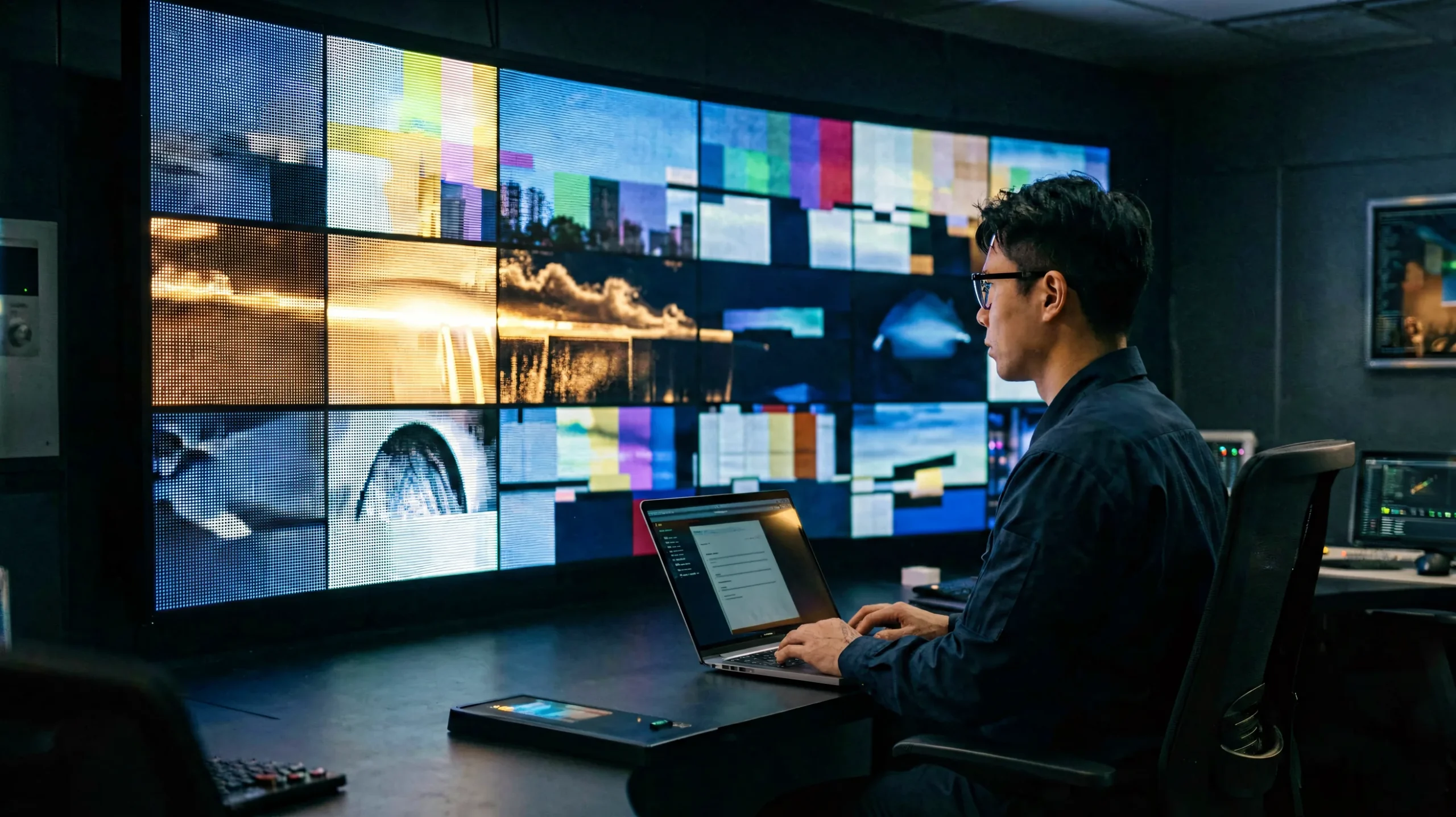
A real MVB-series processor with scaling in action — 8 LED outputs driven from one unit.
- MVB2S — entry class, ≈1.3 million pixels. The cheapest complete two-in-one chain (street ≈$110).
- Mooncell MVB4S Pro — ≈2.6 million pixels, 4 ports, VGA/DVI/HDMI inputs. The value pick for medium walls (street ≈$198).
- Mooncell MVB12E — 7.8 million pixels, 12 Gigabit Ethernet outputs, 4K@60Hz input. One unit drives a full 4K wall without cascading (street ≈$865).
- MVB20E — 20 Ethernet outputs for wider 4K walls that need more ports per row (official page).
- Mooncell M40 — the flagship: 40 Gigabit Ethernet + 4 fiber outputs, 26 million pixels, 6 simultaneous inputs (HDMI 2.0 ×2, HDMI 1.2, DVI ×2), PIP multi-layer (2×4K + 2×2K or 6×2K) and 3D support. Stadium and broadcast territory; Alibaba listings start around $3,200.
- KT series — entertainment-venue two-in-one units; the KT160 carries 16 outputs for 10.4 million pixels (official page).
Category 2: Receiving Cards (A Series)
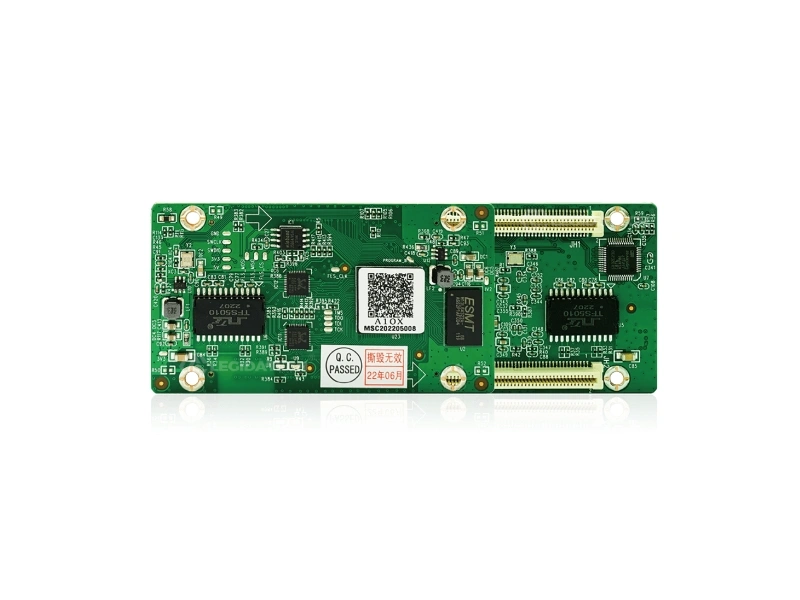
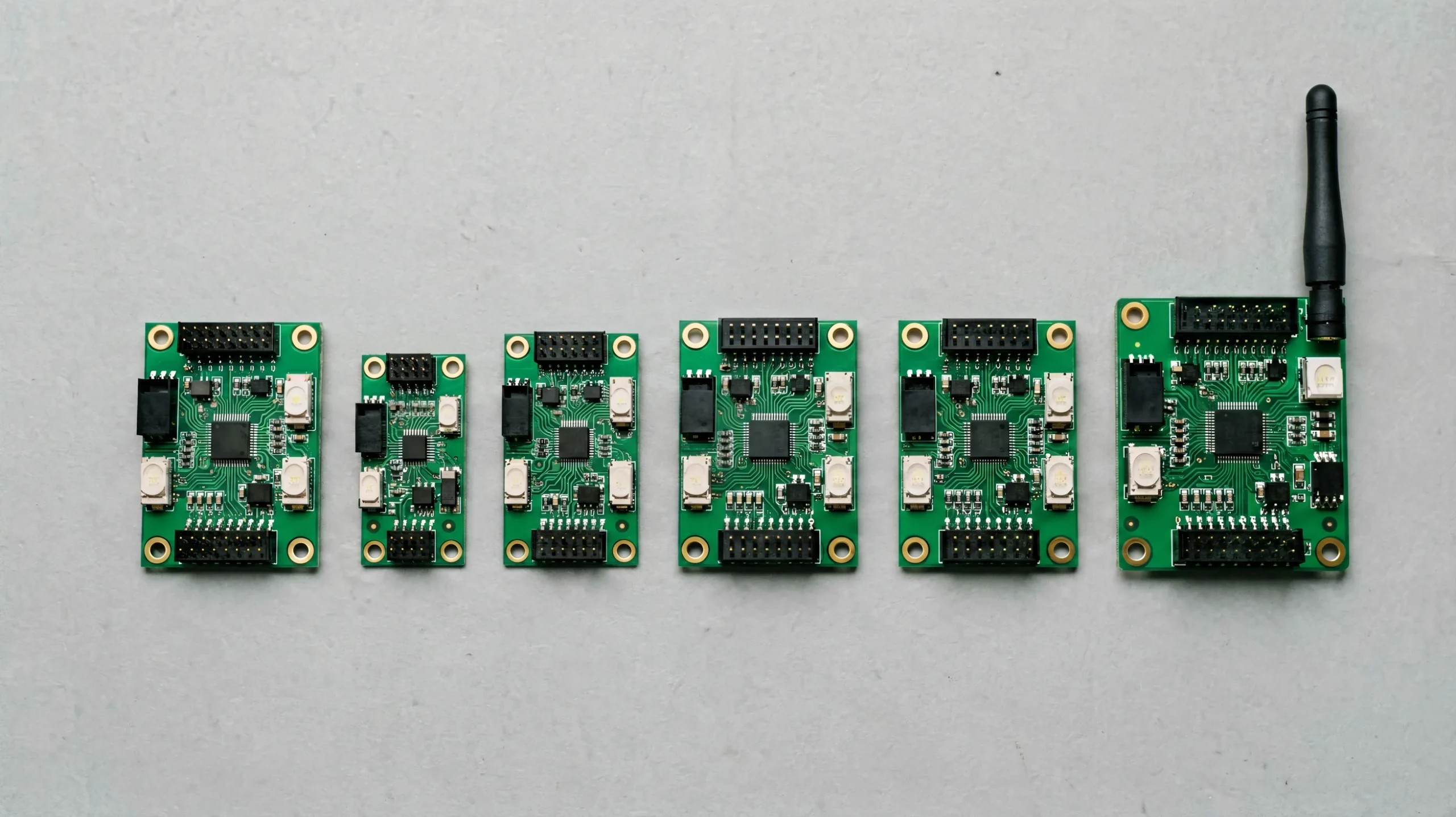
The A10X — Mooncell’s high-capacity receiving card that sits inside each LED cabinet.
What is an LED receiving card? The receiving card is the small circuit board inside every LED cabinet that receives pixel data over Ethernet and drives the LED modules. The number of cards you need depends on your total pixel count divided by each card’s capacity — use our receiving/sending card calculation guide for the exact math.
- A10X — the workhorse: 512×640 pixels (PWM), 32-group RGB parallel data, 22-bit grayscale, pixel-level brightness/chroma calibration and 3D support. Street ≈$27 — one of the best capacity-per-dollar cards on the market (official page).
- A712 — 12× HUB75E interfaces, 512×384 pixels, 24-group RGB data: the wide-compatibility card for mixed-IC cabinets and repairs (official page).
- A716 — the step-up in the same family (768×256 loading class, loop backup).
- A4X / A8X / M10D — smaller form-factor variants for compact cabinets.
- PA703 — newer receiving card generation (spec sheet listed in the official download center, August 2026).
Category 3: Sending Controllers (MTB Series)
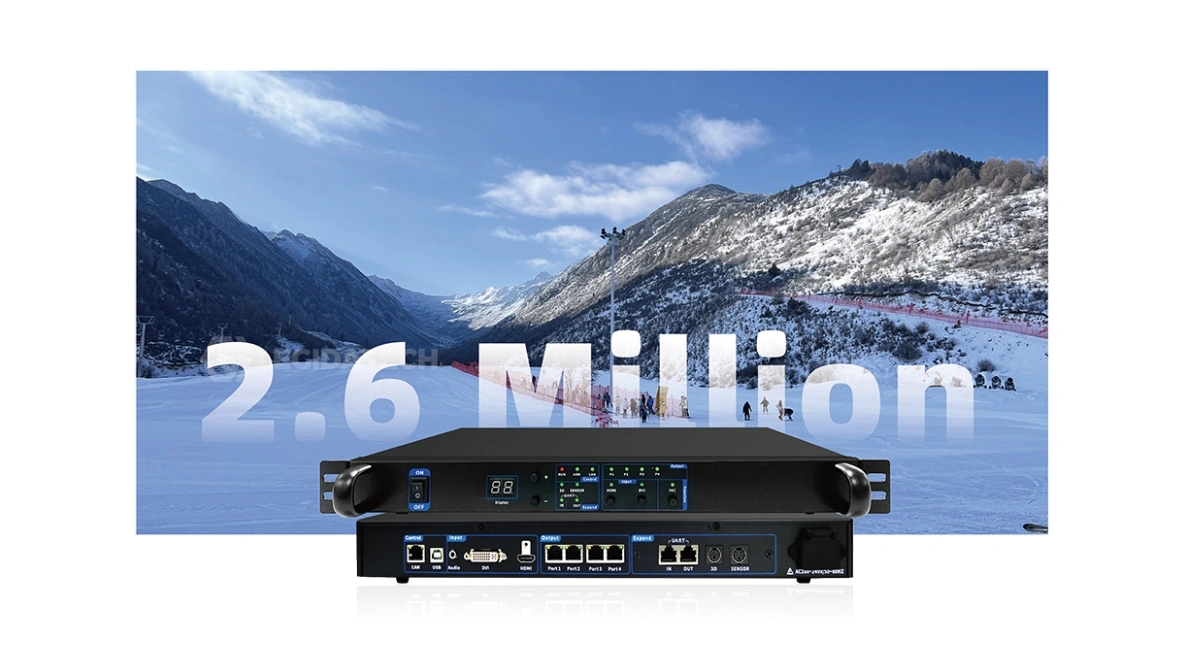
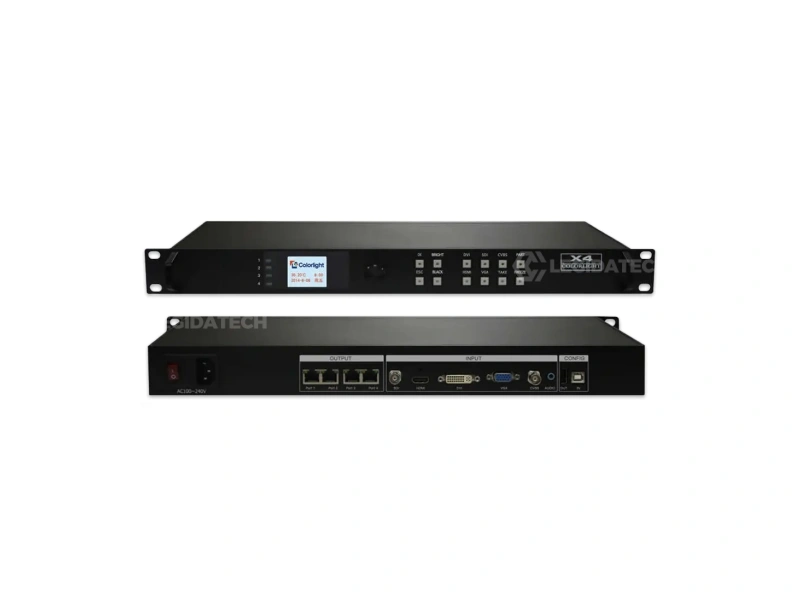
The MTB400E — Mooncell’s mid-range sending controller in rack-mount form.
When the project keeps processing and sending separate (processor from any brand + Mooncell sending + Mooncell receiving cards), the MTB series is the sending tier:
- MTB200 — entry sending controller, DVI input, dual network outputs, 1.3M px (street ≈$112).
- MTB400E — 2.6 million pixels, 4 network ports, DVI + HDMI input (official page).
- MTB600E — 6 Ethernet outputs, 2.3M px class with more cabling flexibility.
- MTB2000E — the top of the line: full 4K×2K@60Hz processing (official page). MTB800E/MTB1200E fill the middle.
Not sure whether you even need a separate sending controller? Our sending card selection guide explains the processor-vs-sending-controller decision in depth.
Category 4: Creative & Special-Shape Controllers (BS / MBS Series)
This is the category that separates Mooncell from every other brand. The BS and MBS series are built specifically for irregular screens:
- Mooncell B1200S — BS series creative controller: multiple Gigabit Ethernet outputs and the dynamic interpolation algorithm that keeps content seamless across spheres, domes and disc screens, with irregular module cropping and 8K decode (official page).
- Mooncell MB400S — MBS series networked player with an 8-core CPU, built for custom-shaped displays with network publishing (official page).
- B2000ES-G — larger BS-series sibling for complex 4K dome and immersive projects (spec sheet on the official download center).
If your project is a sphere, dome, ring, stair or floor screen, this category — not a generic processor — is where the Mooncell decision actually happens.
Category 5: Multimedia Servers (MC Series)
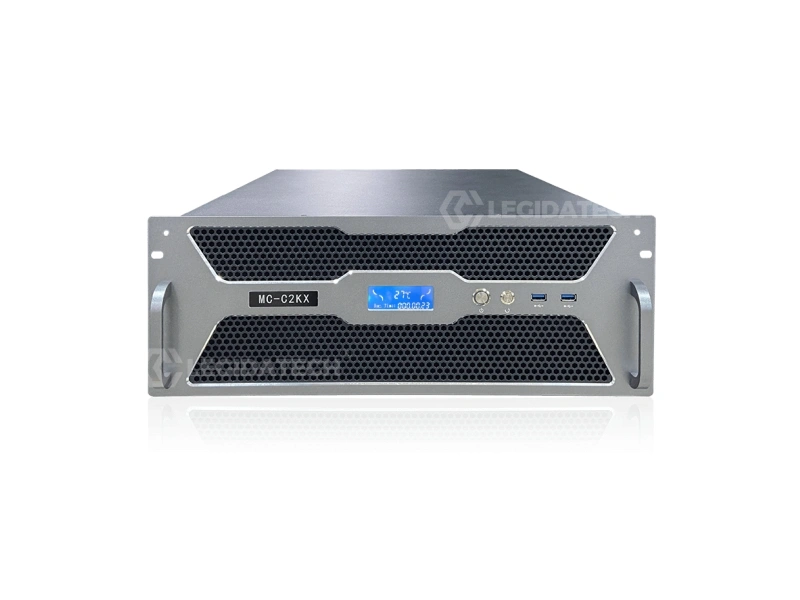
The MC-C2 — server-class playback with 8K hardware decoding for synchronized multi-screen shows.
- Mooncell MC-C2 — professional graphics cards plus 8K hardware decoding, controlled by the Server C2 broadcast software (v5.2.5): the platform for KTV chains, bars, immersive spaces and synchronized multi-screen content (official page).
- MC4K-2 / MC4K Pro / MC8K-2 — the wider MC server family at 4K and 8K tiers (spec sheets on the official download center).
Category 6: Cloud Players & Linkage Boxes (MP / KA / K Series)
For signage networks that publish content remotely, Mooncell’s cloud player line completes the ecosystem:
- MP401 — networked media player with 4K HDMI output and remote cluster control over the internet (official page).
- MP1 / MP2 — compact async players (0.65M / 1.3M px); the MP1 streets around $139.95.
- K / KA series — linkage player boxes for KTV and bar scenes: the K3100 unifies screen, lighting and music scheduling with automatic scene switching (official page).
Setting up a Mooncell MB1 media player box — the async workflow in practice.
Street Price Reference (August 2026)
Indicative street prices from public retailer listings we verified in August 2026 — not factory quotes, and project pricing for complete LED systems differs:
| Model | Category | Indicative Street Price | Source (public listing) |
|---|---|---|---|
| A10X | Receiving card | ≈ $27 | ledcontrollercard.com / led-mall.com |
| MVB2S | 2-in-1 processor | ≈ $110 | controller-led.com |
| MTB200 | Sending controller | ≈ $112 | ledcontrollerparts.com |
| MP1 | Async media player | ≈ $139.95 | ledlightsworld.com |
| MVB4S Pro | 2-in-1 processor | ≈ $198 | led-mall.com |
| MVB12E | 2-in-1 4K processor | ≈ $865 | Aliexpress listing |
| M40 | Flagship processor | from ≈ $3,200 | Alibaba listing (1 pc) |
For cross-brand price context (NovaStar MCTRL, Colorlight X series), the same tables appear in our Mooncell vs NovaStar vs Colorlight comparison.
Worked Examples: Real Projects, Real Math
Three typical projects, calculated exactly as our engineers do them:
Example 1 — Church P2.5 indoor wall, 1920×1080
- Pixel count: 1920 × 1080 = 2,073,600 px
- Processor: MVB4S Pro (2.6M capacity — comfortable headroom)
- Receiving cards: 2,073,600 ÷ 327,680 (A10X) = 6.3 → 7× A10X, distributed per cabinet layout
- Result: one processor, seven cards — a standard church-wall BOM
Example 2 — Outdoor P8 advertising billboard, 3.84 m × 2.56 m
- Pixel count: 480 × 320 = 153,600 px
- Processor: MVB2S (1.3M capacity — far more than needed, but the entry class)
- Receiving cards: 1–2× A10X depending on how many cabinets the billboard is built from
- Result: the lowest-cost complete Mooncell chain, ideal for outdoor advertising screens
Example 3 — Rental stage wall, native 4K (3840×2160)
- Pixel count: 3840 × 2160 = 8,294,400 px — above the MVB12E’s 7.8M single-unit ceiling
- Processor: M40 (26M capacity, fiber outputs for long runs) — or two cascaded MVB12E units for budget builds
- Receiving cards: 8,294,400 ÷ 327,680 = 25.3 → 26× A10X
- Result: a true 4K rental wall with one flagship processor — the configuration we ship for rental LED display projects
How to Choose: The Decision Flow
- Calculate your pixel count. Width × height of the wall, in physical pixels. This number decides everything.
- Pick the processor class. ≤1.3M px → MVB2S · ≈2.6M px → MVB4S Pro / MTB400E · ≤7.8M px → MVB12E · larger or broadcast → M40.
- Count the receiving cards. Total pixels ÷ card capacity (A10X: 512×640 · A712: 512×384), rounded up.
- Check the shape. Rectangular? Standard chain. Sphere/dome/ring/floor/3D? Move to the BS/MBS category.
- Check the playback model. Live source → synchronous (AutoLED). Scheduled content, no PC → async (MB/MP + LEDmagic). Multi-screen sync show → MC-C2 + Server C2.
- Match the screen to the controller. We ship indoor, outdoor and rental LED display LED screens with the right Mooncell controller already configured, tested and warrantied inside — you never have to do this math alone.
How We Ship Mooncell Systems at the Factory
As an LED screen factory (13 years, 10,000 m² production, exports to 108+ countries), we treat the controller selection as part of the screen engineering: the right processor class for the pixel count, the right receiving card for the cabinets, configuration and calibration done before shipping, and 24-hour remote support after. For the software behind each category, see our Mooncell software guide; for the same lineup treatment of other brands, see the Colorlight X series lineup and Huidu controller lineup guides.
FAQ: Mooncell LED Controller Lineup
Which Mooncell controller do I need for a 4K wall?
Careful distinction first: the MVB12E accepts a 4K@60Hz input and drives up to 7.8 million pixels — perfect for 4K-source walls up to that size. A native full-4K wall (3840×2160 = 8.3 million pixels) exceeds it and needs the M40, or two cascaded MVB12E units. For broadcast-class 4K walls with multiple sources, the M40.
What is an LED receiving card?
The receiving card is the circuit board inside each LED cabinet that receives pixel data over Ethernet from the processor or sending controller and drives the LED modules. Its loading capacity (in pixels) determines how many cards your wall needs.
How many receiving cards does my screen need?
Divide your total pixel count by the card capacity — A10X: 512×640, A712: 512×384 — and round up per cabinet. Our calculation guide walks through worked examples.
Is Mooncell a good LED control brand?
Yes — it is the control system supplier of the CCTV Spring Festival Gala, contributed to the Beijing 2022 Winter Olympics opening ceremony, and was named a national “little giant” enterprise in 2022. It is strongest in creative and irregular displays.
What is the difference between a sending controller and a two-in-one processor?
A sending controller (MTB series) only distributes pixels — it needs a separate video processor for scaling and multi-window. A two-in-one processor (MVB series, M40) does both in one box, which is simpler and usually cheaper at small to medium scale.
Can Mooncell drive an 8K wall?
Yes. The M40 drives 26 million pixels (8K-class) with 40 GigE + 4 fiber outputs, and the MC8K-2 multimedia server handles 8K content with hardware decoding.
Do Mooncell receiving cards work with any LED module?
The A712’s 12× HUB75E interfaces and the A10X’s hub connector cover the most common module standards, but always confirm the module’s driver IC and scan rate against the card’s supported list — the same rule as any brand.
What does “T6 controller software” mean?
T6 is Mooncell’s earlier receiving-card control chip generation. The official download center still provides T6 Controller software (v3.1.26) for legacy T6-era hardware; newer cards use the current AutoLED releases.
Where can I buy Mooncell controllers?
Mooncell hardware is sold by international parts retailers (the street prices above come from their public listings). LEGIDATECH does not retail controllers — we integrate them into complete LED display systems.
Does LEGIDATECH ship Mooncell-based LED screens?
Yes. Every Mooncell-based system we ship arrives pre-configured: processor class matched to the pixel count, receiving cards mapped, software installed and a full burn-in completed. Tell us your wall size and application, and we deliver the working screen.
Sources & References
- Mooncell official website
- Mooncell MVB series official page
- Mooncell MVB20E official page
- Mooncell A series receiving cards official page
- Mooncell A712/A716 official page
- Mooncell MTB series official page
- Mooncell MTB2000E official page
- Mooncell BS series official page
- Mooncell MBS series official page
- Mooncell KT series official page
- Mooncell MC-C2 official page
- Mooncell MP series official page
- Mooncell K series official page
- Mooncell official download center (spec sheets & software versions)
Explore the Mooncell LED Control System Hub
For the complete Mooncell picture — product overview, comparison table, applications, selection logic and FAQs — visit the Mooncell LED Control System: Complete Guide & Product Hub.