Mooncell vs NovaStar vs Colorlight: Which LED Control System Fits Your Project? (2026 Full Comparison)
The LED control system is the brain of every LED display. Choose the wrong one and a high-end LED wall shows tearing, color drift, or fails on show day. Choose the right one and even a budget screen looks professional for years.
At LEGIDATECH, we build complete LED display systems — indoor, outdoor, rental and creative — and we configure Mooncell, NovaStar and Colorlight control systems every week for customers in more than 108 countries. In this comparison we break down what each brand actually does well, what the real specs and street prices are (August 2026), and which system belongs in your project.
Quick answer: NovaStar is the safe default for most fixed and rental installations thanks to its mature ecosystem. Colorlight delivers the best price-to-performance for standard screens and cloud-managed digital signage. Mooncell wins in creative, irregular and stage applications — spheres, domes, floor screens, KTV and 3D — the exact territory where the other two are weaker. The rest of this guide explains why, with real specifications, verified public prices and honest trade-offs.
Quick Verdict: Which Brand for Which Project
| Your Project | Our Recommendation | Reason in One Line |
|---|---|---|
| Fixed indoor LED wall (lobby, church, meeting room) | NovaStar or Colorlight | Mature ecosystem, easy spares, integrators everywhere know them |
| Rental & live stage events | NovaStar (stability) / Mooncell (creative stages) | NovaStar for standard walls; Mooncell when the stage involves unusual shapes |
| Outdoor billboard / advertising | NovaStar or Colorlight | Proven outdoor reliability and remote monitoring |
| Creative shapes: sphere, dome, ring, floor, 3D | Mooncell | Purpose-built irregular-shape controllers — its core specialty |
| Cloud-managed DOOH / digital signage network | Colorlight (C-Cloud) / Mooncell (MC-C2 + MP series) | Both have strong cloud platforms; Colorlight is more widely deployed |
| Tight-budget standard screen | Colorlight | Lowest entry cost with good quality |
What Is Mooncell?
Mooncell is a Shenzhen-based manufacturer of LED display control systems founded on one specialty: making irregular LED screens easy to control. Its product line spans two-in-one video processors (MVB and M40 series), the V series video splicers, receiving cards (A series), sending controllers (MTB series), creative-shape controllers (BS/MBS series), multimedia servers (MC-C2) and cloud media players (MP series).
Mooncell’s credentials are unusually strong for a brand you may not have heard of:
- CCTV Spring Festival Gala: Mooncell is the official supplier of the display control system for China’s CCTV Spring Festival Gala — one of the most-watched live broadcast stages in the world (official site).
- Beijing 2022 Winter Olympics: Mooncell control technology was used in the opening ceremony (Mooncell news).
- National “little giant” enterprise: In 2022, China’s Ministry of Industry and Information Technology listed Mooncell as a national-level specialized and innovative “little giant” enterprise — a designation given to only a small percentage of Chinese manufacturers (Mooncell news).
- Industry award: “Top Ten LED Display Peripheral Equipment Brands” at the 2021 Huicong LED Display Industry Brand Awards (Mooncell news).
In plain terms: Mooncell is not a clone brand. It is the control-system vendor that high-profile creative LED projects in China turn to when the screen is not a rectangle. On our side, we integrate Mooncell into complete rental LED display and creative screen projects — see the Mooncell MVB12E page for a full walkthrough of one such processor.
What Is NovaStar?
NovaStar is the market leader in LED display control systems and the default choice of most LED screen factories worldwide. Its ecosystem — MCTRL sending controllers, VX all-in-one processors, A series and MRV receiving cards, NovaLCT configuration software and the VNNOX cloud platform — is the most widely adopted in the industry, which means spare parts, tutorials and experienced technicians are easy to find in almost every country.
For a complete introduction, read our guide What Is NovaStar Control System? Complete Guide to LED Display Controllers. Key models we configure daily: MCTRL300 (entry-level sending controller), MCTRL660 Pro (mid-range 4K workhorse), A8s receiving card and MRV208-N.
NovaStar’s weakness in this comparison is also its strength: it optimizes for the standard rectangular LED wall. Creative irregular screens are possible but require more workarounds than with Mooncell.
What Is Colorlight?
Colorlight (Shenzhen) is the strongest price-performance player in LED control. Its X series controllers (X2, X4, X8m, X16, X20), receiving cards (i5, i6, i9, Z6Pro) and the LEDVISION software plus C-Cloud remote platform cover everything from a 1.3-million-pixel shop window screen to an 8K 11.5-million-pixel wall — usually at a lower street price than equivalent NovaStar hardware.
See our Colorlight X Series Full Lineup guide for the complete 2026 model breakdown, or the What Is Colorlight Control System primer. Colorlight is particularly strong in fixed installations and cloud-managed signage; like NovaStar, its creative-shape tooling is functional but not its focus.
Head-to-Head: The Three Systems Compared
| Dimension | Mooncell | NovaStar | Colorlight |
|---|---|---|---|
| Brand position | Creative / irregular / stage specialist | Global market leader, safe default | Price-performance + cloud signage |
| Flagship 2-in-1 processor | M40: 40× GigE + 4× fiber, 26M px, 6 inputs | VX series + MCTRL660 Pro (6× GigE + fiber, genlock) | X20: 8K, 20 ports, 11.5M px |
| 4K-class processor | MVB12E: 7.8M px, 12 GigE, 4K@60Hz | MCTRL4K / VX1000 | X8m (5.24M px) / X16 |
| Receiving cards | A10X (512×640, 22-bit), A712 (12× HUB75E) | A8s, MRV208-N, Armor series | i5 / i6 / i9, Z6Pro |
| Configuration software | AutoLED, LEDmagic, M3 Studio | NovaLCT, SmartLCT, VNNOX | LEDVISION, C-Cloud |
| Creative-shape capability | Excellent — dedicated BS/MBS series, sphere/dome/floor solutions | Good, via workarounds | Good, via workarounds |
| Cloud platform | LEDmagic cloud + MP series players | VNNOX | C-Cloud |
| Typical street price position | Mid | High | Low–mid |
| Best for | Creative, stage, KTV/bar, 3D | Standard fixed & rental, broadcast | Budget, DOOH, cloud signage |
2-in-1 Video Processors Compared
A “two-in-one” processor combines the video processor (scaling, multi-window, color correction) and the sending controller (pixel distribution to the LED cabinets) in one box. It is the heart of most serious installations today.
Mooncell: MVB Series & M40
- Mooncell MVB12E — 12 Gigabit Ethernet outputs, 7.8 million pixel capacity, 4K@60Hz input. One unit drives a full 4K wall without cascading (official MVB series page).
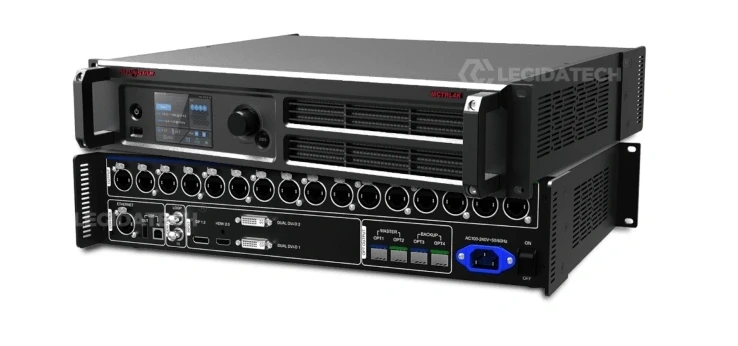
- Mooncell M40 — the flagship: 40 Gigabit Ethernet + 4 fiber outputs, 26 million pixel capacity, 6 video inputs (HDMI 2.0 ×2, HDMI 1.2, DVI ×2), real-time PIP multi-layer (2×4K + 2×2K or 6×2K) and 3D support. This class of capacity is what stadium and broadcast walls need.
- Mooncell MVB4S Pro — 2.6 million pixels, 4 ports, 1× VGA / 1× DVI / 1× HDMI inputs. The value pick for medium walls (official MVB2S/MVB4S page).
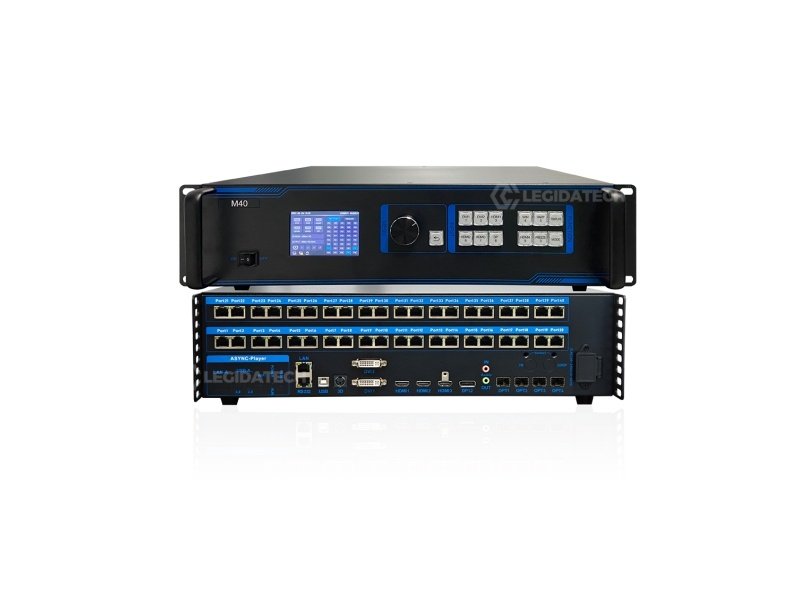
Mooncell M40 — 26 million pixel capacity over 40 Gigabit Ethernet and 4 fiber outputs, with 6 simultaneous video inputs.
NovaStar: VX Series & MCTRL
NovaStar’s VX all-in-one units (VX4S, VX1000) and the MCTRL660 Pro sending controller (6× Gigabit Ethernet, 2× fiber outputs, genlock for multi-camera broadcast) dominate the standard-wall market. Our NovaStar buyer’s guide walks through the full VX vs MCTRL decision.
Colorlight: X Series
The X8m is the 4K entry point (5.24M px), the X16 adds HDMI 2.0 4K and more ports, and the X20 reaches 8K at 11.5M px. Colorlight’s 2-in-1 units are consistently the cheapest route into each pixel class — see our Colorlight X Series lineup guide for model-by-model specs.
Sending & Receiving Cards Compared
For projects that keep the processor and the controller separate, the sending controller plus the receiving cards in each cabinet do the heavy lifting.
Sending controllers
- Mooncell MTB400E — 2.6 million pixels, 4 network ports, DVI + HDMI input (official MTB page). The MTB2000E steps up to full 4K×2K@60Hz processing (official page).
- MCTRL300 — 2 ports, DVI only (no HDMI). The cheapest NovaStar sending controller, with the input limitation that matters in the field.
- Colorlight X2 — 1.3M px, HDMI + DVI. The entry point; the X4 (2.6M px, 4 ports) is the workhorse for mid-size walls.
Before picking any sending card, use our receiving/sending card calculation guide — most buyers buy cards that are either too small or needlessly large.
Receiving cards
- Mooncell A10X — 512×640 pixels (PWM), 32-group RGB parallel data, 22-bit grayscale, pixel-level brightness and chroma calibration, 3D support (official A series page).
- Mooncell A712 — 12× HUB75E interfaces, 512×384 px, 24-group RGB data — the wide-compatibility card for mixed-IC cabinets (official page).
- NovaStar — the A8s and MRV208-N are the most widely stocked receiving cards on earth — the easiest cards to replace on any continent.
- Colorlight — the i5/i6/i9 and Z6Pro family, strong color processing and low cost; see our Z6 Pro G2 page.
Creative & Irregular Displays: Where Mooncell Stands Out
This is the decisive difference between the three brands. Mooncell builds dedicated hardware and software for non-rectangular screens, which is why the brands sit in different tiers here:
- BS series creative controllers (B1200S) — Mooncell’s dynamic interpolation algorithm keeps content seamless across spheres, domes and disc screens, with irregular module cropping and 8K decode (official BS series page).
- MBS series networked players (MB400S) — an 8-core networked player built for custom-shaped displays (official MBS page).
- Proven solutions library: Mooncell ships ready-made control recipes for hemisphere/full sphere, disc, circular, horn-shaped, KTV, bar, immersive and glasses-free 3D screens — the exact geometry work you would otherwise pay an integrator to figure out manually.
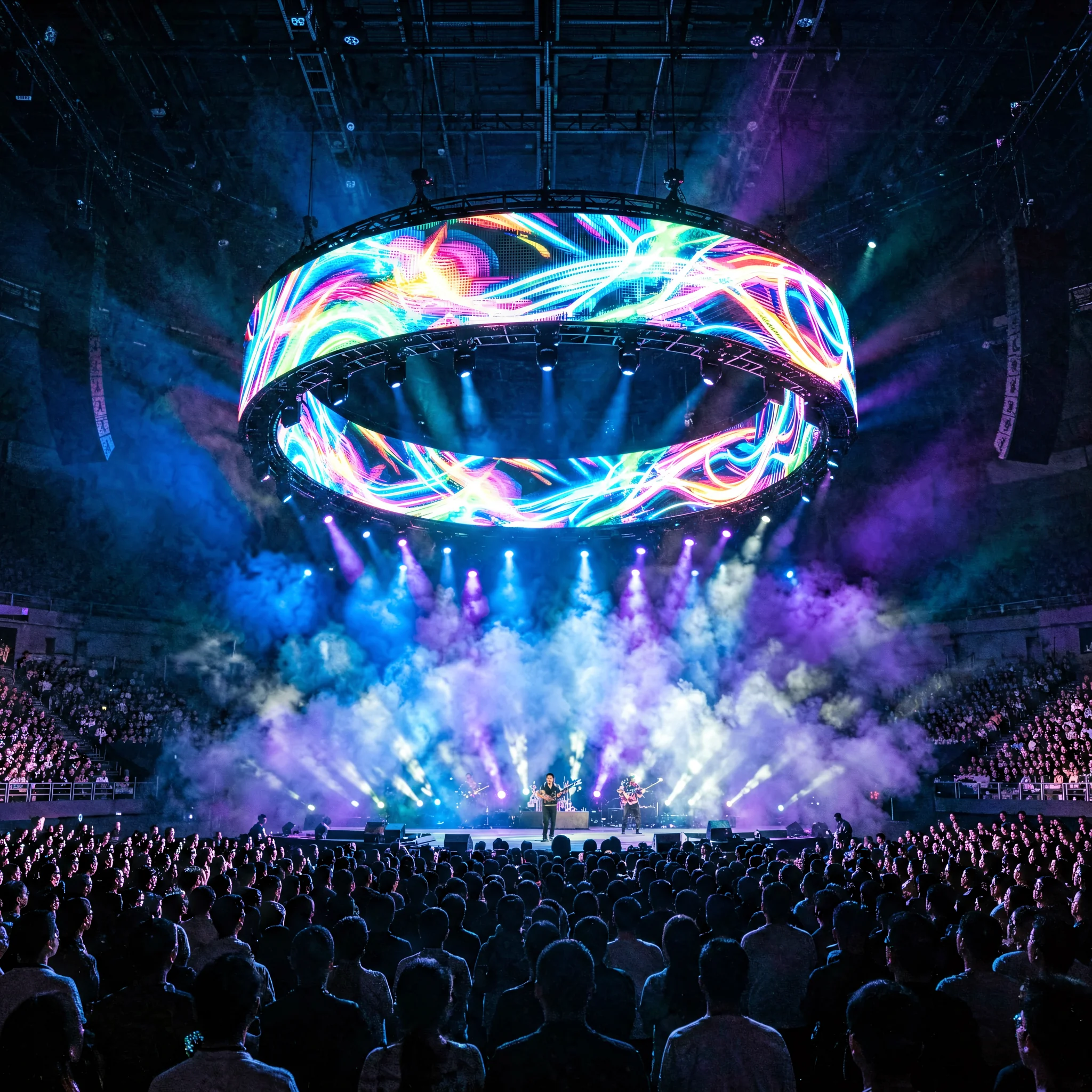
NovaStar and Colorlight can both drive creative screens — but through generic tools, cropping and manual mapping. If your project is a stair LED display, a floor screen, a ring or a sphere, Mooncell usually reaches the result faster and more reliably. For standard rental walls on the same event, NovaStar remains the default — this is why many of our rental LED display shipments combine both.
Media Servers & Asynchronous Playback
When the screen must play content without a PC — digital signage, remote billboards, retail — the media player architecture matters more than the processor:
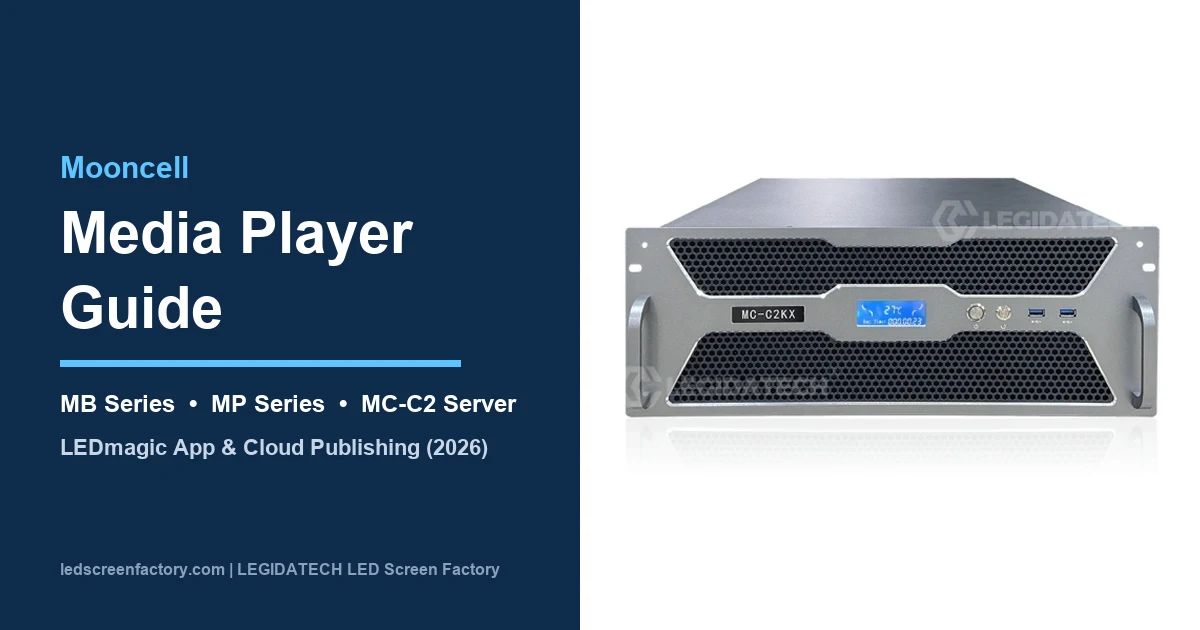
- Mooncell MC-C2 — a true multimedia server: professional graphics cards, 8K hardware decoding and the C2 broadcast control software for multi-screen synchronized shows (official MC-C2 page).
- Mooncell MP series — networked cloud players; the MP401 outputs 4K HDMI and supports remote cluster control over the internet (official MP series page).
- Colorlight A200 / EP11 — cloud network players tightly integrated with C-Cloud; watch how the A200 handles sync/async in the video below.
- NovaStar — media players plus VNNOX cloud publishing; the ecosystem choice when the signage network may grow large.
For signage-style projects, compare with our foldable LED poster and all-in-one LED display pages — these are the screen categories where async control is the default.
Software Ecosystems: AutoLED / LEDmagic vs NovaLCT vs LEDVISION
Software is where installers feel brand differences daily.
- Mooncell: AutoLED (synchronous screen configuration), LEDmagic (asynchronous players, mobile app and cloud platform) and M3 Studio (V series splicer control) — all free from the official download center.
- NovaStar: NovaLCT / SmartLCT for configuration, VNNOX for remote management.
- Colorlight: LEDVISION for configuration, C-Cloud for remote control — downloads at the official Colorlight download center.
Three quick real-world demos — one per brand:
How to connect and configure a Mooncell controller for a floor LED display.
NovaLCT configuration workflow in the field — from our own engineering team’s video library.
Colorlight A200 cloud network player — sync/async operation explained.
Street Prices: What Integrators Actually Pay (August 2026)
Honesty note first: the prices below come from public retailer listings we verified in August 2026 (Aliexpress, controller-led.com, ledcontrollercard.com, led-mall.com, ledcontrollerparts.com, ledlightsworld.com). They are indicative street prices for individual units — not factory quotes, and your project cost will differ because an LED screen project is priced as a complete system.
| Model | Role | Indicative Street Price | Source (public listing) |
|---|---|---|---|
| Mooncell A10X | Receiving card | ≈ $27 | ledcontrollercard.com / led-mall.com |
| Mooncell MVB2S | 2-in-1 processor | ≈ $110 | controller-led.com |
| Mooncell MVB4S Pro | 2-in-1 processor | ≈ $198 | led-mall.com |
| Mooncell MTB200 | Sending controller | ≈ $112 | ledcontrollerparts.com |
| Mooncell MP1 | Async media player | ≈ $139.95 | ledlightsworld.com |
| Mooncell MVB12E | 2-in-1 4K processor | ≈ $865 | Aliexpress listing |
| NovaStar MCTRL300 | Sending controller | ≈ $150–300 | Our published buyer’s guide |
| NovaStar MCTRL660 | Sending controller | ≈ $300–600 | Our published buyer’s guide |
| Colorlight X8m | 2-in-1 4K processor | ≈ $400–700 | Our published lineup guide |
| Colorlight X16 | 2-in-1 4K processor | ≈ $800–1,500 | Our published lineup guide |
Read the full pricing logic in our NovaStar MCTRL4K price guide and Colorlight controller price guide.
Model Mapping: Mooncell vs NovaStar vs Colorlight Equivalents
If you are switching a project from one brand to another (or quoting alternatives for a client), this cross-brand map shows the closest functional equivalents. These are approximate classes — not pin-for-pin replacements — because each ecosystem sizes its loading capacity differently. Always re-calculate the actual pixel count of your wall before choosing.
| Role | Mooncell | Closest NovaStar | Closest Colorlight |
|---|---|---|---|
| Entry 2-in-1 processor (≈1.3M px) | MVB2S | VX2s class / MCTRL300 | X2 |
| Mid 2-in-1 processor (≈2.6M px) | Mooncell MVB4S Pro | VX4S / MCTRL660 | X4 |
| Sending controller (≈2.6M px) | Mooncell MTB400E | MCTRL660 | X4 |
| 4K processor (≈7.8M px) | Mooncell MVB12E | MCTRL660 Pro / VX1000 | X16 |
| 4K×2K sending controller | MTB2000E | MCTRL4K | X8m / X16 |
| Flagship processor (26M px, fiber) | Mooncell M40 | MCTRL4K class | X20 (11.5M px — smaller class) |
| Entertainment 2-in-1 (16 ports, 10.4M px) | KT160 | VX1000 class | X16 class |
| High-capacity receiving card | Mooncell A10X (512×640, 22-bit) | A8s class | i9 / Z6Pro class |
| Standard HUB75E receiving card | Mooncell A712 (512×384) | MRV208-N class | i5 / i6 class |
| Creative-shape controller | Mooncell B1200S / Mooncell MB400S | No direct equivalent | No direct equivalent |
| Multimedia server (8K decode) | Mooncell MC-C2 | No direct equivalent (VNNOX + player stack) | A200 / EP11 (lower class) |
The rows that matter most for project decisions: the creative-shape controller and multimedia server rows, where Mooncell has no true counterpart in the other ecosystems. For the standard processor classes, all three brands are interchangeable in capability — the decision becomes price, spare availability and which software your team knows. We covered the two incumbents head-to-head in our NovaStar vs Colorlight comparison, and the fourth major brand in our Huidu vs NovaStar guide.
What We Recommend as an LED Screen Factory
We are LEGIDATECH, an LED display factory with 13 years of production and engineering experience: a 10,000 m² production base with DECAN SMT lines, an in-house R&D department, on-site installation teams, spot warehouses in Malaysia, South Africa, the USA and Nigeria, and 24-hour remote technical support. Our screens are RoHS, FCC and CCC compliant (certifications) and have been exported to more than 108 countries.

Inside our 10,000 m² factory: DECAN SMT lines where the LED modules behind every control system we configure are produced.
Because we configure all three control systems every week, our recommendation is project-based and genuinely brand-neutral:
- We default to NovaStar for standard indoor LED screens, outdoor LED displays and rental walls — ecosystem maturity means faster local repair and easier handover.
- We recommend Mooncell for creative shapes, floor screens and demanding stage designs — its BS/MBS controllers and proven solution library cut days of mapping work and reduce on-site risk. That is why our Mooncell MVB12E, Mooncell B1200S and Mooncell MB400S pages exist: they document the systems we actually integrate into shipped projects.
- We suggest Colorlight when budget is the hard constraint or when the signage network will be cloud-managed.
One important clarification: we do not retail control cards. You buy a complete LED display system from us — the controller is selected, configured and tested inside it. That is the difference between buying a “Mooncell MVB12E” from a parts shop and buying an outdoor LED displays with the right processor engineered in, configured, burned in and warrantied as one system.
Which Control System Should You Choose? Final Decision Guide
- Standard fixed or rental wall → NovaStar. Choose Colorlight if you want to save 20–40% on the control hardware and don’t need the broadest spare-parts network. See indoor LED screens and rental LED display options.
- Creative or irregular project → Mooncell. Sphere, dome, ring, floor, 3D — start from the Mooncell B1200S and Mooncell MB400S pages and tell us the shape.
- Stage with both standard and creative elements → Hybrid: NovaStar for the main wall, Mooncell for the specials. Discuss with our engineers via the stage LED screen page.
- Outdoor advertising / DOOH network → Colorlight C-Cloud for remote management, or Mooncell MC-C2 for content-heavy synchronized shows. See outdoor LED advertising screens.
- Budget-first, quality still matters → Colorlight. Same wall, lower control cost, honest performance.
FAQ: Mooncell vs NovaStar vs Colorlight
Is Mooncell better than NovaStar?
Not universally — they are better at different things. NovaStar is stronger for standard rectangular walls thanks to its ecosystem and global support network. Mooncell is genuinely better for creative and irregular displays (spheres, domes, floor screens, 3D), where its BS/MBS controllers do in software what you would otherwise hand-map for days. For most buyers the decision is project-shape, not brand-loyalty.
Is Mooncell software free to use?
Yes. AutoLED, LEDmagic and M3 Studio are available free from the official Mooncell download center — the same model NovaStar (NovaLCT) and Colorlight (LEDVISION) follow. There are no license fees for standard configuration and playback software.
Can I mix Mooncell sending cards with NovaStar receiving cards?
No — and this applies between all brands. Each control system is a closed ecosystem: sending card, receiving cards and configuration software must be from the same manufacturer. Mixing causes recognition failures, flicker or dead sections. If you convert a screen from one brand to another, both the cards and the configuration file must be replaced. Our controller setup guide explains the full commissioning sequence.
Why is Mooncell hardware cheaper than NovaStar?
NovaStar’s pricing reflects its market-leader position, brand premium and the cost of its global support infrastructure. Mooncell prices are closer to Colorlight territory — see the street-price table above. Lower price here does not mean lower capability; Mooncell’s M40 (26M px) exceeds the pixel capacity of most NovaStar units below MCTRL4K class.
Can Mooncell drive a 4K LED wall?
Yes. The Mooncell MVB12E handles 4K@60Hz input with 7.8 million pixels over 12 GigE ports, and the Mooncell M40 scales to 26 million pixels with fiber outputs for very large or very long runs.
Which control system is best for rental and stage?
NovaStar for standard rental walls — reliability, quick spares and every rental house knows it. Mooncell for creative stages: the CCTV Spring Festival Gala and Beijing 2022 Winter Olympics opening ceremony both ran on Mooncell control. Our stage LED screen covers both routes.
Which is best for an outdoor advertising billboard?
All three work outdoors. We most often ship NovaStar or Colorlight on outdoor LED advertising screens because remote monitoring and spare availability matter more than creative features. Mooncell’s outdoor/traffic solution is also mature, and its MC-C2 server shines for synchronized multi-screen content.
Which system handles a spherical or dome screen?
Mooncell, without competition in practice. The BS series controllers and the official hemisphere/sphere solution handle interpolation, module cropping and 8K content natively. With NovaStar or Colorlight you hand-map the geometry and accept more on-site tuning.
Where can I download AutoLED or LEDmagic?
Only from the official Mooncell download center. Avoid third-party “setup” bundles — they often package outdated versions. The same applies to NovaLCT (NovaStar) and LEDVISION (Colorlight) downloads.
Does LEGIDATECH sell Mooncell controllers?
We do not retail controllers. We build complete LED display systems — indoor LED screens, outdoor LED displays, rental LED display, stair LED display — with the Mooncell, NovaStar or Colorlight control system selected, configured, tested and warrantied inside. Tell us the project; we deliver the working screen.
Sources & References
- Mooncell official website — brand positioning, CCTV Spring Festival Gala supplier statement
- Mooncell — About Us
- Mooncell news — Beijing Winter Olympics opening ceremony
- Mooncell news — national “little giant” enterprise selection (2022)
- Mooncell news — Top Ten LED Display Peripheral Equipment Brands (2021)
- Mooncell MVB6S/8S/10E/12E official specifications
- Mooncell MTB series official specifications
- Mooncell A series receiving cards official specifications
- Mooncell BS series official specifications
- Mooncell MC-C2 series official specifications
- Mooncell hemisphere/full sphere solution
- Mooncell official download center
- NovaStar official website
- Colorlight official website
- Colorlight official download center
Explore the Mooncell LED Control System Hub
For the complete Mooncell picture — product overview, comparison table, applications, selection logic and FAQs — visit the Mooncell LED Control System: Complete Guide & Product Hub.