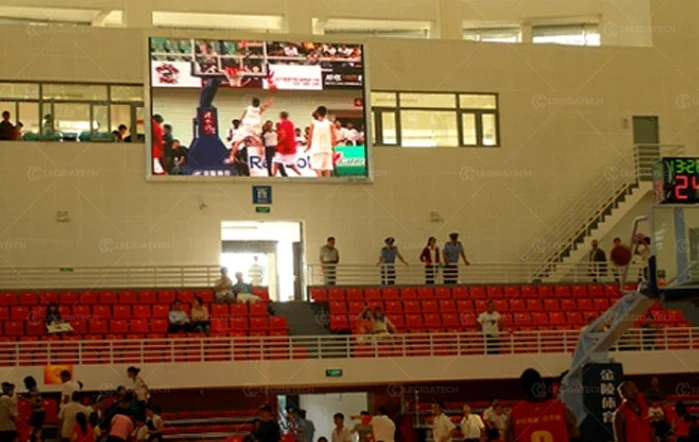
Before finalizing any bulk B2B purchase, it is highly critical to evaluate the P3.91 outdoor LED screen factory price against rigorous engineering benchmarks rather than surface-level quotes.
This analysis dissects the true cost drivers for a 50sqm installation, equipping global integrators with the technical audit criteria necessary to verify supplier claims.
From pixel load calculations per Novastar HUB75 port to thermal dissipation limits and wind load structural requirements, the following sections provide a transparent, component-level breakdown of wholesale pricing, ensuring procurement decisions are grounded in verifiable performance data and long-term total cost of ownership.
Next, I will explain this in detail as an LED display manufacturer with 15 years of experience in the industry.
P3.91 Outdoor LED Screen Factory Price: Component Cost Breakdown per Square Meter
LED Chip & Driver IC Cost Breakdown
When calculating the P3.91 outdoor LED screen factory price, LED chip bin classification and driver IC specification stand as the two biggest variable cost drivers.
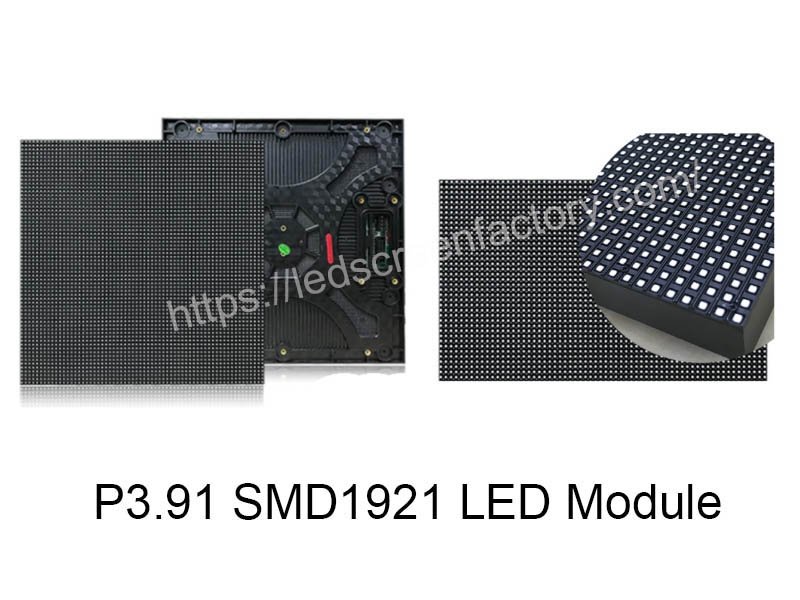
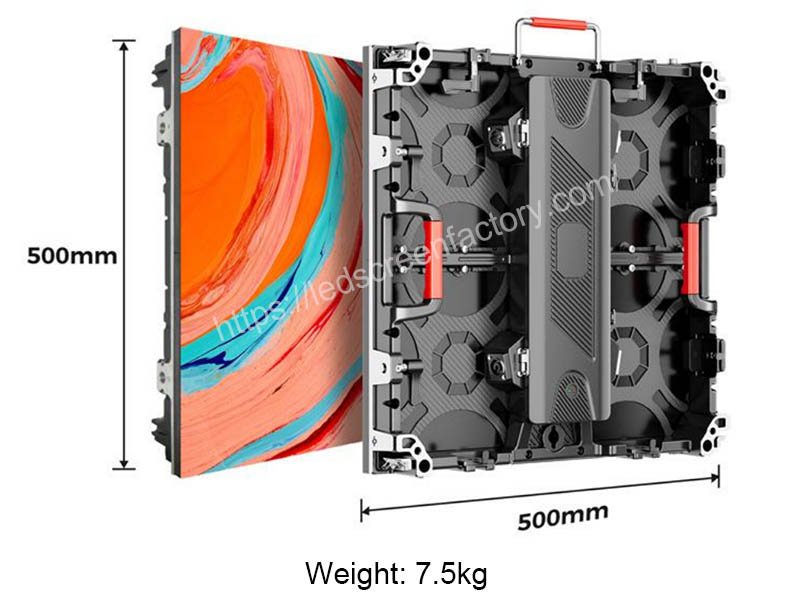
As an LED screen supplier, our standard unit adopts a 500×500 mm cabinet with die-cast aluminum with a 64×64 pixel layout.
Reputable premium manufacturers fit these cabinets with high-luminance SMD 1921 or 2727 lamp beads that deliver a minimum brightness output of 6500 nits.
If raw LED components are purchased directly from tier-one manufacturers, including Nationstar and Kinglight, the standalone material cost of these chips falls between $180 and $250 per square meter.
To cut down the P3.91 outdoor LED screen factory price by 15% to 20%, low-end manufacturers often switch to dimmer LEDs or chips with loose binning standards.
This cost-saving measure comes with clear drawbacks: uneven color performance and rapid brightness attenuation after long-term operation.
Driver IC selection also exerts a huge influence on the final P3.91 outdoor LED screen factory price and overall display quality.
High-grade 16-bit PWM constant-current driver ICs (ICND2153 and MBI5153 as mainstream models) deliver a 3840Hz high refresh rate and 14-bit grayscale depth, which are mandatory standards for premium stadium screens and commercial advertising billboards.
Such professional driver ICs add an extra material cost of $45 to $65 per square meter. Any supplier quoting an unusually low P3. 91 outdoor LED screen factory prices usually equips panels with inferior 8-bit or 12-bit drive ICs.
These low-spec chips lead to obvious screen flicker under normal viewing conditions and cannot satisfy broadcast-level display standards.
Power Supply and Cabinet Structure
Power supplies and cabinet structures are another key factor that determines the final P3.91 outdoor LED screen factory price. For a standard 50sqm LED display project, around 100 pieces of 500×500mm cabinets are required to complete the full setup.
We adopt certified Mean Well or equivalent industrial-grade power supplies. These 200W high-efficiency PSUs deliver over 90% energy efficiency and cost between $18 and $25 per unit.
While unbranded generic power supplies are available for less than $10 each, they cannot meet industrial outdoor standards.
Most cheap PSUs fail the 240-hour ASTM B117 salt spray test and feature unstable performance with higher failure rates, which leads to higher maintenance costs in the long run.
Our standard die-cast aluminum cabinet with a zinc-plated inner frame costs $80 to $120 per unit. The price includes high-precision machining that ensures a flatness tolerance below 0.5 mm, as well as front and rear IP65 sealing gaskets for reliable outdoor waterproof and dustproof protection.
When you compare the P3.91 outdoor LED screen factory price from different vendors, professional and trustworthy suppliers will always provide a complete, detailed BOM (Bill of Materials) with clear cost breakdowns for every component.
For bulk orders of 50 sq m, volume discounts apply, lowering cabinet costs by 8–12% and PSU costs by 5–10%. After discount adjustments, the overall core hardware cost typically falls within $350 to $450 per square meter.
Assembly, Testing, and Overhead
Assembly labor, full performance testing, and factory operating expenses make up the last portion of costs that directly affect the overall P3.91 outdoor LED screen factory price.
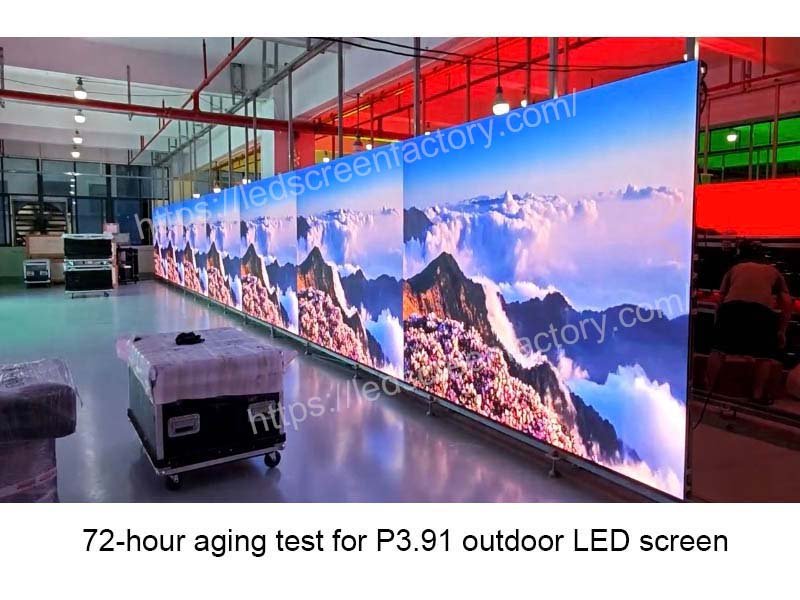
For a 50sqm bulk order, all related assembly and testing work adds an extra cost of $50 to $80 per square meter. This charge covers full SMT mounting labor and handwave soldering for all connectors, plus the non-negotiable 72-hour continuous burn-in aging test.
Every cabinet will be precisely calibrated via photometric cameras to hit a strict ΔE < 2 color consistency standard, with pixel-level calibration data fully recorded and verified.
Some manufacturers cut corners by removing these complete testing procedures to quote a cheaper P3.91 outdoor LED screen factory price.
However, screens produced without full calibration will show obvious, inconsistent color shifts across the whole wall, which cannot meet the display standards of high-end advertising projects.
Technical Specifications That Impact the P3.91 Outdoor LED Screen Factory Price
Brightness, Power, and Thermal Management
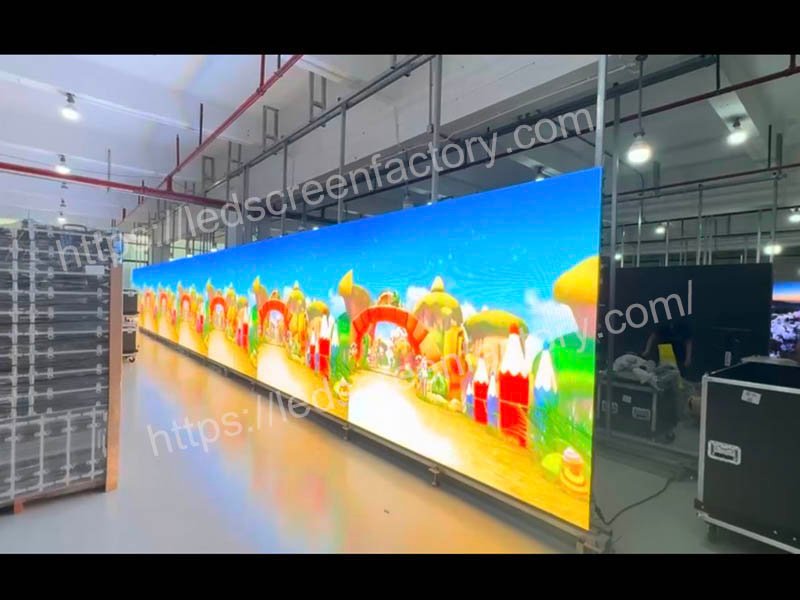
The rated 6,500 nits brightness of a P3.91 outdoor LED video wall is far more than a marketing selling point — it is a core engineering parameter that directly shapes the P3.91 outdoor LED screen factory price.
To reach this high brightness output, SMD 2727 lamp beads need to operate under a larger driving current, which inevitably raises the chip junction temperature.
Reliable manufacturers cap the maximum junction temperature at 85°C and apply professional thermal interface materials (TIM) between the LED circuit board and aluminum cabinet to deliver efficient heat dissipation.
We can calculate heat dissipation with the formula Q = h * A * ΔT. A single 500×500 mm cabinet has a heat dissipation area A=0.25 m². Under natural convection conditions (h=25 W/m²K) and a 30°C temperature difference, the cabinet can only release up to 187.5W of heat.
Yet a standard P3.91 cabinet consumes an average of 250W, with peak power reaching 800W per square meter. This makes active cooling solutions, such as built-in cooling fans or rear-mounted heat sinks, an indispensable design.
Some manufacturers cut thermal management configurations to quote a lower P3.91 outdoor LED screen factory price. Without proper heat dissipation design, LED chips will age much faster, and the actual service life will drop far below the official rated 100,000 hours.
Weight and Structural Integrity
The standard 500×500mm die-cast aluminum cabinet for P3.91 outdoor SMD LED displays weighs 7.5 kg.
This standard weight is achieved by adopting 2.0mm thick aluminum alloy material with built-in reinforcing ribs, which is specially structured to meet professional wind load resistance requirements.
For a typical 50sqm LED screen project, the total cabinet weight reaches approximately 1,500 kg, excluding the external steel support structure.
The supporting steel frame must be engineered to withstand standard wind pressure calculated by the formula: P = 0.613 × V² × C. Under extreme wind conditions of 50 m/s (180 km/h) with a shape coefficient of 1.3, the wind pressure lands at 1,992 Pa. Covering a 50sqm display surface, this generates a total lateral wind force of 99.6 kN.
Many suppliers offer a more competitive P3.91 outdoor LED screen factory price by compromising cabinet construction. They use thinner 1.2–1.5mm cabinet walls and reduce internal reinforcement bracing.
Although this cuts production costs, such an inferior structural design easily causes panel deformation and pixel misalignment under strong wind pressure, greatly compromising overall screen stability and flatness.
Refresh Rate and Data Load Verification
For P3.91 outdoor LED billboards deployed in stadium venues and live event stages, a 3,840Hz high refresh rate is an essential standard to eliminate camera scan lines during video shooting and live broadcasting. High-grade 16-bit PWM driver ICs and stable, high-performance receiving cards enable this superior display performance.
Each Novastar HUB75 port has a fixed data load limit of 650,000 pixels under 60 Hz frequency and 8-bit color depth conditions.
Since a P3.91 outdoor LED screen contains 65,536 pixels per square meter, a single HUB75 port can stably drive a maximum of 9 cabinets, calculated as floor(650,000 / 65,536) = 9.
For a standard 50 sqm LED screen project consisting of 100 cabinets, no fewer than 12 Novastar A8 receiving cards are required to maintain consistent full-refresh and high-definition display performance.
Some manufacturers lower their P3.91 outdoor LED screen factory price by cutting hardware configurations and falsely claiming support for more panels per single port.
In fact, this is only achieved by reducing the refresh rate or lowering the color bit depth. Both improper adjustments will severely compromise the overall image uniformity, clarity, and professional display quality of the LED screen.
Quality Assurance and Testing: Ensuring Value at the P3.91 Outdoor LED Screen Factory Price
IP65 Certification and Environmental Stress Testing
The rigor of environmental durability testing is one of the key factors that determines the final P3.91 outdoor LED screen factory price.
True IP65-rated outdoor cabinets must complete a minimum 240-hour ASTM B117 salt spray test, with zero corrosion or oxidation on aluminum cabinet frames and metal fasteners.
To meet this industrial standard, premium-grade configurations are mandatory, including 316 stainless steel screws and 2.0mm thick powder-coated die-cast aluminum housings.
In contrast, cost-effective manufacturers often adopt zinc-plated fasteners and thinner 1.2mm cabinet walls to lower the P3.91 outdoor LED screen factory price.
These compromised constructions typically fail the salt spray test within 72 hours, resulting in early rust formation, water penetration, and accelerated aging, especially for projects located in coastal and high-humidity areas.
For 50sqm large-scale P3.91 outdoor LED billboards installed in marine environments, long-term corrosion resistance is non-negotiable. Any cutting of material or testing standards should be clearly identified during factory inspection and quality audits.
72-Hour Burn-In and Vibration Testing
Every cabinet manufactured for P3.91 outdoor LED video walls must undergo a strict 72-hour continuous burn-in test. The full aging process is conducted under a constant ambient temperature of 55°C, running at full white brightness of 6,500 nits with a 50% duty cycle.
This standardized high-stress test effectively eliminates early-stage failures of LED chips and power supplies caused by manufacturing defects, with a strict allowable pixel failure rate controlled below 0.1% during the entire burn-in period.
After completing thermal aging, all cabinets further pass the IEC 60068-2-6 professional vibration test.
The test adopts a sinusoidal frequency sweep ranging from 10Hz to 150Hz under 2g acceleration, with 10 test cycles for each axis. It accurately simulates mechanical vibration and oscillation stress generated during long-distance transportation and on-site wind load shaking.
Many low-cost suppliers simplify or completely skip these critical testing steps to offer a more competitive P3.91 outdoor LED panel price list. Delivering untested cabinets reduces factory costs but transfers hidden failure risks to the client, easily causing unstable operation and abnormal damage after official installation.
Color Uniformity and Calibration Precision
To achieve a professional ΔE < 2 color uniformity across a full 50 sq m P3.91 outdoor LED display, precise pixel-level calibration with 14-bit or 16-bit grayscale processing is essential.
During factory production, every individual LED lamp is tested for accurate chromaticity coordinates (x, y) and luminance value (Y). The system then writes customized correction coefficients into each module’s EEPROM to standardize visual performance across the entire screen.
Without this detailed calibration process, P3.91 outdoor SMD LED displays will show obvious color patches and uneven brightness, especially when operating at low grayscale levels below 10% brightness.
Premium manufacturers adopt professional camera systems paired with high-precision spectrophotometers to control full-screen brightness uniformity within a ±3% tolerance.
All calibration data is fully backed up and compatible with receiving card systems, allowing seamless data migration for field-replaced modules and maintaining consistent color performance throughout the display’s long-term operation.
Total Cost of Ownership: Beyond the P3.91 outdoor LED display cost per square meter
When evaluating a 50sqm outdoor LED project, the upfront P3.91 outdoor LED display cost per square meter only covers part of the overall total cost of ownership (TCO).
A comprehensive assessment of the P3.91 outdoor LED screen factory price should also factor in long-term power consumption, spare part reserves, and equipment operational reliability.
For a standard 6,500-nit outdoor LED display with an average power consumption of 250 W per square meter, the annual power usage is calculated as 250 W/sqm × 50 sqm × 12 hours/day × 365 days = 54,750 kWh per year.
With a standard industrial electricity rate of $0.10/kWh, the entire screen incurs an annual power cost of $5,475, equal to $109.5 per square meter each year.
Manufacturers that adopt energy-efficient driver ICs and advanced common cathode technology can cut power consumption by 25% to 30%. This significant energy-saving advantage greatly optimizes return on investment and lowers the long-term operational costs beyond the initial P3.91 outdoor LED display cost per square meter.
Maintenance and Spare Parts Logistics
The on-site failure rate is the core indicator that reflects the reliability of a P3.91 outdoor LED video wall. Trustworthy high-end suppliers promise an annual pixel failure rate below 0.1%.
A full 50sqm screen contains 3,276,800 pixels in total (calculated as 65,536 pixels per square meter × 50 sqm), so the number of faulty pixels will not exceed 3,277 within one year under normal operation.
Each replacement LED module for P3.91 outdoor SMD LED displays generally costs around $30. Even under the worst operating condition with 10 damaged modules per year (equivalent to a 0.03% failure rate), the material expense for replacements only hits $300 annually.
That said, on-site service labor fees are far more costly: dispatching technicians to stadium or high-rise venues for module replacement can cost over $200 per service trip.
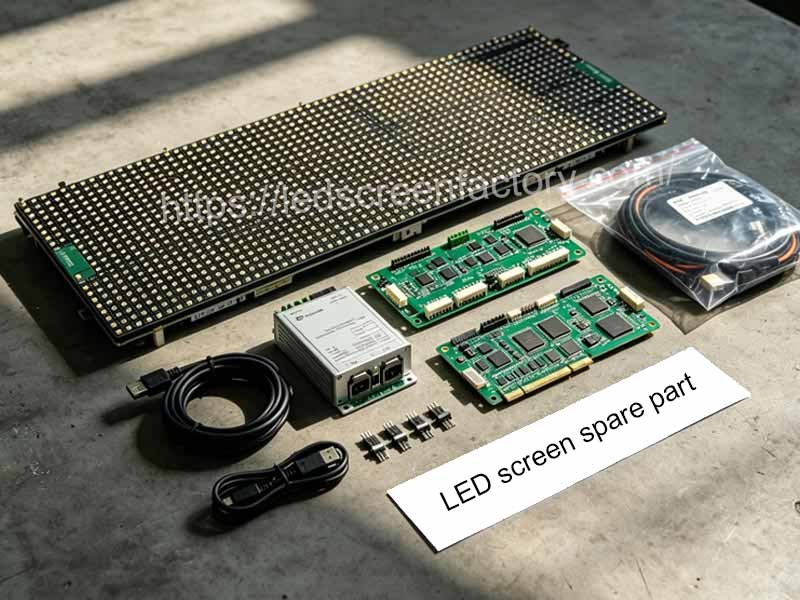
For this reason, official P3.91 outdoor LED screen installation guidance advises clients to prepare a 5% spare parts kit in advance. Around 10 spare modules are suitable for a 50sqm project, which helps prevent business downtime and extra charges for urgent express delivery.
Thermal Management and Lifespan Projection
LED chip service life is strictly governed by thermal dissipation performance, calculated through the standard heat transfer formula: Q = h * A * ΔT.
For a standard 500×500 mm P3.91 LED cabinet with a heat dissipation area (A) of 0.25 m², a natural convection coefficient (h) of 15 W/m²K, and a maximum allowable temperature rise (ΔT) of 30°C, the maximum sustainable heat dissipation capacity reaches 112.5W per cabinet.
When the actual operating power exceeds this threshold, LED chip junction temperatures will rise above 85°C. Excessive operating heat accelerates brightness attenuation, triggers a gradual color shift, and drastically shortens the display’s usable lifespan.
Many suppliers offer a competitive P3.91 outdoor LED panel price list without clearly stating thermal structure specifications or maximum ambient operating temperature (rated at 50°C for industrial-grade screens). These low-cost models usually adopt downgraded, undersized heat sinks.
As a result, their actual lifespan drops to only 50,000 hours, far below the industry standard of 100,000 hours. This hidden quality gap greatly influences bulk buyers’ P3.91 outdoor LED screen wholesale purchasing decisions.
A 50% reduction in service life essentially doubles the display’s annualized operational cost, making seemingly low-priced panels far less cost-effective in the long run.
Conclusion / Summary
For global LED project integrators, evaluating the P3.91 outdoor LED screen factory price should never rely solely on the upfront unit cost. Instead, purchasing decisions must focus on achieving the lowest total cost of ownership throughout the full 10-year product lifecycle.
A P3.91 outdoor LED display cost per square meter that is 15% lower than the average market rate typically comes with hidden quality compromises, including downgraded thermal management systems, low-efficiency driver ICs, and substandard cabinet alloy materials.
All technical audit standards outlined in this document form the mandatory baseline for any 50sqm P3.91 outdoor LED screen procurement project.
This includes core criteria such as the Novastar HUB75 pixel load limit of 9 panels per port and the minimum 240-hour ASTM B117 salt spray test certification.
A reasonable P3.91 outdoor LED display cost per square meter must be benchmarked against verified engineering parameters, including the 1992 Pa wind pressure resistance for 50 m/s wind speeds and the 187.5W maximum heat dissipation capacity of a standard 500×500mm cabinet.
Any supplier unable to provide official certified test reports for these critical specifications is unqualified for high-standard stadium and commercial billboard projects.
A professional P3.91 outdoor LED panel price list should be fully transparent, reflecting complete engineering quality rather than merely serving as a flexible negotiation starting point.
For a standard 50sqm project, the initial price gap between fully compliant and non-compliant LED screens is usually less than 8%. However, the difference in service lifespan, operational stability, and long-term maintenance risks between the two is exponentially significant.
Related Project About P3.91 Screen
P3.91 Outdoor LED Screen Stadium LED Screen 3x2m in Nigeria——Metastar Series
P3.91 Outdoor Rental LED Screen to France
Outdoor P3.91 Stage LED Display Screen Project In Tanzania-LEGIDATECH
P3.91 Outdoor Rental LED Screen Shipped to USA
p3.91 outdoor led screen to Malaysia-Quick Guide
Related Posts About P3.91 Screen
P3.91 LED Module-Detailed guidance
A Comprehensive Introduction to P3.91 LED Screen-magic
Rental LED Screen Price Quick Guide
FAQ: Real B2B LED Industry Queries Answered
Q: How much does an outdoor LED screen cost?
A: The cost of an outdoor LED screen varies based on pixel pitch, size, and brightness. For a high-end P3.91 outdoor LED screen, expect a factory-direct price ranging from $800 to $1,200 per square meter for the complete screen (die-cast aluminum cabinets with IP65 protection, power supply and receiving cards included — not the bare material cost). For indoor rental configurations of the same pitch, see the P3.91 range of $750–$980/m² in our rental LED screen price guide. For a precise quote, request a custom configuration from a reliable LED screen factory. A practical tip: always verify the brightness level (≥5,000 nits) to ensure sunlight readability.
Q: What is the cost of an outdoor LED screen panel?
A: An outdoor LED screen panel’s cost depends on pixel pitch and cabinet material. For a P3.91 outdoor LED screen factory price, a single 500x500mm panel typically ranges from $200 to $300. These panels feature high refresh rates (≥1920Hz) and robust waterproofing. When budgeting, consider that premium panels offer better color consistency and longer lifespan. Always request a sample to test durability before bulk purchase.
Q: How much does a P3.91 LED screen weigh?
A: A standard P3.91 outdoor LED screen cabinet (500x500mm) weighs approximately 7-8 kg per panel, thanks to lightweight die-cast aluminum construction. This weight ensures easy installation and structural stability. For a full display, total weight depends on size; a 10m² screen weighs around 300-320 kg. When planning, confirm the load-bearing capacity of your mounting structure. For the best value, check the P3.91 outdoor LED screen factory price directly from a trusted LED factory supplier.