Virtual production has stopped being a technology demo and become a line item in studio budgets. Ever since The Mandalorian proved that actors could perform inside a real-time digital environment, every production company, rental stage, and broadcast facility has had to answer one question: what does a virtual production LED wall cost? The honest answer runs from the price of a used car to the price of a blockbuster season — an 80 ft diameter LED volume of the kind used on The Mandalorian runs $8–16 million with rendering equipment included, excluding labor, according to virtual production veterans interviewed by Copilot Co. That headline number, however, hides a market with far more affordable entry points. This guide breaks down virtual production LED wall cost at every tier — per square meter, per component, and per configuration — including factory-direct pricing that reseller quotes never show you.
Short answer: A camera-ready virtual production LED wall costs $15,000–$80,000 as factory-direct hardware for a small studio wall, $150,000–$500,000 for a mid-size indie volume, and $4–16 million for a Hollywood-class ICVFX stage built by an integrator. Per square meter, camera-grade fine-pitch panels run $900–$2,500 factory-direct, versus the $1,000–$3,000+ range US integrators quote (Royal Display, 2026). Hardware is only part of the budget: processors, camera tracking, genlock, and a roughly 14-person operating team push complete ICVFX volumes toward the multi-million mark. Buying factory-direct compresses that total by roughly 2–3x against reseller pricing.
What Is a Virtual Production LED Wall?
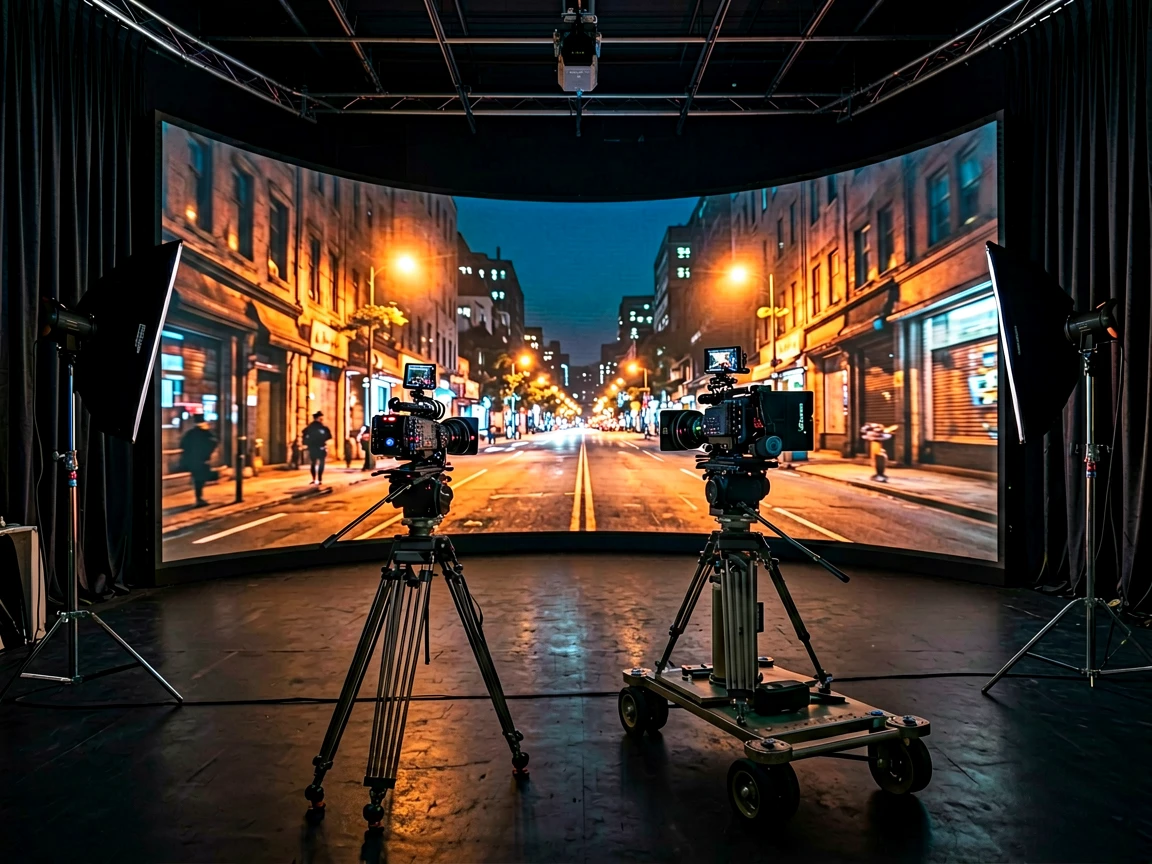
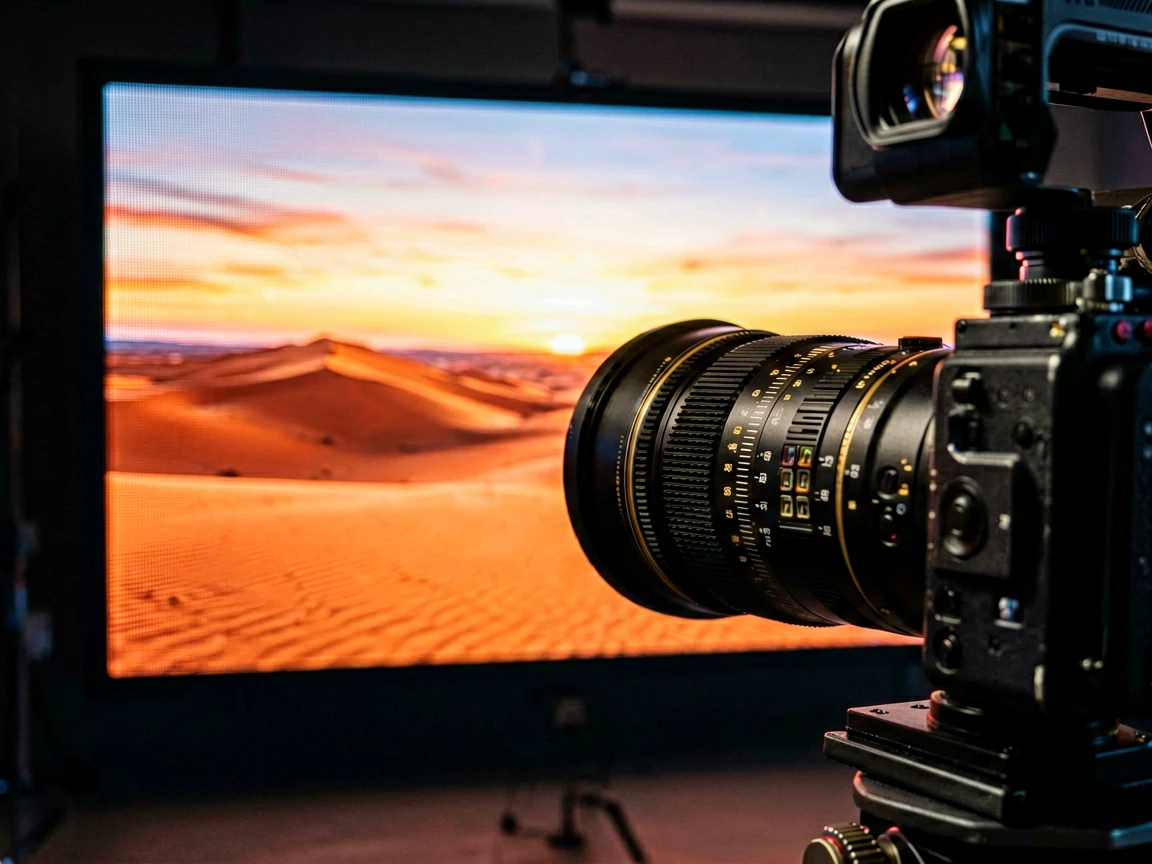
A virtual production LED wall is a large LED display built for camera work that shows real-time rendered digital environments behind actors during filming, replacing green screens with backgrounds that are captured in camera. Driven by a real-time engine such as Unreal Engine and synchronized to the camera through a tracking system, the wall updates perspective, lighting, and reflections as the camera moves, so what the sensor records is close to the finished shot.
That camera-facing job is also what separates a virtual production LED wall from an ordinary LED video wall in a conference room or retail lobby. The panel, its driver ICs, and its calibration are selected for how a lens sees the image — flicker at a given shutter angle, moiré from pixel structure, color shift at low brightness — not for how a standing audience does. Cost follows the same logic: three hardware groups set the budget, and they are priced differently everywhere in the world.
- LED panels and cabinets — typically 60–70% of total hardware spend (ARwall cost analysis)
- Video processing and control — the processor layer that maps rendered content onto the wall
- Tracking and synchronization — camera tracking, genlock, and timecode that keep background and sensor locked together
How Much Does a Virtual Production LED Wall Cost in 2026?
The virtual production LED wall cost ladder has three rungs, and the spread between them is wide because the job changes, not just the size. A wall for car-process photography and interviews is a different purchase from a fully enclosed ICVFX volume with a ceiling and wild walls. The table below shows both sides of the market: what the hardware costs sourced factory-direct from an LED screen manufacturer, and what turnkey integrator builds cost in North America and Europe.
| Configuration | Typical size | Factory-direct hardware | Turnkey integrator build |
|---|---|---|---|
| Small camera-ready wall (interviews, product film, 2D playback) | 4–6 m × 2.5–3 m | $15,000–$80,000 | $40,000–$150,000 |
| Mid-size indie volume (curved main wall + ceiling, episodic TV, commercials) | 10–14 m × 3.5–5 m | $150,000–$500,000 | $500,000–$1,500,000 |
| Full ICVFX volume (enclosed stage, ceiling, wild walls, feature film) | 20 m+ diameter | $1,000,000–$3,000,000 (hardware share) | $4,000,000–$16,000,000 |
The turnkey column is anchored to published figures: ARwall places small studio configurations at $500,000–$1.5 million and large Hollywood installations at $4–15 million, while Copilot Co’s expert interviews put a Mandalorian-scale 80 ft volume at $8–16 million excluding labor. The factory-direct column is the hardware share of those same builds, priced from the manufacturing side. Neither column includes the tracking, processing, and integration layer — that comes next.
What Does a Virtual Production LED Wall Cost Per Square Meter?
Per-square-meter pricing is where factory-direct and reseller quotes diverge the most. Published industry guides put general indoor LED displays at $400–$1,500 per square meter; camera-ready builds sit at the top of that band and above it, because of high-refresh driver ICs, tighter LED binning, and per-cabinet calibration.
| Pixel pitch | On-camera use | Factory-direct per m² | US market reference per m² |
|---|---|---|---|
| P2.6 | Wide shots, driver plates, backings | $600–$900 | $3,000–$8,000 (ARwall, 2.6 mm class) |
| P1.8–P2.3 | Standard ICVFX main walls | $900–$1,800 | $1,000–$3,000+ (Royal Display, 2026) |
| P1.2–P1.5 | Close-up work, tabletop, product film | $1,800–$2,800 | $3,000–$8,000 (ARwall, fine-pitch class) |
| P0.9 | Extreme close-up, shallow depth of field | $8,000–$15,000 | $15,000–$25,000 (ARwall, 0.9 mm class) |
The same pitch-to-price logic that applies to a standard indoor LED screen price guide applies here, with a camera-ready premium on top. Final pricing depends on cabinet size, driver IC selection, brightness class, and calibration scope — request a quote with your camera and shot list before locking a budget.
What Drives the Cost of a Virtual Production LED Wall Per Square Meter?
How Pixel Pitch Moves LED Wall Pricing
Pixel pitch is the distance between pixel centers, and it decides how close the camera can work before the wall’s pixel structure shows up as moiré. Finer pitch multiplies LED count per square meter, which is why price climbs steeply below P1.5 — diode cost dominates the bill of materials. Production expert Phillip Galler framed the trade in an interview with Copilot Co: resolution is a chase with no finish line, because cameras keep gaining pixels; the practical move is matching pitch to the closest planned camera position instead of buying the finest pitch available. A P1.8 LED display is the workhorse class for main walls, with finer pitches reserved for close-up work.
Why High Refresh Rates and Driver ICs Add Cost
A wall that looks perfect to the eye can still band or flicker through a lens. Refresh rates of 3840 Hz or higher are the baseline for cinema work, and high-speed or variable-shutter shots push toward 7680 Hz. What buyers actually pay for is the driver IC and scan design behind the refresh number — camera-rated ICs hold stable grayscale and color at the 200–600 nit brightness levels studios actually shoot at, which budget ICs cannot do. This is the least visible cost line on a specification sheet and the one that most often separates a wall that tests well from one that tests badly.
What Calibration and Binning Do to the Price
Two cabinets with identical specifications can photograph differently if their LEDs come from different bins or were calibrated at different brightness levels. Factory-side costs that protect on-camera performance include tight binning at order time, per-cabinet calibration data you can inspect, and low-brightness grayscale verification — the regime where crushed shadows and color shift appear on set. ARwall’s analysis notes that panel-to-panel uniformity issues are hard to fix after installation, which is why calibration scope belongs in the purchase contract, not in the punch list.
What Does a Complete ICVFX Volume Cost Beyond the LED Wall?
The wall is the largest line, not the last one. Copilot Co’s cost breakdown lists camera systems, camera tracking, timecode genlock, LED processors, and PC builds as the components that turn panels into a working volume — and, on large projects, a team of roughly 14 specialists to run them.
| Component | Typical cost | Source |
|---|---|---|
| Video processor / controller layer | $15,000–$100,000 factory-direct; $50,000–$200,000 via integrators | ARwall; LSF factory pricing |
| Media servers / render nodes (Unreal Engine) | $20,000–$150,000 | Industry estimate |
| Camera tracking system | $30,000–$100,000+ | Industry estimate |
| Genlock / timecode synchronization | $2,000–$10,000 | Industry estimate |
| Mounting and structural systems | $20,000–$100,000 | ARwall |
| Installation and commissioning | 25–40% of hardware; $10,000–$50,000 commissioning | ARwall |
| Operating team | ~14 specialists on large projects (LED supervisor, tracking, systems, virtual art department) | Copilot Co interviews |
The processor layer deserves as much scrutiny as the panels: it carries the calibration, the genlock chain, and the latency budget of the whole system. Our LED video wall controller buying guide and the Huidu vs NovaStar comparison cover how to evaluate that layer in detail.
Virtual Production LED Wall vs Green Screen: Which Costs Less?
A green screen wins any comparison of day rates; an LED wall wins the comparison that actually decides budgets — total cost per finished minute of footage. Compositing, lighting fixes, and reshoots from mismatched reflections are where green screen invoices grow, while an LED wall moves most of that work into setup and amortizes it across every project the stage hosts.
| Aspect | Virtual production LED wall | Green screen |
|---|---|---|
| Upfront investment | $15,000–$16,000,000 depending on scale | Near zero — fabric and lighting |
| Cost per project | Stage time plus content prep | Low on set, high in post: $5,000–$50,000+ per complex shot (industry estimate) |
| Lighting and reflections | Captured in camera from the wall itself | Recreated artificially in post |
| Post-production load | Reduced — backgrounds already final | Heavy compositing on every shot |
4 key differences between the two cost models:
- Where the money is spent: LED walls concentrate spend before the shoot; green screens concentrate it after.
- How cost scales: green screen post work scales with shot count; LED wall content cost scales with scene count, then repeats for free.
- Who carries the risk: compositing mistakes surface late on green screen; on an LED wall most artifacts surface during the camera test, while they are still free to fix.
- Where the break-even sits: productions with recurring stage work cross into LED wall territory faster than one-off projects, which remain cheaper on green screen.
Why Is Factory-Direct LED Wall Pricing 2–3x Lower Than Reseller Quotes?
US retail listings make the spread visible. A 10×5 ft P2.9 turnkey package with NovaStar processing lists at $10,950–$15,268 at DVS LED Systems; B&H’s LED volume category starts around $17,000 for a kit; a single P2.5 panel for virtual production lists at $12,089 at LED Market USA. The same cabinet class, purchased from the factory that builds it, prices at a fraction of those figures — the difference is brand margin, layers of distribution, and local service overhead, not the panels themselves.
Buying factory-direct shifts work onto your side of the table, so price the trade honestly. What a factory relationship expects from you: a defined shot list and camera package up front, and acceptance testing against your own lens and shutter settings. What you should demand in return: per-cabinet calibration data, an on-camera test video of your actual configuration before shipment, a spare-parts percentage included in the order, and firmware and control-system support for the processor layer. Our virtual production LED wall and XR stage screens page shows the cabinet classes behind these price bands, and the EXR stage system details a complete main-wall-plus-ceiling configuration.
Should You Rent or Buy a Virtual Production LED Wall?
Most productions rent, and the rental market has clear tiers. Copilot Co’s interviews with operators put 2D plate playback — the car-process work that makes up most industry volume — at $50,000–$75,000 per week, standing stages at $35,000–$50,000, and pop-up volumes at $100,000–$250,000 per week mid-size or $100,000–$400,000 for large enclosed builds.
| Rental type | Typical weekly rate |
|---|---|
| Standing stage (equipment included in space rental) | $35,000–$50,000 |
| 2D plate playback / car process | $50,000–$75,000 |
| Medium pop-up volume (some tracking included) | $100,000–$250,000 |
| Large pop-up volume (80 ft, near-360°, 20–30 ft tall) | $100,000–$400,000 |
Buying pencils out for operators with consistent bookings. ARwall’s investment analysis places premium stage day rates at $25,000–$75,000 and payback periods at 2–5 years, with facilities above 70% utilization recovering investment in 24–36 months. The screen-ownership math resembles the digital billboard revenue model: the purchase price you negotiate determines how quickly a booked asset turns into income, which is why the pixel pitch ROI trade-offs in our P3 vs P4 ROI analysis matter here too. A practical rule: fewer than eight to ten rental weeks per year, rent; a pipeline of recurring stage work, buy factory-direct.
Which Specifications Make an LED Wall Camera-Ready?
Specification sheets describe walls for audiences; camera work needs a different checklist. Royal Display’s 2026 guide recommends P1.2–P2.5 pitch, refresh of 3840 Hz or higher, 600–1,500 nits of adjustable brightness, DCI-P3 or wider color gamut, and viewing angles of 140° or more for production walls. To that list, add the items that only show up through a lens.
| Specification | Camera-ready standard | Why it matters on set |
|---|---|---|
| Pixel pitch | P1.2–P2.6 | Sets closest camera position before moiré |
| Refresh rate | ≥3840 Hz; 7680 Hz for high-speed work | Flicker and banding control at working shutter angles |
| Brightness | 600–1,500 nits, stable and adjustable | Matches practical lighting without overexposure |
| Color gamut | ≥DCI-P3 | Skin tone and environment accuracy |
| Low-brightness grayscale | Verified at production brightness levels | Prevents crushed shadows and color shift in dark scenes |
| Synchronization | Genlock across camera, render, processor, wall | Eliminates tearing and rolling bands |
| Panel uniformity | Per-cabinet calibration data supplied | Uniformity faults are visible on camera but not to the eye |
Before signing, run the acceptance test Royal Display and Copilot Co both press on: shoot your actual camera, lens, frame rate, and shutter angle at the brightness you will produce at, and inspect gradients, dark scenes, and motion for moiré, scan lines, and banding. A factory confident in its calibration will run that test with you; one that will not has answered your question about the price difference.
Frequently Asked Questions About Virtual Production LED Wall Cost
How much does a virtual production LED wall cost per square meter?
Camera-grade fine-pitch panels run $900–$2,500 per square meter factory-direct depending on pitch and refresh class. US integrator guides quote $1,000–$3,000+ per square meter for standard builds, rising to $15,000–$25,000 per square meter for 0.9 mm ultra-fine panels (Royal Display 2026; ARwall).
How much does a small LED volume cost for an indie studio?
A small camera-ready wall of 4–6 m × 2.5–3 m costs $15,000–$80,000 as factory-direct hardware, or $40,000–$150,000 installed through an integrator. Add processing and tracking before the wall is usable for tracked shots — roughly $50,000–$200,000 more at indie scale.
Is it cheaper to rent or buy a virtual production LED wall?
Productions using a stage fewer than eight to ten weeks per year save money renting at $35,000–$75,000 per week. Operators with recurring bookings buy: factory-direct hardware of $150,000–$500,000 for a mid-size volume pays back in 2–5 years, and facilities above 70% utilization recover cost in 24–36 months (ARwall).
What pixel pitch do I need for a virtual production LED wall?
Match pitch to the closest camera position: P1.8–P2.3 covers standard ICVFX main walls, P1.2–P1.5 serves close-up and tabletop work, and P2.6 is enough for wide shots and driver plates. Finer pitch raises cost steeply, so buy resolution the shot list uses.
How much does it cost to run an LED volume?
Operating cost combines power, content, and crew. Large walls draw 100–500 kW during operation (ARwall), Unreal Engine content runs $5,000–$50,000 per scene at industry rates, and large projects carry teams of about 14 specialists (Copilot Co). Renters see all of this inside the weekly rate; owners budget it annually.
Why are LED walls for virtual production so expensive?
Because the specification is camera-grade end to end: fine-pitch LED counts, camera-rated driver ICs, per-cabinet calibration, and the processor, tracking, and synchronization layers around the panels. Integrated turnkey builds add 25–40% for installation and commissioning. Factory-direct purchasing removes the distribution layers — the hardware itself is the smallest part of the spread.
References & Data Sources for Virtual Production LED Wall Cost
The Bottom Line: Virtual Production LED Wall Cost
So, what does a virtual production LED wall cost? A small camera-ready wall is a $15,000–$80,000 factory-direct purchase, a mid-size indie volume is $150,000–$500,000 in hardware, and a Hollywood-class ICVFX stage runs into millions once processing, tracking, and integration stack on top. The per-square-meter rate is set by pitch and driver electronics; the total is set by who assembles the system. That last line is the one you control: sourced from the LED screen manufacturer instead of a distribution chain, the same wall prices 2–3x lower — and the payback math that ARwall puts at 2–5 years compresses with it. Define the shot list, demand the camera test, and buy the specification the footage actually needs.