One question sits at the center of every landowner, media company, and investor conversation in outdoor advertising: how much do digital billboards make? The short version is that a single screen has become a rotating inventory of six to ten advertising slots instead of one printed face — and the market around it keeps expanding. According to the Out of Home Advertising Association of America (OAAA), US out-of-home revenue reached a record $9.46 billion in 2025, up 3.6% year over year, the industry’s 19th consecutive quarter of growth, with digital out-of-home (DOOH) taking 36.3% of total OOH revenue.
Short answer: Most digital billboards earn $1,500–$5,000 per month in smaller markets, $5,000–$15,000 in suburban corridors, and $10,000–$50,000+ in major metro locations, based on industry ranges compiled from Blip Billboards and MegaSign. A digital face generates roughly 4–6x the revenue of a static billboard because it sells 6–10 rotating slots instead of one. The screen itself is the cost line you control most: sourced factory-direct from an LED screen manufacturer, a highway-size LED face costs a fraction of domestic turnkey prices — which is how payback compresses from the 3–7 years commonly quoted for US-built units toward 2–5 years.
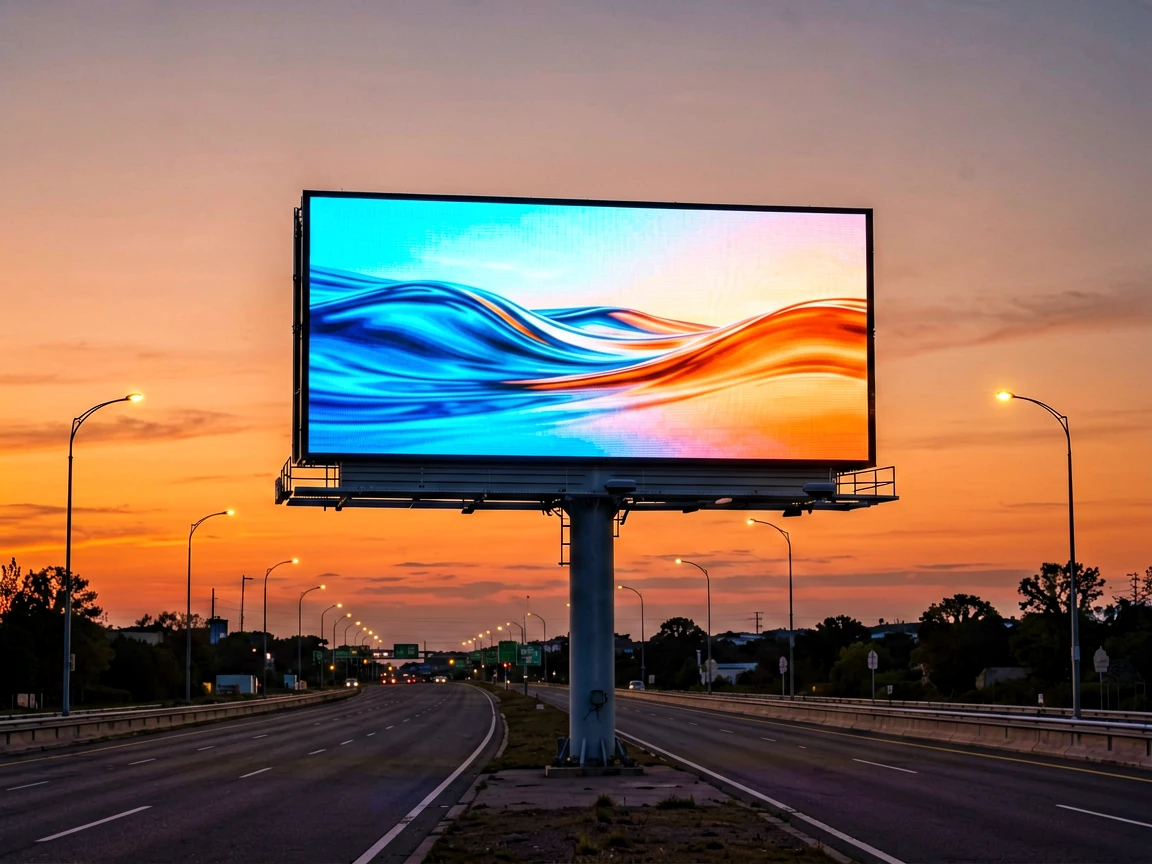
How Much Do Digital Billboards Make Per Month?
Monthly revenue follows the market tier the structure stands in. The ranges below are gross advertising income — before land lease, electricity, permits, and maintenance — compiled from industry guides published by Blip Billboards, MegaSign, and LSI Media in 2025–2026.
| Market tier | Typical monthly revenue | Typical annual revenue | What drives the range |
|---|---|---|---|
| Rural highway / small town | $1,500 – $5,000 | $18,000 – $60,000 | Lower traffic counts and ad rates, steady local demand |
| Suburban / small city | $5,000 – $15,000 | $60,000 – $180,000 | Commuter traffic, retail and service advertisers |
| Major metro | $10,000 – $50,000+ | $120,000 – $600,000+ | Premium rates, national brands, programmatic demand |
MegaSign places the same spread in slightly different words: $3,000–$5,000 per month in weaker markets and $30,000–$100,000+ in premium urban corridors. The extremes go further still. Times Square inventory rents for $5,000–$50,000 per day, and the Nasdaq screen alone is quoted at $150,000+ per week (Blip Billboards, citing Times Square pedestrian-count data of about 450,000 people daily). Those landmarks are outliers — but they prove the underlying rule: a billboard earning $100,000 per month does not cost 100 times more to operate than one earning $1,000, so location premium converts almost directly into margin.
Two structural numbers back the opportunity. OAAA research on media mix found that every $1 spent on out-of-home advertising returns an average of $5.97, which keeps national brands renewing their OOH budgets. And Grand View Research projects global DOOH spend to grow at roughly 10.7% per year through 2030, approaching $40 billion — demand that lands on the screens owners build today.
How Much Digital Billboard Revenue Does One Screen Generate vs a Static Billboard?
A static billboard is a printed or painted face that carries one advertiser’s message for the full length of a contract. A digital billboard is an outdoor LED display — assembled from outdoor LED modules in standard cabinets — that rotates 6–10 advertisements on 8-second slots and can change creative remotely within minutes. That mechanical difference is the entire revenue model.
| Format | Advertisers per face | Typical monthly revenue | Revenue vs static |
|---|---|---|---|
| Static billboard | 1 | $2,500 – $10,000 | 1x |
| Digital billboard (LED) | 6 – 10 | $10,000 – $50,000 | 3 – 8x |
| Programmatic digital | 20+ | $15,000 – $75,000 | 4 – 10x |
Source: Blip Billboards 2025 pricing and ROI guide; Harvard Digital published the widely cited finding that digital faces generate 4–6x more revenue than static displays.
Three key differences explain the multiplication:
- Inventory depth: the same structure sells 6–10 slots instead of one, so eight advertisers paying $2,000 each turn a $5,000 static face into $16,000 of monthly income — about 3.2x from one hardware change.
- Rate per slot: advertisers pay for time segments (morning commute, dinner rush, weekend), and a single brand can dominate one daypart while another owns the next, which static faces cannot price at all.
- Fill flexibility: unsold slots can go to house ads, PSAs, or programmatic exchanges at marginal cost, so occupancy — the real revenue driver — stays high even between long-term contracts.
How Much Does a Digital Billboard Cost to Build?
Revenue only matters against what the structure costs. A build has three cost blocks: the LED face itself, the steel and civil works, and the approvals. The first block is the one buyers get wrong most often, because quotes for “the same” screen vary enormously by supply chain.
Here is the factory-side hardware picture for 2026 (LEGIDATECH factory price list, consistent with our outdoor LED display price guide):
| Model | Factory price | Best fit |
|---|---|---|
| P10 outdoor LED display | $280 – $420/m² | Highway billboards viewed from 20–30 m |
| P8 LED display | $350 – $520/m² | City advertising screens, building façades |
| P6 outdoor LED display | $420 – $680/m² | Urban squares and closer viewing |
| P5 outdoor LED display | $550 – $850/m² | Premium outdoor retail walls |
A standard 14 × 48 ft bulletin is about 62.4 m². At P10 factory pricing, the LED hardware for that face lands between $17,500 and $26,200 — a 960×960mm outdoor LED display cabinet system with power and receiving cards included. Our P5 vs P6 vs P8 vs P10 outdoor LED display comparison walks through when the finer pitch pays for itself in higher ad rates.
Three key differences separate a factory-direct build from a domestic turnkey purchase:
- The hardware line item: MegaSign quotes US turnkey digital builds at $150,000–$500,000, with premium highway installations exceeding $750,000. The LED face inside that quote is the largest controllable component — sourced factory-direct it is $17,000–$50,000 for the same size class, as our OK series outdoor LED billboard and B Pro series DIP outdoor LED billboard projects show.
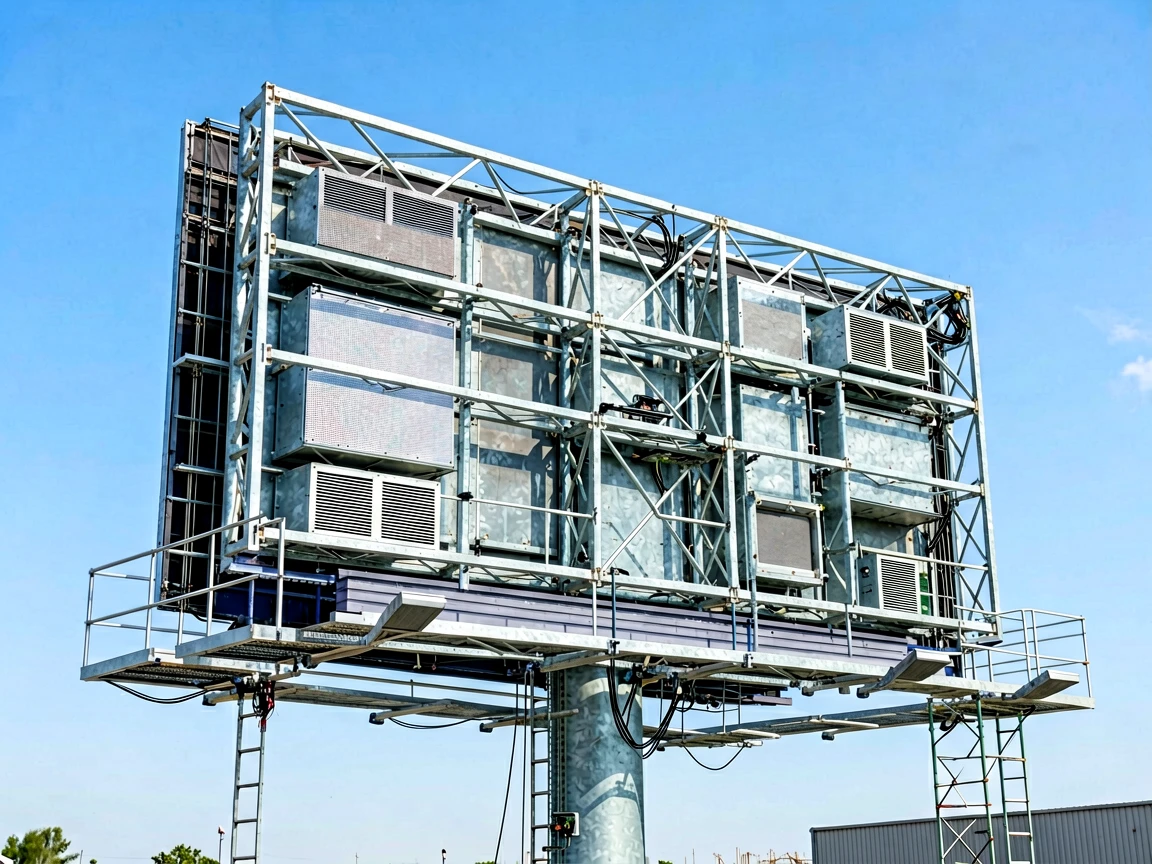
- What stays local either way: the concrete base ($15,000–$40,000), steel monopole ($30,000–$80,000), power and connectivity ($5,000–$25,000), permits, and installation are location costs that no screen supplier removes. Our large outdoor LED video wall structure safety guide covers the engineering side.
- Lead time and logistics: factory-direct adds sea freight (typically 4–6 weeks) and customs handling; our how to import LED screens from China guide details the process and duty planning.
Then come the running costs. Electricity is the one owners ask about most, and it is calculable: a 62.4 m² face rated at 400 W/m² maximum, running 12 hours per day at a realistic average brightness duty of about 35%, consumes roughly 105 kWh per day — about 3,100 kWh or $450–$500 per month at $0.15/kWh. MegaSign’s broader industry range is $200–$800 per month depending on brightness settings and operating hours. Our LED screen power supply and power consumption guide shows the full calculation, and the energy-saving outdoor LED billboard OF960 cuts that line by 30–50% with common-cathode drive. Add land lease, insurance, and an annual maintenance budget of 10–15% of hardware cost (MegaSign), and the total operating load typically runs 30–40% of gross revenue — the same ratio Blip uses in its investment model.
What Factors Determine Digital Billboard Revenue?
How Does Traffic Count Change Digital Billboard Revenue?
Traffic is the base of the pricing formula. The industry rule of thumb, drawn from state DOT traffic data, is that every 10,000 vehicles of average daily traffic (ADT) adds roughly $1,000–$2,000 to monthly billboard value (Blip Billboards). A highway face reading 50,000 ADT therefore justifies rates several times higher than a 10,000 ADT arterial. Demographics then multiply that base: Blip’s compiled multipliers give 1.5–2x for household incomes above $75,000, 2–3x for commute-hour decision-makers, and 1.2–1.5x for tourist corridors — which is why a face reaching 30,000 affluent commuters can out-earn one reaching 50,000 rural vehicles. Read time matters too: clear sightlines with an 8+ second read carry a 30–50% premium, while obstructed views discount 20–40%. For a real roadside face in daily service, see our P10 outdoor LED billboards in Ghana case study.
Why Do Rotation Slots and Dayparting Change Monthly Income?
At the standard 8-second slot, a face cycles 450 slots per hour per advertiser position. Selling 6–10 positions is the default model (MegaSign); programmatic exchanges push past 20 by auctioning individual plays. Dayparting is where smaller operators win: a coffee brand buys the morning commute, a restaurant chain buys 4–8 pm, a tax preparer buys March and April. Each of those contracts prices against the audience actually present at that hour, so the same face earns more per play than one flat monthly rate would ever yield.
Which Screen Specifications Protect Digital Billboard Revenue?
Specs are revenue protection, not engineering trivia. Outdoor LED screen brightness of 5,500–7,500 nits keeps the face legible at midday — the hours that carry the most expensive slots; our outdoor LED screen visibility guide explains the daylight math. An IP65 rating on the cabinets keeps rain and dust from taking the face dark. Front-service cabinet designs let a technician swap modules from the walkway instead of closing lanes behind the screen — see our front service vs rear service outdoor LED cabinets comparison — and keeping spare LED modules on site turns a module fault into a 20-minute fix instead of a week of unsold inventory. Reliability habits compound too: our guide on how to improve LED display lifespan covers the maintenance calendar that keeps a 100,000-hour face selling for its full rated life.
How Long Is the Digital Billboard ROI Payback Period?
Blip’s investment frame puts a working US-built billboard at $30,000–$120,000 annual gross revenue, 30–40% operating expenses, 15–30% annual ROI, and a 3–7 year payback on turnkey builds of $250,000+. The same face sourced factory-direct removes the largest single line item from that math. The scenarios below are illustrative — occupancy, lease terms, and permit timing decide every real project — but they show the mechanism honestly:
| Scenario | Turnkey investment (factory-direct screen) | Gross monthly at full occupancy | Net after opex and vacancy | Simple payback |
|---|---|---|---|---|
| Secondary highway, P10 face | $70,000 – $90,000 | $4,000 – $6,000 | $1,500 – $3,000 | ~2.5 – 4 years |
| Suburban corridor, P8 face | $90,000 – $130,000 | $8,000 – $15,000 | $4,000 – $7,000 | ~2 – 3 years |
| Major metro, P8/P6 face | $150,000 – $300,000 | $15,000 – $50,000 | $7,000 – $20,000 | ~2 – 4 years |
Read the middle column against the cost section: a $70,000–$90,000 secondary-highway build already includes the factory screen, structure, installation, and controller. The gap between these figures and the 3–7 year domestic payback is the hardware arbitrage — and it is also why experienced operators check the screen invoice line by line before signing anything. For a documented factory-direct build, see our P5 outdoor LED billboard in Rwanda case study.
How Can You Maximize Digital Billboard Revenue?
Once the structure stands, income is an operations problem with four levers:
- Sell the schedule, not the sign. Package dayparts and seasons (commute hours, holiday retail, election windows) so each slot prices against its real audience instead of one flat rate.
- Fill remnant inventory with programmatic DOOH. Exchanges auction individual plays, keeping occupancy high between long-term contracts; Grand View Research pegs DOOH growth at about 10.7% per year through 2030, so demand per screen keeps rising.
- Keep uptime near 100%. A dark face earns zero on every slot. Remote monitoring through a proper LED display control system catches faults before advertisers do — a NovaStar LED control system suits large synchronized faces, while a Huidu LED control system with 4G cloud publishing handles remote scheduling and status checks from a phone.
- Build inventory, not just a face. A double-sided outdoor LED display doubles sellable slots on one lease; compact outdoor pole LED display units add fill-in inventory on the same corridor; 3D-capable high-brightness faces command premium creative contracts — the P8 build below is one example. Truck-mounted units extend the same sellable-slot logic to routes and events without a fixed structure — our mobile LED billboards guide covers the strategy and execution side.
Frequently Asked Questions About Digital Billboard Revenue
How much do digital billboards make per month in smaller markets?
Industry guides place rural and small-town digital faces at roughly $1,500–$5,000 per month, with suburban corridors at $5,000–$15,000 and major metros at $10,000–$50,000+ (compiled from Blip Billboards, MegaSign, and LSI Media). Local ad rates, traffic counts, and how many slots you sell determine where a specific face lands.
Are digital billboards profitable for owners?
Yes, when occupancy and lease terms behave. Blip’s investment model puts a working face at $30,000–$120,000 annual gross with 30–40% operating expenses — net operating income of $20,000–$75,000 per year and 15–30% annual ROI for US-built assets. Factory-direct screens shift the hardware line down sharply, which is what compresses payback toward the 2–5 year range in our worked examples.
How much does it cost to build a digital billboard?
A US turnkey build runs $150,000–$500,000 (MegaSign), with premium highway installations above $750,000. The LED hardware itself — the part a factory supplies — costs $17,000–$50,000 factory-direct for a standard 14 × 48 ft class face. Structure, base, permits, and installation stay local regardless of screen origin.
How much electricity does a digital billboard use per month?
A 62.4 m² (14 × 48 ft) face at 400 W/m² maximum rating, 12 hours per day and ~35% average duty, consumes about 3,100 kWh — roughly $450–$500 per month at $0.15/kWh. The broader industry range is $200–$800 per month (MegaSign). Energy-saving common-cathode models cut that line by 30–50%.
How long does it take for a digital billboard to pay for itself?
US-built turnkey investments pay back in 3–7 years (Blip). Factory-direct builds in our worked scenarios reach simple payback in about 2–5 years, because the same income lands on a smaller investment base. Occupancy is the swing factor: a face that stays 80%+ sold beats every projection, while vacancy stretches any payback table.
How many advertisements can a digital billboard rotate?
The standard rotation is 6–10 advertisers on 8-second slots (MegaSign, Blip). Programmatic platforms go beyond 20 by auctioning individual plays. Each rotation position is a separate monthly contract, which is where the 4–6x revenue advantage over static faces comes from.
References & Data Sources for Digital Billboard Revenue
- OAAA — Out of Home Advertising Revenue Reaches Record $9.46 Billion (March 2026)
- Blip Billboards — How Much Revenue Does a Billboard Generate? 2025 Pricing & ROI Guide
- MegaSign — LED Billboard Cost: Pricing Breakdown, Building, Renting, 3D Displays and ROI
- LSI Media — Digital Billboard Advertising Costs Guide
- Grand View Research — Digital Out-of-Home Advertising Market Report
The Bottom Line: How Much Do Digital Billboards Make?
So, how much do digital billboards make? Between $1,500 and $5,000 per month on a quiet rural highway, $10,000 and $50,000+ in a major metro, and up to six figures a week in landmark locations — with digital faces out-earning static ones by 4–6x on the same steel. The income side is set by traffic and occupancy; the profit side is set by what you pay for the screen. That is the line item an experienced LED screen manufacturer controls, and it is the difference between a 7-year payback and a 3-year one. Price the face honestly, protect uptime with the right control system and service design, and the structure pays for itself on a schedule you can defend to any investor.