When sourcing an LED display control system, you’ll quickly encounter three names: NovaStar (the premium leader), Colorlight (the fast innovator), and Linsn — the original pioneer that has been powering LED screens since the year 2000. For budget-conscious projects, especially indoor fixed installations, Linsn remains one of the most cost-effective and widely compatible control systems on the market.
Founded in Shenzhen over two decades ago, Linsn Technology Development Co., Ltd. was building LED control hardware before most of today’s competitors existed. Its control system has been adopted by hundreds of LED screen factories across China and exported worldwide. The companion software, LED Studio, has become one of the most recognized names in the industry — a testament to Linsn’s longevity and user base.
This guide provides a complete overview of what a Linsn control system is, its product architecture, key strengths and limitations, and when it’s the right choice for your LED display project in 2026.
What Is a Linsn Control System?
A Linsn LED control system is the hardware-and-software solution that converts video and image signals from your source device into the data stream that drives LED display modules. It supports a full range of LED screen types — full-color synchronous, full-color asynchronous, dual-color synchronous, and dual-color asynchronous — making it versatile across indoor billboards, signage, rental screens, and simple outdoor displays.
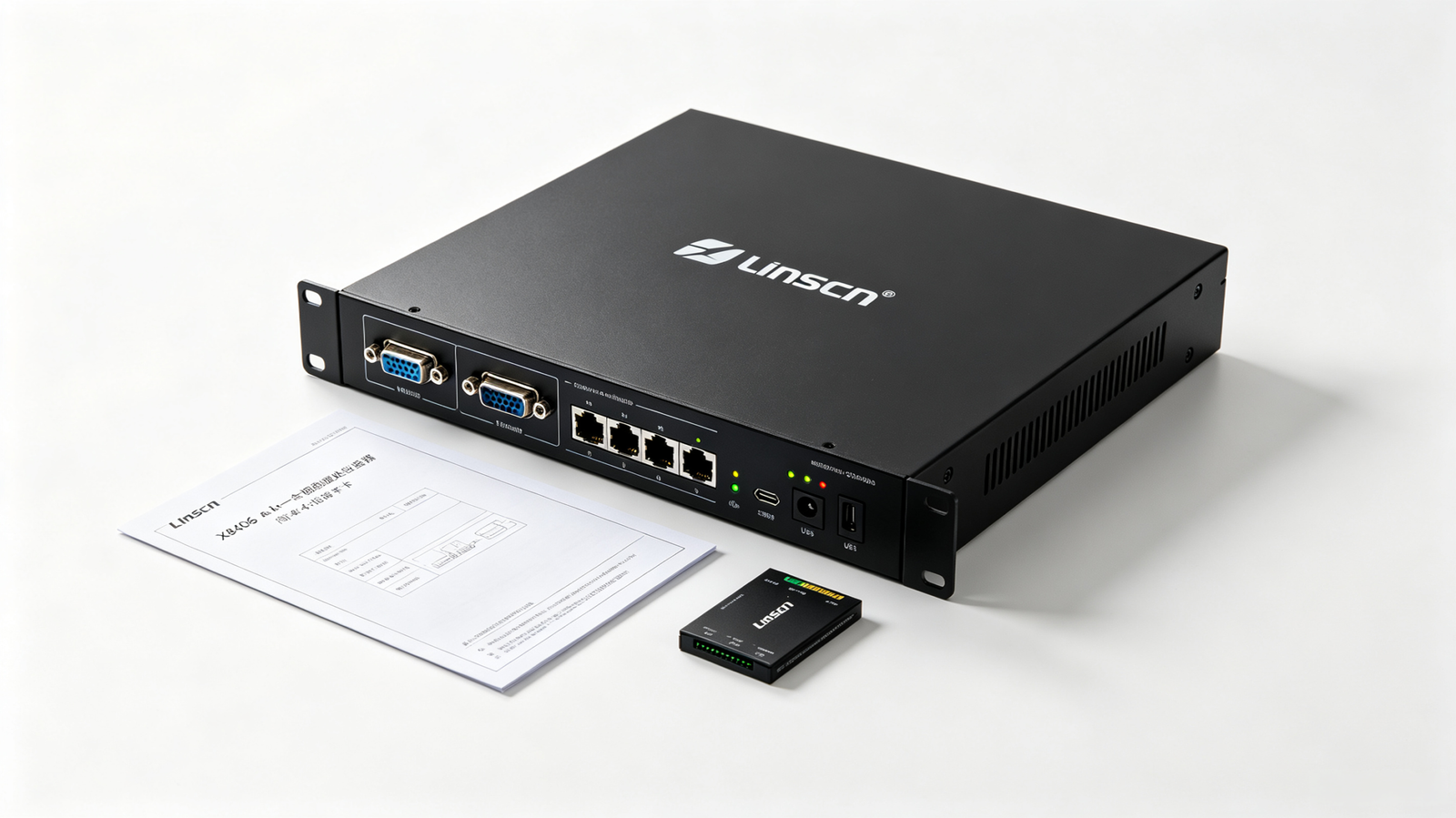
Compared to NovaStar and Colorlight, Linsn’s positioning is clear: reliable performance at a lower price point. It may lack the cutting-edge features of its competitors — 5G transmission, AI-powered calibration, native ST 2110 broadcast support — but for the majority of standard LED installations, it delivers everything you need without the premium markup.
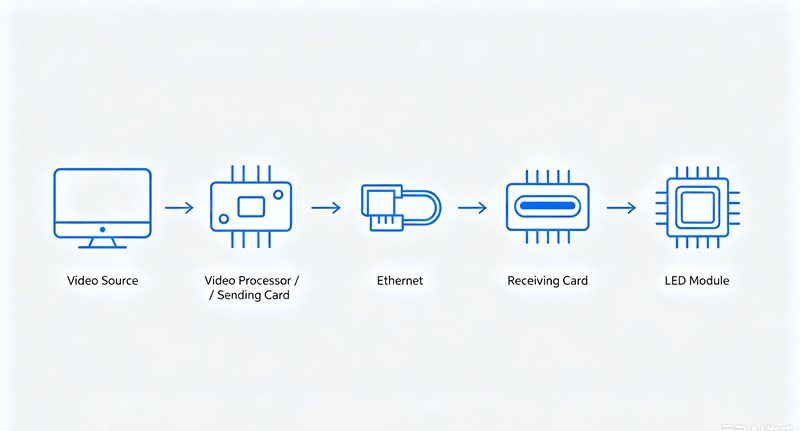
| Layer | What It Does | Key Linsn Products |
|---|---|---|
| 1. Video Processing | Receives video input, performs scaling and multi-layer compositing | X8406, X8408, X8414, X8212, X8216, X8208 |
| 2. Signal Transmission | Converts video to Ethernet data streams for distribution | Sending Cards: TS802, TS901, TS16, TS12, TS8, TS952PLUS, TS962 |
| 3. Signal Reception | Decodes data at cabinet level and drives LED modules | Receiving Cards: RV908H32, RV908M32, RV906, RV904, MiNi913K, MiNi913KA, RV998 |
| 4. Asynchronous Playback | Standalone content playback without PC connection | AD Players: L1, L2, L3, L4, L6 |
| 5. Software | Configuration, content editing, and playback control | LED Studio, LED Set |
Linsn Video Processors: Two-in-One Controllers
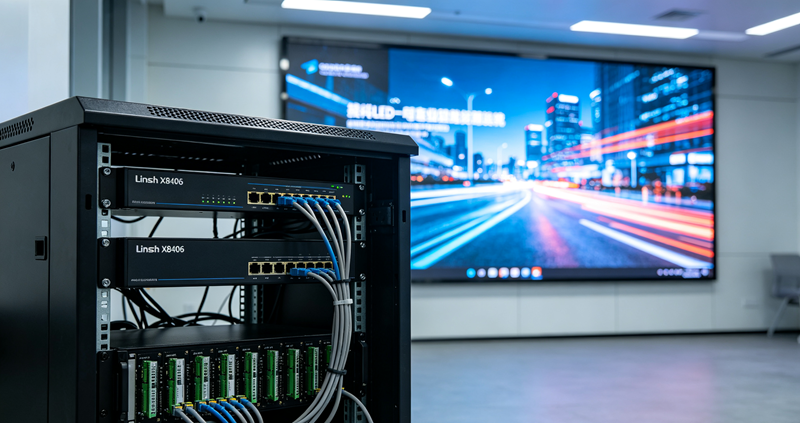
Linsn’s video processor lineup follows a two-in-one design philosophy — each unit combines a video processor and a sending card in a single chassis, simplifying system architecture and reducing cabling. The flagship models include:
- X8406: The most popular model. A two-in-one controller with 4-layer output, supporting up to 3.84 million pixels across 6 Gigabit Ethernet ports (up to 7680 pixels wide or 4000 pixels high). Features 4× DVI input, fade-in/fade-out transitions, and dual USB communication. Compatible with the entire Linsn receiving card ecosystem.
- X8414 / X8408: Higher-capacity variants for larger displays, supporting more pixels and additional input options.
- X8212 / X8216 / X8208: Mid-range processors for standard fixed installations and indoor advertising walls.
The key advantage of Linsn’s two-in-one approach is simplicity: you don’t need to match a separate video processor with a separate sending card, which is common in NovaStar’s traditional architecture. For integrators handling straightforward installations, this reduces both hardware cost and commissioning time.
Sending Cards & Receiving Cards: The Signal Chain
Sending Cards (Transmitters)
Linsn’s sending card family spans a wide range of loading capacities — the higher the load, the higher the price.
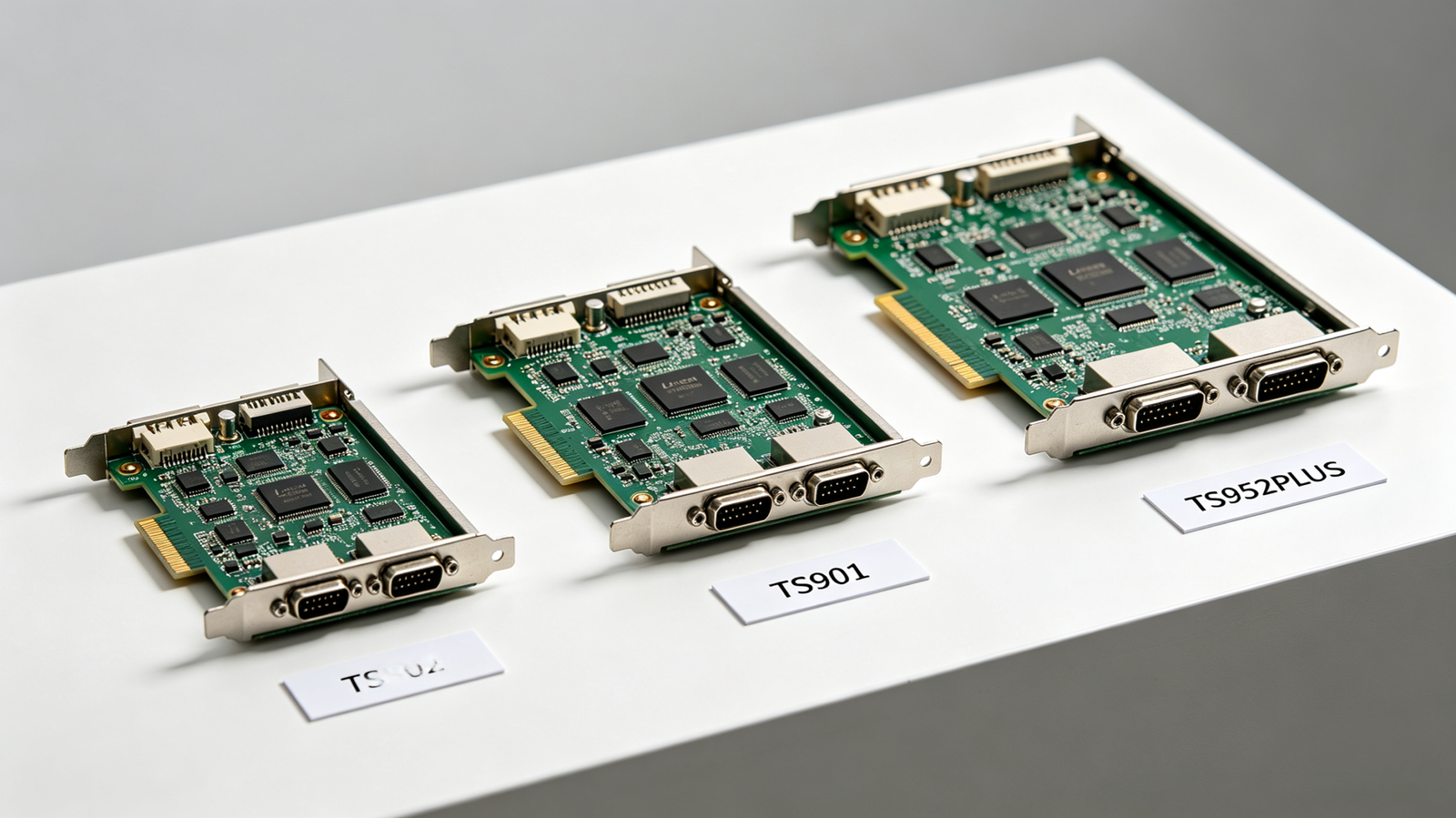
Key models:
- TS962 / TS952PLUS: Flagship senders with the highest pixel loading capacity. Suitable for large-scale outdoor billboards and LED walls exceeding 2 million pixels.
- TS901 / TS16: Mid-range senders balancing capacity and cost. Popular for medium-sized indoor displays, conference room walls, and retail signage.
- TS802 / TS12 / TS8: Entry-to-mid-level senders for small-to-medium displays. The TS802 supports up to 2048×640 pixels at 60Hz, making it a workhorse for standard indoor installations.
Receiving Cards (Receivers)
Linsn offers a broad range of receiving cards compatible with virtually all common LED driver ICs and scan modes (static through 1/32 scan). The naming convention reflects the form factor and generation:
- RV908 Series (RV908H32, RV908M32): High-performance receivers with HUB75 interfaces, supporting PWM driver ICs and high refresh rates up to 3840Hz. The “H32” and “M32” variants indicate different connector configurations for flexible cabinet design.
- RV904 / RV906: Mid-range receivers balancing performance and cost. Widely used in fixed indoor and outdoor installations.
- MiNi913K / MiNi913KA: Compact receivers for space-constrained rental cabinets. The “KA” variant adds additional features for calibration and diagnostics.
- RV998: Legacy workhorse receiver — one of the most widely deployed receiving cards in the industry, compatible with older Linsn systems and still in active use.
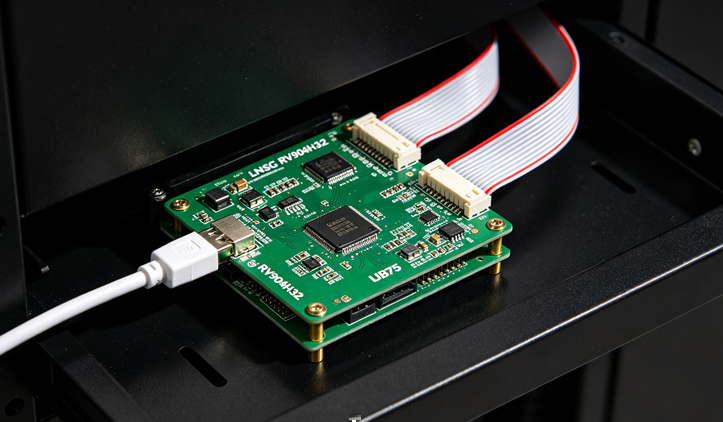
One notable strength: Linsn maintains strong backward compatibility — their current processors and sending cards are compatible with older-generation receiving cards, protecting customers’ existing hardware investments when upgrading the control system.
AD Players: Asynchronous Control for Standalone Displays
For applications where a PC connection isn’t practical — roadside billboards, door-header signs, retail displays — Linsn’s AD Player series provides asynchronous content playback via Wi-Fi, LAN, USB, or 4G. The lineup includes:
- L1: Entry-level player supporting up to 650,000 pixels. Compact (178×103×32 mm), suitable for advertising machines and small signage.
- L2 / L3: Mid-range players with higher capacity and additional connectivity options.
- L4 / L6: Higher-capacity players for larger asynchronous displays, supporting more pixel real estate and advanced scheduling features.
All AD Players support multiple media formats (video, images, animations, text, and database content), and can be updated over Wi-Fi, LAN, or USB flash drive. The L1, for instance, delivers up to 3840Hz refresh rate for scanning displays and 6000Hz for static displays — more than sufficient for flicker-free content in most environments.
LED Studio: The Software That Defined an Era
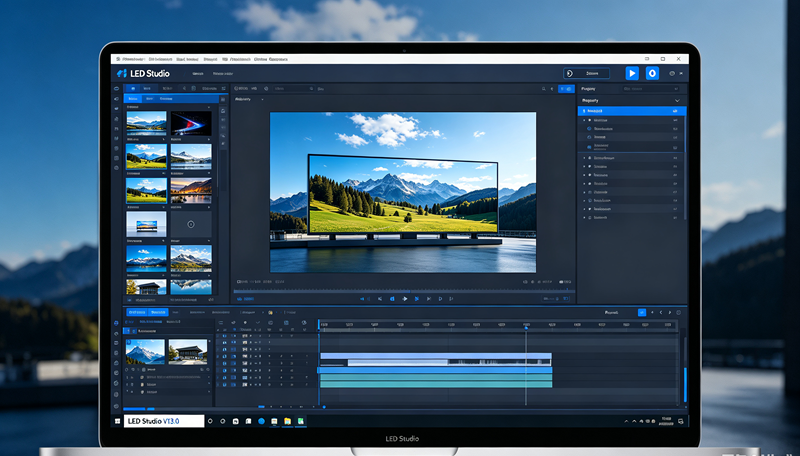
LED Studio is Linsn’s flagship control software and one of the most enduring applications in the LED display industry. Its feature set reflects its maturity — two decades of development have produced a remarkably comprehensive tool:
- Multi-format media playback: Supports documents (.txt, .doc), images (.BMP, .JPG, .GIF, .PNG), video (.MPG, .AVI, .SWF, .RM, .ASF), web pages, databases (Access, ODBC), and even external .exe programs — all playable within the LED display canvas.
- Score Manager: For sports venues, LED Studio includes built-in scoreboard management.
- Picture-in-Picture (PIP): Display multiple content sources simultaneously with customizable positioning and size.
- Database Window: Directly connect to and display content from Access and ODBC-compatible databases — useful for schedules, pricing boards, and information displays.
- Temperature & Date/Time Windows: Built-in widgets for environmental monitoring and clock displays.
- PPT Support: Play PowerPoint presentations directly on the LED screen without conversion.
The companion utility LED Set handles receiving card configuration, screen mapping, and firmware management. Together, LED Studio and LED Set provide a complete software workflow for Linsn systems — from initial configuration to daily content operation.
Accessories: Completing the Installation
Linsn provides a suite of accessories for professional installation:
- EX902D Multi-Function Card: Adds automatic brightness adjustment (via ambient light sensor), internal/external temperature and humidity monitoring, 3.5mm audio output, and remote power control — enabling the LED display to turn on/off on a schedule.
- EX906 / MC801 Signal Converters: Extend signal transmission over long distances using fiber optic or network-based conversion, essential for outdoor installations where the control room is far from the display.
Linsn vs the Competition: Where It Fits in 2026
| Dimension | Linsn | NovaStar | Colorlight |
|---|---|---|---|
| Founded | 2000 (oldest) | 2008 | 2012 |
| Price | ✅ Lowest — 20–40% below NovaStar | ⚠️ Premium | ✅ 10–20% below NovaStar |
| Software Maturity | ✅ LED Studio — 20+ years, feature-rich | ✅ VNNOX + NovaLCT — modern, polished | ✅ LEDVISION + GrandShow |
| Ease of Use | ✅ Simple two-in-one architecture | ⚠️ Separate processors + senders (more complex) | ✅ All-in-one X Series available |
| Indoor Performance | ✅ Excellent color uniformity | ✅ Industry benchmark | ✅ Infi-bit for low brightness |
| 4K/8K Support | ⚠️ Limited — max ~3.84M pixels per controller | ✅ Full 4K/8K (COEX, MCTRL4K) | ✅ Full 4K (X Series) + 5G+8K |
| Cloud Platform | ⚠️ Basic — AD Players with simple remote access | ✅ VNNOX — mature, multi-screen | ✅ Colorlight Cloud — fast-growing |
| Redundancy | ⚠️ Standard — single signal path | ✅ Dual-loop backup | ⚠️ Standard |
| Calibration | ⚠️ Basic point-by-point | ✅ Industry-leading | ✅ Scientific-grade, COB-optimized |
| Best For | ✅ Budget indoor, small-to-medium displays | ✅ Rental, broadcast, large-scale | ✅ Creative, XR, broadcast, mid-market |
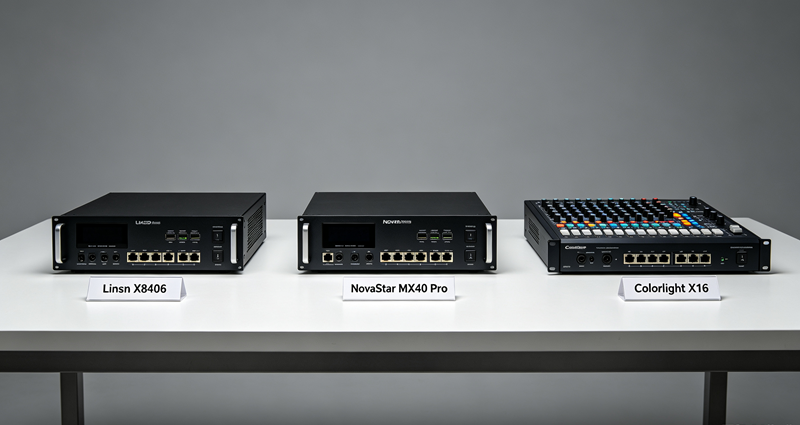
📖 Full brand comparisons: NovaStar vs Colorlight 2026 Comparison | NovaStar Complete Guide | Colorlight Complete Guide
When Linsn Is the Right Choice (and When It Isn’t)
✅ Choose Linsn When:
- Budget is the primary concern: Linsn hardware costs 20–40% less than equivalent NovaStar components — significant for multi-screen deployments.
- You’re building indoor fixed displays: Linsn’s color uniformity and stability excel in controlled indoor environments like retail stores, conference rooms, churches, and information boards.
- Simplicity matters: The two-in-one processor + sender design means fewer components to purchase, configure, and troubleshoot.
- Compatibility with legacy systems: If you’re expanding or maintaining an existing Linsn-based LED wall, staying within the ecosystem avoids compatibility headaches.
- Small-to-medium pixel counts: For displays under ~3.8 million pixels, Linsn’s controllers are more than capable.
⚠️ Consider Alternatives When:
- You need 4K/8K resolution: For ultra-high-res displays exceeding 4 million pixels, NovaStar (MCTRL4K, COEX) or Colorlight (X Series) offer significantly higher bandwidth.
- Mission-critical redundancy is required: Live broadcasts, stadiums, and 24/7 control rooms demand dual-loop backup — a feature Linsn doesn’t prioritize.
- Cloud management across multiple sites: NovaStar VNNOX and Colorlight Cloud offer more sophisticated multi-screen remote management than Linsn’s basic AD Player remote access.
- You’re building a rental/touring fleet: NovaStar’s A Series receiving cards with Mapping function and industry-standard rental workflows give it a clear edge for touring applications.
Frequently Asked Questions
What is the difference between Linsn and NovaStar?
Linsn is the older, more affordable option with a simpler architecture (two-in-one processors) and mature LED Studio software. NovaStar offers higher pixel capacity (4K/8K), a more advanced cloud platform (VNNOX), dual-loop signal redundancy, and deeper global support — at a premium price. For budget indoor projects, Linsn is often the better value; for professional rental, broadcast, and large-scale displays, NovaStar justifies its premium.
Can I mix Linsn with NovaStar or Colorlight components?
No. Each brand’s control system uses proprietary communication protocols. Linsn sending cards only work with Linsn receiving cards and Linsn software (LED Studio/LED Set). The signal chain must remain within a single brand ecosystem.
What software do I need for a Linsn LED display?
You’ll need LED Studio for content playback and management, and LED Set for receiving card configuration, screen mapping, and firmware updates. Both are available for free download from the official Linsn website.
How many pixels can a Linsn X8406 controller drive?
The X8406 supports up to 3.84 million pixels across 6 Gigabit Ethernet outputs, with a maximum width of 7680 pixels or maximum height of 4000 pixels. This is sufficient for most standard indoor and outdoor fixed installations up to approximately 4K equivalent resolution.
Is Linsn still actively developed in 2026?
Yes. Linsn continues to release new hardware (including updated Y8 Series processors) and maintains LED Studio with compatibility for modern Windows versions. While its innovation pace is slower than NovaStar or Colorlight, the platform remains actively supported and widely deployed globally.
Is Linsn good for outdoor LED displays?
Linsn works for outdoor displays but is best suited for small-to-medium outdoor installations like storefront signs and simple billboards. For large-format outdoor advertising with demanding brightness and weather requirements, NovaStar or Colorlight provide more robust environmental management features including automatic brightness scheduling, advanced thermal monitoring, and fiber-optic transmission options.
Conclusion: The Smart Budget Choice That Still Delivers
Linsn occupies a unique position in the LED control system market: it’s the oldest player, with a track record spanning over two decades, yet it competes on value rather than features. For integrators and end users who need a reliable, simple, and cost-effective control system — particularly for indoor fixed installations under 4 million pixels — Linsn remains a pragmatic and proven choice.
The key is understanding the trade-offs: you sacrifice cutting-edge features like 4K/8K bandwidth, cloud management sophistication, and signal redundancy. But what you gain — lower hardware cost, simpler system architecture, and battle-tested software — is exactly what many projects actually need.
In 2026, Linsn isn’t trying to beat NovaStar at the high end. It’s focused on being the best value control system for standard LED installations — and by that measure, it still succeeds.
Need help choosing between Linsn, NovaStar, or Colorlight for your project? Contact our team — we’ll help you select the right control system based on your display specifications, application, and budget, with factory-direct pricing on all major brands.
Continue Reading: LED Control System Resources
- What Is NovaStar Control System? Complete Guide (2026)
- What Is Colorlight Control System? Complete Guide (2026)
- What Is Huidu Control System? Overview
- NovaStar vs Colorlight: Ultimate 2026 Brand Comparison
- LED Video Wall Controller: Everything You Need to Know
- Synchronous vs Asynchronous LED Displays: What’s the Difference?
References: Linsn official website (en.linsn.com), Linsn product documentation, industry integrator feedback.