NovaStar’s MCTRL series spans five controllers — from the entry-level MCTRL300 to the flagship MCTRL4K. Each targets a specific project scale and budget. Use the wrong one and you either overpay for unused capacity or bottleneck your entire display. This guide compares all five side-by-side so you can match the controller to your exact requirements.
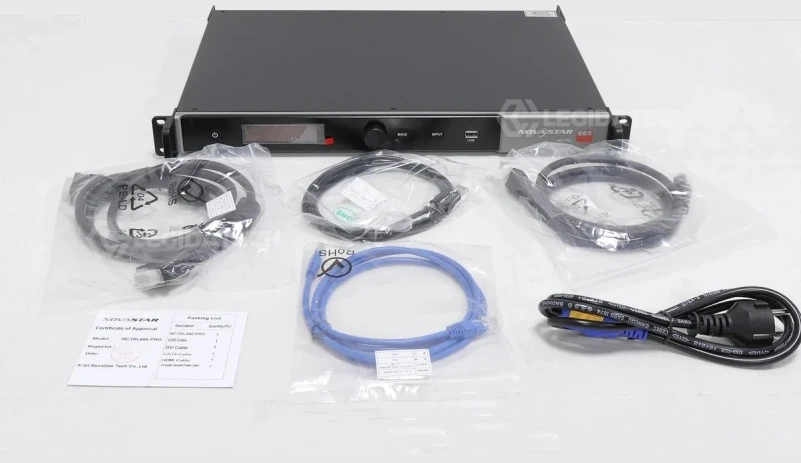
At LEGIDATECH, we supply the complete MCTRL lineup factory-direct — all units undergo 48-hour burn-in testing, include full accessories, and ship with a 3-year warranty.
MCTRL Series at a Glance: Quick Comparison
| Feature | MCTRL300 | MCTRL600 | MCTRL660 | MCTRL660 Pro | MCTRL4K |
|---|---|---|---|---|---|
| Pixel Capacity | 1.3M | 2.6M | 2.3M | 2.3M | 8.8M |
| Ethernet Ports | 2× RJ45 | 4× RJ45 | 4× RJ45 | 6× RJ45 | 16× EtherCON |
| Max Resolution | 1920×1200 | 1920×1200 | 1920×1200 | 1920×1200 | 4096×2160 |
| Max Custom W/H | 2560 px | 3840 px | 3840 px | 3840 px | 7680 px |
| Video Input | 1× DVI | 1× DVI + 1× HDMI | 1× DVI + 1× HDMI | 3G-SDI + HDMI + DVI | DP + HDMI + 2× DVI |
| Fiber Output | — | — | — | 2× 10G SFP+ | 4× 10G |
| GENLOCK | — | — | — | ✅ | ✅ |
| HDR / 3D | — | — | — | — | HDR10+HLG / 3D |
| Color Depth | 8-bit | 8/10/12-bit | 8-bit | 8/10/12-bit | 8/10/12-bit |
| Audio Input | — | ✅ | ✅ | — | — |
| Light Sensor | — | ✅ | — | — | — |
| Max Cascade | 20 units | 20 units | 20 units | 8 units | 10 units |
| Redundancy | Dual-port + Multi-unit | Dual-port | Dual-port | Port + Fiber backup | Port + Fiber backup |
| Power | 3W | 6.6W | 16W | 20W | 30W |
| Weight | 1.04 kg | 2.5 kg | 3.6 kg | 4.6 kg | 4.6 kg |
| Form Factor | Compact box | 1U rack | 1U rack | 1U rack | 2U rack |
| Price (Factory) | $120–$300 | $200–$400 | $350–$550 | $650–$850 | $2,000–$2,500 |
| Best For | Small displays, rental | Mid-size, efficient | Standard mid-size | Broadcast, SDI, fiber | 4K, HDR, stadiums |
1. MCTRL300 — The Compact Entry Point
The MCTRL300 is the lightest, most portable, and most affordable controller in the lineup. At 1.04 kg and 3W, it fits in a laptop bag and draws less power than a night light. With 1.3M pixels across 2 Ethernet ports, it handles typical P3.91 rental screens up to ~4m×3m.
Unique advantage: Multi-unit hot backup — if a controller fails mid-show, a backup unit takes over automatically. No other controller at this price point offers this.
- Pixel capacity: 1.3 million | Input: DVI only | Ports: 2× RJ45
- Weight: 1.04 kg | Power: 3W | Cascade: Up to 20 units
- Price: $120–$300 factory-direct
2. MCTRL600 — The Efficiency Champion
The MCTRL600 is the most energy-efficient controller with 4 Ethernet ports — 6.6W, 2.5 kg, slim 1U chassis. It loads 2.6M pixels (more than the MCTRL660) while drawing less than half the power. Native HDMI + DVI inputs, audio input, light sensor for auto-brightness, and 10/12-bit color make it the best value mid-tier option.
Unique advantage: Highest pixel-to-power ratio in the series. The only mid-tier controller with both audio input and light sensor.
- Pixel capacity: 2.6 million | Input: DVI + HDMI | Ports: 4× RJ45
- Weight: 2.5 kg | Power: 6.6W | Cascade: Up to 20 units
- Price: $200–$400 factory-direct
3. MCTRL660 — The Standard Workhorse
The standard MCTRL660 is the established mid-range option — 2.3M pixels, 4 Ethernet ports, DVI + HDMI input. It delivers the same core performance as the MCTRL600 but in a heavier-duty chassis at higher power draw and cost. It lacks the MCTRL600’s audio input and light sensor, but has been the industry standard for mid-size rental installations since 2017.
Who should buy it: Rental companies that need rugged, proven reliability and don’t require SDI, GENLOCK, or fiber — and who prefer the heavier chassis for touring durability.
- Pixel capacity: 2.3 million | Input: DVI + HDMI | Ports: 4× RJ45
- Weight: 3.6 kg | Power: 16W | Cascade: Up to 20 units
- Price: $350–$550 factory-direct
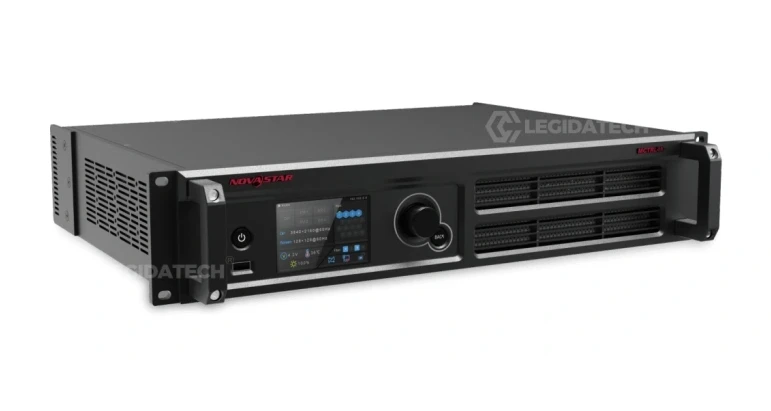
4. MCTRL660 Pro — The Broadcast Specialist
The MCTRL660 Pro is the only MCTRL controller with native 3G-SDI input — built for broadcast OB vans, XR virtual production, and any deployment where the LED wall is filmed by cameras. GENLOCK frame synchronization, dual 10G SFP+ fiber outputs, sub-1ms latency, and a built-in fiber converter mode set it apart from the standard MCTRL660.
Unique advantage: Fiber Converter Mode saves $200–$400 per link by eliminating external media converters. The only controller below MCTRL4K with 12-bit 4:4:4 color.
- Pixel capacity: 2.3 million | Input: 3G-SDI + HDMI + DVI | Ports: 6× RJ45 + 2× 10G SFP+
- Weight: 4.6 kg | Power: 20W | Cascade: Up to 8 units
- Price: $650–$850 factory-direct
5. MCTRL4K — The 4K Flagship
The MCTRL4K is NovaStar’s highest-capacity standalone controller. A single unit drives true 4K (4096×2160@60Hz) across 16 Neutrik EtherCON ports and 4 optical fiber outputs. HDR10/HLG, stereoscopic 3D, multi-card mode for dual independent sources, and sub-1ms latency make it the reference standard for stadium-scale, broadcast, and cinema-grade LED walls.
Unique advantage: The only controller with HDR10/HLG and 3D. Multi-Card Mode splits it into two independent controllers.
- Pixel capacity: 8.8 million | Input: DP + HDMI + 2× DVI | Ports: 16× EtherCON + 4× 10G fiber
- Weight: 4.6 kg | Power: 30W | Cascade: Up to 10 units
- Price: $2,000–$2,500 factory-direct
How to Choose: Decision Framework
Step 1: Calculate Your Pixel Count
Multiply your total cabinets by pixels per cabinet. A P3.91 500×500mm cabinet = 128×128 = 16,384 pixels. A 5m×3m wall = 60 cabinets × 16,384 = 983,040 pixels. Compare this number against the controller’s pixel capacity.
Step 2: Match to a Controller
| If Your Pixel Count Is… | Your Options | Recommendation |
|---|---|---|
| Under 1.3M | MCTRL300 or higher | MCTRL300 (save money, gain portability) |
| 1.3M – 2.3M | MCTRL600, MCTRL660, MCTRL660 Pro | MCTRL600 (best value, lowest power) |
| 2.3M – 2.6M | MCTRL600 or cascade 2× MCTRL300 | MCTRL600 (single unit = simpler) |
| 2.6M – 8.8M | MCTRL4K or cascade 2–4 mid-tier | MCTRL4K (one device, less complexity) |
| Over 8.8M | Cascade 2+ MCTRL4K | MCTRL4K × N (uniform, GENLOCK-ready) |
Step 3: Add Feature Requirements
- Need 3G-SDI input? → MCTRL660 Pro (only model with native SDI)
- Need HDR10/HLG or 3D? → MCTRL4K (only model with HDR)
- Need fiber output for long-distance? → MCTRL660 Pro or MCTRL4K
- Need audio input + light sensor? → MCTRL600 (only mid-tier with both)
- Need the lightest, most portable unit? → MCTRL300 (1.04 kg)
- Need the lowest electricity cost? → MCTRL300 (3W) or MCTRL600 (6.6W)
- Need the most Ethernet ports? → MCTRL4K (16× EtherCON)
Common Mistakes When Choosing an MCTRL Controller
Mistake 1: Overbuying “Just in Case”
Buying an MCTRL4K for a 1.5M-pixel corporate lobby display wastes ~$1,800. The extra capacity, HDR, 3D, and 16 ports provide zero benefit if your display doesn’t use them. Match the controller to the actual pixel count.
Mistake 2: Underbuying and Cascading Too Many Units
Cascading 4 MCTRL660 Pros to drive a 4K wall costs $2,600–$3,400 and adds GENLOCK complexity across 4 devices. A single MCTRL4K does the job for $2,000–$2,500. When cascading exceeds 3 units, a single higher-capacity controller is almost always cheaper.
Mistake 3: Ignoring Power Consumption in 24/7 Installs
For a control room running 10 controllers 24/7: MCTRL300 fleet costs $32/year in electricity. MCTRL660 fleet costs $168/year. MCTRL4K fleet costs $315/year. Over 5 years, the energy cost difference between the most and least efficient options is ~$1,400 — enough to buy an additional controller.
Mistake 4: Mixing Controller Models
NovaStar advises against mixing different MCTRL models in the same cascaded system. Different processing latencies and architectures cause synchronization issues. Use identical controllers throughout any synchronized deployment.
MCTRL Series Price-to-Performance Ranking
If we rank controllers by pixels per dollar (how much capacity you get for your money), the order is surprising:
- MCTRL600 — 10,400 px/$ (2.6M ÷ $250). The best value in the entire series.
- MCTRL300 — 6,200 px/$ (1.3M ÷ $210). Excellent entry-level value.
- MCTRL660 — 5,100 px/$ (2.3M ÷ $450). Lower value due to higher cost for similar capacity.
- MCTRL4K — 3,900 px/$ (8.8M ÷ $2,250). You pay for HDR, 3D, and fiber — not raw pixel capacity.
- MCTRL660 Pro — 3,100 px/$ (2.3M ÷ $750). You pay for SDI, GENLOCK, and fiber — the broadcast premium.
This ranking reflects a fundamental truth: pixels-per-dollar is not the right metric for professional applications. The MCTRL660 Pro ranks last in px/$ — but for a broadcast OB van where SDI and GENLOCK are mandatory, it’s the only controller that works at any price. Choose the controller that meets your technical requirements first, then optimize for price within that category.
Software: All MCTRL Controllers Use NovaLCT
Every MCTRL controller — from the $120 MCTRL300 to the $2,500 MCTRL4K — uses the same NovaLCT software. Learn it once, configure any controller. The MCTRL660 Pro adds an OLED display with rotary knob for standalone configuration, and the MCTRL4K supports web-based control. But the core configuration workflow is identical across the entire series.
Frequently Asked Questions
Which MCTRL controller is best for a rental company?
For rental fleets handling diverse projects: MCTRL600 for most jobs (best value, 4 ports, 2.6M pixels). Add MCTRL660 Pro for broadcast/SDI jobs. Add MCTRL4K for 4K/HDR events. The MCTRL300 is ideal for small corporate event kits where portability matters more than capacity.
Can I upgrade from MCTRL300 to MCTRL4K and reuse my configuration?
Partially. Cabinet mapping (RCFG files) transfers between controllers. But resolution settings, Ethernet port allocation, and advanced features (HDR, GENLOCK, fiber) need reconfiguration in NovaLCT. The software is the same — the configuration is controller-specific.
Why does MCTRL600 have more pixel capacity than MCTRL660?
The MCTRL600 is a newer design (2022+) with more efficient pixel processing, allowing 2.6M pixels at lower power (6.6W). The MCTRL660 (2017) has an older architecture that loads 2.3M pixels at higher power (16W). The MCTRL600 is objectively the better mid-tier value — the MCTRL660 remains in the lineup for customers who need its specific chassis, I/O configuration, or have standardized on it across their fleet.
Do all MCTRL controllers support receiving card redundancy?
All MCTRL controllers support dual-port Ethernet backup (if one port fails, the other takes over). The MCTRL300 uniquely adds multi-unit hot backup (a second controller can take over if the primary fails). The MCTRL660 Pro and MCTRL4K add fiber port backup (OPT2 mirrors OPT1). No controller in the series supports receiving card redundancy — that’s handled at the receiving card level, not the sending controller.
The Bottom Line
The MCTRL series covers every LED display from 0.5M to 88M+ pixels. The key is matching the controller to your actual requirements — not your aspirations.
For 70% of professional projects, the MCTRL600 hits the sweet spot: 2.6M pixels, 4 ports, 10/12-bit color, and the lowest power consumption in the series — all at $200–$400. Add the MCTRL660 Pro for broadcast, and the MCTRL4K for 4K/HDR. The MCTRL300 remains the best entry-level option for portable, budget-conscious deployments.
Get Factory-Direct Pricing on the Complete MCTRL Series
At LEGIDATECH, we stock every MCTRL controller with factory-direct pricing, 48-hour burn-in testing, full accessory kits, and 3-year warranty:
- MCTRL300 — $120–$300 | Entry-level, 1.3M pixels, ultra-portable
- MCTRL600 — $200–$400 | Best value, 2.6M pixels, 6.6W
- MCTRL660 — $350–$550 | Standard workhorse, 2.3M pixels
- MCTRL660 Pro — $650–$850 | Broadcast-grade, 3G-SDI, GENLOCK, fiber
- MCTRL4K — $2,000–$2,500 | Flagship, 8.8M pixels, HDR10/HLG, 3D
📧 legidatechled@gmail.com
📞 WhatsApp: +86 185 69492693
Published by LEGIDATECH — Your factory-direct source for NovaStar controllers, LED display cabinets, and complete LED screen solutions. 15+ years of LED manufacturing experience.