MCTRL 4K LED Processor — Real 4K LED Display Controller with 8.8M Pixel Loading Capacity
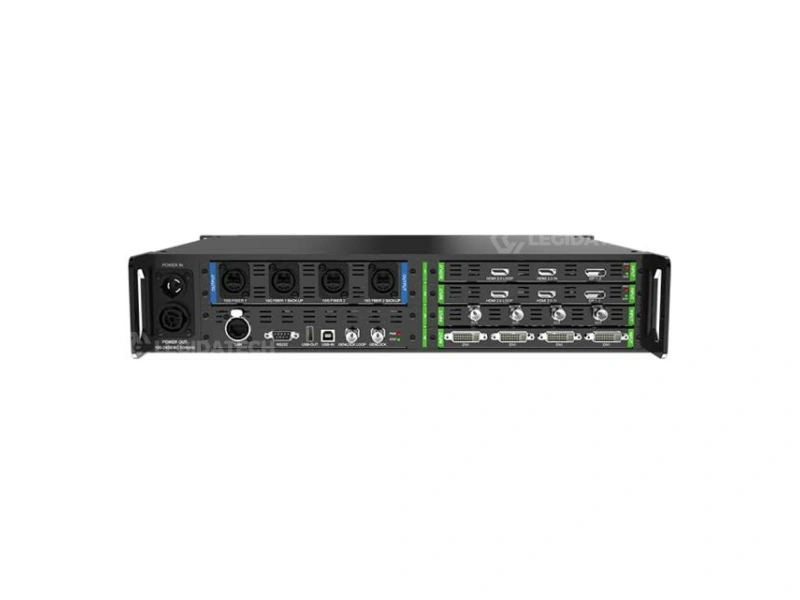
A single MCTRL4K unit drives up to 4096×2160@60Hz across 16 Neutrik Gigabit Ethernet ports and 4 optical fiber outputs, supporting custom resolutions up to 7680 pixels wide or tall for ultra-wide and ultra-tall LED video walls.

What Is the MCTRL 4K LED Processor?
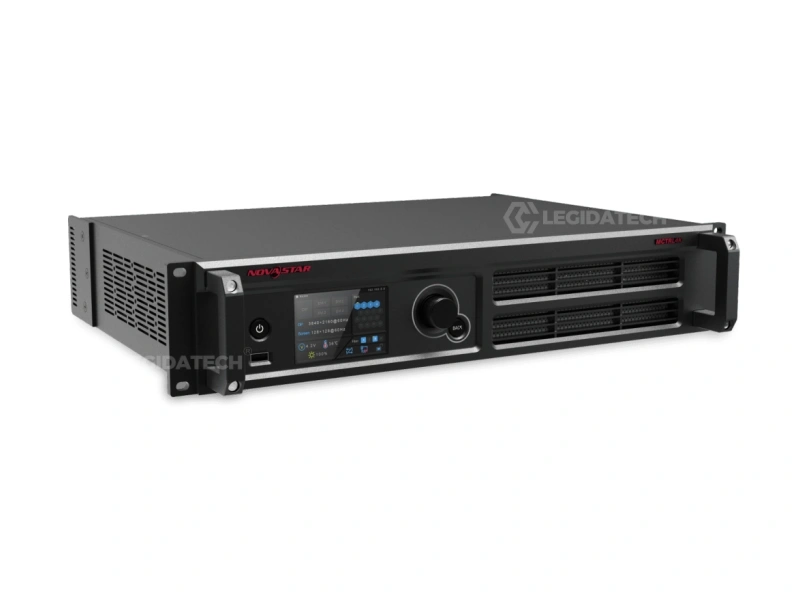
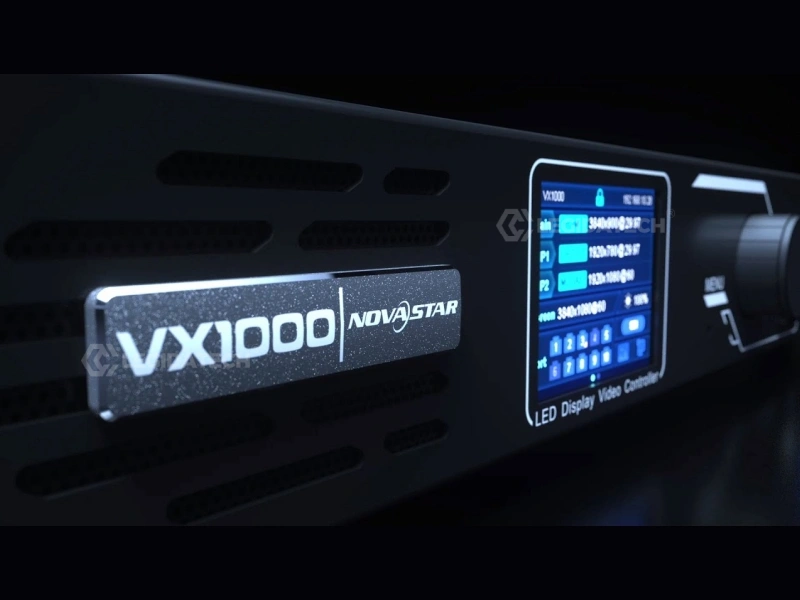
MCTRL 4K LED processor (model MCTRL4K) is a flagship independent LED display controller developed by Xi’an NovaStar Tech Co., Ltd. Designed as a pure sending controller rather than an all-in-one processor, the MCTRL4K sits between your video source and the LED wall, distributing a single 4K×2K@60Hz signal across up to 16 Ethernet outputs and 4 optical fiber ports. Each unit handles 8.8 million pixels via DP 1.2 or HDMI 2.0 input, and 8.3 million pixels via dual-link DVI.
Unlike entry-level LED display controllers, the MCTRL4K brings industry-leading technologies — HDR10/HLG, individual RGB gamma adjustment at 10-bit/12-bit, 3D display with EMT200 emitter, and pixel-level brightness and chroma calibration — into a single 2U rack-mount chassis weighing only 4.6 kg and drawing just 30 W.
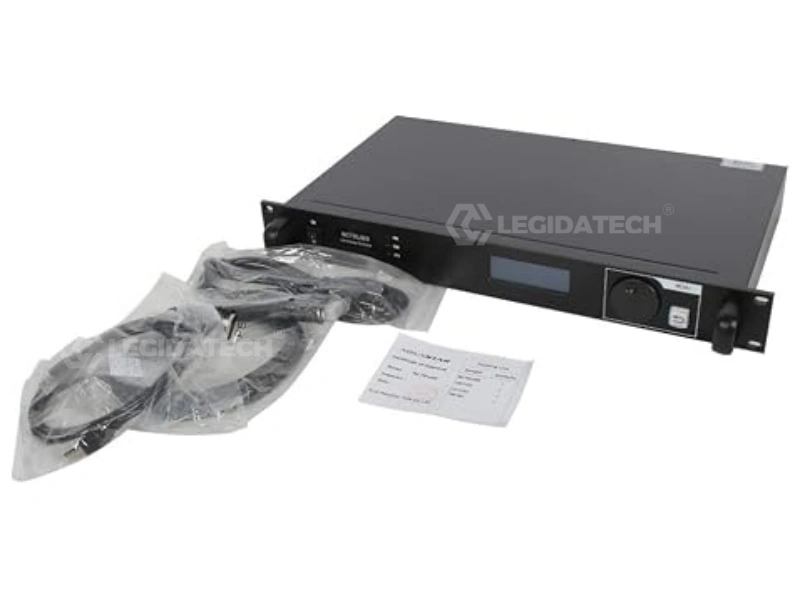
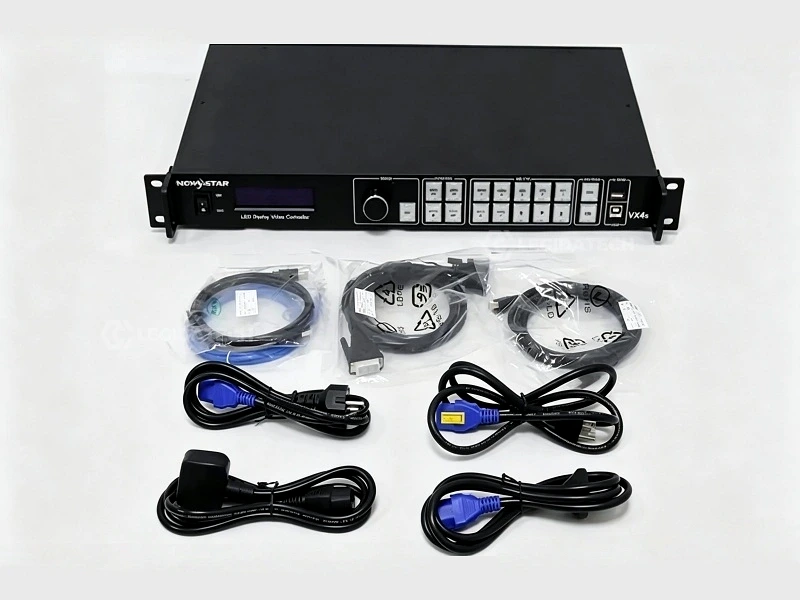
As a direct LED screen manufacturer and authorized NovaStar partner, Legidatech supplies the MCTRL4K at factory-direct pricing with full technical support. Every unit ships with power cord, Ethernet cable, USB cable, HDMI cable, and DP cable included.
Key Features of the MCTRL 4K LED Processor
Each feature addresses a specific challenge in large-scale LED display deployment.


HDR10 & HLG Support
The MCTRL4K supports both HDR10 (fixed installation) and HLG (live broadcast). When paired with NovaStar A8s or A10s Plus receiving cards, HDR expands dynamic range significantly. Seven HLG modes (300–1700 nits) allow precise matching to your screen’s actual peak luminance. HDR operates via HDMI input only and requires a 10-bit source.
Low Latency — Under 1 ms
In live event production, any perceptible delay between video source and LED wall is unacceptable. The MCTRL4K achieves sub-1ms latency when input source sync is enabled. The built-in Genlock connector supports Bi-level, Tri-level, and Blackburst reference signals, with up to 10 MCTRL4K units cascaded for multi-screen synchronization.
3D Display Capability
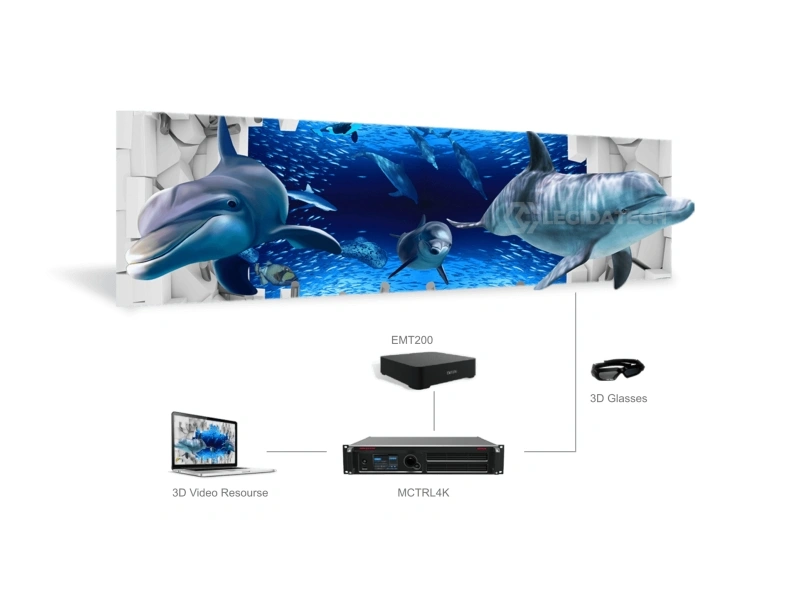
Paired with the NovaStar EMT200 3D emitter and compatible 3D glasses, the MCTRL4K delivers full 3D LED display effects. It supports Side-by-Side, Top-and-Bottom, and Frame Sequential formats. In DVI mode, DVI1 handles left-eye and DVI2 handles right-eye image feeds.
Individual RGB Gamma Adjustment
For 10-bit or 12-bit input sources, the MCTRL4K allows independent gamma curve adjustment for red, green, and blue channels — addressing white balance offset and color non-uniformity at low grayscale levels that a global gamma curve cannot compensate for.
Pixel-Level Calibration
Working with NovaStar’s high-precision calibration system, the MCTRL4K calibrates brightness and chroma at the individual pixel level. This eliminates hot spots, brightness gradients, and color drift between panels — even across hundreds of cabinets from different production batches.
16× Ethernet + 4× 10G Optical Fiber
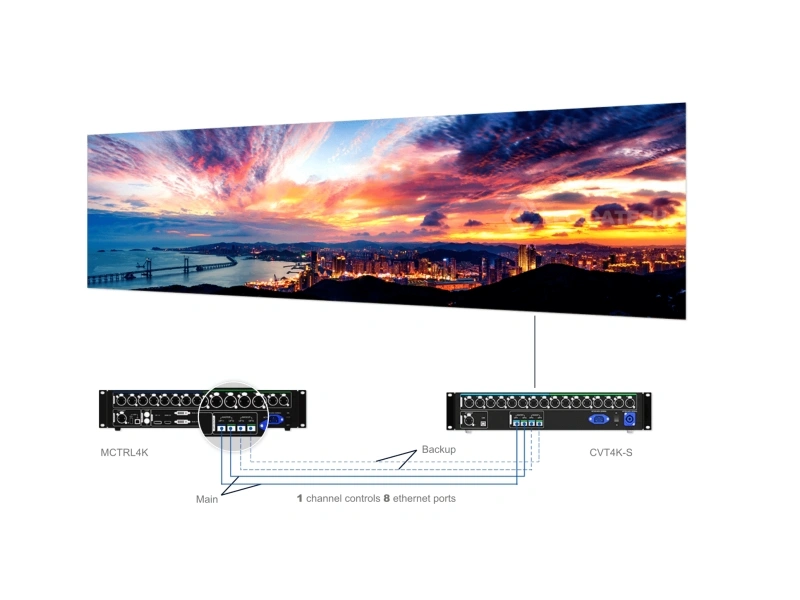
Each MCTRL4K provides 16 Neutrik Gigabit Ethernet ports — each driving up to 650,000 pixels at 8-bit/60Hz — plus 4 optical fiber ports with backup redundancy. Single-mode fiber reaches 10 km. For long-distance optical fiber transmission, this architecture supports stadium-scale deployments.
MCTRL4K Technical Specifications
All specifications sourced from NovaStar official documentation V1.2.2. Verified against production units.
Electrical & Environmental
| Parameter | Value |
|---|---|
| Input Voltage | AC 100 V–240 V, 50/60 Hz |
| Rated Power Consumption | 30 W |
| Operating Temperature | -20°C to +60°C (-4°F to +140°F) |
| Operating Humidity | 10% RH to 90% RH, non-condensing |
| Storage Temperature | -20°C to +70°C (-4°F to +158°F) |
Physical Specifications
| Parameter | Value |
|---|---|
| Dimensions (W × D × H) | 482.6 mm × 372.0 mm × 88.1 mm (19.0″ × 14.6″ × 3.5″) |
| Net Weight | 4.6 kg (10.1 lbs) |
| Form Factor | Standard 2U rack-mount (horizontal orientation only) |
| Included Accessories | 1× Power cord, 1× Ethernet cable, 1× USB cable, 1× HDMI cable, 1× DP cable |
Certifications: FCC, CE, RoHS, IC, UL & CUL, CB, RCM, NTRA, PSE

Input & Output Connectivity
Video Inputs
| Port | Standard | Max Resolution | HDCP |
|---|---|---|---|
| DP 1.2 | DisplayPort 1.2 | 4096×2160@60Hz (Custom: 7680×1080@60Hz) | 1.3 |
| HDMI 2.0 | HDMI 2.0 | 4096×2160@60Hz (Custom: 7680×1080@60Hz) | 1.4 / 2.2 |
| DL-DVI ×2 | Dual-Link DVI | 3840×1080@60Hz each | — |
All inputs support custom resolutions and decimal frame rates (23.98/29.97/47.95/59.94/71.93/119.88 Hz). Interlaced sources are not supported.
Outputs & Per-Port Loading
| Output Type | Qty | 8-bit / 60Hz per Port | 10/12-bit / 60Hz per Port |
|---|---|---|---|
| Neutrik EtherCON | 16 | 650,000 px | 320,000 px |
| 10G Optical Fiber | 4 | Aggregates 8 Ethernet ports each; up to 10 km (SM) / 300 m (MM) | |
Ethernet ports support redundancy. OPT1→ports 1-8, OPT2→ports 9-16, OPT3/OPT4 are backup channels. The complete set of LED display accessories is available for one-stop procurement.
Application Scenarios
Concerts & Live Events
Sub-1ms latency keeps LED walls synchronized with performers and cameras. Cascading up to 10 units supports massive stage backdrops. Stage LED screens paired with MCTRL4K ensure flawless live production.
Sports Venues & Stadiums
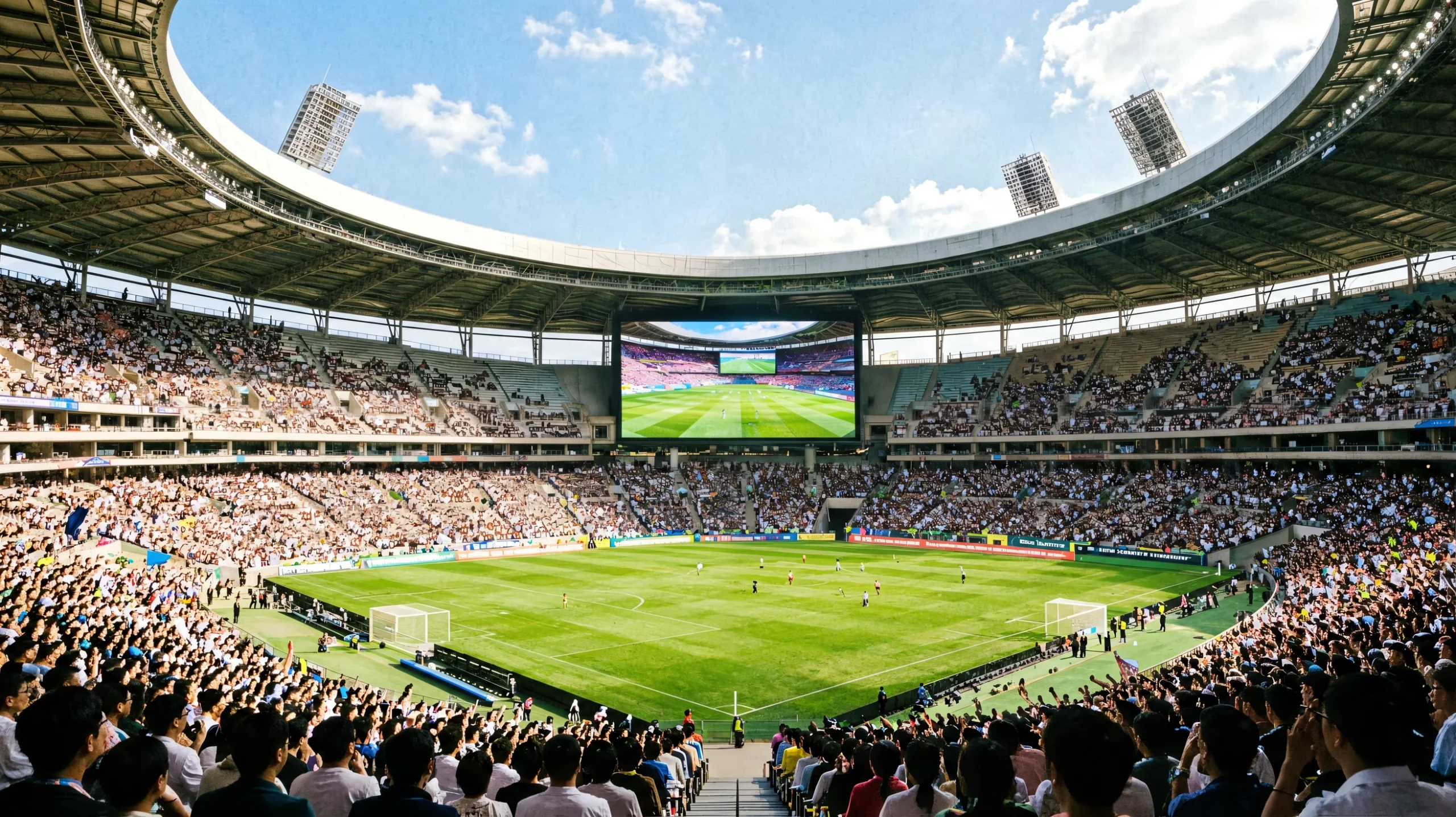
Optical fiber outputs reach distant scoreboard locations up to 10 km. Genlock ensures frame-accurate sync across multiple displays. HDR enhances visibility under stadium lighting conditions.
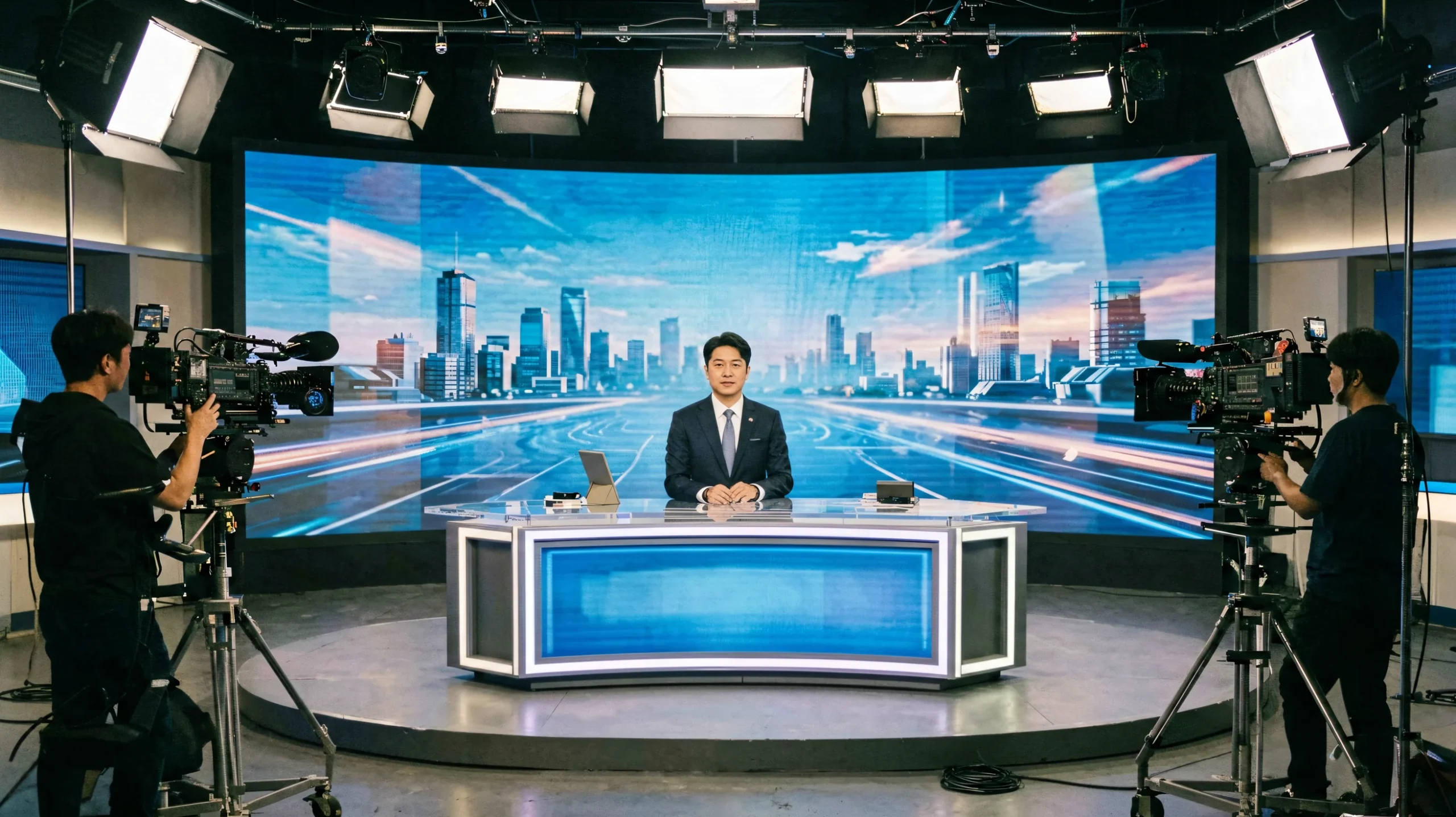
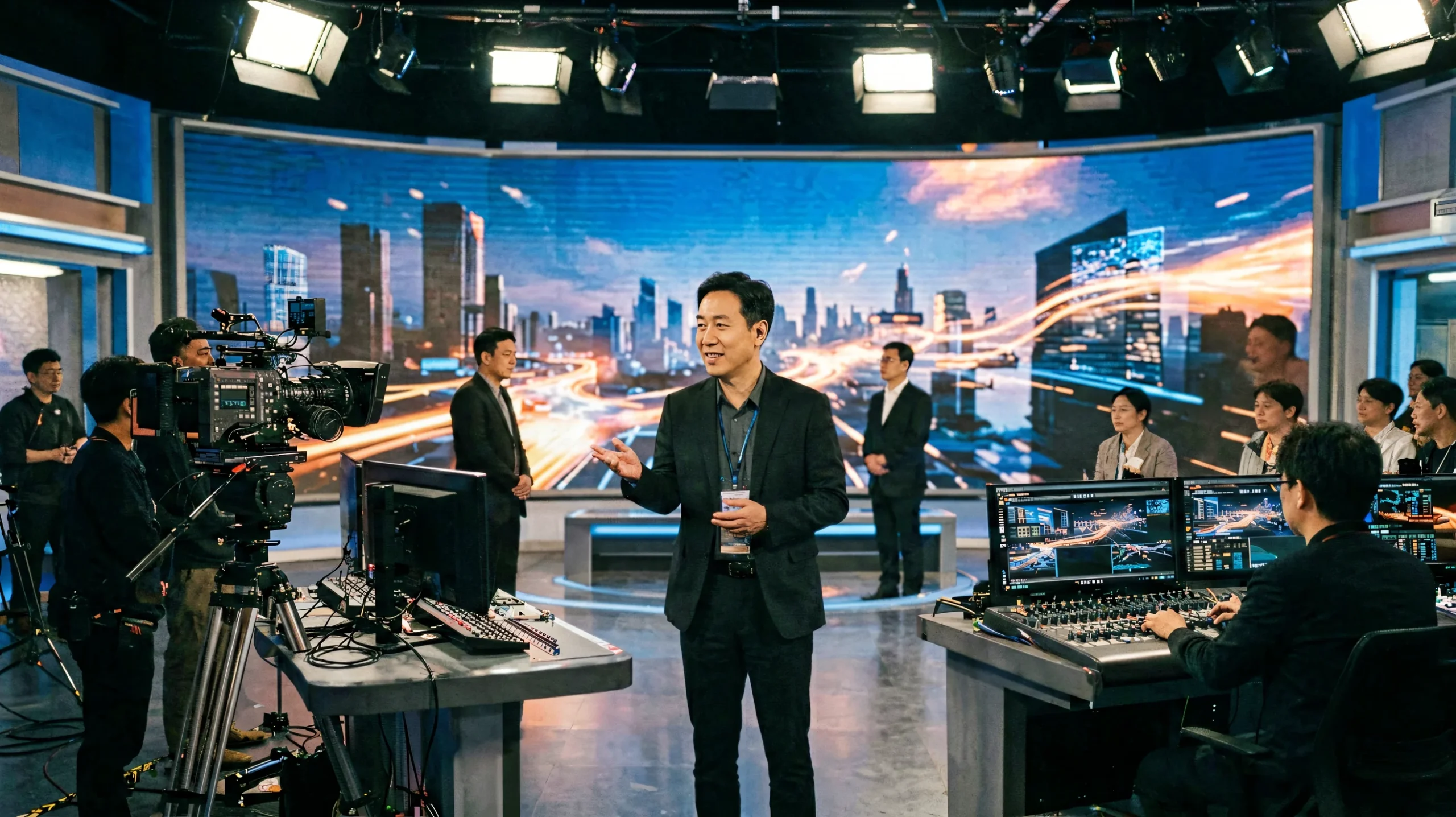
Broadcast Studios
Genlock with Blackburst/Tri-level sync locks LED walls to camera shutters. HLG mode simplifies broadcast HDR workflows by removing the need for post-production grading.
Rental & Staging
At 4.6 kg in a 2U chassis, the MCTRL4K is road-ready for touring. Web-based configuration enables on-site adjustments from any mobile device. Pair with rental LED displays for a complete touring solution.

From Our Factory to Your Stage
When you source the MCTRL4K from Legidatech — an LED screen manufacturer with in-house production lines — you receive a complete, pre-tested ecosystem: the controller configured to your cabinet specifications, compatible receiving cards, and ongoing technical support from engineers who understand the entire signal chain from processor to pixel.
Every MCTRL4K unit we ship is powered on, firmware-updated, and tested before packaging. Our LED screen factory production line integrates controller testing with cabinet assembly, ensuring plug-and-play compatibility out of the box.
MCTRL 4K LED Processor vs Other Controllers
| Parameter | MCTRL4K | MCTRL660 Pro | MCTRL R5 |
|---|---|---|---|
| Max Loading (Standard) | 8,800,000 px | 2,300,000 px | 4,100,000 px |
| Max Width/Height | 7,680 px | 3,840 px | 4,096 px |
| Ethernet Ports | 16× Neutrik Gigabit | 6× RJ45 Gigabit | 8× Neutrik Gigabit |
| Optical Fiber | 4× 10G (10 km) | None | 2× 10G |
| HDR Support | HDR10 + HLG | Not Supported | Not Supported |
| 3D Display | Yes (with EMT200) | Not Supported | Not Supported |
| Low Latency | <1 ms | Not Supported | Not Supported |
| Bit Depth | 8/10/12-bit | 8/10/12-bit | 8/10/12-bit |
| Cascading | Up to 10 units | Up to 20 units | Up to 10 units |
| Power | 30 W | 16 W | 25 W |
| Weight | 4.6 kg | 3.6 kg | 4.2 kg |
Which Controller Is Right for Your Project?
- Choose the MCTRL4K if your LED wall exceeds 4 million pixels, requires HDR or 3D, spans ultra-wide/ultra-tall custom resolutions, or needs optical fiber for stadium-scale signal distribution.
- Choose the NovaStar MCTRL660 Pro for mid-size rental setups under 2.3M pixels where HDR and 3D are not required.
- Choose the MCTRL R5 as a middle-ground option with 8 Ethernet ports and optical outputs for ~4M-pixel projects that don’t need HDR.
Frequently Asked Questions
Can the MCTRL4K drive two independent content sources simultaneously?
Yes — in Multi-Card mode, DVI1 and DVI2 each carry an independent video source. Each card handles up to 3840×1080@60Hz. Both sources display on the screen at the same time. This mode requires DVI input only; DP and HDMI are not available in Multi-Card mode.
What receiving cards are compatible with MCTRL4K HDR?
HDR requires NovaStar A8s or A10s Plus receiving cards. Standard receiving cards cannot process HDR metadata or 10-bit HDR signals. Using non-HDR-compatible cards will result in incorrect tone mapping and color artifacts.
How many MCTRL4K units can be cascaded?
Up to 10 units via USB IN/OUT for centralized PC control, and up to 10 units via GENLOCK IN/LOOP for synchronized output timing. For ultra-large walls exceeding 88 million pixels, multiple cascaded MCTRL4K units distribute the load evenly.
Does the MCTRL4K support interlaced video signals?
No. All input interfaces — DP 1.2, HDMI 2.0, and DL-DVI — require progressive scan signals. Interlaced formats (1080i, etc.) must be deinterlaced before reaching the controller.
What is the actual loading capacity at different bit depths?
At 8-bit/60Hz: 650,000 pixels per Ethernet port, totaling 8.8M via DP/HDMI. At 10-bit or 12-bit/60Hz: 320,000 pixels per port (5.1M total). At 120Hz, capacity halves again. See our sending cards and receiving cards calculation guide for detailed formulas.
Does the MCTRL4K support audio output?
No. The MCTRL4K is a pure video controller. Audio must be routed separately through your audio system. The Ethernet output ports carry video data only — no embedded audio.
MCTRL 4K LED Processor: The Complete Technical Guide for AV Professionals
1. Understanding MCTRL4K Architecture — Mosaic Mode vs Multi-Card Mode
Before configuring your MCTRL 4K LED processor, you must choose between its two operating modes. This decision determines how many video sources you can display and how Ethernet ports are allocated.
Mosaic Mode (default) operates the MCTRL4K as a single high-capacity sending controller. One video input — Auto, DP, HDMI, or DVI×2 — is distributed across all 16 Ethernet ports and optical outputs. Auto-detection follows the priority order DP → HDMI → DVI. This is the correct mode for the vast majority of installations: one LED wall, one content source.
Multi-Card Mode splits the MCTRL4K into two independent sending cards. DVI1 and DVI2 each carry a separate video source — up to 3840×1080@60Hz per card — and both display on the screen simultaneously. The trade-off: only DVI input is available; DP and HDMI are disabled.
2. How to Configure MCTRL4K for Ultra-Wide LED Screens
Ultra-wide and ultra-tall LED displays — ribbon boards, perimeter signage, architectural facades — push beyond standard 16:9 aspect ratios. The MCTRL4K supports custom resolutions up to 7680 pixels in either dimension.
Step 1 — Set Input Mode: Navigate to Input Settings > Input Mode. Set DVI Mode to Mosaic. Select DP or HDMI for custom ultra-wide resolutions. Enable “Limited to Full” only if your source outputs RGB Limited.
Step 2 — Customize Resolution: Go to Input Settings > Input Resolution > Custom. Enter your target width, height, and refresh rate. For resolutions where width or height exceeds 4092 pixels, configure via NVIDIA Control Panel on the source PC. The pixel clock must not exceed 595.0 MHz.
Step 3 — Quick Screen Configuration: Navigate to Screen Settings > Quick Config. Set Cabinet Row QTY and Cabinet Col QTY. Set Port1 Cabinet QTY. All ports 1 through (N-1) must load the same number of cabinets as an integer multiple of cabinet rows or columns.
Step 4 — Verify Data Flow: Ensure cabinets are connected sequentially in the same direction, with Ethernet Port 1 at the physical beginning. Use the Mapping function (Advanced Settings > Mapping Function) to verify each cabinet displays its correct port number.
3. Understanding HDR on LED Displays — Why It Matters
HDR directly translates to measurable improvements in peak brightness handling, shadow detail preservation, and color volume. In SDR, brightness is encoded in a gamma curve designed for ~100 nit CRTs. When displayed on an LED wall capable of 1,000–5,000 nits, SDR content either clips highlights or raises black levels to grey.
HDR10 replaces this with the ST.2084 (PQ) electro-optical transfer function, allocating code values based on human visual perception — more bits to shadows where the eye is most sensitive. The MCTRL4K implements HDR10 with three adjustable parameters: Screen Peak Luma (100–10,000), Ambient Light (0–30), and Low Grayscale Mode (0–50).
For live broadcast, HLG (Hybrid Log-Gamma) is the preferred standard. Unlike HDR10, HLG is scene-referred: the same signal produces a viewable SDR image on standard displays and an HDR image on compatible screens. Select the mode closest to your screen’s peak luminance from the 7 available HLG modes.
4. Fiber vs Ethernet — When to Use Optical Transmission
The MCTRL4K’s Neutrik EtherCON ports handle most installations with Cat6/Cat6a up to 100 meters. For distances beyond 100 m, optical fiber becomes essential. Each optical port carries the aggregated data of 8 Ethernet ports. Single-mode fiber (OS1/OS2, 1310 nm) reaches 10 km; multi-mode (OM3/OM4, 850 nm) reaches 300 m. For long-distance optical fiber transmission beyond 10 km, intermediate repeaters or alternative fiber converter solutions are required.
5. Loading Capacity Calculation — 8-bit vs 10-bit vs 12-bit
One of the most common errors in LED wall design is miscalculating MCTRL4K loading capacity. At 8-bit/60Hz: Each port loads 650,000 pixels (10.4M theoretical, capped at 8.8M). At 10-bit or 12-bit/60Hz: Each port loads 320,000 pixels (5.1M total). At 120Hz: Capacity halves again. For a 4K LED wall at 10-bit (~8.3M pixels), two cascaded MCTRL4K units are required.
Formula: Ports needed = (Screen Width × Screen Height) ÷ Per-port capacity. Always include a 10% safety margin. See our sending cards and receiving cards calculation guide for detailed examples.
6. MCTRL4K ROI Analysis for Rental Companies
At factory-direct pricing, the MCTRL4K typically achieves full payback within 3–5 rental events when driving a 50 sqm 4K wall. Beyond direct rental revenue, HDR capability qualifies your inventory for broadcast productions, sub-1ms latency makes your wall viable for live IMAG (Image Magnification), and 3D support opens the immersive event and virtual production market. The web-based control interface also reduces labor costs by eliminating the need for a dedicated LED technician during on-site configuration.
7. Firmware Update & Maintenance
Current firmware: V1.3.0.0. Update via NovaLCT (User > Advanced Synchronous System User Login > enter “admin” > Browse firmware > Update) or SmartLCT (V-Sender > Firmware Upgrade). Keep chassis vents unobstructed — the 30W draw generates minimal heat, but dust accumulation in rack environments can reduce airflow. For software downloads, visit the Download NovaStar systems page.
8. Conclusion — Is the MCTRL 4K LED Processor Right for Your Project?
The MCTRL 4K LED processor occupies a specific position in NovaStar’s product line: it is the highest-capacity standalone sending controller before crossing into all-in-one video processor territory. For AV professionals deploying LED walls exceeding 4 million pixels — particularly those requiring HDR, 3D, sub-millisecond latency, or stadium-scale optical fiber distribution — the MCTRL4K remains the reference standard. Its limitations are equally clear: it does not scale or switch between multiple input sources, it does not output audio, and its HDR/3D features come with capacity trade-offs. But what it does, it does with engineering precision — and as a direct LED screen manufacturer, Legidatech ensures every unit is pre-configured to your exact specifications.
To discuss your project requirements or request a customized quotation, contact our engineering team.
Get Factory-Direct Pricing on the MCTRL 4K LED Processor
As an authorized NovaStar partner and direct LED screen manufacturer, Legidatech offers the MCTRL4K at competitive factory pricing with global shipping to 60+ countries. Every unit is pre-tested, firmware-updated, and includes the complete accessory kit. Compare LED screen prices — we provide transparent, itemized quotations.
FCC / CE / RoHS / UL Certified
Global Shipping to 60+ Countries
Engineer-Level Technical Support