LED Mesh vs Transparent LED Screen: Facade & Building Exterior Guide
A building exterior is the largest advertising surface most owners have, and two display families are quoted for it repeatedly: the open LED mesh screen facade and the transparent LED screen. They look similar in a rendering, but they differ in wind behavior, weight, service access, and cost. This guide compares them on the numbers that decide a façade tender in 2026.
Short answer: An LED mesh screen facade is an open grid of LED strips or pixel strings on cables or steel, usually 55–85% open and 5–10 kg/m², built for exteriors viewed from 30–100 m. A transparent LED screen is a denser strip or film construction attached to glass, 60–95% transparent, designed for 1–10 m viewing. Mesh bodies run $288–$720/m², installed $650–$1,450/m² (SightLED, 2026). Use mesh for towers and high-wind façades; transparent LED for retail glass and atriums.
What Is an LED Mesh Screen Facade and How Does It Work?
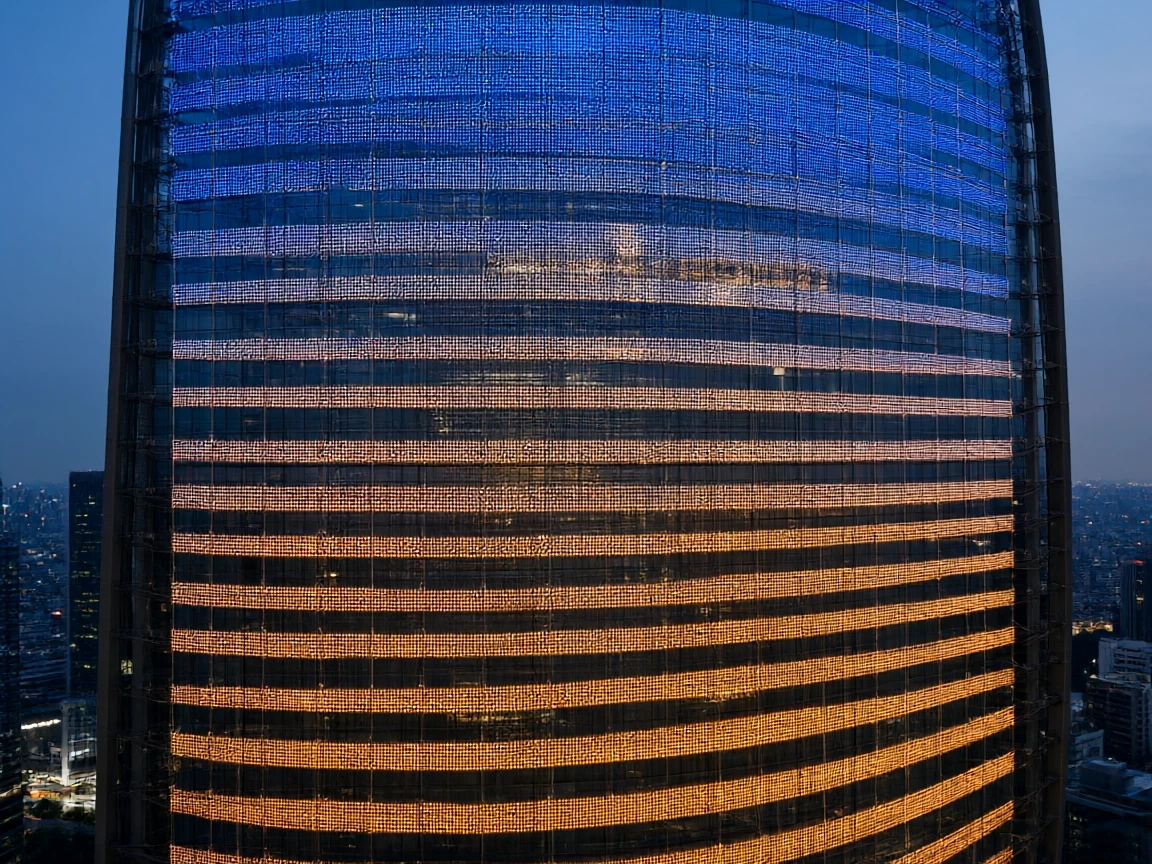
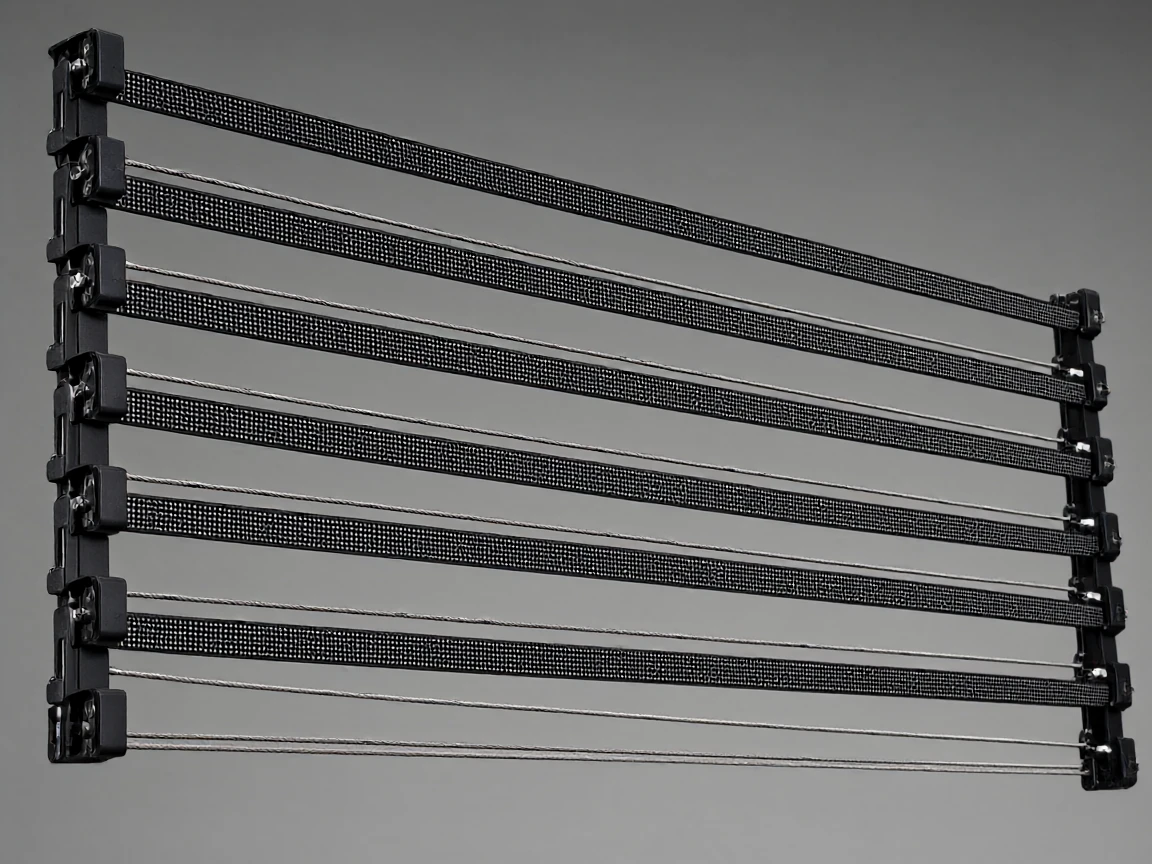
An LED mesh screen facade is an exterior display built as an open grid of LED pixels — normally horizontal light strips, pixel strings, or narrow modules suspended on steel cables, wire rope, or a steel lattice — so that air, daylight, and views pass through the gaps between light lines. Each strip is a row of addressable pixels; together they form a low-resolution video surface at the scale of a building.
The construction is quoted at P31.25 to P71.43, with 55–85% openness, 5–10 kg/m² weight, IP66–IP67 protection, and 280–360 W/m² average power (SightLED, 2026). Because the strips are cable-supported, the load path runs through the cables and brackets into the building’s concrete or steel frame. A mesh facade is a structural system, not a screen hung on a wall.
How Does an LED Mesh Screen Facade Handle Wind and Rain?
The open grid is the reason mesh exists on tall buildings. Wind passes through the surface instead of loading it like a sail, and manufacturer-published figures for open systems cite wind-load reductions of up to 60% against a solid panel (ChinaLEDScreens, 2026). Treat that as a starting point, not a design value: the engineer still models gust pressure, cable vibration, anchor fatigue, and local wind. Chipshow (2026) makes the same point — openness reduces solid area, but airflow effects still need project-specific calculation.
Water protection follows the same logic. Outdoor mesh strips are potted or sealed to IP66–IP67, with protected connectors and UV-stabilized cable jackets (SightLED, 2026; KTR Light, 2026). Coastal sites need gold-wire LEDs, coated PCBs, and stainless or galvanized brackets. IP67 adds 20–25% over IP65, which is cheap compared with a service campaign after two monsoon seasons (SightLED, 2026).
How Does an LED Mesh Screen Facade Differ from a Transparent LED Screen?
A transparent LED screen is a see-through display built from narrow LED bars in slim cabinets, or film bonded to glass; transparency comes from removing material between the light lines. The Legidatech EIT strip runs P3.91–7.81, 70% transparency, 11 kg/m², and 1,000–5,500 nits (Legidatech, 2026).
The families overlap in marketing but not in engineering. QSTECH (2026) draws the line: media mesh runs P40–P100 for long-distance effects, while a denser facade screen runs P4–P10 for readable brand content. The table below compares them.
| Attribute | LED mesh screen facade | Transparent LED screen |
|---|---|---|
| Typical pitch | P31.25–P71.43 outdoor; 40–100 mm media mesh (QSTECH, 2026) | P3.91–P7.81 strip; P5–P20 film |
| Weight | 5–10 kg/m² assembled (SightLED, 2026) | 11 kg/m² strip (Legidatech EIT); about 1.3 kg per film panel |
| Brightness | 5,000–9,600 nits (SightLED, 2026); 6,000–10,000 nits (KTR Light, 2026) | 1,000–5,500 nits EIT strip |
| Viewing distance | 30–100 m for building-scale content | 1–10 m for storefront and atrium content |
| Screen body price | $288–$720/m² (SightLED, 2026) | $400–$1,200/m² strip factory-direct; $740–$2,220/m² film (DOIT VISION, 2026) |
Five key differences decide most projects:
- Open area is structural, not just visual. Mesh trades pixel density for wind permeability; transparent LED trades openness for close-range image density.
- Pitch follows viewing distance. A P50 mesh reads at 50–100 m; a P3.91 strip reads at 4 m.
- Mounting points differ. Mesh loads a cable-and-bracket frame; transparent strip loads the glass framing; film loads the glass.
- Maintenance access differs. Mesh strips unclip individually; transparent modules unclip from the cabinet; film repairs mean patching bonded sections (KTR Light, 2026).
- Price gap reaches 20–40% outdoors. Mesh costs less at building scale; transparent strip wins on small glass areas (SightLED, 2026).
What Is the Difference Between LED Mesh and Transparent LED Film?
LED film is a self-adhesive PET sheet with LEDs bonded to it, cut to the glass and applied to the pane. It is an indoor retrofit product rated around IP31, relying on the glass for support and heat dissipation. Mesh is an outdoor structural system with its own cables and IP66–IP67 sealing. Film suits boutique windows; mesh suits building exteriors. For the full price comparison, see the transparent LED screen price guide.
Why Does an LED Mesh Screen Facade Reduce Wind Load and Structural Cost?
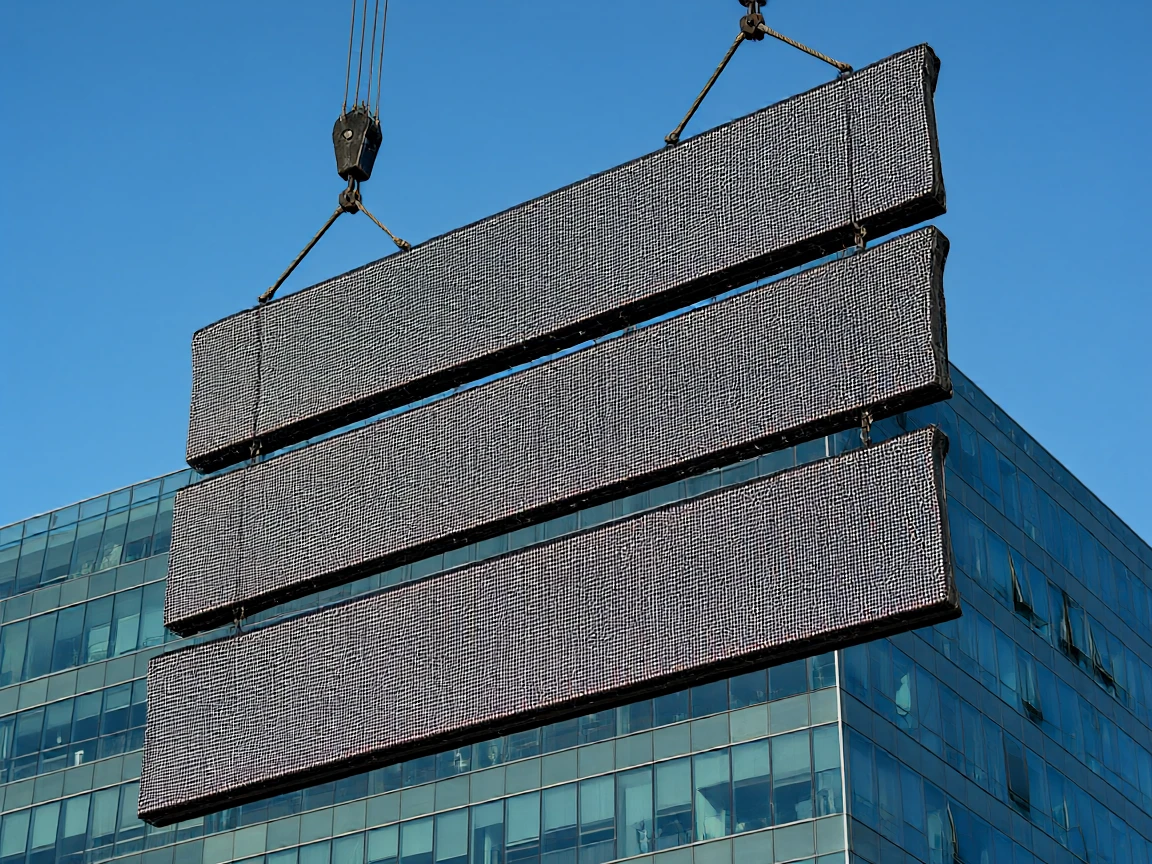
Wind load is the first cost driver on any tall façade, and mesh attacks it directly. A solid cabinet wall presents a continuous surface; an open mesh presents strips and gaps, so pressure equalizes and the effective solid area drops. On a 60 m tower, that can remove tons of secondary steel, reduce anchor count, and simplify the connection.
Weight compounds the advantage. A mesh assembly at 5–10 kg/m² is far lighter than a sealed outdoor cabinet wall at 35–65 kg/m² (Yinmu, 2026; SightLED, 2026). Lighter surfaces need smaller lifting equipment, shorter installation windows, and less structural strengthening on occupied retrofits. Open airflow also keeps strip temperature below a sealed box, supporting the 100,000-hour life figure (KTR Light, 2026).
The trade-off is a designed support system. Cables must be tensioned, brackets engineered for local wind, and the engineer must confirm the building can take the point loads. On a glass curtain wall, the frame lands on the slab edge or steel mullion support — not on the glass. That separation is why mesh is lower-risk for an occupied building: the display has its own structure. The transparent LED screen installation standards show the same principle on the glass-mounted side.
What Does an LED Mesh Screen Facade Cost in 2026?
Mesh pricing is driven by pitch first, then IP, brightness, LED brand, and order volume. The 2026 ladder is for the screen body at FOB terms; it excludes steel, control, cabling, shipping, and installation.
| Pixel pitch | Pixel density | Transparency | Body price per m² | Best viewing distance |
|---|---|---|---|---|
| P31.25 | 1,024 dots/m² | 55–70% | $580–$720 | 30–60 m |
| P41.67 | 576 dots/m² | 65–78% | $520–$650 | 40–80 m |
| P50 | 400 dots/m² | 72–82% | $420–$620 | 50–100 m |
| P55 | 330 dots/m² | 78–85% | $360–$560 | 60–120 m |
| P71.43 | 196 dots/m² | 82–85% | $288–$480 | 80 m and beyond |
The body price is roughly 55–70% of a completed project. On a 100 m² P41.67 façade, SightLED (2026) breaks a New York reference down to about $580/m² for the screen, $70/m² for steel, $30/m² for control, $40/m² for cabling, and $180/m² for installation — roughly $900/m² all-in. A P71.43 rooftop screen with simple structure lands near $650/m² installed; a P31.25 retail-facing façade with gold-wire LEDs, IP67, 3,840 Hz, and complex steel reaches $1,450/m². For standard panel benchmarks, see the LED screen price guide.
How Much Does an LED Mesh Screen Facade Cost per Square Meter?
The screen-only range is $288–$720/m² across P31.25–P71.43, and the installed range is $650–$1,450/m² (SightLED, 2026). Moving from P31.25 to P71.43 cuts the body price by 40–50% because the coarse pitch carries more than five times fewer LEDs per square meter. Pitch is the first budget decision: P31.25 at 80 m buys resolution the eye cannot resolve.
| Cost line | 2026 range per m² | Notes |
|---|---|---|
| Mesh screen body | $288–$720 | Pitch, IP rating, LED brand, brightness |
| Steel structure and brackets | $40–$200 | $40–$90 flat wall; $90–$200 curved or rooftop with high wind load |
| Control system and power | $20–$40 | Controller, receiving cards, power supplies |
| Installation and commissioning | $180–$280 | Labor varies by country and access method |
| All-in project | $650–$1,450+ | Typically 35–60% above the screen-only price |
Two commercial levers matter early. Suppliers commonly discount 5–10% above 50 m² and quote custom terms above 200 m²; a 500 mm module family avoids new PCB tooling, while a non-standard 600 or 700 mm cabinet can add 20–35% (SightLED, 2026).
How Do You Specify an LED Mesh Screen Facade for a Building Exterior?
A mesh façade quote is only comparable when every line uses the same vocabulary. Use this sequence for the RFQ and the technical evaluation:
- Geometry: width, height, segmentation, corners, cutouts, and the true elevation in CAD or BIM.
- Viewing distances: nearest pedestrian, main road, and farthest city view.
- Pitch and transparency: target pitch band and minimum open area, not just “high transparency.”
- Brightness: day/night levels, auto-dimming range, and the luminance cap required by planning.
- IP and corrosion: IP66 or IP67, connector protection, salt-spray class, and site exposure.
- Structure: who designs the steel and cables, design wind speed, anchor points, and the envelope interface.
- Service access: BMU, rope access, catwalk, or crane; front or rear service; spare strip strategy.
- Control: controller brand, signal topology, redundancy, and remote content access.
Which Controller and Power System Does an LED Mesh Screen Facade Need?
A building-scale mesh has a large canvas and a modest pixel count, so control is about reliability and remote access. A NovaStar or Colorlight controller with a fiber or Cat6 backbone, distributed receiving cards, and per-section power distribution is standard; the LED display control system page covers the chain from player to receiving card. Specify surge protection and lightning arresters, and keep emergency shutdown separate from the media player.
Power density is a budgeting item. At 280–360 W/m² average, a 200 m² mesh draws 56–72 kW, and the supply must be sized for the peak, not the average (SightLED, 2026). For a night-only façade, a dimming schedule and a photo sensor cut running cost.
LED Mesh Screen Facade vs Transparent LED Screen: Which Fits Your Building?
The matrix below is the one to take into a design meeting. It assumes a permanent installation, not a one-week event.
| Project condition | First choice | Why |
|---|---|---|
| Tower, stadium, rooftop, or podium above 50 m² | LED mesh screen facade | Wind permeability, low weight, long viewing distance |
| Retail window or atrium at 1–10 m viewing | Transparent LED screen | Denser pitch, sharper text, glass-first appearance |
| Large curved or irregular façade | Flexible mesh or flexible LED display | Flexible modules follow the geometry without a complex cabinet frame |
The working rule: start with viewing distance and the structural constraint. If the audience is 30 m away and the building is tall, start with mesh. If the audience is 3 m away and the surface is glass, start with a transparent LED screen. Pitch, brightness, IP, and controller follow from those two answers.
When Is a Transparent LED Screen the Better Choice?
A transparent LED screen wins when the glass is part of the design and the content must read from a short distance. That covers luxury storefronts, mall atriums, hotel entrances, car showrooms, and shop windows where merchandise stays visible. The shop window LED display guide covers the retail case; the transparent LED screen product line covers the P3.91–7.81 strip construction used in most of those projects.
How Is an LED Mesh Screen Facade Installed and Maintained?
A high-rise install is a sequence of engineering checks: site survey; bracket and cable-grid fabrication; anchors; cable tensioning and load testing; strip mounting; power and signal cabling; controller commissioning; brightness calibration; and a burn-in period before acceptance.
Access method decides much of the labor line. A building with a BMU can use the existing cradle; a bare façade needs rope access, scaffolding, or a crane, and each changes the safe working load and schedule. The $180–$280/m² installation figure assumes a straightforward crew; complex access pushes it higher (SightLED, 2026).
What Installation Method Suits a High-Rise LED Mesh Screen Facade?
For a new-build tower, design the brackets into the façade before the cladding closes, so the display uses the same anchor grid as the curtain wall. For a retrofit, a cable grid tensioned between existing slab edges avoids drilling the glass line and keeps the load path separate from the envelope. In both cases, a structural engineer with local wind data should sign the steel and cable design.
Maintenance is the second cost curve. Mesh strips are individually replaceable from the front: a technician unclips the faulty strip, plugs in a spare, and the rest keeps running (KTR Light, 2026). Keep 2–5% spare strips on site, label each by row and column, and include a torque check on cable terminations in the annual service plan. Coastal and industrial sites need more frequent washing, and dusty climates can block the open area. A service drill during commissioning — timing one strip swap — proves the plan before the warranty starts.
What Are the Limits of an LED Mesh Screen Facade?
Mesh is not a universal replacement for a billboard or transparent screen. Its limits belong in the design brief:
- Resolution is low by design. P31.25–P71.43 cannot show small text at close range; content should use large shapes and slow motion.
- Wind engineering is mandatory. Openness reduces load but does not remove it; cable vibration and anchor fatigue need project-specific calculation (Chipshow, 2026).
- Coastal corrosion is a lifetime cost. Gold-wire LEDs, sealed connectors, and galvanized or stainless steel are not optional on a salt-spray site.
- It is not a retail window product. For 3 m viewing, a transparent LED screen or a sealed outdoor LED display is the better tool.
For the transparent alternative, the P3.91 transparent LED screen analysis explains where that pitch works. For a sealed billboard, see the outdoor LED billboard range; for a flat indoor wall, the LED video wall range covers the standard alternative. Curved mesh projects can use a flexible LED display or a custom LED display built to the elevation.
Which Sources Support This LED Mesh Screen Facade vs Transparent LED Screen Guide?
The comparison relies on published 2026 manufacturer data and market research. Key sources:
- Omdia (2025): transparent display revenue projected to reach $100.2 million by 2032, 9.3% CAGR from 2025 to 2032.
- TrendForce (2025): total LED display terminal market forecast at $8.105 billion in 2026.
- SightLED (2026): mesh price ladder, all-in cost breakdown, weight, IP rating, and power density.
- KTR Light (2026): brightness, IP67/IP68 protection, single-strip maintenance, and lifespan.
- QSTECH (2026): pitch bands for facade screens and media mesh, and content-fit guidance.
- Chipshow (2026) and ChinaLEDScreens (2026): wind-load review, open-area engineering, and RFQ structure.
- DOIT VISION and iamledwall (2026): transparent strip and film price references.
- Legidatech (2026): EIT transparent screen specifications (P3.91–7.81, 70% transparency, 11 kg/m², 1,000–5,500 nits).
Frequently Asked Questions About LED Mesh Screen Facade
What is the difference between an LED mesh screen facade and a transparent LED screen?
A mesh facade is an open grid of LED strips on cables or steel, built for large exteriors at 30–100 m. A transparent LED screen is a denser strip or film on glass, built for 1–10 m storefront and atrium viewing.
How much does an LED mesh screen facade cost per square meter in 2026?
The body runs $288–$720/m² across P31.25–P71.43; installed projects run $650–$1,450/m² (SightLED, 2026). Steel, control, cabling, shipping, and installation add 35–60%.
Can an LED mesh screen facade be installed on a glass curtain wall?
Yes, but the display should not load the glass. A cable grid or bracket frame anchors to the slab edge or steel mullion support, with the mesh in front of the glazing; the engineer confirms anchors and wind loads.
What pixel pitch does an LED mesh screen facade need?
Match pitch to distance: P31.25 for 30–60 m, P41.67 for 40–80 m, P50 for 50–100 m, P71.43 for 80 m and beyond (SightLED, 2026). A finer pitch adds cost without visible benefit.
Is an LED mesh screen facade waterproof?
Outdoor mesh is typically IP66–IP67, with potted strips, sealed connectors, and UV-stabilized cables (SightLED, 2026; KTR Light, 2026). Coastal sites need gold-wire LEDs and corrosion-resistant brackets.
How long does an LED mesh screen facade last?
Branded-LED mesh with proper sealing is quoted at 100,000 hours and an 8–10 year service life (SightLED, 2026; KTR Light, 2026); climate, cleaning, and surge protection decide actual life.
Final Word: Is an LED Mesh Screen Facade Right for Your Building?
Decide the geometry and the viewing distance first. A tall, wind-exposed building viewed from 30 m or more points to an LED mesh screen facade: open structure, 5–10 kg/m², 55–85% transparency, and a body price from $288/m². A glass storefront viewed from 1–10 m points to a transparent LED screen: denser pitch, 60–95% transparency, and a glass-first appearance. Both can be quoted from an LED screen manufacturer, and both should be compared on the same line items — pitch, brightness, IP, structure, control, installation, and spares. Match the system’s distance, structural load, and service plan to the building.