If your LED wall exceeds 2 million pixels and needs to look flawless on camera, you’re choosing between two NovaStar flagships. The MCTRL4K and MCTRL660 Pro are both broadcast-grade independent LED controllers — but they target fundamentally different project scales. Use the wrong one and you either overpay for capacity you’ll never use, or under-spec a controller that bottlenecks your entire display.
At LEGIDATECH, we supply both models factory-direct with 3-year warranty and 48-hour burn-in testing. This comparison draws on real deployment data — not datasheet theory — to help you make the right call.
Quick Comparison at a Glance
| Feature | 🔷 MCTRL660 Pro | 🌟 MCTRL4K |
|---|---|---|
| Max Pixel Capacity | 2.3 million | 8.8 million |
| Video Inputs | 3G-SDI + HDMI 1.4a + SL-DVI | DP 1.2 + HDMI 2.0 + 2× DL-DVI |
| Max Input Resolution | 1920×1200@60Hz (custom 3840 px) | 4096×2160@60Hz (custom 7680 px) |
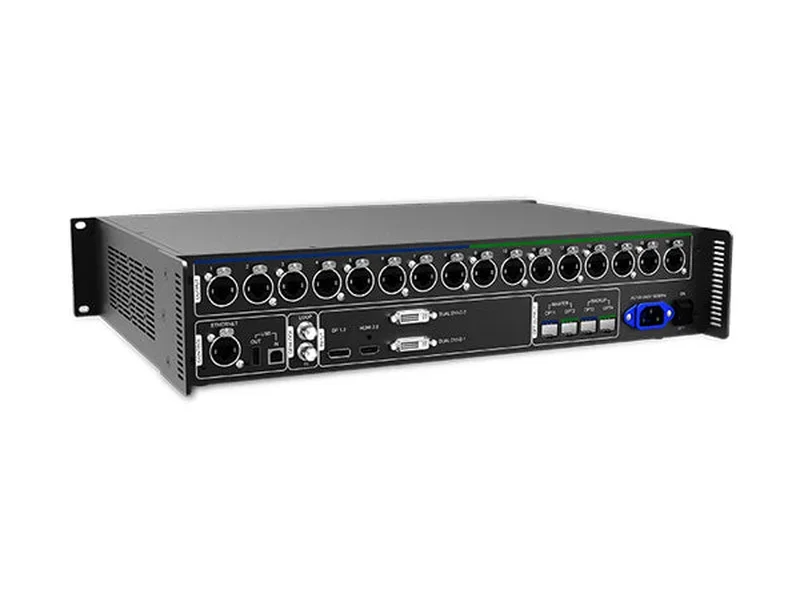
| Ethernet Outputs | 6× RJ45 Gigabit | 16× Neutrik EtherCON Gigabit |
| Fiber Outputs | 2× 10G SFP+ | 4× 10G Optical |
| SDI Input | ✅ 3G-SDI + Loop | ❌ None |
| GENLOCK Sync | ✅ Bi-Level / Tri-Level / Black Burst | ✅ Bi-Level / Tri-Level / Black Burst |
| Processing Latency | Sub-1ms (≤10 lines) | Sub-1ms |
| HDR Support | ❌ Not Supported | ✅ HDR10 + HLG |
| 3D Display | ❌ Not Supported | ✅ With EMT200 Emitter |
| Color Depth | 8 / 10 / 12-bit 4:4:4 | 8 / 10 / 12-bit |
| Free Rotation / Mirroring | ✅ Image Mirroring + Free Rotation | ❌ Standard Mirroring Only |
| Fiber Converter Mode | ✅ Built-in (saves $200-$400 per link) | ❌ None |
| Max Cascaded Units | Up to 8 | Up to 10 |
| Form Factor | 1U Rack-Mount | 2U Rack-Mount |
| Weight | 4.6 kg | 4.6 kg |
| Power Consumption | 20W | 30W |
| Market Price (Factory-Direct) | $650 – $850 | $2,000+ |
MCTRL660 Pro: The Broadcast Specialist with SDI
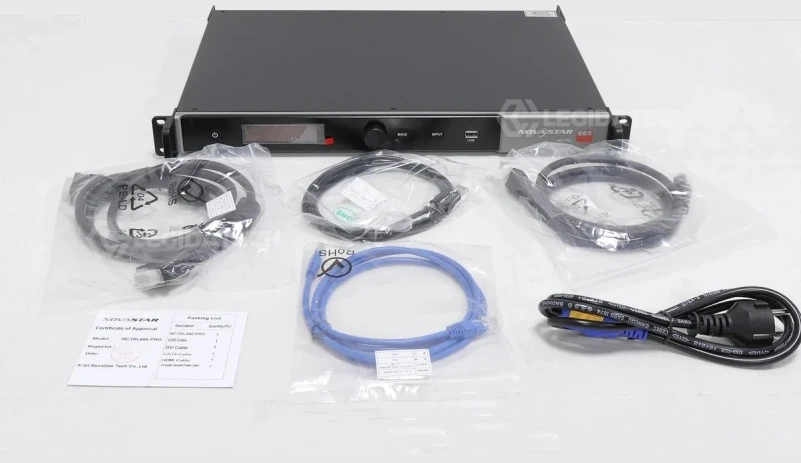
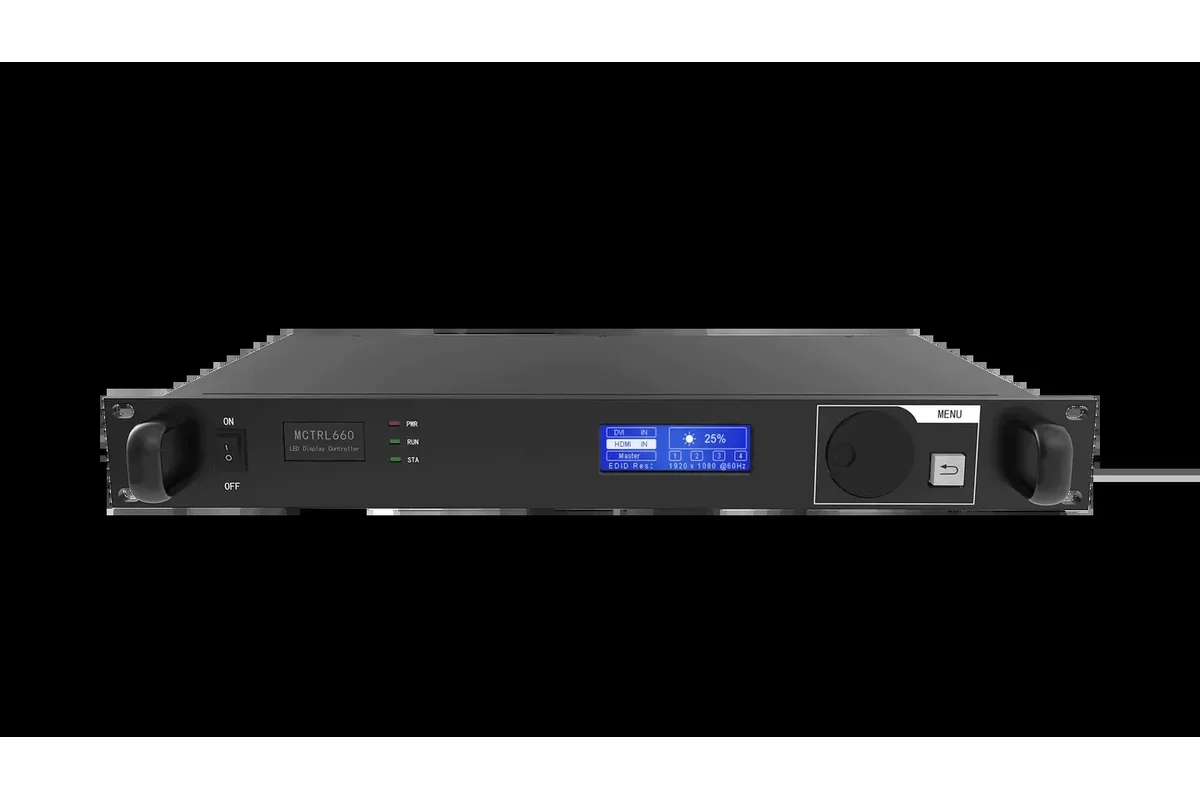
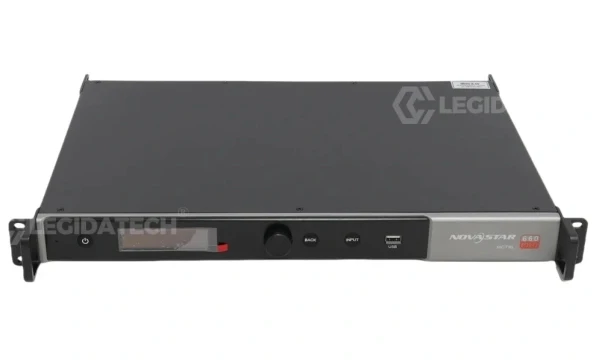
The MCTRL660 Pro is NovaStar’s answer to one question: “What if my LED wall is being filmed?” It is the only controller below the MCTRL4K that combines native 3G-SDI input, GENLOCK frame synchronization, dual 10G fiber outputs, and sub-1ms latency in a single 1U chassis.
Why the MCTRL660 Pro Wins for Broadcast & Live Production
- Native 3G-SDI: SMPTE ST 424/292/259 compliant. Connect broadcast cameras and production switchers directly via BNC — no HDMI-to-SDI converters. SDI carries embedded audio, timecode, and metadata alongside video. BNC connectors rated for 1,000+ mate/demate cycles (vs. HDMI’s ~200). Cable reach: 100m over RG6 coaxial without repeaters.
- GENLOCK: Slaves the controller’s frame timing to an external reference signal (bi-level, tri-level, or black-burst). Eliminates the horizontal tear lines that appear in recorded footage when the LED wall’s refresh drifts relative to the camera shutter. The OLED confirms “Genlock Locked” when active.
- Dual 10G SFP+ Fiber: Single-mode reaches 10 km; multi-mode reaches 300 m. OPT1 auto-detects fiber converter or video processor mode. OPT2 mirrors OPT1 for hot backup. Eliminates ground loops and electromagnetic interference — critical for outdoor stages and stadiums.
- Fiber Converter Mode: A unique feature: the controller itself performs optical-to-electrical conversion. Eliminates external fiber media converters entirely — saving $200–$400 per fiber link and reducing the signal chain by two devices.
- 12-bit 4:4:4 with RGB Gamma: 68.7 billion colors with independent red, green, and blue gamma curves — compensates for LED batch variations and panel aging at the hardware level.
MCTRL660 Pro Limitations
- 2.3M pixel ceiling: At 8-bit, it drives a 1920×1200 display. For anything larger — like a 4K (3840×2160) wall — you need multiple cascaded units or the MCTRL4K.
- No HDR or 3D: If HDR10/HLG or stereoscopic 3D is in your project scope, the MCTRL4K is the minimum requirement.
- Price premium over standard MCTRL660: You pay roughly double for SDI + GENLOCK + fiber. If none of those features apply to your project, the standard MCTRL660 is the better buy.
MCTRL4K: The 8.8M-Pixel Flagship with HDR
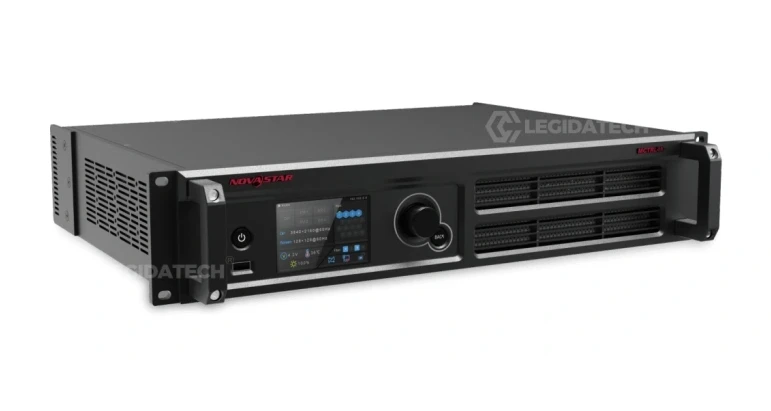
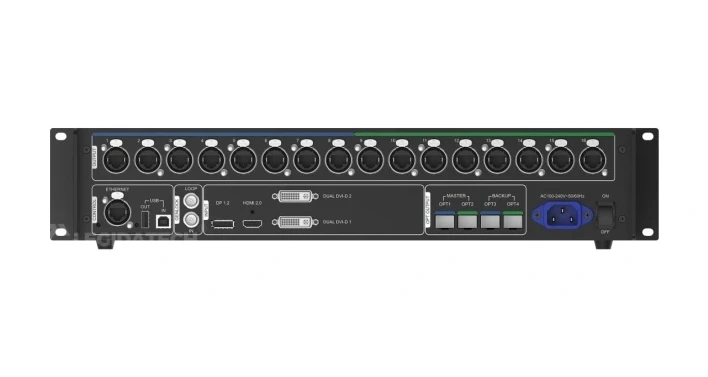
The MCTRL4K is NovaStar’s highest-capacity standalone sending controller — designed for stadium-scale LED walls, 4K broadcast studios, and XR virtual production volumes. A single unit handles 8.8 million pixels across 16 Neutrik EtherCON ports and 4 optical fiber outputs, with true 4096×2160@60Hz input.
Why the MCTRL4K Wins for Large-Scale & HDR Projects
- 8.8M pixel capacity: Nearly 4× the MCTRL660 Pro. A single unit drives a native 4K (3840×2160) display at 8-bit, or a 5.1M-pixel display at 10/12-bit. Cascade up to 10 units for walls exceeding 88 million pixels.
- HDR10 + HLG: HDR10 for fixed installations with adjustable Screen Peak Luma (100–10,000 nits). HLG for live broadcast — scene-referred so the same signal produces viewable SDR and HDR images. Seven HLG modes (300–1700 nits) match your screen’s actual peak luminance.
- 3D Display: With the NovaStar EMT200 3D emitter and compatible glasses. Supports Side-by-Side, Top-and-Bottom, and Frame Sequential formats via dual-link DVI (DVI1 = left eye, DVI2 = right eye).
- 16× Neutrik EtherCON + 4× 10G Fiber: EtherCON locking connectors are standard on touring-grade equipment — they don’t pull loose during a show. Each port drives 650,000 pixels at 8-bit. Four optical ports aggregate 8 Ethernet channels each, reaching 10 km on single-mode fiber.
- Multi-Card Mode: Split the MCTRL4K into two independent sending cards — DVI1 and DVI2 each carry a separate 3840×1080@60Hz source. Both display simultaneously on the same wall. No other controller in this comparison offers this.
MCTRL4K Limitations
- No SDI input: Broadcast cameras and switchers with SDI output require an external SDI-to-HDMI or SDI-to-DP converter. This adds $150–$500 and one more device in the signal chain.
- No Fiber Converter mode: The MCTRL4K’s optical ports are output-only. You cannot use the controller itself as an optical-to-electrical converter — separate media converters are needed for fiber-input scenarios.
- 2U form factor, 30W: Twice the rack height and 50% more power than the MCTRL660 Pro. Manageable, but worth factoring into rack layout and thermal planning for multi-unit deployments.
- Price: At $2,000+ factory-direct, the MCTRL4K costs roughly 3× the MCTRL660 Pro. That investment only pays off if your wall exceeds 2.3M pixels or requires HDR/3D.
7 Critical Differences That Decide Your Purchase
1. Pixel Capacity: 2.3M vs 8.8M — The Deciding Factor
If your display exceeds 2.3 million pixels, the decision is made: you need the MCTRL4K. For context, a P2.6 LED wall at 4m×2.25m (1536×864 = 1.33M pixels) fits within the MCTRL660 Pro’s capacity. A P2.6 wall at 8m×4.5m (3072×1728 = 5.3M pixels) requires the MCTRL4K. Always calculate pixel count before choosing.
2. SDI Input: MCTRL660 Pro’s Unique Advantage
The MCTRL660 Pro is the only MCTRL-series controller with native 3G-SDI input. For broadcast OB vans, production studios, and any setup where the video source is a professional camera or switcher with SDI output, the Pro eliminates external converters. The MCTRL4K requires an SDI-to-DP or SDI-to-HDMI converter — adding cost, complexity, and a failure point.
3. HDR & 3D: MCTRL4K Only
HDR10 and HLG are MCTRL4K-exclusive features. HDR10 requires HDMI input and NovaStar A8s or A10s Plus receiving cards. HLG is preferred for live broadcast workflows. 3D display (with EMT200 emitter) is similarly MCTRL4K-only. If your project spec mentions HDR or 3D, the MCTRL660 Pro is not an option.
4. Fiber Converter Mode: MCTRL660 Pro’s Hidden Cost Saver
The MCTRL660 Pro can operate as a fiber converter — its SFP+ ports accept optical input and output over Ethernet (or vice versa). This eliminates $200–$400 in external fiber media converters per link. The MCTRL4K’s optical ports are output-only. Over 10 deployments, the Pro’s converter mode alone saves $2,000–$4,000.
5. Ethernet Outputs: 6 vs 16 Ports
The MCTRL660 Pro’s 6 RJ45 ports are adequate for most mid-size walls — with each port handling 650K pixels at 8-bit, the total 2.3M capacity is the bottleneck, not the port count. The MCTRL4K’s 16 Neutrik EtherCON ports are needed for 4K walls where pixel count exceeds what 6 ports can handle. EtherCON’s locking mechanism is also more reliable in touring racks than standard RJ45.
6. Multi-Card Mode: MCTRL4K’s Studio Superpower
The MCTRL4K can split into two independent controllers — DVI1 and DVI2 each feed a separate 3840×1080@60Hz source to the same wall. This is invaluable for broadcast studios where the main camera feed and a graphics/confidence monitor feed must co-exist on the same display. No other controller offers this.
7. Price: $650-$850 vs $2,000+ — When “Cheaper” Costs More
The MCTRL660 Pro costs roughly one-third of the MCTRL4K. But the cheaper controller becomes expensive if it bottlenecks your display. Buying a Pro for a 4K wall means cascading 4 units (4 × 2.3M = 9.2M pixels) — at a combined cost of $2,600–$3,400, plus the complexity of managing GENLOCK across 4 cascaded controllers. A single MCTRL4K does it for $2,000+. The lesson: match the controller to the pixel count, not the budget.
Use Case Decision Matrix
Choose the MCTRL660 Pro If:
- Your primary video source outputs 3G-SDI (broadcast cameras, production switchers, OB vans)
- Your display is under 2.3M pixels (up to ~1920×1200)
- The LED wall will be filmed by cameras synced to GENLOCK
- You need fiber transmission over 100m+ but want to eliminate external converters
- You deploy in 1U rack spaces where every rack unit counts
- XR virtual production stages under 2.3M pixels
Choose the MCTRL4K If:
- Your display is over 2.3M pixels — up to true 4K (3840×2160)
- You need HDR10 or HLG high dynamic range
- Stereoscopic 3D display is in the project scope
- You need to display two independent sources simultaneously (Multi-Card Mode)
- The wall is ultra-wide or ultra-tall (>3840 px in either dimension)
- You’re deploying in stadiums, arenas, or large venues with distributed screens
- 16 EtherCON locking ports matter for touring reliability
Total Cost of Ownership: 3-Year Analysis
| Cost Factor | MCTRL660 Pro (1 unit) | MCTRL4K (1 unit) |
|---|---|---|
| Hardware (factory-direct) | $650 – $850 | $2,000 – $2,500 |
| SDI-to-DP/HDMI Converter | $0 (built-in SDI) | $150 – $500 |
| External Fiber Converters (pair) | $0 (built-in converter mode) | $200 – $400 (if fiber input needed) |
| Energy (3 years, 8h/day, 200 days/yr) | ~$12 (20W) | ~$18 (30W) |
| Maintenance (3 years) | ~$0 (fanless, solid-state) | ~$0 (fanless, solid-state) |
| Residual Value (Year 3) | ~$200 (30% resale) | ~$600 (30% resale) |
| NET 3-Year Cost (with accessories) | ~$462 – $662 | ~$1,768 – $2,418 |
Software & Configuration: Both Use NovaLCT
Both controllers are configured via NovaLCT (Advanced Synchronous System User Login for full features). The MCTRL660 Pro adds an OLED display with rotary knob for standalone configuration — no PC needed for basic screen mapping, input selection, or GENLOCK monitoring. The MCTRL4K relies entirely on NovaLCT for setup.
Frequently Asked Questions
Can the MCTRL660 Pro drive a 4K LED wall?
Not on its own. At 2.3M pixel capacity, a single MCTRL660 Pro maxes out at ~1920×1200. To drive a 4K wall (~8.3M pixels at 8-bit), you would need to cascade 4 MCTRL660 Pro units — which works technically but costs $2,600–$3,400 and adds GENLOCK synchronization complexity across 4 devices. A single MCTRL4K handles 4K natively for $2,000+ — simpler, cheaper, and more reliable.
Does the MCTRL4K have SDI input?
No. The MCTRL4K’s inputs are DP 1.2, HDMI 2.0, and 2× DL-DVI. For SDI sources, you need an external SDI-to-HDMI or SDI-to-DP converter ($150–$500). This is the MCTRL660 Pro’s single biggest advantage — if your primary source is SDI, the Pro eliminates one converter from your signal chain.
When is GENLOCK necessary?
GENLOCK is mandatory when the LED wall is filmed by cameras synchronized to an external reference. Without GENLOCK, the wall’s refresh drifts relative to the camera shutter — producing horizontal tear lines in recorded footage. Both controllers support GENLOCK, and both display “Genlock Locked” on their interface when active. If your display will never be on camera, GENLOCK is unnecessary and the standard MCTRL660 (without GENLOCK) may be a better value.
Can I cascade MCTRL4K and MCTRL660 Pro together?
Not recommended. Different internal architectures, different processing latencies, and different maximum pixel capacities create timing and configuration issues. NovaStar advises using identical controller models throughout any cascaded system. If your display exceeds one unit’s capacity, add more of the same model.
Which is better for rental companies?
For mixed rental fleets: the MCTRL660 Pro handles broadcast/SDI jobs and mid-size walls, while the MCTRL4K handles 4K and HDR jobs. If your rental inventory serves mostly corporate events (HDMI/DVI sources, walls under 2.3M pixels), the standard MCTRL660 or MCTRL600 offers better ROI. The Pro’s SDI/GENLOCK/fiber features only pay for themselves when you’re regularly serving broadcast clients or long-distance deployments. For rental companies that win both corporate and broadcast contracts, the Pro pays for itself within 12 months through the elimination of external converters and labor savings.
Final Verdict
The Rule Is Simple
Choose the MCTRL660 Pro if your wall is under 2.3M pixels AND being filmed. Its SDI input, GENLOCK, and fiber converter mode make it the definitive choice for broadcast, XR, and live production — at one-third the cost of the MCTRL4K.
Choose the MCTRL4K if your wall exceeds 2.3M pixels OR requires HDR/3D. Its 8.8M pixel capacity, 16 EtherCON ports, and HDR10/HLG support make it the reference standard for large-scale and 4K installations.
Don’t buy a MCTRL4K for a sub-2.3M-pixel wall without HDR/3D. You’re paying 3× for capacity you’ll never use. And don’t cascade 4 MCTRL660 Pros to drive a 4K wall — one MCTRL4K is cheaper and simpler.
Get Factory-Direct Pricing on Both Models
At LEGIDATECH, we supply both the MCTRL660 Pro and MCTRL4K with factory-direct pricing, 48-hour burn-in testing, 3-year warranty, and global shipping to 60+ countries. Every unit is pre-configured to your cabinet specifications.
We also stock the complete NovaStar lineup: MCTRL300, MCTRL600, VX1000, receiving cards, and LED cabinets. Bundle for deeper discounts.
📧 legidatechled@gmail.com
📞 WhatsApp: +86 185 69492693
Published by LEGIDATECH — Your factory-direct source for NovaStar controllers, LED display cabinets, and complete LED screen solutions. 15+ years of LED manufacturing experience.