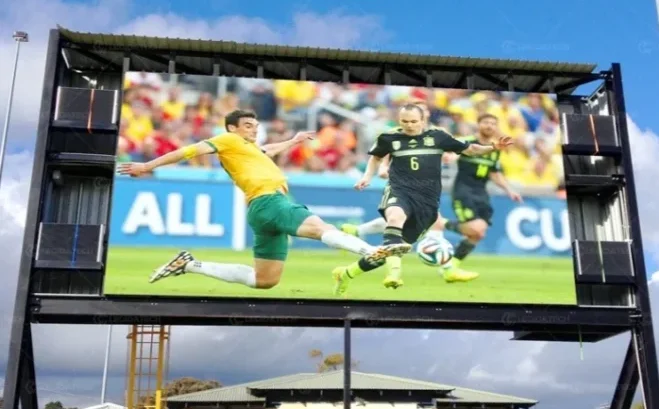
A P5 LED screen is the middle of the outdoor display market: sharper than P6 or P8, cheaper than P4, and readable from about 5 m away. That balance makes it a common choice for roadside advertising, stage backdrops, church screens and stadium perimeter displays. This guide covers the real specifications behind the “P5” label, the difference between indoor and outdoor versions, module and cabinet sizes, 2026 price ranges, viewing distance, installation and the checks we recommend before you buy.
P5 LED screen — factory overview
What Is a P5 LED Screen?
P5 means the pixel pitch is 5 mm — the center-to-center distance between two adjacent LEDs. One square meter contains 40,000 pixels at that pitch. The number is a balance point: fine enough for video and readable text at medium distance, coarse enough to keep the LED count and driver-IC count under control on large outdoor screens.
The “P5” label alone does not tell you whether the screen is indoor or outdoor. The same 5 mm pitch is built in two very different versions: an indoor panel with lower brightness and a lighter cabinet, and an outdoor panel with high brightness, sealed modules and a weather-rated cabinet. Buying the wrong version is the most expensive mistake in this category.

P5 LED module — 5 mm pitch, 320 × 160 mm format

P5 LED screen — outdoor cabinet and module assembly
P5 LED Screen Specifications at a Glance
Most reputable P5 panels sit in the following specification band. Treat it as a reference, not a universal standard: brightness, cabinet material, refresh rate and control system are all selectable.
| Parameter | Typical P5 specification |
|---|---|
| Pixel pitch | 5 mm |
| Pixel density | 40,000 pixels/m² |
| Module sizes | 320 × 160 mm (64 × 32 px) or 160 × 160 mm (32 × 32 px) |
| Cabinet sizes | 960 × 960 mm, 640 × 480 mm, 500 × 500 mm or custom |
| LED package | Indoor SMD3528 / SMD2020 · outdoor SMD2727 |
| Brightness | Indoor about 1,200 nits · outdoor about 6,500 nits |
| Refresh rate | 1,920 Hz or 3,840 Hz |
| IP rating | Indoor IP44 · outdoor IP65 |
| Viewing distance | About 5 m minimum · 10–15 m comfortable · readable to 50 m |
| Lifespan | 100,000 hours rated to 50% brightness |
| Control system | NovaStar, Colorlight or Linsn; synchronous or asynchronous |
Indoor vs Outdoor P5 LED Display
The two versions share a pitch but almost nothing else. The indoor P5 is designed for controlled lighting: about 1,200 nits, IP44 protection, a lighter module and a cabinet that does not need to survive rain. The outdoor P5 is a different product: about 6,500 nits, IP65 front protection, UV-stable masks, sealed cable entries and a cabinet rated for wind and water.
Brightness is the first divider. An indoor P5 taken outside will wash out in direct sun, even on a cloudy day. The second divider is protection: IP44 keeps dust and splashes out of an indoor enclosure, but it is not a rain rating. The third is thermal design: an outdoor cabinet has to shed heat when the sun hits a dark screen, while an indoor cabinet relies on room ventilation.
| Factor | Indoor P5 | Outdoor P5 |
|---|---|---|
| Brightness | About 1,200 nits | About 6,500 nits; 7,000–8,000 optional |
| IP rating | IP44 | IP65 front / IP54 rear typical |
| LED package | SMD3528 or SMD2020 | SMD2727 |
| Cabinet | Lightweight indoor cabinet | Sealed, corrosion-resistant outdoor cabinet |
| Best for | Church halls, conference rooms, retail interiors | Billboards, plazas, stadiums, building facades |
| Relative price | Lower | Higher — brighter LEDs and sealed cabinet |
If the screen will be visible from outdoors but installed behind glass, an indoor P5 can work only if the glass is shaded and the brightness is matched to the space. For a true outdoor wall, specify the outdoor version — the price difference is smaller than replacing a failed indoor screen after one rainy season.
P5 LED Module and Cabinet Sizes
P5 modules come in two common formats. The 320 × 160 mm module carries 64 × 32 pixels; the 160 × 160 mm module carries 32 × 32 pixels. The larger module is more efficient on big walls, while the smaller one gives more flexibility around columns, corners and custom openings.
Cabinet sizes follow the module grid. A 960 × 960 mm cabinet holds 192 × 192 pixels and 3 × 6 modules of 320 × 160 mm (or 6 × 6 of 160 × 160 mm). A 640 × 480 mm cabinet holds 128 × 96 pixels; a 500 × 500 mm cabinet holds 100 × 100 pixels. All three divide exactly at 5 mm, which is why they are common.
| Module | Module resolution | Cabinet | Cabinet resolution | Modules per cabinet |
|---|---|---|---|---|
| 320 × 160 mm | 64 × 32 px | 960 × 960 mm | 192 × 192 px | 3 × 6 |
| 320 × 160 mm | 64 × 32 px | 640 × 480 mm | 128 × 96 px | 2 × 3 |
| 160 × 160 mm | 32 × 32 px | 960 × 960 mm | 192 × 192 px | 6 × 6 |
| 160 × 160 mm | 32 × 32 px | 480 × 480 mm | 96 × 96 px | 3 × 3 |

P5 LED display module — 160 × 160 mm, 32 × 32 pixels
Use the cabinet grid to set the final screen size before you produce content. A 6 × 3 m wall, for example, is 6.25 cabinets wide at 960 mm — so it becomes 6 cabinets (5.76 m) unless a half-cabinet is engineered. Give your supplier the wall dimensions and the closest viewing distance, then let the cabinet grid decide the exact size.
P5 LED Screen Viewing Distance
The working rule is simple: the minimum viewing distance in meters roughly equals the pixel pitch in millimeters. For P5, that is 5 m. The comfortable range is usually two to three times the pitch, or 10–15 m, where the pixel grid disappears and the image reads as continuous. A P5 billboard can still carry brand content at 40–50 m, but small text will not be readable there.
Screen size changes the answer. A 6 × 3 m screen viewed from 10 m looks denser than a 3 × 2 m screen viewed from the same spot, because the larger screen fills more of the viewer’s field of view. For text-heavy content, keep the nearest viewer at 5–8 m or step up to P4; for video and large graphics, P5 holds up well to 20 m and beyond.
| Viewing distance | What the audience sees | Content that works |
|---|---|---|
| 5–8 m | Pixel structure just visible on fine detail | Large logos, video, short headlines |
| 8–12 m | Comfortable; text reads cleanly | Video, prices, medium headlines |
| 12–20 m | The P5 sweet spot | Full video, clear text, product shots |
| 20–40 m | Fine text softens; shapes and color hold | Large graphics, short headlines, logos |
| 40–50 m | Impact and color, not detail | Brand campaigns, simple messages |
P5 vs P4 vs P6 vs P8 vs P10
P5 is a middle pitch, and most projects are really a choice between five neighbors. The table below uses the same 2026 outdoor panel ranges as our price guide, so you can compare like with like.
| Pitch | Pixel density | Minimum viewing distance | 2026 outdoor panel range (USD/m²) | Best fit |
|---|---|---|---|---|
| P4 outdoor | 62,500 px/m² | About 4 m | $750–950 | Premium facades, close-view retail |
| P5 outdoor | 40,000 px/m² | About 5 m | $550–850 | Mall facades, plazas, stage backdrops |
| P6 outdoor | 27,777 px/m² | About 6 m | $420–680 | City advertising, stadium perimeter |
| P8 outdoor | 15,625 px/m² | About 8 m | $350–520 | Roadside billboards, building facades |
| P10 outdoor | 10,000 px/m² | About 10 m | $280–420 | Highway billboards, long-distance ads |
The closest viewer decides the pitch. If the nearest audience is 5–8 m — a mall entrance, a plaza, a stage front row — P5 is the sensible choice. If the nearest viewer is 12 m or more, P6 or P8 will deliver the same perceived clarity for less money. For the full decision framework, read our P5 vs P6 vs P8 vs P10 comparison.
P5 LED Screen Price in 2026
P5 outdoor panels typically quote at US$550–850/m² factory-direct in 2026. The indoor version is lower, because it uses a lighter cabinet and lower-brightness LEDs; the exact figure depends on module type, cabinet material and control system. High-brightness outdoor versions, GOB encapsulation and front-service cabinets add 10–25%.
| Configuration | 2026 factory range (USD/m²) | What changes |
|---|---|---|
| P5 outdoor SMD, 6,500 nits | $550–850 | Standard sealed cabinet, NovaStar or Colorlight control |
| P5 outdoor high-brightness 7,000–8,000 nits | +10–20% | Stronger LEDs and ICs, more heat to manage |
| P5 outdoor GOB | +10–25% | Glue layer, better moisture and impact protection |
| P5 indoor SMD | Below the outdoor range | Lighter cabinet, lower brightness, IP44 |
| P5 front-service cabinet | +10–20% | Front-removable modules for tight sites |
Budget the rest of the system alongside the panel: control system, video processor, steel structure, installation, shipping and spare parts. A 6 × 3 m wall is 18 m², so the outdoor panel alone is roughly US$9,900–15,300 at the P5 range before those extras. For a full cost stack, see our outdoor LED display price guide.
P5 LED Display Types: SMD, GOB and Flexible
P5 panels are built in several processes, and the choice affects durability more than image quality:
- SMD P5 — the standard process. SMD2727 for outdoor, SMD3528 or SMD2020 for indoor. Wide viewing angle, good color mixing, lowest cost. The lamp legs are exposed, so rough handling can damage a bead.
- GOB P5 — SMD modules with a transparent epoxy layer over the lamp surface. The glue seals the beads against moisture, dust and impact. GOB costs 10–25% more but is the right choice for coastal sites, public-touch screens and rental fleets.
- Flexible P5 — a soft PCB module for curved, cylindrical or creative screens. The module can bend to a radius, but the pitch and brightness options are narrower and the price is higher than a flat SMD panel.

Flexible P5 soft modules for curved and creative installations
P5 LED Screen Control System and Content
A P5 screen needs a sending card, receiving cards in each cabinet, a video processor for multiple inputs, and software to schedule and monitor content. NovaStar, Colorlight and Linsn are the three platforms we specify most often; all support synchronous control for live video and asynchronous playback for scheduled advertising.
For a billboard running a playlist, an asynchronous player with network scheduling is enough. For live events or camera feeds, specify a synchronous system with a proper processor. If the screen is far from the control room, run fiber between the processor and the first cabinet. Ask for the exact card and processor models in the quotation — “NovaStar system” alone is not a specification.

P5 LED screen signal and power connection diagram

P5 LED display sending and receiving card wiring
P5 LED Screen Installation and Maintenance
P5 screens are installed in four common ways: wall-mounted, pole-mounted, ground-supported or hoisted. The choice is driven by the building, the viewing direction and how technicians will reach a failed module.
- Wall-mounted: use a galvanized steel sub-frame, seal every penetration, and specify front-service modules if there is no rear access.
- Pole-mounted: common for roadside and plaza screens. The pole and foundation must be engineered for wind load and vibration.
- Ground-supported: common for temporary events and rental. Ballast or ground anchors are essential, and the frame must be rated for wind.
- Hoisted: used for large or temporary screens. The truss and rigging must be rated for the full screen weight plus wind load.
For outdoor sites, plan for roughly 30–50 kg/m² including cabinet and steel, then have a structural engineer confirm the wind and foundation loads. Tilt the screen 5–10° downward where the audience is below it; the tilt improves sightlines and reduces glare. Seal cable entries with IP68 glands, use stainless fasteners, and bond the steel structure to earth with lightning protection.
Maintenance is straightforward if it is designed in. Keep 3–5% spare modules, power supplies and receiving cards on site; clean the module face every one to three months; inspect for dead pixels and brightness drift quarterly; and check power supplies and fans every six months. A module swap should take minutes with front-service cabinets.
P5 LED Screen Applications
P5 is used wherever the audience is mid-range and the budget cannot justify P4:
- Outdoor advertising and billboards — 5 mm is sharp enough for video and text at 8–15 m. See our outdoor digital signage range.
- Stage and rental — a 5 mm backdrop for concerts, conferences and church events. See stage LED screens.
- Church screens — lyrics, sermon slides and camera feeds. See church LED displays.
- Stadiums and sports venues — perimeter and scoreboard content. See sports LED displays.
- Mobile advertising and 3D screens — trailer-mounted and curved builds. See naked-eye 3D LED screens.

Outdoor P5 LED screen used for advertising
P5 LED screen running advertising content — factory test
Real P5 Projects: Japan and Nigeria
Two recent projects show how P5 is used in practice. The Japan project is an outdoor billboard built around a P5 screen; the Nigeria project is an outdoor P5 display for events and advertising. Both use the same pitch but different cabinet and control configurations.

P5 outdoor LED billboard in Japan
Read the full case studies: P5 LED screen billboard to Japan and outdoor P5 LED display to Nigeria. If you need a fixed outdoor billboard rather than a rental wall, compare our P6 outdoor LED display guide.
P5 LED Screen Buying Checklist
Before you compare final prices, confirm these six points in writing:
| # | Confirm | Why it matters |
|---|---|---|
| 1 | Indoor or outdoor version | 1,200 nits/IP44 will fail outdoors; 6,500 nits/IP65 is the outdoor build |
| 2 | Module size and resolution | 320 × 160 mm is 64 × 32 px; 160 × 160 mm is 32 × 32 px — both are “P5” |
| 3 | Cabinet grid and final size | 960, 640 × 480 and 500 × 500 cabinets produce different wall dimensions |
| 4 | Brightness and IP rating | Match the site orientation; 6,500 nits is standard, 7,000–8,000 for direct sun |
| 5 | Refresh rate and driver IC | ≥3,840 Hz avoids camera banding; IC quality drives lifespan |
| 6 | Control system, spares and warranty | Specify cards and processor, keep 3–5% spares, confirm warranty terms |
Frequently Asked Questions
What is a P5 LED screen?
A P5 LED screen is a full-color LED display with a 5 mm pixel pitch, which gives 40,000 pixels per square meter. It is used for outdoor advertising, stage backdrops, church screens and stadium displays where the audience is roughly 5–50 m away.
What is the difference between indoor and outdoor P5?
Indoor P5 uses about 1,200 nits and IP44 protection; outdoor P5 uses about 6,500 nits and IP65 front protection, with a sealed cabinet and UV-stable mask. The outdoor version costs more but is the only one suitable for permanent outdoor use.
What is the viewing distance for a P5 LED screen?
The minimum comfortable distance is about 5 m, and the comfortable range is 10–15 m. A P5 screen can still carry brand content at 40–50 m, but small text will not be readable there.
How many pixels are in a P5 LED screen?
P5 has 40,000 pixels per square meter. A 6 × 3 m wall is 18 m², so it contains about 720,000 pixels; the native resolution depends on the exact cabinet grid and wall dimensions.
How much does a P5 outdoor LED screen cost?
In 2026, a standard P5 outdoor SMD panel typically costs US$550–850/m² factory-direct. High-brightness, GOB and front-service versions add 10–25%; control, steel, installation and shipping are extra.
Is P5 or P6 better for outdoor advertising?
P5 is sharper at 5–8 m and suits mall facades and plazas; P6 is cheaper and works well when the nearest viewer is 8–15 m. Choose P5 if the audience gets close, P6 if the budget matters more than close-range detail.
Can a P5 LED screen be used outdoors in rain?
Yes, if it is the outdoor version with IP65 front protection and sealed cable entries. The rear is typically IP54, so the cabinet should be sheltered or use a rain cover in fully exposed sites. Indoor P5 is not rain-rated.
What is the lifespan of a P5 LED screen?
A quality P5 panel is rated for about 100,000 hours to 50% brightness — roughly 11 years at 24/7 operation or 22 years at 12 hours a day. Real-world life depends on brightness settings, temperature, power quality and maintenance.
Conclusion: Specify the P5 Version, Not Just the Pitch
P5 is a strong middle ground for outdoor displays: enough resolution for a 5–15 m audience, enough brightness for daylight, and a price that still works at billboard scale. The expensive mistakes are almost never about the pitch itself — they are about an indoor panel used outdoors, a cabinet grid that does not fit the wall, or a brightness spec that is too low for the site.
Use the six-point checklist, put the indoor/outdoor version and module resolution in writing, and size the screen to whole cabinets before you produce content. If you send us the wall dimensions, the nearest viewing distance and the site photos, our engineers will return a cabinet layout, a brightness recommendation and a factory-direct price.
Request a P5 LED Screen Layout
LEGIDATECH is an LED screen manufacturer supplying outdoor LED displays, rental LED screens and indoor LED video walls from our Shenzhen factory.
P5 LED screen quick guide — factory walkthrough