First, a Quick Correction: “Giant Screen” vs IMAX Is Not a Fair Fight
“Giant screen” is a size category. IMAX is a licensed cinema format. Only one of them is something you can buy. The Giant Screen Cinema Association defines a giant screen as a display at least 60 feet wide (50 feet if flat), built for steep stadium-style seating. IMAX is a proprietary projection format you license from IMAX Corporation — every IMAX screen is a giant screen, but not every giant screen is IMAX, and no budget level lets a church, arena, event company or conference center purchase an IMAX system. So when venue operators and event buyers ask “giant screen vs IMAX,” the practical comparison is IMAX projection versus a giant LED screen: direct-view LED modules that tile into a seamless wall at any size, indoors or outdoors. This guide makes that comparison with real numbers — screen size, cost, brightness and maintenance — from a factory that builds these walls for concerts, arenas, churches and conference rooms.
Moviegoers will still find the cinema comparison here: how large IMAX screens actually are, how the projection works, and why the format feels different from a normal multiplex. Procurement teams and venue owners will find the part no cinema guide gives you: what each option costs to buy, run and maintain over five years.

How Big Is an IMAX Screen?
An IMAX screen in a purpose-built theatre typically measures between 72 and 120 feet (22–37 m) wide. The largest IMAX screens in the world top out around 144 feet (44 m) wide and 67 feet (20 m) tall — the record size belongs to a laser theatre in Leonberg, Germany. For contrast, a standard multiplex screen runs about 30 to 70 feet wide, so a true IMAX auditorium delivers roughly two to four times the picture area of a regular cinema screen.
IMAX screen size follows one of three aspect ratios:
- 1.43:1 — the classic 15/70 film and IMAX with Laser GT ratio. It is the tallest picture and appears in dome theatres and purpose-built venues.
- 1.90:1 — the most common digital IMAX ratio in multiplex auditoriums.
- 2.39:1 — the standard widescreen shape used for scope-format films.
What the numbers cannot show is how IMAX fills a room: steep stadium seating, a screen that runs floor to ceiling, and a picture calibrated so the frame fills your peripheral vision. That geometry — not the raw dimension alone — is what the brand actually sells, and it only works inside an auditorium designed for it.

How Big Can a Giant LED Screen Be?
Any size you order is the short answer. Direct-view LED walls are built from modular cabinets — typically 500 × 500 mm or 500 × 1000 mm — that tile into whatever dimension, curvature or shape a venue needs. A corporate lobby wall might be 3 m wide; a concert touring wall can exceed 200 m²; an outdoor advertising wall runs 24/7 in direct sunlight. The LED wall sizing method is driven by viewing distance and venue geometry, not by a fixed product size.
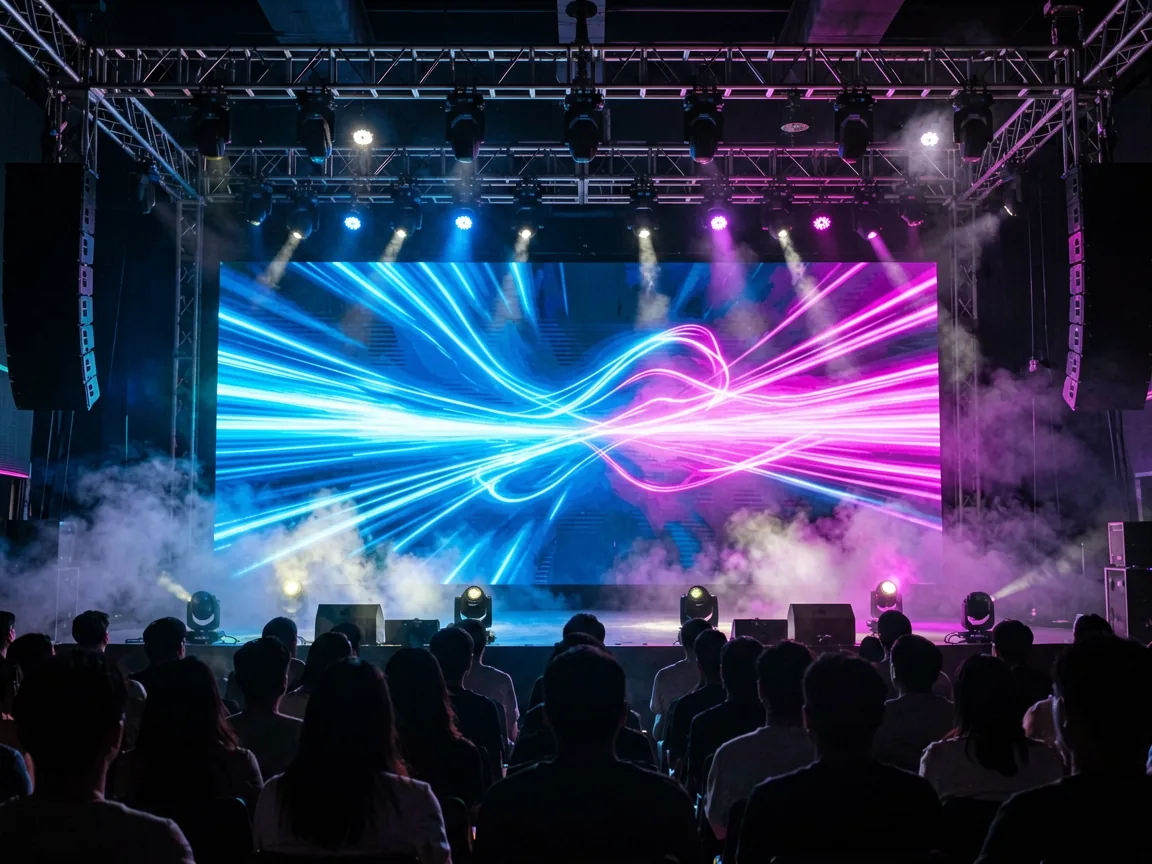
These are real builds from our own factory: a 200 m² rental LED screen delivered for a concert tour in the United States, P2.5 indoor walls installed at ICGC MAINS church in Tema, Ghana and RCCG Swindon in the UK, and fine-pitch walls for hotel conference rooms. A 10 m × 6 m (60 m²) LED wall delivers roughly the same viewing area as a mid-size IMAX screen — in a room you chose, showing content you control.

Spec Comparison: IMAX Screen vs Giant LED Screen
The table below puts the two side by side. The pattern to notice: IMAX is standardized and spectacular inside its own auditoriums; a giant LED screen is whatever your venue needs it to be.
| Specification | IMAX screen (licensed cinema) | Giant LED video wall (purchasable) |
|---|---|---|
| Typical width | 72–120 ft (22–37 m); largest around 144 ft (44 m) | Any size from 2 m to 100+ m, built to order |
| Display technology | Dual 4K laser projection onto a screen surface | Direct-view LED modules, pixel pitch P1.2–P10.42 |
| Brightness at the image | Roughly 14–22 foot-lamberts (about 48–75 nits), in a dark room | 600–1,500 nits indoor; 5,000–6,500 nits outdoor |
| Aspect ratio / shape | Fixed: 1.43:1, 1.90:1 or 2.39:1 | Any: flat, curved, 90° corner, ceiling, floor |
| Sound | Patented IMAX system, up to 12,000 W | Pairs with the venue’s PA or line array |
| Content | IMAX DMR-remastered films only | Anything with a signal: media server, live camera, consoles |
| Who can install one | Licensed cinema partners only | Any venue, event company, church or rental firm |
| Runtime | Scheduled showtimes | 24/7 capable |
Why You Can’t Buy an IMAX Screen for Your Venue
IMAX Corporation does not sell screens; it licenses an experience. A cinema operator signs a multi-year agreement, funds a seven-figure auditorium fit-out — industry reporting commonly puts a full IMAX installation at USD 1 million and up — and then shares ticket revenue with IMAX for the life of the deal. The auditorium must follow IMAX specification for screen surface, sound, seating and even lobby signage, and the projector plays only films remastered in the IMAX DMR process. There is no IMAX dealer who will quote you a screen for a church, a hotel lobby or a festival stage.
A giant LED video wall is the opposite kind of purchase: it is equipment. You buy it factory-direct like any other AV asset, you own it outright, and it displays whatever you feed it — concert visuals, live camera, broadcast TV, data dashboards or a livestream. For a B2B buyer this reframes the entire giant screen vs IMAX question. It is not “which looks better”; it is “which one can you actually have?”
Cost Comparison: IMAX Auditorium vs Giant LED Screen
IMAX publishes no price list — deals are negotiated per cinema — so the figures below combine industry-reported ranges on the IMAX side with our own factory-direct numbers on the LED side. A 20 m² P4.81 wall, for example, lands between USD 12,000 and 18,000 delivered, including control system, cabling and sea freight.
| Cost item | IMAX auditorium (licensed) | Giant LED screen (factory-direct) |
|---|---|---|
| Display hardware | Commonly reported at USD 1M+ per auditorium | Outdoor from USD 350–1,100 per m² (P10.42–P2.97); indoor fine pitch from USD 550 per m² |
| Licensing & fees | Multi-year format license plus per-ticket revenue share | None — you own the equipment outright |
| Installation | Auditorium rebuild: screen frame, acoustic shell, projection booth | Mounts flush to a wall, or rides touring truss and ground support |
| Content | IMAX DMR-remastered films only | Anything: media server, live camera, broadcast feed |
| Energy | Two laser projectors plus full-auditorium HVAC load | Outdoor-class walls run 220–240 W/m² on mixed content; common-cathode design cuts about 25% |
| Example 20 m² build | Not available at any price | USD 12,000–18,000 delivered, installed-ready |
A 100 m² outdoor LED wall lands around USD 60,000–90,000 in hardware from our factory — under a tenth of a single IMAX auditorium fit-out, with no license agreement attached. For pricing context by size, pitch and application, see the full LED screen price guide.
Brightness Comparison: Projected Foot-Lamberts vs LED Nits
Projection and LED measure brightness differently, so the honest comparison is at the surface the audience sees. Cinema projection is calibrated in a dark room to roughly 14 foot-lamberts (≈48 nits) for 2D content; IMAX with Laser pushes that to about 22 fL (≈75 nits). Direct-view LED emits its own light: indoor fine-pitch walls run 600–1,500 nits, and outdoor-class walls reach 5,000–6,500 nits — bright enough to stay readable in direct noon sun.
| Brightness factor | IMAX projection | Giant LED screen |
|---|---|---|
| Luminance at the image | ≈14–22 fL (48–75 nits), calibrated in a dark room | 600–1,500 nits indoor; 5,000–6,500 nits outdoor |
| Ambient light tolerance | Needs darkness; daylight washes the image out | Sunlight-readable in outdoor class; auto-dims at night |
| Contrast | Excellent in the dark; black level raised by screen surface | True per-pixel black, no washout at any hour |
| On camera | 24/48 fps cinema playback, not built for live capture | 3,840–7,680 Hz refresh — flicker-free on broadcast and phone cameras |
| Color processing | IMAX DMR grade | 16-bit+ processing, wide color gamut |
That camera row matters more than it looks. Concert screens, arena displays and church walls all end up on camera — broadcast feeds, IMAG shots, and thousands of phone videos a night. A high-refresh LED wall keeps those captures banding-free. In fairness: inside a pitch-dark, purpose-built theatre, IMAX projection is calibrated superbly, and that is exactly what the format was engineered for. Events simply do not happen in calibrated darkness.
Maintenance Comparison: What Five Years of Ownership Looks Like
Maintenance is where the licensing gap becomes a service gap. An IMAX theatre is serviced under proprietary agreements — your technicians cannot open the projector. An LED wall is modular and owner-serviceable by design.
| Maintenance item | IMAX auditorium | Giant LED screen |
|---|---|---|
| Service model | Proprietary — authorized vendor visits, no self-service | Module-level front service; swap a module in minutes with butterfly locks |
| Most common fix | Laser source degradation, screen surface cleaning, annual recalibration | Replace a module or power supply; LEDs rated 100,000 hours (L50) |
| Spare parts | Proprietary, sourced through IMAX | 2–3% spare modules shipped with the order; module-level spare pricing |
| Downtime | Waiting on an authorized technician | Hot-swap between shows, or during one with front access |
| Five-year cost driver | Service contracts plus light-source replacement | Electricity (common cathode saves ~25%) plus occasional modules |
From our own service records: rental walls of 200 m² run through multi-week tours where the local crew swaps modules between shows, and the church installations in Ghana and the UK are maintained by their own staff using the spares that shipped with the order. Power supplies, not LEDs, are the realistic life-limiting component at 7–10 years — and they are replaced per unit, not per system. Keep our LED screen cleaning guide handy for routine care.
Where IMAX Still Wins
This guide is written for venue buyers, but credit where it is due. IMAX remains unmatched inside its own lane: films shot on IMAX cameras exist in full resolution only in licensed theatres; the 1.43:1 documentary photography has no LED equivalent; the 12,000 W sound mix is part of a system no PA rig replicates; and the brand itself sells tickets. For a cinema operator who can sign the licensing deal, IMAX is a ticket-price multiplier, not a cost line. That is a legitimate business — it is just not a purchase available to venues, event companies or institutions.

Where a Giant LED Screen Wins for Events & Venues
- Concerts and touring: quick-lock 500 × 500 mm and 500 × 1000 mm rental cabinets, truck-packable, curved or straight, re-rigged city to city.
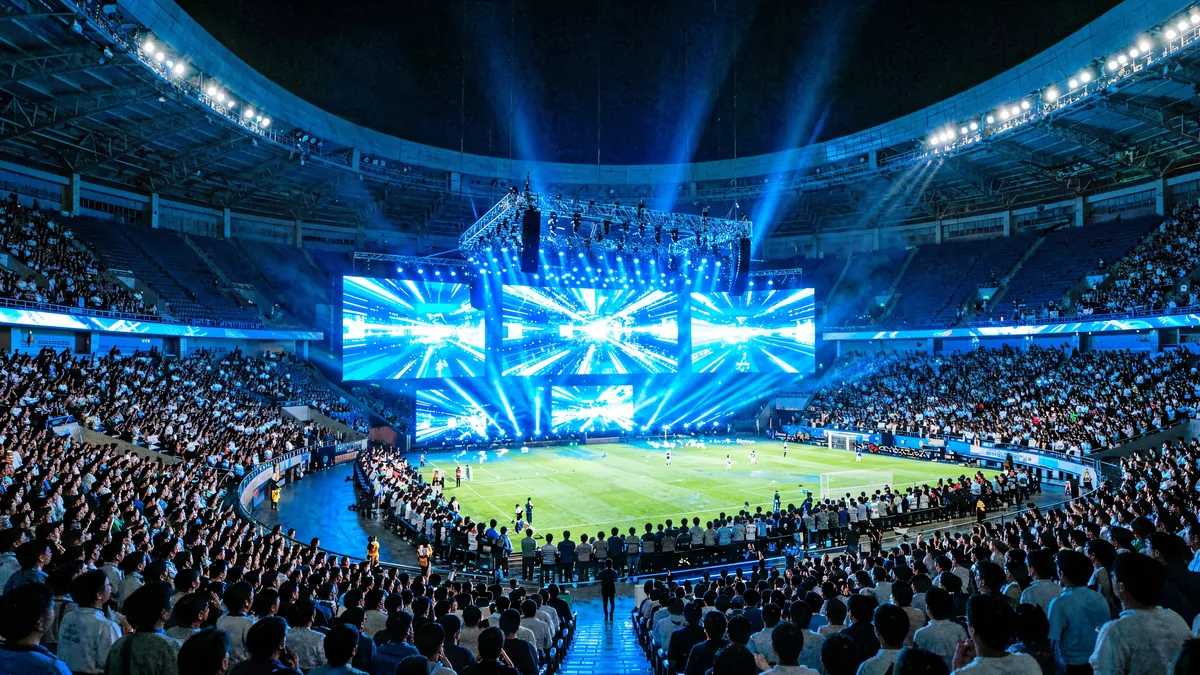
- Arenas and sports: center-hung, perimeter and fascia displays running live feeds, scores and sponsor content 24/7 — see our sports LED display applications.
- Corporate lobbies and conference rooms: P1.2–P2.5 fine pitch stays legible at 3 m viewing distance, with no projector bulb and no darkened room.
- Houses of worship: lyrics, camera IMAG and livestream on one wall, run by volunteer staff.
- Outdoor and daylight: 5,000–6,500 nits with automatic brightness dimming, IP66 sealing and salt-spray treatment for coastal sites.
How to Choose in 5 Steps
- Define the space. Indoor or outdoor, viewing distance, wall width and height — the LED screen size measurement guide walks through the math.
- Define the content and cameras. Live feeds or broadcast? Specify refresh rate of 3,840 Hz or higher so the wall is camera-safe.
- Budget per square meter. Include structure, control system and freight — our price guide shows what moves the number.
- Check the service reality. Front service access, spare module percentage, warranty length — five years is factory standard from us.
- Compare quotes on equal specifications. Pitch, brightness, refresh rate and cabinet material, line for line, before you compare prices.
Giant Screen vs IMAX: FAQs
How big is an IMAX screen?
Purpose-built IMAX screens typically run 72–120 feet (22–37 m) wide, and the largest IMAX screens in the world reach about 144 feet (44 m) wide and 67 feet tall — a laser theatre in Leonberg, Germany holds the record. A standard multiplex screen is 30–70 feet by comparison.
How big is a giant LED screen compared to an IMAX screen?
Exactly as large as you order. Venue LED walls commonly run 10–200 m²; a 10 m × 6 m wall (60 m²) shows roughly the same area as a mid-size IMAX screen. The difference is that IMAX size is fixed by the auditorium, while LED size follows your venue.
Can you rent or buy an IMAX screen for an event?
No. IMAX licenses its format to cinema partners only — it is not sold or rented as equipment. For events, the practical giant screen is an LED wall, which rental companies rig in hours and permanent venues buy factory-direct.
How much does an IMAX screen cost?
IMAX does not sell systems, so there is no purchase price. Industry reporting commonly puts a full IMAX auditorium fit-out at USD 1 million and up, plus multi-year licensing and per-ticket revenue share. A factory-direct LED wall runs USD 350–1,100 per m² outdoors.
How much does a giant LED screen cost per square meter?
Indoor fine pitch starts around USD 550 per m²; outdoor ranges from about USD 350 per m² at P10.42 to USD 1,100+ per m² at P2.97. A complete 20 m² P4.81 wall including control system, cabling and freight typically lands between USD 12,000 and 18,000 delivered.
Which is brighter: IMAX or an LED wall?
The LED wall, by roughly 10–100 times: IMAX projection delivers about 48–75 nits at the screen in a dark room, while LED walls run 600–1,500 nits indoors and 5,000–6,500 nits outdoors. In a pitch-dark cinema, calibrated projection is entirely sufficient — brightness decides things where ambient light exists.
What maintenance does a giant LED screen need?
Modular upkeep: front-service module swaps in minutes, LEDs rated 100,000 hours, power supplies replaced per unit at 7–10 years, and 2–3% spare modules shipped with the order. There is no proprietary service contract and no vendor lock-in.
Is IMAX picture quality better than LED?
In a dark, purpose-built theatre playing DMR-remastered films, IMAX optics are excellent — that is the format’s home turf. For everything else — daylight, live content, camera work, your own content on your own schedule — a giant LED screen wins on brightness, flexibility and ownership.
Conclusion: Choose the Screen You Can Actually Own
The giant screen vs IMAX comparison splits cleanly once you separate the two audiences. If you operate a cinema and can sign a licensing deal, IMAX is a premium format that multiplies ticket prices — and it was never for sale in the first place. If you run an event, an arena, a house of worship or a venue of any other kind, the giant screen you can actually have is an LED video wall: any size, any shape, brighter than projection by orders of magnitude, and serviced with a screwdriver instead of a service contract.
Compare the three numbers that decide it — cost per square meter, nits at the image, and who holds the spare parts — and the B2B answer writes itself.
Get a Free Giant Screen Quote for Your Venue
More comparisons and buying guides are on the LEGIDATECH blog.