KTV LED Screen in Malaysia: Custom-Shaped P2.5 Displays Case Study
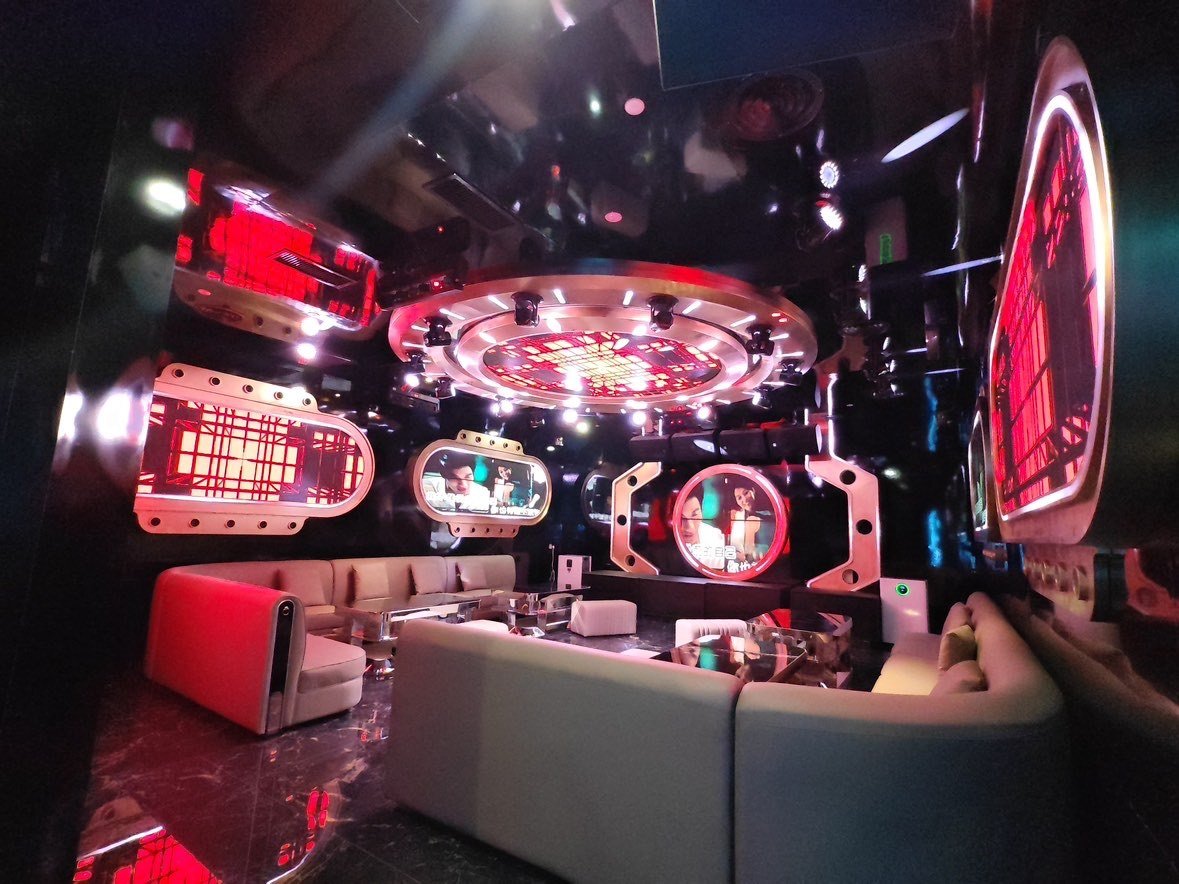
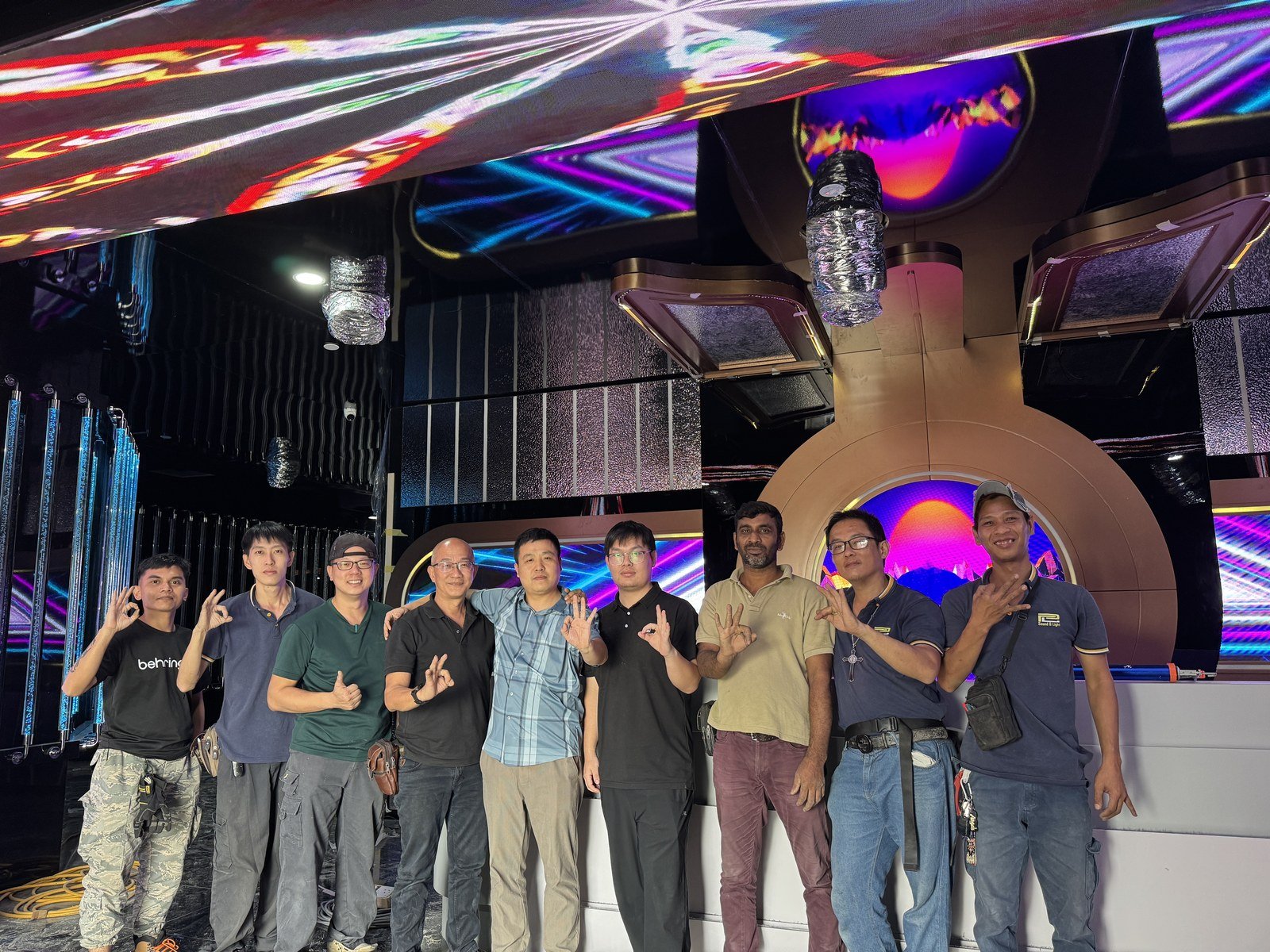
This is a real installation, documented on site. In December 2025, a KTV venue in Malaysia installed a set of custom-shaped P2.5 indoor LED displays: a circular screen set into the ceiling, oval wall screens and round porthole displays in its main room, plus angled ceiling panels in the main hall. The photos below show the build and the finished screens running music video content.
Short answer: A KTV venue in Malaysia runs custom-shaped P2.5 indoor LED screens: one circular ceiling screen, three oval wall screens and two round porthole screens in its main room, plus angled ceiling panels in the main hall. At 2.5 mm pixel pitch the displays hold lyric text and music video detail from the sofas, and the custom formats let each screen follow the interior instead of sitting on it as a standard rectangle. LEGIDATECH supplied the screens and the control system.
Project Facts: KTV LED Screens in Malaysia
| Client | A KTV venue in Malaysia |
|---|---|
| Country | Malaysia |
| Application | KTV main room and main hall — ceiling, wall and feature screens |
| Product | Custom-shaped indoor LED display (P2.5) |
| Pixel Pitch | P2.5 (2.5 mm) |
| Screen Size | Custom — one circular ceiling screen, three oval wall screens, two porthole screens and angled hall ceiling panels |
| Resolution | Matched to each screen format |
| Screen Type | Indoor fixed installation, ceiling and wall mounting |
| Supplier | LEGIDATECH |
- Six custom-shaped screens in the main room: one circular ceiling screen, three oval wall screens and two round porthole screens.
- P2.5 pixel pitch — fine enough for lyric text and music video detail from sofas set about 2.5 to 4 m from the walls.
- The main hall adds large angled ceiling LED panels and oval ceiling pods, all running moving graphics.
- Every position uses an indoor fixed panel; the screens are built into the interior frames, not mounted on top of them.
The Client: A KTV Venue in Malaysia
The client is a KTV venue in Malaysia with a themed interior built around circular motifs: a round ceiling feature in the main room, capsule-shaped wall frames, porthole openings in the back wall and bronze trim throughout. Dark marble floors and curved white sofas face the screens from three sides. The KTV LED display layout follows that interior: a ceiling disc overhead, oval wall screens to the left and right, and two porthole screens at the back. The main hall uses angled LED panels and oval pods set into the ceiling around a central gold feature. The fit-out was completed in December 2025.
The Screens: P2.5 Custom-Shaped LED Displays
These are custom LED displays built at 2.5 mm pixel pitch, from the same indoor panel and control technology used in standard fixed walls. The difference is the format: a disc for the ceiling, capsules for the walls, circles for the portholes, and angled panels for the hall ceiling. The modules are standard service parts; the frames and masks are made to the room drawing.
- P2.5 resolution. The pixel density keeps lyric lines and music video detail crisp from the sofas, which sit roughly 2.5 to 4 m away — the range P2.5 is specified for.
- Custom formats. Circular, oval and porthole screens are cut to the interior shapes, with trim covering the module edges.
- Camera-friendly refresh. High refresh keeps the picture clean when guests film on a phone; no scan lines appear in the site photos or footage.
- Front-service modules. Each module can be removed from the front, so maintenance on a ceiling screen or inside a finished wall needs no rear access.
The shaped faces use flexible LED modules and custom cabinets where the curve requires them, at the same 2.5 mm pitch as the flat sections.
Installation: What the Site Photos Show
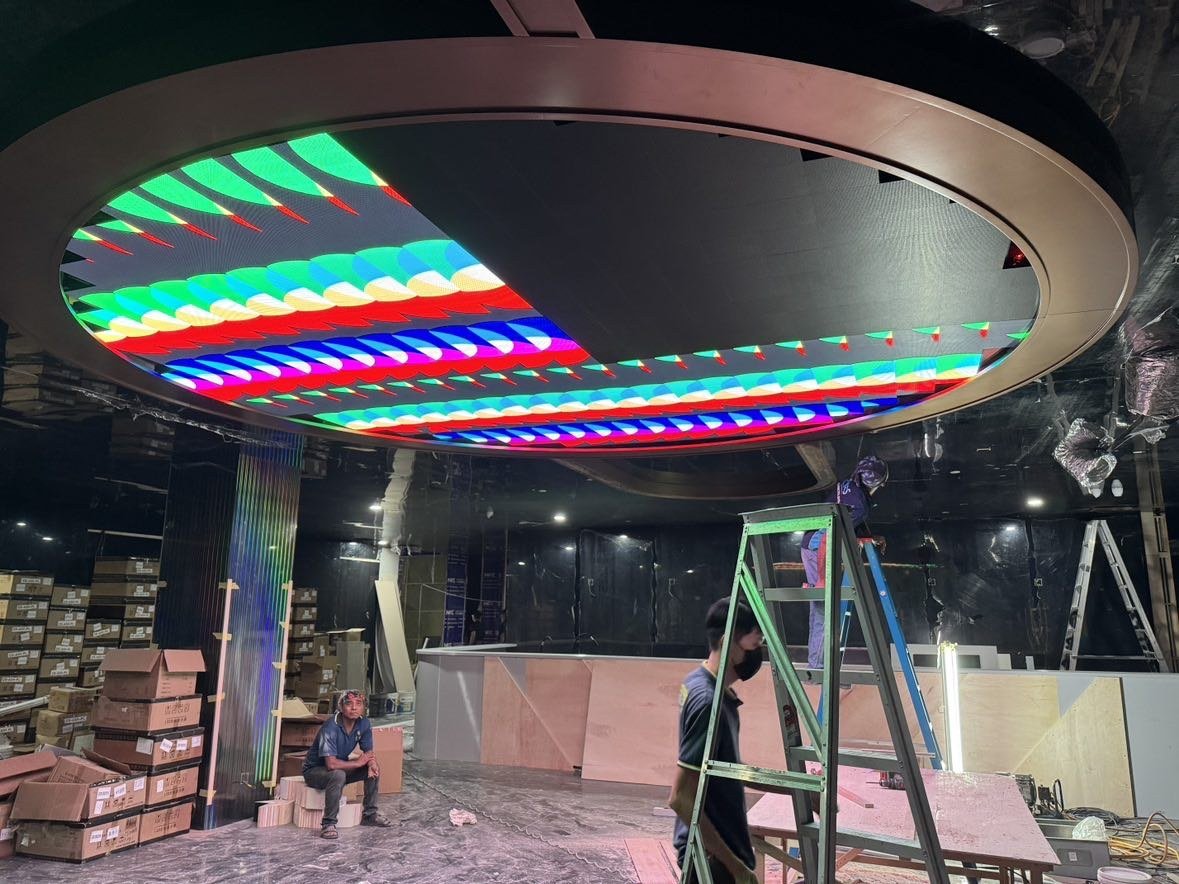
The first site photo catches the circular ceiling screen during installation. The disc sits inside a wide metal ring in the ceiling recess, running a test pattern in green, red and blue, with the ceiling still open around it. Cartons of LED modules are stacked below, and a technician works from a ladder at the rim — an installation in progress, documented as it happened.
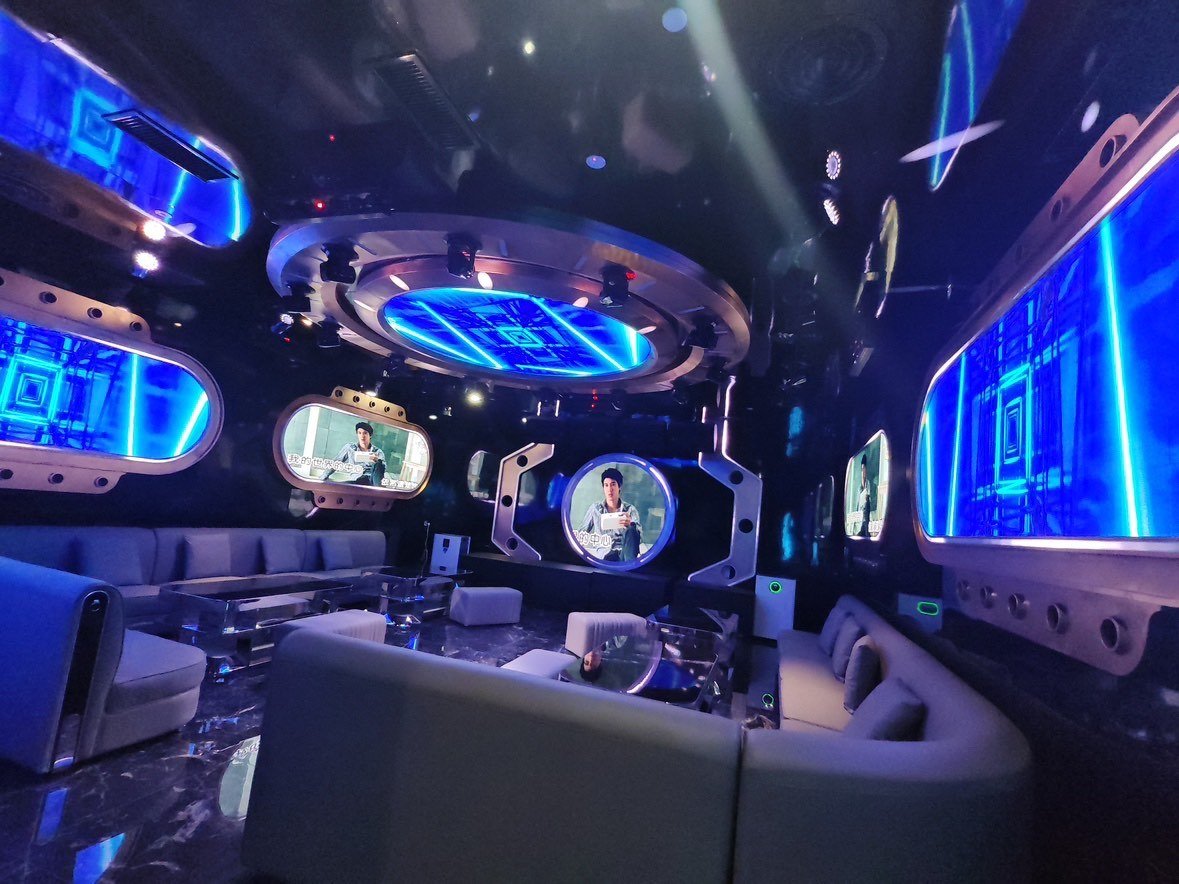
The finished photos show the interior closed up: the ceiling disc sits flush inside its trim, the oval wall screens are set into their capsule frames, and the porthole screens sit inside the back-wall openings. No cabinets, cables or brackets are visible from the seats.
The Screens in Action
The room photos show the same space running two content modes — red and blue. The oval wall screens carry music video, the portholes carry lyric video, and the ceiling disc carries ambient graphics that match the room colour. The room lighting follows the same palette, so the screens and the interior change together.
The last photo is taken in the main hall, below the larger ceiling array. Angled LED panels run a light-streak graphic across the ceiling, and oval pods carry a sunset scene on both sides of the central gold feature. The content is ordinary music video and ambient footage, run from a standard LED control system.
Why P2.5 Custom-Shaped LED Screens Work for a KTV
The pitch fits the seating distance. Guests sit about 2.5 m from the side wall and 3 to 4 m from the back wall. P2.5 is sharp across that range; P1.8 would add cost without a visible gain, and P3.9 would show pixels in lyric text from the nearest sofa.
The shapes fit the room. A standard 16:9 rectangle would have broken every frame in this interior. Custom-shaped LED displays let the screen take the shape of the ceiling disc, the capsule frames and the portholes, while the control system treats each screen as its own output. For themed venue interiors, this is the approach we describe in our creative LED display ideas for bars.
The room has no blank sightline. With screens overhead, on both side walls and at the back, every seat faces content. A KTV LED screen here is more than a television; it is part of the room layout.
It is built for nightly use. Front-service modules, standard spares and a familiar control system keep the screens running without specialist maintenance. A projector in a lit KTV room would wash out, and a television cannot be shaped into a ceiling disc.
LED Screens in Malaysia: KTV and Entertainment Venues
Malaysia is an active entertainment market for us, with an office in the country and a record of indoor projects. Previous documented work includes a 2.88 × 1.92 m P2.5 LED screen shipped to Malaysia and a P2.5 indoor front-maintenance display for a Malaysian project.
This KTV adds a different reference: a full custom-shaped fit-out, with the screens built into the ceiling, the wall frames and the back wall. The same indoor P2.5 approach appears in the twin nightclub screens at Toppest in Lagos. For venue operators comparing a flat wall with a shaped build, our KTV LED screen solutions guide covers the layout, pitch and control choices behind this kind of room.
FAQ: KTV LED Screens in Malaysia
What LED screens did the Malaysia KTV install?
The venue installed six custom-shaped P2.5 indoor LED screens in its main room: one circular ceiling screen, three oval wall screens and two round porthole screens. The main hall adds angled ceiling LED panels. All screens run from a standard LED control system.
What pixel pitch is right for a KTV LED screen?
For a KTV room where guests sit about 2.5 to 4 m from the screen, P2.5 is a common choice. Smaller rooms with seats closer to the wall can use P2 or P1.8, while large club walls viewed from more than 4 m can move to P3 or P3.9.
Can LED screens be made in circular, oval and other custom shapes?
Yes. Flexible LED modules and custom cabinets let a display follow the interior shape. This project uses circular ceiling and porthole screens, oval wall screens and angled ceiling panels, each built to the room design.
Why do KTV venues use LED screens instead of TVs or projectors?
An LED screen can be built to any size and shape, holds contrast in a lit room and does not wash out like a projector. It also films cleanly for guest videos, and the modular design means a failed module is replaced instead of the whole screen.
Can LEGIDATECH ship and support a KTV LED screen project in Malaysia?
Yes. LEGIDATECH has an office in Malaysia and documented projects in the market, including a P2.5 Ehonor screen shipped to Malaysia and this custom-shaped KTV build. Screens ship with spare modules and a pre-configured control system, with remote or local installation support.
How much does a KTV LED screen cost in Malaysia?
Budget depends on screen area, pixel pitch, cabinet type, shapes, control system and freight; custom shapes add engineering and cabinet work. Send the room plan and screen schedule for a factory-direct quote; our LED screen price guide explains the cost factors.
Planning a KTV LED screen in Malaysia? Send us the room plan, ceiling height and the shapes you need — we will reply with a pitch recommendation, a screen schedule and a factory-direct quote, the same custom build now running in this Malaysia KTV venue. Request a quote from our LED screen manufacturer.