When choosing an outdoor LED display, the service access method — front or rear — is a decision that locks in your long-term maintenance costs, installation complexity, and usable screen location. Pick wrong, and every module replacement becomes a crane rental bill. This 2026 guide breaks down the real cost difference between front service vs rear service outdoor LED cabinets, with installation scenarios, 10-year maintenance projections, and a clear decision framework for every outdoor application.
Quick Answer: Front Service or Rear Service for Outdoor LED?
| If Your Installation Is… | Choose | Because |
|---|---|---|
| Wall-mounted (no rear access), building façade | Front Service | No rear corridor — front is the only access point |
| Free-standing billboard with rear walkway | Rear Service | Lower cabinet cost; easier bulk maintenance from behind |
| Rooftop or pole-mounted, difficult to approach | Front Service | Crane access from front is practical; rear access impossible |
| Ground-level, both sides accessible | Rear Service | 15–25% cheaper cabinets; maintenance from ground level |
What Are Front Service and Rear Service LED Cabinets?
Front Service LED Cabinets
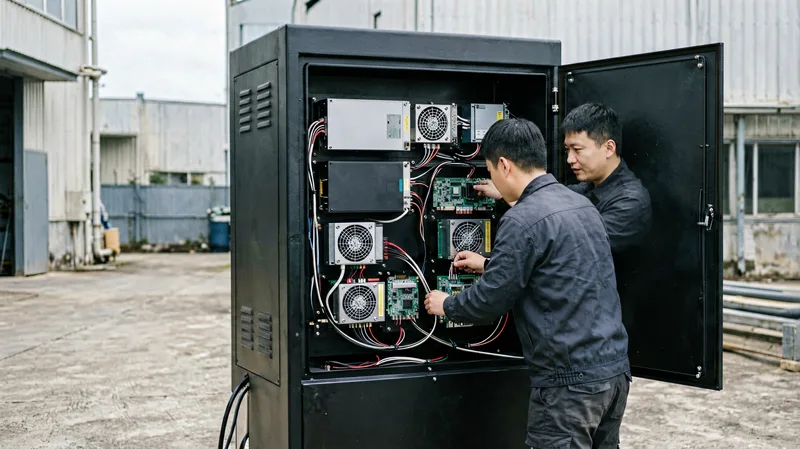
Front service outdoor LED cabinets allow all maintenance — module replacement, power supply swap, receiving card access — entirely from the front face of the screen. The technician removes individual LED modules from the front using a magnetic tool or vacuum suction cup, then accesses internal components through the module bay. No rear clearance is needed at all.
Key mechanism: Magnetic front-attached modules + tool-free quick-release latches. Some premium designs (like LEGIDATECH’s Ehonor and Magic series) allow single-person front module swap in under 30 seconds per panel.
Rear Service LED Cabinets
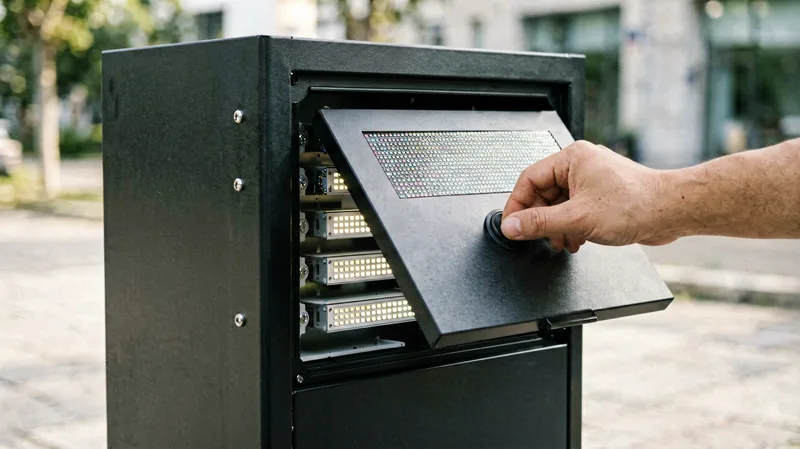
Rear service outdoor LED cabinets require access to the back of the screen for maintenance. Modules are typically screwed in from the rear, and all internal components — power supplies, receiving cards, wiring — are reached through removable rear panels. This demands a maintenance corridor behind the screen: typically 60–100 cm of clear space.
Key mechanism: Screw-fixed modules + hinged or bolted rear access panels. Rear service cabinets are mechanically simpler, which reduces manufacturing cost — but adds spatial requirements.
Watch: How LEGIDATECH Builds Front & Rear Service Outdoor LED Cabinets
Above: Whether front service or rear service, every LEGIDATECH outdoor LED cabinet is built on the same automated production lines. The service access type affects how you maintain the screen — not the manufacturing quality behind it. As a factory-direct LED screen manufacturer, we build both types with identical component quality and QC standards.
Front Service vs Rear Service Outdoor LED: Head-to-Head Comparison
This is the definitive front service vs rear service outdoor LED comparison across every dimension that matters for outdoor advertising display procurement and long-term operation.
| Factor | Front Service | Rear Service | Winner |
|---|---|---|---|
| Cabinet Cost (FOB, 2026) | $480–$720/m² | $380–$580/m² | ✅ Rear |
| Installation Flexibility | Wall-mount, pole-mount, embedded, double-sided — any location | Requires 60–100 cm rear clearance corridor | ✅ Front |
| Single Module Replacement Time | 15–30 seconds (magnetic pop-out from front) | 2–5 minutes (access rear, unscrew, replace) | ✅ Front |
| Full Cabinet Internal Repair | Module removal → reach through bay (moderate complexity) | Open rear door → full unrestricted access (easy) | ✅ Rear |
| Required Structural Clearance | Zero rear space — flush-mount to wall | 600–1,000 mm rear maintenance corridor | ✅ Front |
| Weather Sealing Integrity | Module gasket + cabinet seal — double layer | Rear door gasket — single layer, more leak points | ✅ Front |
| Module Alignment & Flatness | Magnetic + fine-adjustment screws — precise | Screw-fixed — slight variance between cabinets | ✅ Front |
| Bulk Maintenance Efficiency | One-by-one from front (crane/basket required for high mounts) | Walk along rear corridor; replace multiple modules quickly | ✅ Rear |
| Cabinet Weight | ~38–48 kg/m² (stronger front frame) | ~30–40 kg/m² (simpler construction) | ✅ Rear |
| Typical Lifespan | 8–12 years | 8–12 years | 🟰 Tie |
Front service wins 6/10 categories, rear service wins 4/10. But the real deciding factor is your installation location — a front service cabinet on a ground-level billboard is wasted money; a rear service cabinet on a building façade is impossible to install.
Installation Scenarios: Where Each Outdoor LED Service Type Wins
Scenario A: Building Façade / Wall-Mounted Billboard
Winner: Front Service 🏆
When mounting an outdoor LED advertising screen directly onto a building wall, there is zero rear access. The screen is bolted to the wall — the back faces bricks or concrete. Only front service cabinets work here. Installing rear service cabinets on a wall would mean you have no way to replace a failed power supply without removing the entire screen from the wall. For building-mounted outdoor LED, front service is not optional — it is mandatory.
Scenario B: Free-Standing Roadside Billboard (Ground-Level)
Winner: Rear Service 🏆
A typical 6m×3m roadside billboard with a steel gantry structure has ample rear space. Technicians walk along the rear maintenance platform and access cabinets directly. Rear service cabinets save 15–25% on hardware cost for the same pixel pitch and brightness. Over a network of 10+ billboards, the savings multiply significantly. For ground-level, rear-accessible installations, rear service delivers the best outdoor LED display ROI.
Scenario C: Rooftop or High-Pole Billboard
Winner: Front Service 🏆
Rooftop signage and high-pole billboards (8m+ mounting height) already require a crane or cherry-picker for any access. There is no rear maintenance corridor — and building one at 15m height would cost more than the LED screen itself. Front service cabinets allow the technician to work from the basket, popping modules from the front without needing to access the rear at all.
Scenario D: Double-Sided Billboard (Median / Highway)
Winner: Front Service 🏆
Double-sided billboards have LED screens on both faces — there is no “rear” because both sides are display surfaces. Front service is the only option: cabinets are mounted back-to-back with zero internal access space. Both faces must be serviceable from the outside.
Scenario E: Ground-Level Perimeter / Fence-Mounted Display
Winner: Rear Service 🏆
Sports venue perimeter displays, fence-mounted advertising screens, and ground-level information boards typically have easy rear access. Rear service cabinets cost less and allow bulk maintenance — a technician can walk the entire length of a 100m perimeter display and swap modules continuously without repositioning equipment.
10-Year Maintenance Cost: Front Service vs Rear Service
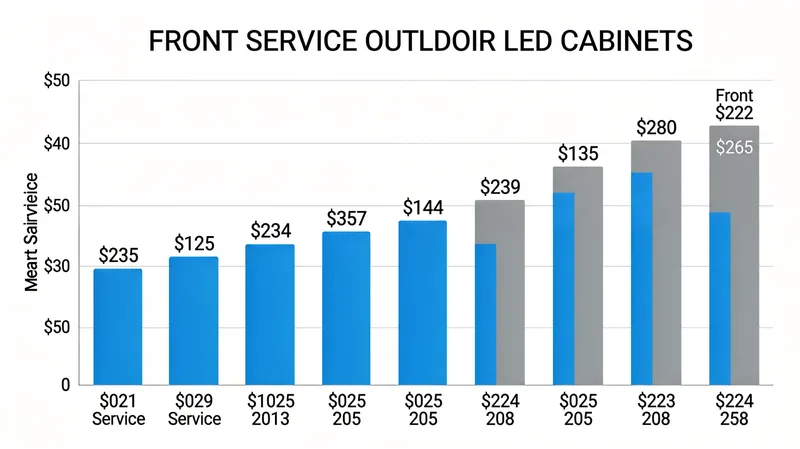
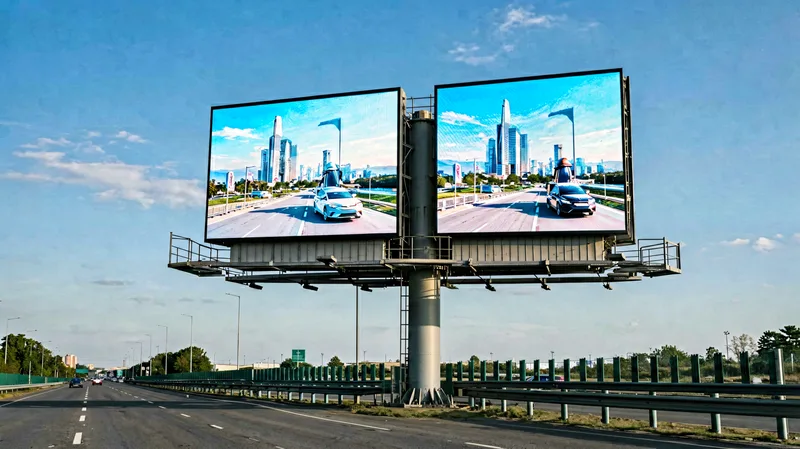
This is the number that matters most. The front vs rear service outdoor LED cost difference isn’t just about cabinet price — it’s about every module swap, power supply replacement, and technician visit over a decade of operation. Below is a realistic projection for a 6m×3m (18 m²) roadside billboard.
| Cost Item (10-Year Projection) | Front Service (Wall-Mount) | Rear Service (Ground Access) |
|---|---|---|
| Initial Cabinet Cost (18 m² FOB) | $8,640–$12,960 | $6,840–$10,440 |
| Steel Structure | $2,000–$3,500 | $2,500–$4,500 (includes rear platform) |
| Installation Labor | $1,500–$2,500 (crane required) | $800–$1,500 (ground assembly) |
| Annual Maintenance Visits (×10 years) | $3,000–$6,000 ($300–600/yr, crane basket) | $1,500–$3,000 ($150–300/yr, walk-up access) |
| Module Replacements (est. 2% failure over 10yr) | $200–$400 (quick front swap) | $150–$300 (rear swap) |
| Power Supply Replacements (est. 10% over 10yr) | $300–$600 | $200–$400 |
| 10-Year Total Cost | $15,640–$25,960 | $11,990–$20,140 |
| Annualized Cost | $1,564–$2,596/year | $1,199–$2,014/year |
| Cost Difference | Rear service saves $3,650–$5,820 over 10 years (~23% lower TCO) | |
The takeaway: Rear service is cheaper over the lifecycle — when the installation site allows it. The front service premium (~23%) buys you installation flexibility and zero rear clearance. If your site has rear access, the savings are real. If it doesn’t, front service isn’t an option — it’s the only option.
For factory-direct pricing on both cabinet types, see our outdoor LED display price guide and LED screen cost breakdown.
Decision Framework: Which Outdoor LED Service Type for Your Project?
Answer these three questions to lock in the right outdoor LED cabinet service type:
- “Is there 60cm+ of clear space behind where the screen will be mounted?”
YES → Rear service is possible. NO → Front service is mandatory. - “How will maintenance be accessed — walk-up from ground, or crane/basket?”
Walk-up from rear → Rear service saves 23% over 10 years.
Crane/basket from front → Front service simplifies each visit (no need to get behind the screen). - “Is this a double-sided or back-to-back installation?”
YES → Front service only. Both faces must be accessible from outside.
For most buyers, the answer reveals itself from the installation site. As a LED screen manufacturer serving 108+ countries, LEGIDATECH supplies both front and rear service outdoor LED cabinets — and we provide free system design to determine which type fits your specific mounting location.
5 Common Mistakes When Choosing Outdoor LED Service Access
- Buying rear service for a wall-mount installation. The most expensive mistake. Rear cabinets mounted flush to a wall become unserviceable — every repair requires screen removal. Always verify rear clearance before ordering rear service.
- Paying for front service on a ground-level billboard with rear access. Unnecessary premium. The 15–25% cost difference over 18 m² is $1,800–$4,500 — enough to cover 5+ years of maintenance visits.
- Assuming “front service” means zero rear access for cabling. Front service means module-level maintenance from the front. Power and data cables still need to reach the cabinet — typically from the side or through conduit. Plan cable routing before finalizing the installation design.
- Not checking module compatibility between front and rear service cabinets. LED modules are often not interchangeable between front and rear service cabinet designs. If you’re expanding an existing installation, confirm compatibility or you’ll end up with two incompatible spare part inventories.
- Ignoring local labor cost when calculating maintenance TCO. In markets where crane rental costs $500+/day (North America, Western Europe), front service on high-mount billboards can actually save money — fewer crane days over 10 years. In markets with low labor costs, rear service’s hardware savings dominate.
Frequently Asked Questions
Q: Can outdoor LED cabinets be both front AND rear service?
A: Yes — dual-service cabinets exist, offering module access from the front and internal component access from the rear. They cost 10–15% more than front-service-only cabinets. This design is ideal for installations where module replacement happens from the front (quick magnetic swap) but major repairs like power supply replacement benefit from rear walk-up access. Dual-service is increasingly standard for premium outdoor installations.
Q: How much rear clearance does a rear service outdoor LED cabinet actually need?
A: Minimum 600 mm (24 inches) for a technician to work. Recommended 800–1,000 mm for comfortable access with tools. The clearance must run the full width and height of the screen. For a 6m×3m billboard, that’s a 6m-long maintenance corridor — which requires structural steel walkway construction behind the screen.
Q: Is front service more expensive because it’s better quality?
A: The cost difference comes from mechanical complexity, not quality. Front service cabinets need magnetic module mounts, precision alignment mechanisms, and more robust front frames — adding 15–25% to manufacturing cost. The LED chips, driver ICs, power supplies, and control system are identical between front and rear service versions of the same model. Both can deliver the same 8–12 year lifespan when properly maintained.
Q: Does front service affect the waterproof rating of outdoor LED displays?
A: Front service cabinets often have better real-world weather sealing because the module-to-cabinet interface uses a continuous compression gasket. When a module is snapped into place magnetically, the gasket compresses uniformly — creating a consistent seal. Rear service cabinets rely on door gaskets and screw-tightened panels, which can develop gaps over time as gaskets age. For extreme weather locations (coastal, high rainfall), front service’s double-layer sealing provides an edge.
Q: Can I mix front and rear service cabinets on the same outdoor LED wall?
A: Technically possible but strongly discouraged. Front and rear service cabinets usually have different physical dimensions, mounting systems, and module types. Mixing them creates visible seams, alignment inconsistencies, and dual spare part inventories. Choose one service type for the entire installation.
Q: Which service type is standard for rental outdoor LED displays?
A: Rear service dominates the rental market because rental screens are almost always set up with rear access — they’re on stage truss or ground-support structures with open backs. Rear service cabinets are also lighter and cheaper. The exception: outdoor rental screens mounted on building façades for events use front service. Read our rental vs fixed LED display guide.
Conclusion: Front Service vs Rear Service Outdoor LED — The Right Choice Depends on Your Wall
The front service vs rear service outdoor LED display decision isn’t about which technology is better — it’s about which one fits your physical installation site. No rear access? Front service is mandatory. Easy rear access from ground level? Rear service saves 23% over 10 years.
The math is straightforward: rear service cabinets cost 15–25% less to buy, and maintenance from a rear walkway costs 50% less per visit than crane-based front access. Over a decade, that adds up to $3,600–$5,800 in savings for a typical roadside billboard. But those savings evaporate instantly if you install rear service on a wall with no rear access — because every repair becomes a screen removal job.
Bottom line: Survey your mounting site first. Measure the rear clearance. Then choose the service type that matches the location. As a factory-direct LED screen manufacturer, LEGIDATECH supplies both types with free system design, steel structure plans, and 2–5 year warranty. Get a quote for your specific installation scenario — response within 24 hours.
Explore more: outdoor LED display price guide · common cathode energy savings · outdoor LED brightness guide · LED screen cabinet guide
Sources: Maintenance cost projections based on industry-average technician rates and equipment rental costs in North American and European markets (2026); cabinet pricing per LEGIDATECH factory-direct quotations Q3 2026.