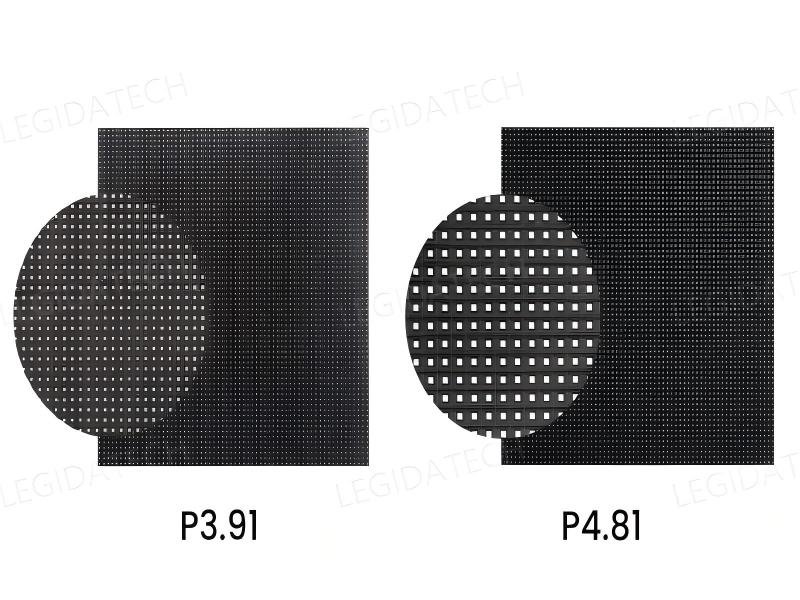
As the global LED display market surges toward a projected $22.5 billion by 2026 (Grand View Research), businesses worldwide face a critical challenge: choosing the right pixel pitch for their needs while managing costs.
From ultra-high-definition indoor panels to economical outdoor screens, the spectrum from P0.9 to P10 offers diverse solutions.
This guide unpacks technical trade-offs, cost structures, and real-world applications to empower international buyers, with insights from LEGIDATECH, a leading LED screen manufacturer with 12+ years of export expertise.
Table of Contents
ToggleTechnical Trends and Performance Insights
Technological Drivers for Small-pitch Displays (≤P2.5)
Case Study: LEGIDATECH’s EHonor Series (P1.2–P2.5) employs AM-driven ICs to eliminate the “caterpillar effect,” supporting 3840Hz refresh rates and 14-bit grayscale for virtual production scenarios.

Cost Advantages of Large-pitch Displays (e.g., P10)
- P0.9: 1.23 million pixels per㎡, viewing distance ≥1m
- P10: 10,000 pixels per㎡, optimal viewing distance ≥10m
Case Study: LEGIDATECH’s OK Series outdoor P10 screens feature IP65 protection and 5,000 nits brightness, installed in Lagos’ commercial district to withstand tropical climates. 

Full Lifecycle Cost Analysis
Hardware Cost Differences
| Type | Cost Range ($/㎡) | Key Configurations |
|---|---|---|
| P0.9 Indoor (COB) | $7,000 | NATIONSTAR chips, NovaStar controls |
| P10 Outdoor | $550–$1,100 | MEAN WELL power supplies |
Note: the P10 Outdoor range above is the landed cost including the control system and power supplies; panel-only factory reference prices for P10 are $280–$420/m² — see the outdoor LED display price table.
Case Study: A Johannesburg event company saved $12,000 by purchasing P2.5 screens directly from the factory versus regional distributors.
Installation & Maintenance Costs
- Outdoor P10 installation: $110–$200/㎡ (includes steel structure and waterproofing)
- Annual P0.9 maintenance: $280–$2,800/㎡ (requires specialized temperature control)
Hidden Costs: P0.9’s climate-controlled environment may raise annual energy bills by 30–50%, while P10’s low maintenance suits temporary setups.
Application Scenarios by Pixel Pitch
Premium Scenarios (P0.9–P1.5)
- Virtual Production: Thailand’s 15% subsidy for P1.2 screens drives demand in Bangkok’s film studios; LEGIDATECH’s Magic Series eliminates motion blur during high-speed filming with 3840Hz refresh rates.
- Command Centers: Dubai’s smart city projects deploy P1.8 screens with 100,000-hour lifespans, matching Huawei’s 24/7 drive technology.


Economical Solutions (P8–P10)
- Community Info Screens: P10 screens under $700/㎡ dominate rural India. In Uttar Pradesh, LEGIDATECH’s DIP technology reduced power costs by 30% for a local government information board.
Strategic Procurement Guide for International Buyers
Technical Fit
Cost Structure Planning
- Rent for short-term events (as low as $28/㎡/day) or buy for long-term projects
- LEGIDATECH’s factory-direct model saved a Saudi hotel chain 25% on P1.5 conference room screens.
Supplier Selection Tips
- Brand Manufacturers: LEGIDATECH offers 5-year warranties (Metastar Series installed in 300+ churches worldwide).
- Factory Sourcing: Supports bulk customization—Malaysia’s warehouse enabled a Singapore event company to receive P4 rental screens within 72 hours.
Policy Incentives & Technical Foresight
- Leverage EU RoHS compliance incentives or regional subsidies (a German retailer gained 10% tax rebate on LEGIDATECH’s energy-efficient P2.5 screens).
- Delay P0.7 purchases until MiP technology matures (post-2025 Q4 capacity release—early South Korean adopters saw costs drop 40% within six months).
Risk Control
LEGIDATECH’s Competitive Edge
- Global Footprint: 1,600+ partners, local offices in the US, Malaysia, and South Africa.
- Technical Prowess: XR stage solutions used in Netflix’s The Gray Man virtual production, with 3840Hz refresh rates and 14-bit grayscale for cinematic quality.