First, a Quick Correction: IPS vs Full HD Is Not a Real Matchup
IPS and Full HD are not competing technologies. IPS (In-Plane Switching) is a panel technology used in LCD screens; Full HD (FHD, 1920×1080) is a resolution. One screen can be both IPS and Full HD at the same time. The real decision for a business is: IPS-LCD video wall vs direct-view LED video wall — and that comparison is what this guide covers.
This confusion is worth fixing directly because it changes what you should buy. If you search “IPS vs FHD” you will find consumer monitor threads comparing panel types and resolutions that are not actually opposed. For a business buyer planning a control room, meeting room, retail wall, or outdoor sign, the practical question is different: which display technology — tiled LCD (typically IPS panels) or a modular direct-view LED video wall — fits your space, content, viewing distance, and budget. The tables below answer exactly that.
| Term | What it actually is | Where you’ll see it |
|---|---|---|
| IPS | LCD panel technology with liquid crystals that switch in parallel, giving wide viewing angles and accurate color | Monitors, TVs, tiled LCD video walls |
| Full HD (FHD) | Resolution of 1920 × 1080 pixels | Any screen type — LCD, LED, projector |
| LED | Two meanings: an LED backlight inside LCD panels, or direct-view LED displays built from pixel modules | Video walls, billboards, signage |
| UHD / 4K | Resolution of 3840 × 2160 pixels | Any screen type |

What Is an IPS Display?
IPS stands for In-Plane Switching, an LCD panel technology where the liquid crystals rotate parallel to the glass substrate rather than perpendicular. This architecture is why IPS screens are known for three qualities:
- Wide viewing angles — color and contrast stay stable at up to ~178°, so people standing at the side of the screen still see an accurate image.
- Accurate, consistent color — IPS panels reproduce color faithfully, which is why design studios and broadcast facilities prefer them.
- Stable touch performance — the parallel liquid-crystal arrangement interacts predictably with touch overlays, common in interactive signage.
Its weaknesses matter too: IPS panels are backlit LCDs, so black levels and contrast are limited by light leaking through the liquid-crystal layer; brightness is capped by the backlight (typically 500–700 nits for video wall panels, some high-bright versions reach 1,000–2,500 nits at a steep price); and when you tile multiple panels into a video wall, each one brings a thin but visible bezel that breaks up the image. Read our guide on optimizing viewing angle for how this plays out in real rooms.
What Is an LED Video Wall Display?
A direct-view LED video wall is built from self-emitting LED modules — each pixel is its own red, green, and blue diode that generates its own light. There is no backlight, no liquid crystal layer, and no glass panel. Modules tile in a grid (cabinets of 500–960 mm), so the wall can be any size or shape with a fully seamless surface.
The practical consequences:
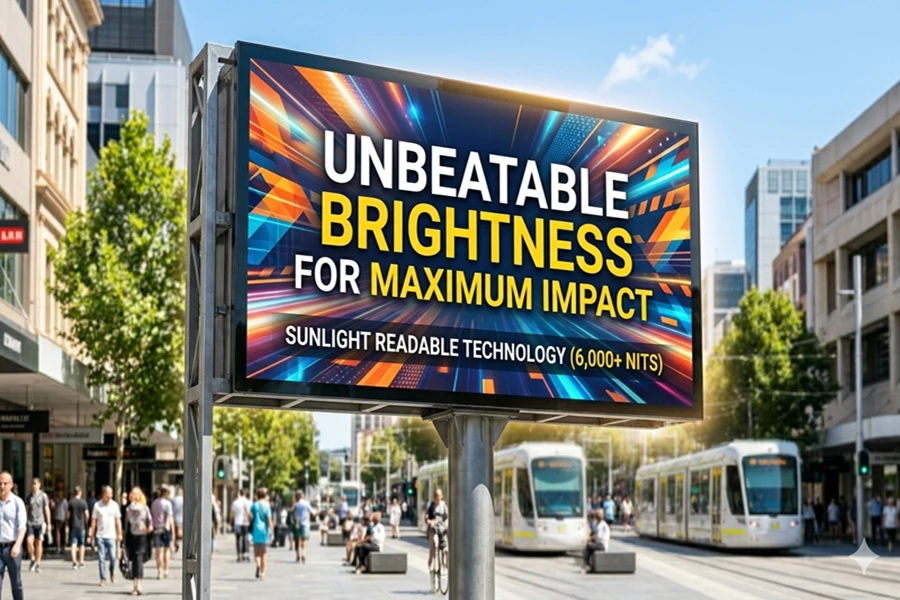
- Brightness on demand — indoor fine-pitch walls run 600–1,000 nits; outdoor walls reach 5,000–6,500 nits and stay readable in direct sun.
- No bezels — the image flows edge to edge, which is what makes the “single canvas” effect possible.
- Resolution scales with pixel pitch — a P1.5 wall is razor sharp at 1.5 m; a P6 billboard is designed to be read from 60 m. FHD or 4K is achieved by sizing the wall, not by choosing a panel.
- Long service life — diodes are typically rated for ~100,000 hours to half brightness.
Do not confuse this with “LED-backlit LCD” — many consumer products say “LED TV” when they mean an LCD panel with LED backlighting. A true LED video wall is the direct-view type described above.
Decision Table: IPS (LCD) Video Wall vs LED Video Wall
Here is the head-to-head comparison for business buyers, with the realistic ranges you will meet in quotations:
| Factor | IPS-LCD video wall (tiled 55″) | Direct-view LED video wall |
|---|---|---|
| Seams / bezels | Thin bezels visible (~0.4–3.5 mm gap) | Completely seamless |
| Brightness | 500–700 nits standard; 1,000–2,500 nits high-bright | 600–1,000 nits indoor; up to 6,500 nits outdoor |
| Best viewing distance | 2 m and closer loses bezel effect; sweet spot 3–8 m | Set by pixel pitch: ~2 m (P1.2) to 60 m+ (P10) |
| Contrast & blacks | Backlight limits dark-scene depth | True per-pixel black; deep contrast |
| Outdoor capability | Limited — glare, temperature, weatherproofing issues | Native — brightness, waterproofing, temperature range |
| Standard size grid | Fixed panel size: 2×2, 3×3, 4×4 of 55″ | Any dimension in module increments |
| Lifetime | ~50,000 h (backlight to half brightness) | ~100,000 h (diodes to half brightness) |
| Power draw | ~150–300 W per 55″ panel | ~300–800 W per m² (pitch and brightness dependent) |
| Typical installed price | Low for standard 2×2/3×3 grids; rises with high-bright panels | Higher per m² at fine pitch; competitive from mid sizes up |
| Failure mode | Whole panel swap; backlight aging | Module/IC-level repair; lamp beads replaceable |
| Best fit | Close-viewing color-critical rooms on a budget | Seamless large canvas, bright spaces, camera-facing, outdoor |
Where an IPS (LCD) Video Wall Wins
Tiled IPS video walls remain the right answer in specific business scenarios:
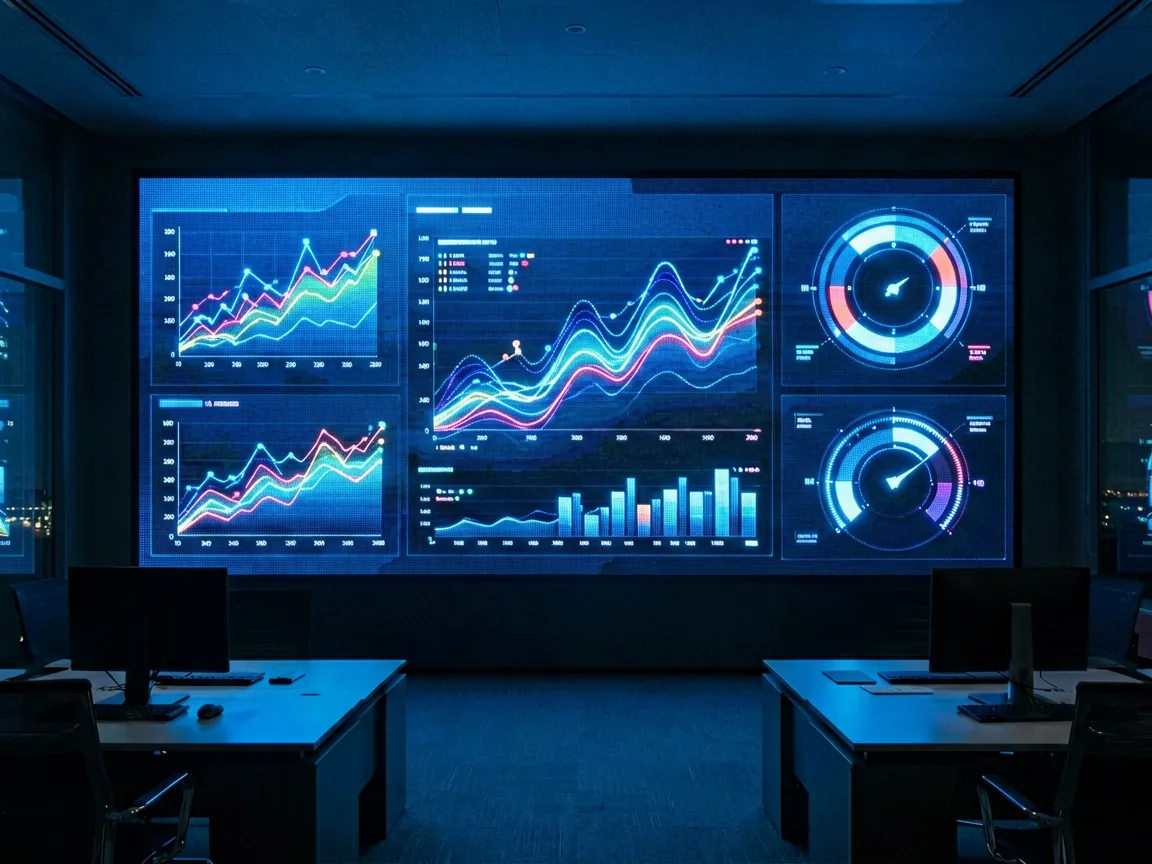
- Small control rooms with seated operators 2–4 m away — a standard 3×3 grid of 55″ panels delivers full HD per tile (6600×1860 px total in a 3×3 FHD grid) at a lower cost than an equivalent fine-pitch LED wall.
- Color-critical review rooms — labs, medical imaging review, broadcast edit suites, where IPS color accuracy is the priority and content is shown on one tile at a time.
- Tight budgets with rectangular room layouts — when a 16:9 multi-panel grid fits the wall and the bezel grid is acceptable at the viewing distance.
- Temporary or leased spaces — standard panels are easy to source, install, and resell.
The litmus test: if viewers get close and study data, and the content is dashboards or documents, LCD tiling is a rational, budget-friendly choice.
Where an LED Video Wall Wins
Direct-view LED takes over whenever one or more of these apply:
- The screen must be seamless — lobbies, brand experiences, broadcast backdrops, exhibition stands where a bezel grid would ruin the image.
- Ambient light is strong — shop windows, atriums, outdoor facades. LED brightness cuts through; an LCD wall washes out. See our tips on outdoor LED screen visibility in sunlight.
- Cameras will film it — stage backdrops, church broadcasts, hybrid-event studios; with the right driver ICs the wall is flicker-free on camera.
- Non-standard dimensions or shapes — curved, ceiling-hung, pillar-wrapped, or oversized walls that fixed 55″ panels cannot cover.
- Long daily runtime — 24/7 operation favors the ~100,000-hour LED diode rating and module-level maintenance.
Cost Comparison: Upfront Price and Total Cost of Ownership
Upfront, a standard LCD video wall grid is usually cheaper in small sizes: a 3×3 grid of 55″ FHD panels typically lands below the price of an equivalent fine-pitch LED wall of the same viewable area. The LED wall becomes competitive as the canvas grows, when brightness above 1,000 nits is needed (high-bright LCD prices jump sharply), or when seamlessness is a requirement the LCD option simply cannot meet at any price.
Total cost of ownership tells a longer story:
- Power: comparable per square meter at indoor brightness; LED pulls ahead outdoors because LCD high-bright panels are disproportionately power-hungry.
- Maintenance: an LED module or even a single component can be replaced in the field; a failed LCD panel means swapping a whole 55″ unit, and backlight aging is the usual end of life.
- Lifespan: roughly double for direct-view LED (~100,000 h vs ~50,000 h), which matters for 24/7 control rooms and always-on signage.
- Content value: harder to price, but a seamless canvas with true blacks simply sells more — in retail and brand spaces the wall is doing marketing work, not just displaying data.
As a factory-side rule of thumb from quotations we ship: for rooms under ~6 m viewing distance with rectangular walls and dashboards, LCD wins on price; for everything larger, brighter, or more brand-facing, LED wins on impact per dollar over its life. Our LED screen selection guide walks the full decision path.
How to Choose in 5 Steps
- Measure the space and viewing distance. Under 3 m and data-heavy → shortlist IPS LCD. Anything from 3 m out, or a wall bigger than ~4 m wide → shortlist LED. Our LED screen size guide shows how to match size to the wall.
- Check the ambient light. Sunlight, skylights, or shop-window placement effectively decides for LED.
- Decide if seams are acceptable. Bezel grid on brand content is the number-one reason businesses upgrade from LCD walls to LED within two years.
- Set the brightness and runtime requirement. 12–24 h daily operation or 1,000+ nits → LED territory.
- Compare total cost over 5 years, not the invoice: power, spares, maintenance, and expected lifetime. Then request quotes specifying panel/LED module specs in writing. Browse our LED display product range for reference configurations, and keep the screen cleaning guide handy for whichever technology you pick.
IPS vs LED Video Wall FAQs
Is IPS better than Full HD?
They are not comparable — IPS is a panel technology, Full HD is a resolution. A screen can be both (an IPS panel running 1920×1080) and most are. The real business choice is between IPS-LCD video walls and direct-view LED video walls.
Is IPS the same as LED?
No. IPS is the LCD panel technology; “LED” either means the backlight inside an LCD or a direct-view LED display built from self-emitting pixel modules. An IPS screen with LED backlight is still an LCD, not a true LED video wall.
Which is better for a business: IPS LCD video wall or LED video wall?
Close viewing (under ~3 m), rectangular rooms, dashboards, tight budget: IPS LCD tiling. Larger canvas, bright ambient light, seamless branding, outdoor, camera-facing, or 24/7 runtime: LED. Size, light, and distance decide it more than brand preferences.
Can an IPS panel have Full HD resolution?
Yes — most 55″ video wall panels are Full HD IPS panels, and a 3×3 grid combines to 6,600×3,240 effective pixels (with bezels between). Resolution is independent of panel technology.
Do LED video walls have bezels?
No. Direct-view LED modules tile seamlessly edge to edge, so the canvas is unbroken at any size. Bezel grids are the defining visual drawback of tiled LCD video walls.
How long do LED video walls last compared with IPS LCD walls?
Direct-view LED diodes are typically rated ~100,000 hours to half brightness; LCD backlights age to that point around ~50,000 hours. For 24/7 operation that is roughly a 5–6 year LCD service life before noticeable dimming versus 10+ years for LED.
Which is cheaper: IPS video wall or LED video wall?
Small standard grids (2×2, 3×3) of LCD panels are cheaper upfront. LED becomes competitive as size grows, brightness exceeds ~1,000 nits, or seamlessness is required — and usually wins on 5-year total cost of ownership.
Which display technology is better for outdoor use?
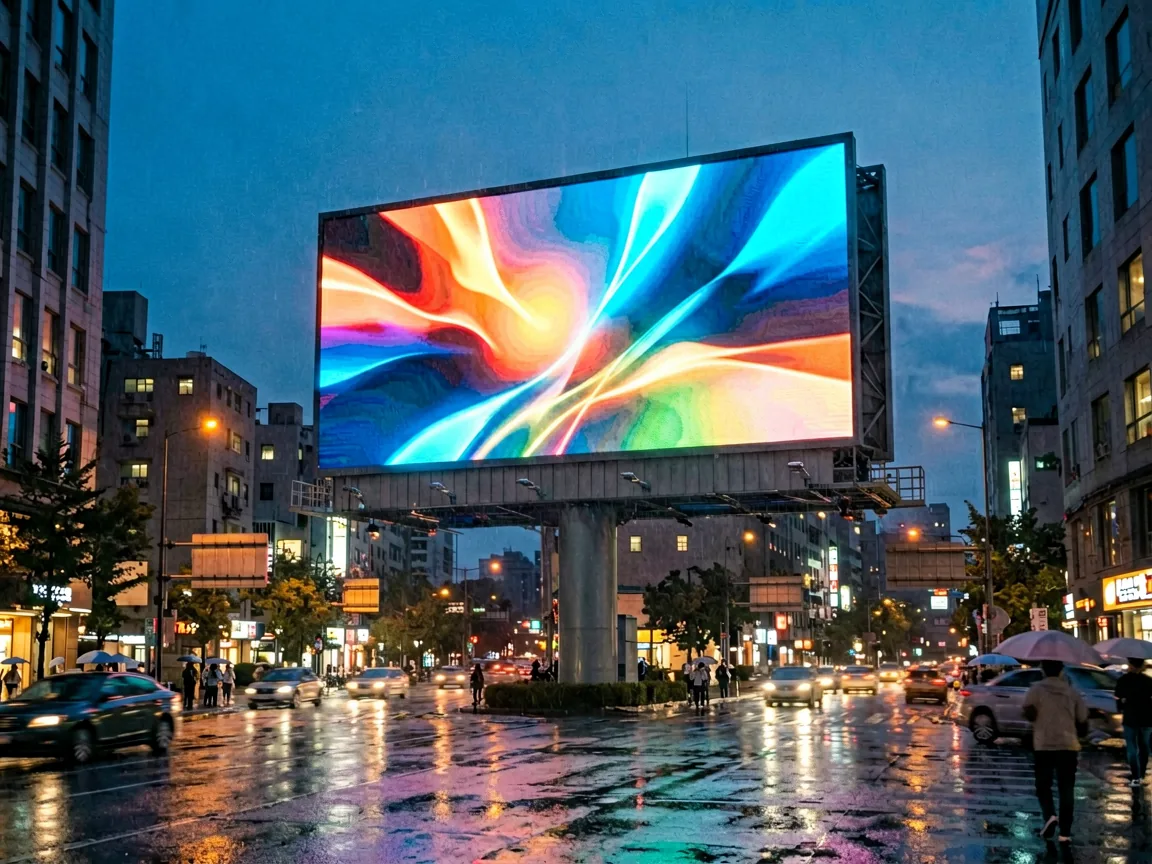
Direct-view LED, by a wide margin. Outdoor LED walls deliver 5,000+ nits, weatherproof cabinets, and wide temperature tolerance; LCD panels struggle with glare, waterproofing, and brightness costs outdoors.
Conclusion: Match the Technology to the Room, Not the Label
“IPS vs Full HD” was never a real contest — one is panel technology, the other a resolution. The decision that actually affects your budget is tiled IPS-LCD video wall vs direct-view LED video wall, and it resolves cleanly: short viewing distances and dashboard content favor LCD tiling; size, brightness, seamlessness, outdoor duty, and camera work favor LED. Define those four variables first, then compare quotations on equal specifications — and if the answer is LED, our team can size the wall to your exact space and content. Explore more comparisons and buying guides on the LEGIDATECH blog, or the outdoor digital sign applications if your project is exterior.