


In the lively center of Shinjuku, Tokyo, there is an amazing technological wonder: a huge 3D billboard featuring a realistic calico cat that stretches, yawns, and peers down at the crowd below.
Since it went viral in 2021, this single screen has redefined what outdoor advertising can do — and by 2026 it is a certified tourist landmark with its own rival screens, rotating anime campaigns and a global copycat industry. Below we explain how the naked-eye 3D illusion actually works, where to watch it, and — if you run a venue, agency or advertising business — how to build a 3D billboard like Tokyo’s, with a real project process and cost ranges.
What and Where Is Tokyo’s 3D Cat Billboard?
The billboard is called Cross Shinjuku Vision, mounted on the Cross Shinjuku Building at the east exit of Shinjuku Station in Kabukicho. It went live in April 2021 and its star is a giant tri-color calico cat named Mia, created by the ad agency MicroAd with AI-assisted animation. The screen itself is a curved LED display of roughly 19 m × 7.2 m (about 135 m²), wrapped around the building’s corner — and that corner is not decoration. It is the physical trick the whole illusion depends on, as we will explain below.
- Location: Cross Shinjuku Building, east exit of Shinjuku Station, Kabukicho — near Studio Alta and the Godzilla Head
- Screen: about 19 × 7.2 m (approx. 135 m²) curved naked-eye 3D LED display
- Star: Mia the calico cat, animated with AI-assisted production by MicroAd
- Status in 2026: still running, with rotating 3D spots and upgraded “Full Fidelity” picture and audio introduced in 2024

Behind the Scenes of Tokyo’s 3D Cat Billboard
What makes this display possible is the blend of advanced display engineering and artistic skill. The billboard features a large curved LED screen playing carefully produced 3D content, and the curved surface gives the viewing angles their depth cue — the illusion is engineered in both hardware and content.
The Technology that Brings the Cat to Life
At the core is a corner-wrapped LED screen running 4K-class content. Unlike a flat billboard, the folded surface lets one eye see slightly more of the image than the other — the same cue your brain uses to judge depth in real life. Combined with ultra-high resolution that resolves every detail of the cat’s fur and whiskers, the result is a window effect: a virtual object that appears to sit outside the screen, balancing on the building’s edge. In 2024 the operator upgraded the spot with “Full Fidelity Live” picture and “Full Fidelity Audio”, making the cat’s movements and purrs noticeably more lifelike.
The Creative Minds Behind the Purr-fect Illusion
Hardware alone would just be a curved TV on a building. A creative team turned pixels into a cat with personality: each yawn, stretch and paw over the edge is storyboarded animation, timed to the rhythm of the city. Mia behaves differently through the day — sleepy in the morning, playful at noon — and the content rotates seasonally: past campaigns have included Godzilla, Demon Slayer, Evangelion Unit-01, Minecraft, Assassin’s Creed and music-video tie-ins. That storytelling discipline is exactly as important to the effect as the LED modules, and it is a real budget line when you build your own (see the project process below).
How the Naked-Eye 3D Effect Actually Works
The technique is called anamorphosis — the same forced-perspective art that street chalk artists use, rendered at billboard scale. Three ingredients have to come together:
- A folded or curved screen. Nearly every famous 3D billboard wraps around a 90° building corner (an L-shape). The fold lets content be rendered so that, from one specific “sweet spot” on the street, the two faces fuse into one 3D object.
- Content rendered from the sweet spot. The anamorphic video is 3D-rendered with the real viewing angle and distance of that street corner baked in. Watch the Shinjuku cat from directly below and it still convinces; watch it from the crossing and the depth is overwhelming.
- Display hardware strong enough to sell it. Outdoor-class brightness so daylight never washes the shadow detail out, high refresh rate so every phone camera records it flicker-free — the viral clips are the whole business model — and fine enough pixel pitch for the typical 20–50 m viewing distance of a city intersection.
This is what the reference screen uses, and what a buildable version needs:
| Specification | Cross Shinjuku Vision (reference) | Buildable 3D billboard (LEGIDATECH spec) |
|---|---|---|
| Screen size | About 19 × 7.2 m, approx. 135 m² | Any size; most 3D facades run 60–300 m² |
| Geometry | Curved wrap on a building corner | 90° L-shape corner or gentle curve, radius engineered per facade |
| Pixel pitch | Not published; comparable facades use P6–P10 | P6–P10 for 20 m+ viewing; P4–P6 for closer sidewalks |
| Brightness | Outdoor class, full-day Shinjuku operation | 5,000–6,500 nits, auto-dimming at night |
| Refresh rate | Camera-friendly (built for viral phone video) | ≥3,840 Hz — flicker-free on broadcast and phone cameras |
| Content | Anamorphic 3D spots on rotation (Mia, Godzilla, anime campaigns) | Anamorphic video rendered for your corner’s exact angle |
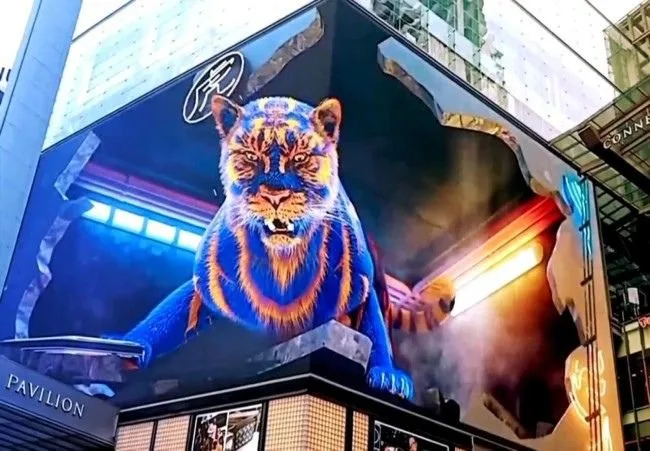
The Impact of the 3D Cat Billboard on Tokyo’s Landscape
The Shinjuku 3D cat is more than an ad; it gets people talking, brings joy, and turns a city block into an attraction. Here is the spot that started the global wave:
Video: the Shinjuku 3D cat billboard in action — watch how the cat interacts with the corner of the building.
Boosting Local Business and Tourism
The billboard sits by Shinjuku Station, one of the busiest transport hubs in the world. Tourists now put “the cat billboard building” on their itineraries by name, and the footfall lifts nearby shops, restaurants and entertainment spots. Two effects stand out:
- Increased footfall: the corner draws crowds on repeat, helping every business in sight of it.
- Global recognition: viral clips do the media buying for free — the screen earns attention worth far more than its media slots.
A New Cultural Icon — and Its Rivals
Mia has become part of Tokyo’s cultural identity, and success has bred competition: in September 2024 a rival 3D billboard with a giant golden retriever opened across the station area in JR Shinjuku’s new east–west passageway, in a building designed by architect Kengo Kuma — so visitors now hunt for both animals. For advertisers, that race is the proof: a 3D corner screen is no longer a novelty, it is premium media infrastructure, and cities from Osaka to Chengdu to New York have followed Tokyo’s lead.

Where to Find More 3D Billboards in Japan?
Outside Tokyo, look for Osaka’s Dotonbori district, Sapporo’s Tanuki Koji Shopping Arcade and Yokohama’s Minato Mirai waterfront — all run large LED screens with naked-eye 3D content. The format has also gone global: anamorphic 3D spots now run on landmark corners in China, South Korea, the US and Europe, and screen sizes range from single-facade billboards to entire building wraps. If you are hunting spots in Japan, evening hours are prime time — content rotations typically run all day with featured spots around the top of each hour.
LEGIDATECH 3D LED Display Solutions
LEGIDATECH is a factory-direct builder of 3D LED display technology in Shenzhen — we manufacture the curved and corner-wrapped screens that make anamorphic content work, and we have shipped them well beyond Japan. Real install: our naked-eye 3D billboard in Mexico, and P10 OK-series billboards in Ghana running full-time outdoor duty.
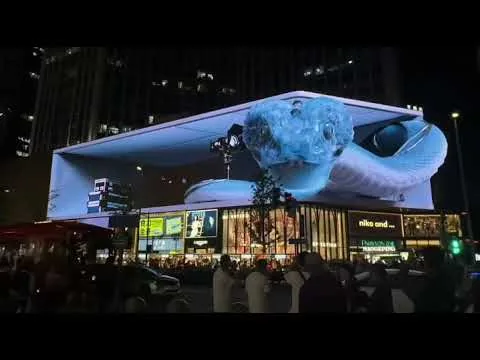
OK Series 3D Screen
The OK series is our workhorse for corner 3D facades: high-brightness outdoor modules that hold color and contrast in direct sunlight, in sizes and pixel pitches matched to the viewing distance of your site. It is engineered for 24/7 duty with front and rear service access, so content stays on air and maintenance stays simple.
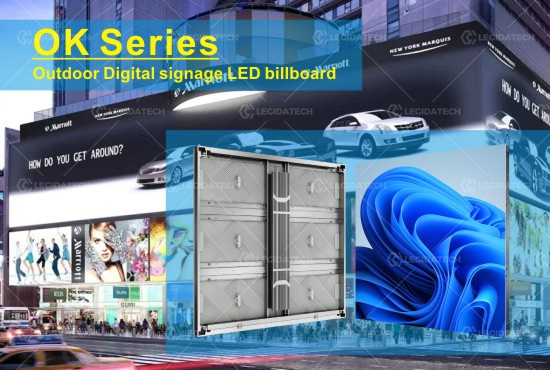
OF Series 3D Billboard
The OF series 3D billboard targets landmark advertising: sharp imagery, bright color and the depth that pulls viewers into the brand story. Content updates over the network in minutes — new products, interactive campaigns or scheduled rotations — which is how the Shinjuku model works in practice: one screen, endlessly reprogrammed.
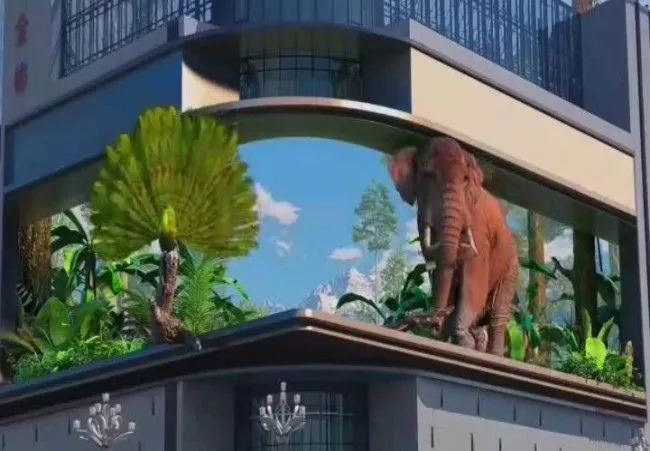

How to Build a 3D Billboard Like Tokyo’s
You cannot buy the Shinjuku screen, but you can build the same effect — it is a repeatable formula: a corner, the right LED specification, and content rendered for that exact corner. This is the project process we run with clients:
- Site survey and corner geometry. The effect needs a 90° corner (or an engineered curve) with an open viewing zone across the intersection. We measure sightlines, viewing distance and facade structure first — geometry decides everything downstream.
- Structure and permits. The screen hangs on a steel sub-frame sized for wind load and facade condition, and every city has its own advertising permit process. Budget this line early; it is real money and real lead time.
- LED specification. For typical 20–50 m viewing: P6–P10 pitch, 5,000–6,500 nits brightness, refresh ≥3,840 Hz so phone and broadcast cameras record it clean, curved/corner cabinets custom-bent to your radius.
- Anamorphic content production. The 3D spot is rendered specifically for your corner’s angle and distance — a Tokyo-style cat will not just play on any screen. Production is a separate line item (agency or in-house) and typically runs USD 5,000–30,000 per spot.
- Install, calibrate, rotate. After commissioning we calibrate color and seams corner-to-corner, then your team schedules content rotations — the Shinjuku playbook: one screen, a calendar of characters and campaigns.
What it costs, in honest ranges (screen hardware is our own factory pricing; other lines are industry-typical and vary by country):
| Budget line | Typical range | Notes |
|---|---|---|
| LED screen hardware | USD 350–700 per m² (P8–P10 outdoor class) | A Shinjuku-size 135 m² screen lands around USD 47,000–95,000 factory-direct; see the full LED screen price guide |
| Steel structure & facade works | Site-dependent; often comparable to the screen cost | Corner frame, wind-load engineering, cladding |
| Anamorphic 3D content | Commonly USD 5,000–30,000 per spot | Rendered for your corner’s exact viewing angle |
| Permits & installation | Varies by city and facade | Local advertising permits, crane access, commissioning |
| Maintenance | 2–3% spare modules; front/rear service | LEDs rated 100,000 hours; power supplies 7–10 years |
Get a 3D Billboard Quote for Your Building
Frequently Asked Questions
How is the 3D effect achieved without glasses?
Through anamorphosis: a folded or curved LED screen playing content that is 3D-rendered from one specific street viewpoint. From that sweet spot, the two screen faces fuse into a single object with convincing depth — your brain supplies the 3D, so no glasses are needed. Brightness and high refresh keep the illusion intact in daylight and on camera.
Where exactly in Tokyo can I see the 3D cat billboard?
At the Cross Shinjuku Building, east exit of Shinjuku Station in Kabukicho — near Studio Alta and the Godzilla Head. Since September 2024 there is also a rival 3D dog screen in the JR Shinjuku east–west passageway, so you can catch both animals in one visit.
What times can the 3D billboard be viewed?
The screen runs through the day and evening. The cat appears in rotating spots — traditionally around the top of each hour — but exact times change with the campaign calendar, and evening hours are the most atmospheric.
Can the billboard display other animals or images?
Yes — the hardware is a normal high-brightness LED screen; only the content makes it 3D. Shinjuku’s rotations have included Godzilla, Demon Slayer, Evangelion, Minecraft and Assassin’s Creed campaigns alongside the cat, and any owner can schedule their own characters, products or brand stories.
Has the billboard featured in any major events or campaigns?
Yes — it has hosted global brand takeovers, game and anime launches, and music-video tie-ins, and clips of its spots have reached tens of millions of views. It is now premium media inventory, which is exactly why building your own corner screen has become a serious advertising investment.
How much does it cost to build a 3D LED billboard like Shinjuku’s?
Screen hardware for a Shinjuku-size 135 m² outdoor display runs roughly USD 47,000–95,000 factory-direct (USD 350–700 per m² at P8–P10). Add steel structure, permits and installation, plus USD 5,000–30,000 per anamorphic 3D content spot. Total projects commonly land in the low-to-mid six figures USD depending on site and country.
Can I build a naked-eye 3D billboard outside Japan?
Yes — the technique depends on geometry, not location. Any building with a 90° corner and an open viewing zone can host one. LEGIDATECH ships corner-wrapped 3D screens worldwide — our installs include a naked-eye 3D billboard in Mexico and OK-series billboards in Ghana.
What LED specifications does a naked-eye 3D screen need?
Three numbers matter most: pixel pitch matched to viewing distance (P6–P10 for 20 m+), brightness of 5,000–6,500 nits for full-daylight outdoor duty, and refresh rate of 3,840 Hz or higher so phone and broadcast cameras record the content flicker-free. Corner cabinets are custom-bent to the facade’s radius.
Conclusion
Tokyo’s 3D cat billboard is a formula, not a miracle: a corner, a high-brightness curved LED screen, and anamorphic content rendered for one exact viewpoint. Tokyo turned that formula into a cultural icon and a media business; the same formula is now buildable in any city with the right partner.
If you are planning a landmark screen for your building, agency network or city, explore our naked-eye 3D LED display solutions, browse more guides on the LEGIDATECH blog, or grab the quote button above — send us your facade and we will tell you what your corner can do.


Pingback: Techno Image Survey – My Digital World