


1000x1000mm Outdoor LED Display — A1000 Series 3D LED Screen from the Factory
1000x1000mm outdoor LED display is the industry-standard fixed-installation cabinet format for outdoor advertising, building facades, stadium screens and naked-eye 3D landmarks. LEGIDATECH builds the A1000 Series around a 25 kg CNC-machined aluminum profile cabinet with IP66 front-and-rear sealing, Common Cathode Technology that saves 25% on electricity, true front-service installation and 6 pixel pitches from P2.97 to P10.42 — quoted factory-direct with engineering drawings before production.
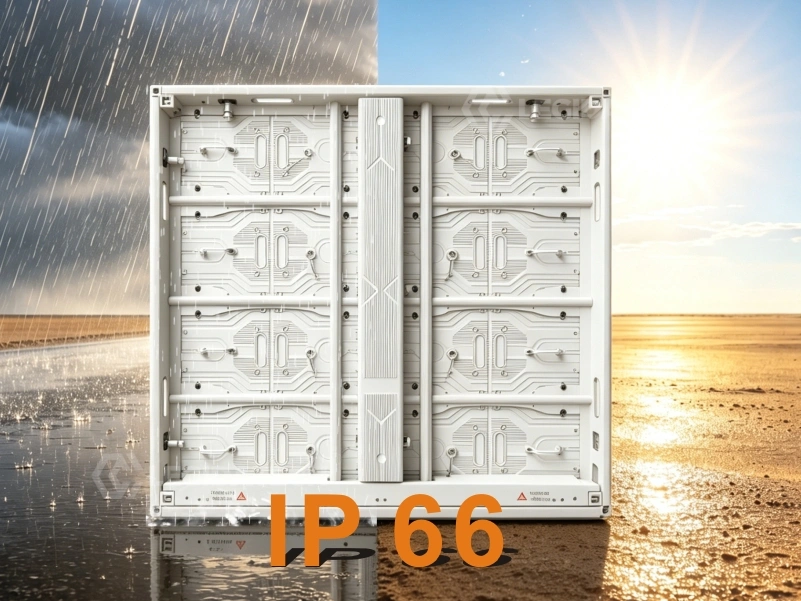
✓IP66 front & rear sealed
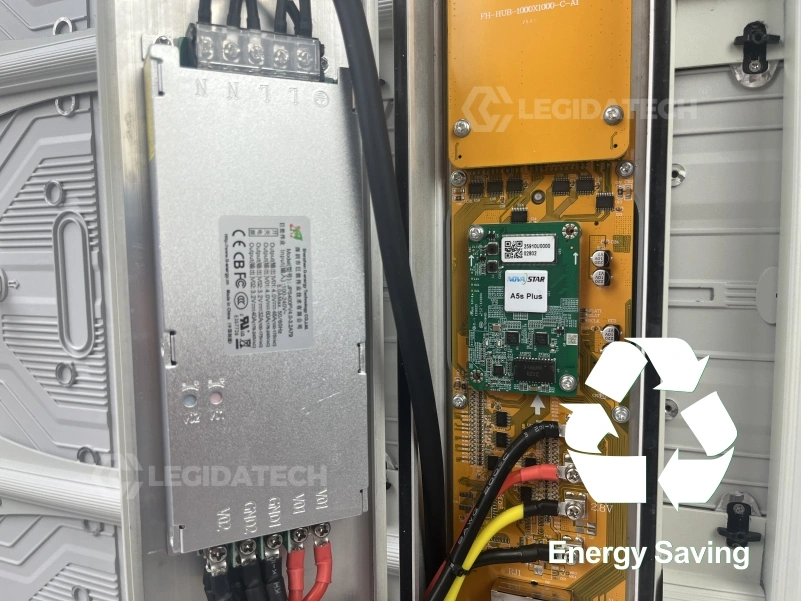
✓25% energy saved (CCT)
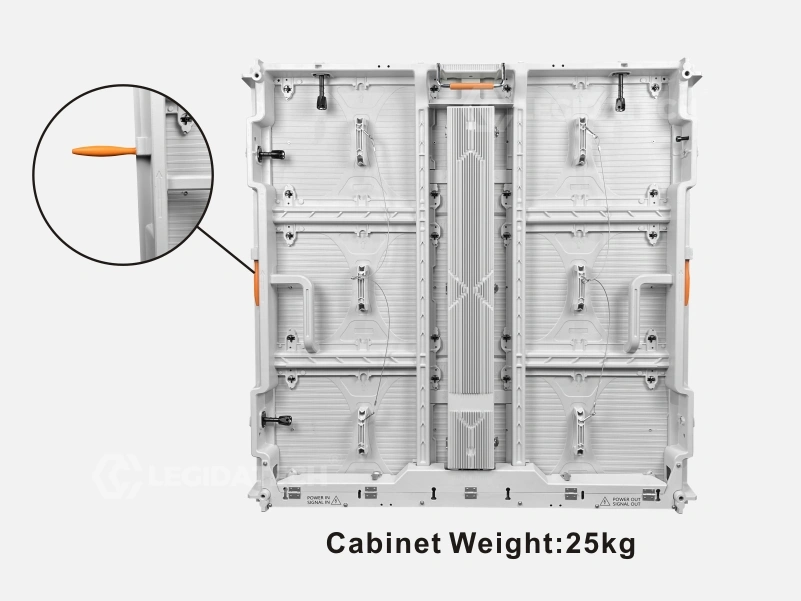
✓25 kg per cabinet
✓5-year factory warranty
What Is a 1000x1000mm Outdoor LED Display?
A 1000x1000mm outdoor LED display is a modular advertising screen built from square 1000×1000 mm cabinets, each carrying eight 500×250 mm LED modules. The cabinets lock together mechanically and are driven by one controller, so a wall can grow from a single 1×1 m unit to a 10×6 m billboard using identical parts. With pixel pitches from P2.97 to P10.42, the same A1000 cabinet family covers short-viewing digital signage and long-distance roadside billboards alike.
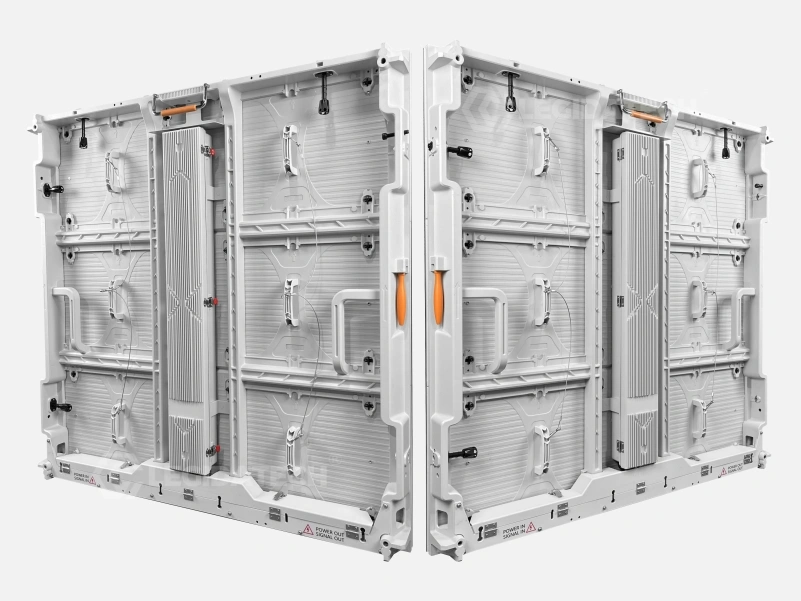
The format matters because 1000×1000 mm is the de facto standard for fixed outdoor installations worldwide: it matches the 500×250 mm module grid used across the industry, simplifies spare-part stocking, and lets your integrator size a screen to architecture instead of a panel format. The A1000 adds two capabilities most fixed outdoor cabinets do not have: true front service (no rear access corridor) and naked-eye 3D splicing for S-shaped or curved landmark installations.
What Is the A1000 Series Built From?
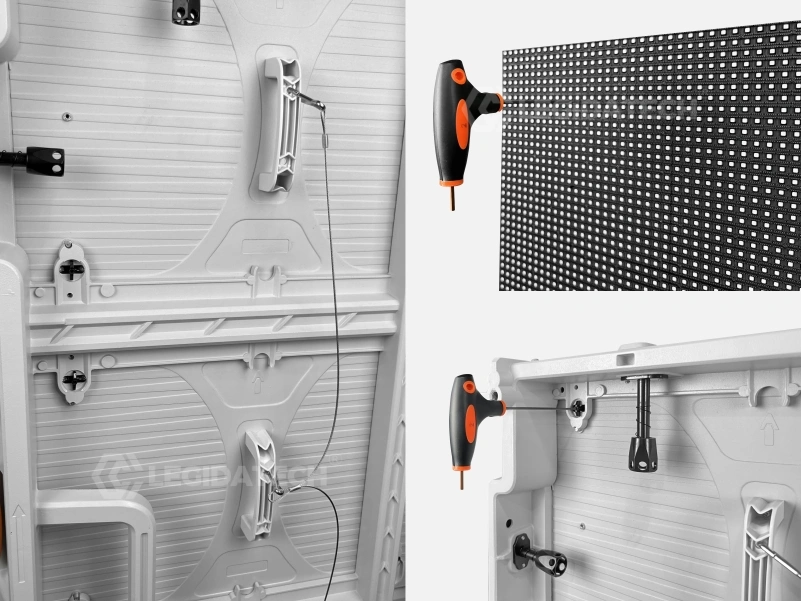
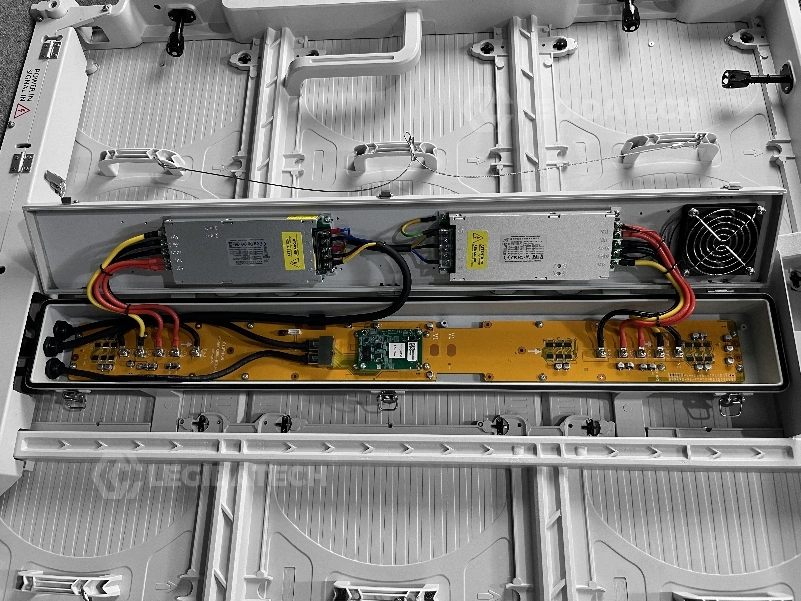
Each cabinet is a CNC-machined aluminum profile frame with die-cast corner connectors, 25 kg total weight, a hollow interior that channels airflow for cooling, and quick-lock fasteners inherited from rental-grade designs. Modules are held by butterfly locks — four per module, replacing the 12-screw system of earlier series — and each module carries a handle plus four precision positioning pins so panels seat flush with zero visible seam.
Choosing the right cabinet format is the first decision that shapes your budget, so we compare the 1000×1000 mm option against the alternatives below — then read the rest of this page for the outdoor LED display family overview.
1000×1000mm vs 960×960mm vs 500×1000mm Cabinets
Three cabinet formats dominate the outdoor market, and the choice between them changes your steel structure, your module inventory and your installation labor. The 1000×1000 mm format wins on fewer cabinets per square metre — 1.0 cabinet per m² versus 1.09 for 960×960 mm — which means fewer frames, fewer connections and faster rigging on large walls.
Its 500×250 mm module grid is shared with the widest range of spare modules on the market, so replacement parts stay cheap for the life of the screen. The 960×960 mm format remains popular where an existing structure or old screen defines the mounting grid; 500×1000 mm is a rental-world format that trades flatness precision for rapid assembly.
For fixed outdoor advertising, LEGIDATECH recommends the A1000 unless your existing structure dictates 960×960 mm. Compare it against our 960x960mm outdoor advertising screen series to see which grid your site already matches.
| Comparison | 1000×1000 mm (A1000) | 960×960 mm | 500×1000 mm (rental) |
| Cabinets per m² | 1.00 | 1.09 | 2.00 |
| Module size | 500×250 mm ×8 | 320×160 mm ×18 | 500×250 mm ×4 |
| Typical weight | 25 kg | 23–28 kg | 12–15 kg |
| Maintenance access | Front & rear | Front & rear | Front only |
| Best suited for | Fixed billboards, facades, 3D landmarks | Replacement / grid-matched walls | Events, touring, stage use |
| Naked-eye 3D capability | Yes (S-shape splicing) | Limited | No |
Key Features of the A1000 Series 1000x1000mm Outdoor LED Display
Six engineering decisions separate a screen that still performs in year eight from one that fails in year two. Every A1000 cabinet is built around all six.
Total Cost of Ownership: 25% Energy Saving × 10 Years
The purchase price is less than half the story. On a 20 m² wall running 12 hours a day at a typical commercial rate, the worked example below shows what CCT energy saving and front-service installation are actually worth over a decade.
| 10-year ownership line item | Traditional DIP screen | A1000 (CCT) |
| Average power draw (mixed content) | ~320 W/m² | ~240 W/m² |
| Annual electricity, 20 m² × 12 h/day | ~USD 3,360 | ~USD 2,520 |
| Electricity over 10 years | ~USD 33,600 | ~USD 25,200 |
| Steel structure (rear access walkway) | +USD 2,000–4,000 | None — wall mount |
| Module replacement labor (per swap) | ~30 min (12 screws) | <5 min (butterfly) |
| Total 10-year ownership | Higher — pay more for power + steel | Lower — saves ~USD 8,400+ on power alone |
Worked example assumes USD 0.14/kWh, 20 m² wall, 4,380 h/year, average-content power draw. Your quotation comes with a screen-specific energy estimate. See live ranges on our LED screen price page.
A1000 Series 1000x1000mm Outdoor LED Display — Specifications
Six models share one 1000×1000 mm cabinet; only the module pitch changes. Brightness, resolution and recommended viewing distance scale with pitch as shown.
| Specification | A1000-2.97 | A1000-3.91 | A1000-4.81 | A1000-6.25 | A1000-7.81 | A1000-10.42 |
| Pixel pitch | P2.97 | P3.91 | P4.81 | P6.25 | P7.81 | P10.42 |
| Cabinet size (mm) | 1000×1000×85 | 1000×1000×85 | 1000×1000×85 | 1000×1000×87 | 1000×1000×87 | 1000×1000×87 |
| Cabinet material | CNC-machined aluminum profile (die-cast corners) | |||||
| Weight (kg/cabinet) | 25 kg | |||||
| Cabinet resolution | 336×336 | 256×256 | 208×208 | 160×160 | 128×128 | 96×96 |
| Brightness (nits) | ≥5,000 | ≥5,500 | ≥6,000 | ≥6,500 | ≥6,500 | ≥6,500 |
| IP rating | IP66 (front & rear) | |||||
| Maintenance | Front & rear service, butterfly locks, safety ropes | |||||
| Refresh rate | ≥3,840 Hz | |||||
| Max power (W/m²) | ~800 | ~800 | ~780 | ~760 | ~750 | ~720 |
| Avg power (W/m², mixed content) | ~240 | ~240 | ~235 | ~230 | ~225 | ~220 |
| Viewing angle | 160° horizontal / 160° vertical | |||||
| Recommended viewing distance | ≥3 m | ≥4 m | ≥5 m | ≥6 m | ≥8 m | ≥10 m |
| Warranty | 5-year factory warranty, 100,000 h rated LED life | |||||
Power and resolution figures are typical values — final numbers come with the factory specification sheet for your model. Module-level guidance: P3.91 LED module detailed guidance · P4.81 LED module detailed guidance
Installation: Front-Service Design Saves Structure, Labor and Time
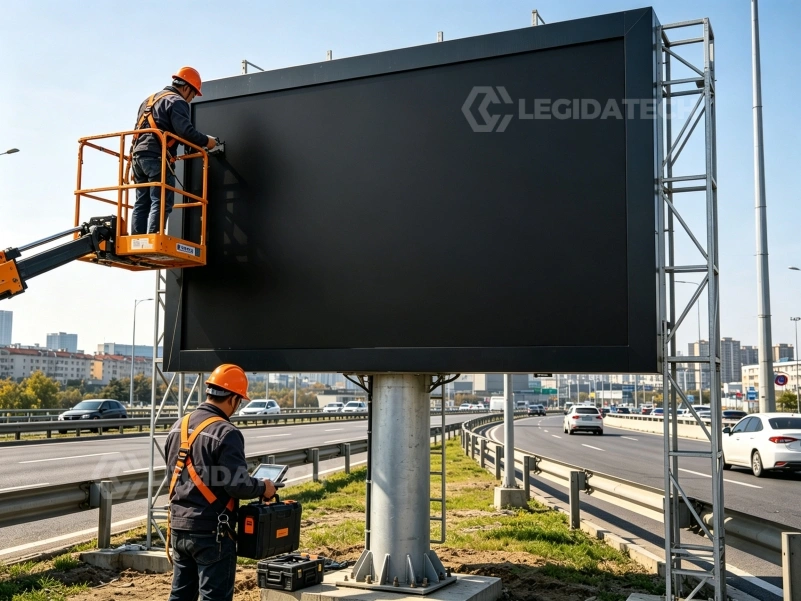
A rear-service outdoor screen forces you to build a steel walkway behind the display, reserve 800–1,200 mm of access space, and buy two access doors per bay. The A1000 eliminates all of it: modules swap from the face, so the cabinet mounts directly to the wall or a lightweight main frame.
On site, two riggers hoist each 25 kg cabinet, engage the top locks, and adjust the four positioning pins until modules seat flush. Butterfly locks on the module back complete the job — no screw gun, no torque spec, no 12 screws per module. A 30 m² wall typically rigs in 2–3 days with a two-person crew instead of a week with a scaffold gang.
Rooftop and high-rise rules vary by country; LEGIDATECH provides wind-load calculations and mounting drawings before production so your civil engineer can approve the wall-mount frame up front. Spare modules ship with the order, and the front-service design means a roadside replacement takes one ladder access, not a crane and a full bay teardown.
Installation Cost: Front-Service vs Rear-Service
| Cost item (per 20 m² wall) | Rear-service screen | A1000 front-service |
| Secondary steel structure | USD 2,000–4,000 | USD 0 (wall mount) |
| Access corridor space | 800–1,200 mm behind wall | None required |
| Rigging crew | 4–6 people + scaffold | 2 people, no scaffold |
| Installation time | 5–7 days | 2–3 days |
| Module swap time (per module) | ~30 min (12 screws) | <5 min (butterfly lock) |
| Typical saved on install | — | USD 4,000–8,000 per wall |
Where the 1000x1000mm Outdoor LED Display Delivers ROI
The A1000 serves every fixed outdoor application, from pure advertising to civic infrastructure. Four of the highest-ROI uses are below.
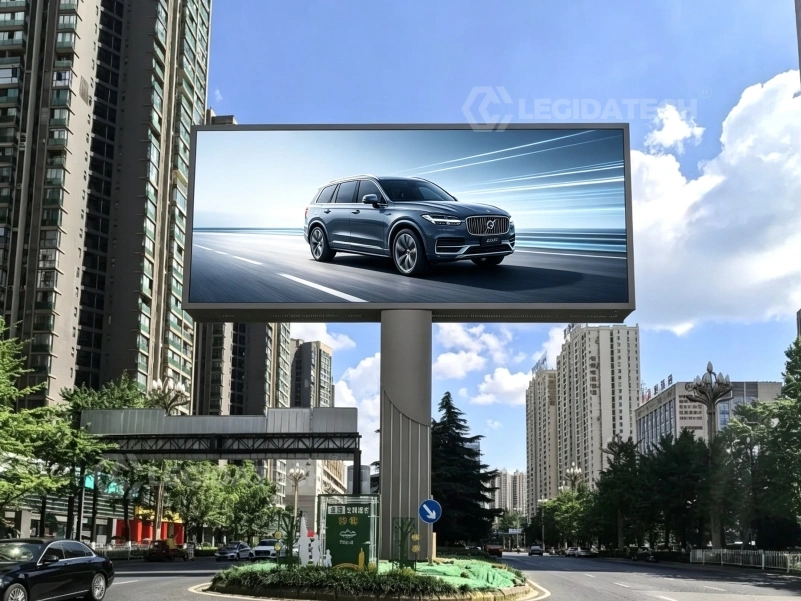
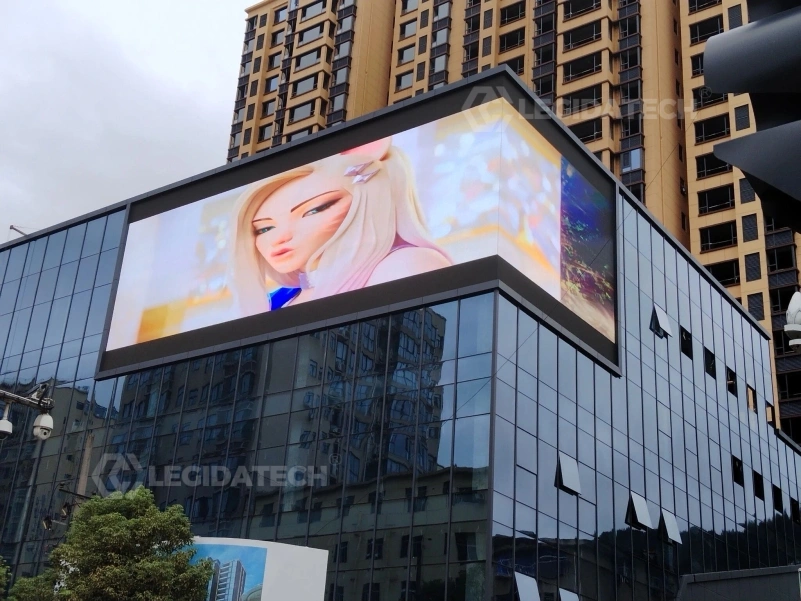
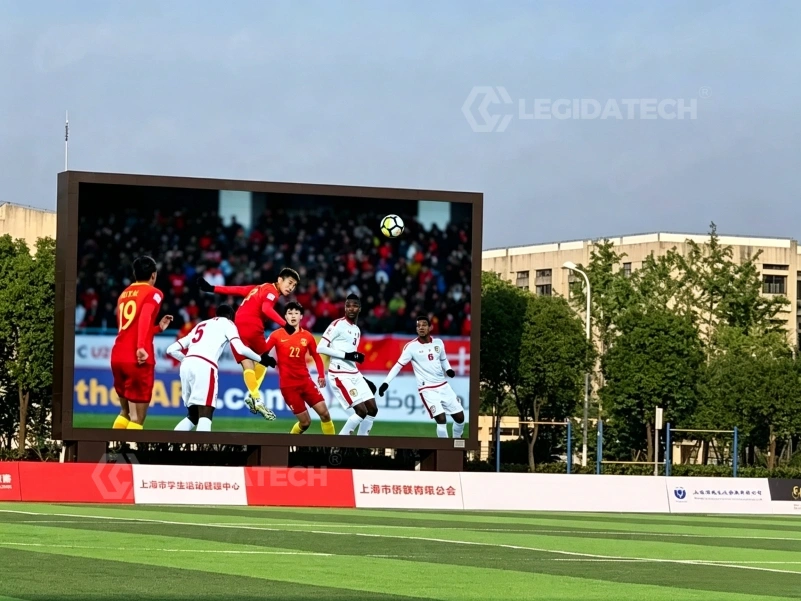
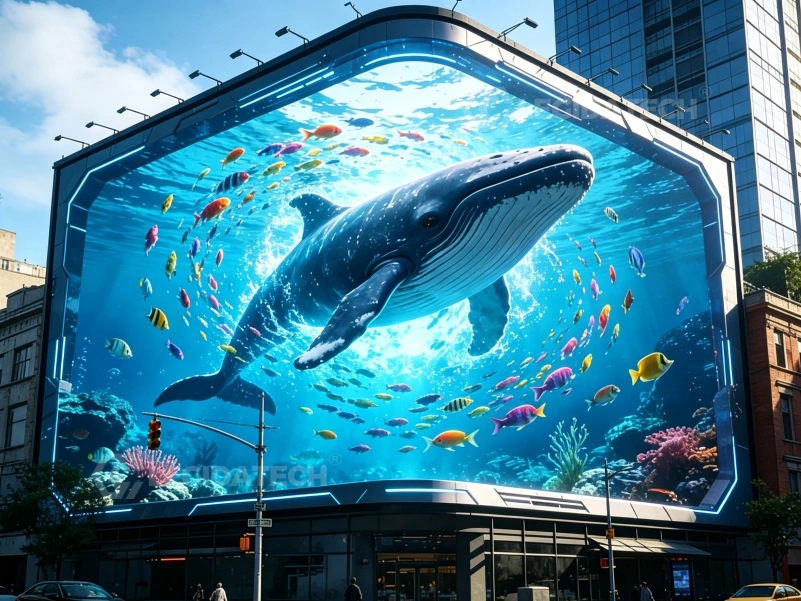
Outdoor advertising screen guide: what a fixed outdoor LED billboard is and how it is built for roadside advertising.
Outdoor billboard case: an A1000-class fixed wall in Egypt delivering vivid, sun-readable content in extreme heat.
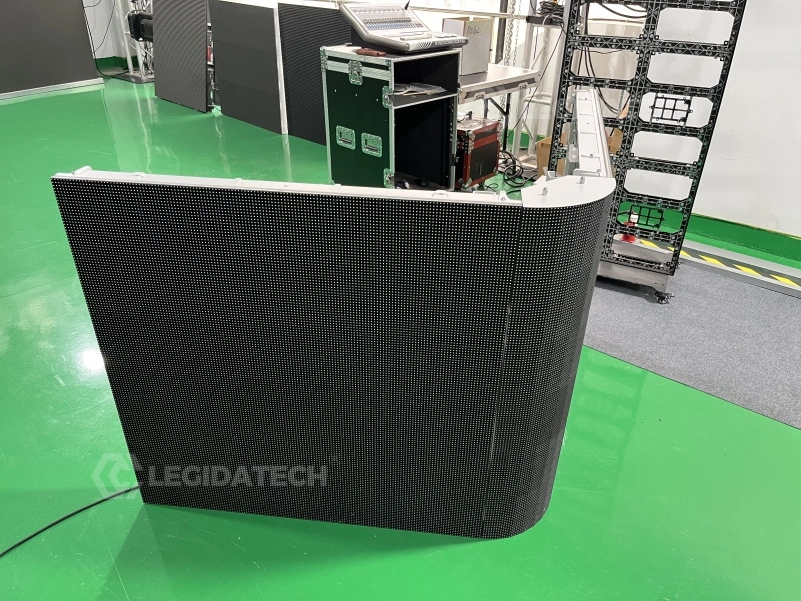
Naked-Eye 3D: The A1000 as a Landmark Advertising Canvas
Naked-eye 3D is not a different screen — it is a splicing geometry. Two flat walls joined at a 90° corner (or an S-shaped concave sweep) let the brain reconstruct depth from parallax between the two planes. The illusion only works when the seam is invisible; any module offset or cabinet gap destroys it.
That is exactly what the A1000’s CNC frame and Hard Connection joints are engineered for: 0.1 mm-class flatness across cabinets, adjustable top locks that dial in seam gap, and positioning pins that seat every module flush. LEGIDATECH supplies corner brackets, the controller mapping for 90° and S-shape layouts, and content production guidance with the order.
Media owners in Asia, the Middle East and Europe currently price corner 3D units 30–100% above flat billboard inventory of the same size — the same hardware, a different geometry, and content that travels on social media for free.
Why LEGIDATECH as Your 1000x1000mm Outdoor LED Display Manufacturer
Buying an outdoor screen is a ten-year relationship. Here is the factory you would be dealing with — and what every quotation from us includes.
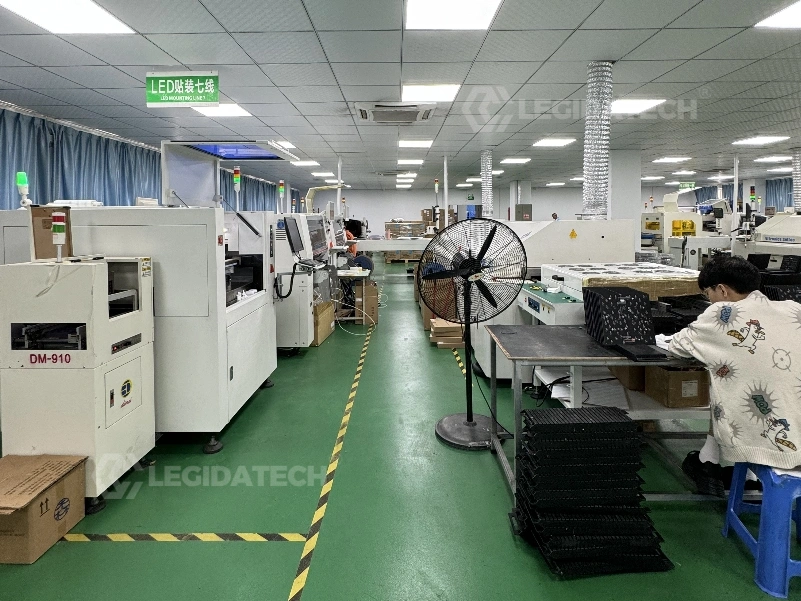
LEGIDATECH is a Shenzhen-based LED screen manufacturer with automated SMT lines, 72-hour aging tests on every cabinet, and in-house quality engineers who sign off each module before packing. When you buy from us you deal with the people who design the cabinet — not a trading company quoting someone else’s drawing. Walk through the production floor on our factory page.
CE / RoHS / FCC
Certified electronics and documented compliance paperwork with every export order. See the full list on our certification page.
Engineering First
Cabinet layout drawing and wind-load calculation delivered before production, so your civil engineer approves the mount before you commit.
60+ Countries Shipped
FOB/CIF terms, sea or air freight, export documentation handled in-house — from Nigeria to Ireland, Egypt to the USA.
24-Hour Quotation
Send dimensions, viewing distance and environment — you get a spec sheet and factory-direct price within 24 h via our contact for a quote page.
1000x1000mm Outdoor LED Display FAQ
Get Your 1000x1000mm Outdoor LED Display Priced by the Factory
Send us the wall dimensions, viewing distance and environment. Within 24 hours you receive a cabinet layout drawing, full specification sheet and factory-direct quotation — no distributor margin, with the energy and TCO numbers worked out for your site.
Related Products & Articles
PRODUCT960×960mm Outdoor Advertising ScreenThe classic 960×960mm outdoor cabinet format with the same front-service, IP66 construction and energy-saving CCT option.PRODUCTOutdoor LED Screen RangeFull outdoor line-up from LEGIDATECH — fixed billboards, advertising walls and weatherproof display systems for any site.
1000x1000mm Outdoor LED Display Buying Guide 2026: Cabinet Economics, IP Ratings and Total Cost of Ownership
Most supplier articles about the 1000x1000mm outdoor LED display format are brochures with headings. This one is written from the factory floor: where the money actually goes, which specification lines get inflated, and what a 1000×1000 mm wall costs to own for a decade rather than to buy on day one.
1. Cabinet Economics: Why 1000×1000 mm Became the Fixed-Installation Standard
The 1000×1000 mm cabinet is the price-performance champion of fixed outdoor advertising for three structural reasons. First, it yields exactly one cabinet per square metre, so a 40 m² billboard is 40 cabinets and 40 frame attachments — a 960×960 mm wall needs 44 units for the same face. Second, its 500×250 mm module grid is the most widely produced module size in the industry, which keeps spare modules cheap and available years after your screen model leaves production. Third, the square format tiles cleanly into every standard billboard aspect ratio: 4:3, 16:9 and 3:1 all resolve with whole cabinets at common wall sizes.
The economics change as soon as you leave the fixed world. Rental companies prefer 500×500 or 500×1000 mm cabinets because they pack into flight cases and rig faster; but rental cabinets trade away the flatness precision a permanent wall needs. The A1000 deliberately keeps the rental-grade quick-lock mechanism (butterfly locks, adjustable top locks) while staying a fixed-installation cabinet — you get fast assembly without sacrificing the rigid CNC frame that keeps a permanent wall flat for a decade.
One number most quotations hide: module count per square metre. At 8 modules per cabinet the A1000 needs 8 modules/m², versus 11–12 for the 320×160 mm modules used by some 960×960 competitors. Fewer modules means fewer connectors, fewer potential failure points, and a spares basket that costs a third less to stock. When you compare quotations, convert everything to per-square-metre and per-module figures — the cabinet price alone tells you almost nothing.
There is also a structural arithmetic worth knowing before you specify. A 1000×1000 mm grid lets a 3×3 cabinet wall hit 3.0×3.0 m, a 4×3 wall hit 4.0×3.0 m, and a 10×6 wall hit 10.0×6.0 m — every standard billboard and facade proportion resolves in whole cabinets. Odd site dimensions simply add a column or row of cabinets; because the module is 500×250 mm, half-cabinet corrections are available without cutting anything on site. This matters more than it sounds: every time a wall has to be shaved to fit a non-standard grid, the leftover cabinets become dead inventory, and dead inventory is where “cheap” screens quietly become expensive.
2. IP Ratings: IP66 vs IP65 vs IP67
Every outdoor screen claims “waterproof,” but the claim is a two-digit standard. The first digit is solids: 6 means total dust exclusion — every outdoor screen at this level passes. The second digit is water pressure: 5 resists low-pressure jets, 6 resists high-pressure jets, 7 survives temporary immersion up to 1 m. The gap between 5 and 6 is where rain becomes a commercial risk: monsoon downpours, coastal storms and pressure-washer cleaning all exceed what an IP65 gasket line was designed for.
The A1000 is rated IP66 on both faces, with salt-spray-treated gaskets and connectors as standard. That last point matters more than the rating itself: a screen that is IP66 on paper but ships with untreated rubber can still corrode at the seams in a coastal city. Insist on seeing the salt-spray test certificate, not just the IP logo. If your site is a beachfront property or an industrial zone with chemical exposure, ask for the accelerated aging report before you sign.
Temperature range is the silent partner of IP rating. The A1000’s −40 °C to +60 °C operating envelope covers every inhabited market on earth, but verify the same range on the power supplies and receiver cards, not just the module data sheet — cheap components inside an expensive cabinet are where outdoor screens actually die.
Outdoor screen selection in practice: what our engineers compare before recommending a configuration for advertising sites.
3. Common Cathode Technology: Where the 25% Energy Saving Actually Comes From
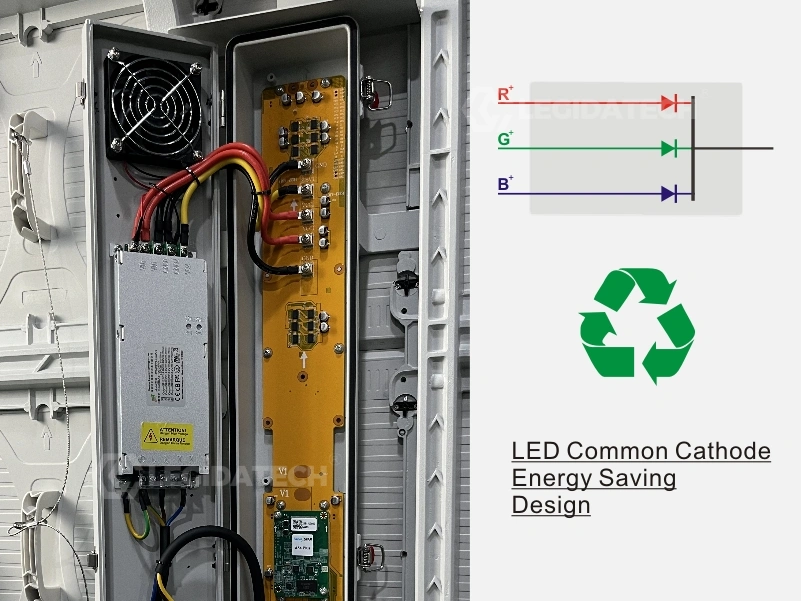
An LED die is a current-driven device with a forward voltage that depends on its color chemistry: red dies sit around 2.0–2.2 V, green and blue around 2.8–3.2 V. A conventional “common anode” driver feeds all three channels from one rail sized for the highest channel — typically 5 V — and burns the voltage difference on every red die as heat. On a screen full of red-heavy ad content, that waste is continuous and measurable.
Common Cathode Technology splits the supply: red gets its own low-voltage rail, green and blue share a higher rail, and each channel runs at its natural voltage. The measured result on the A1000 is a 25% reduction in power draw versus an equivalent DIP-based screen, with the same brightness. That is not a marketing percentage — it is a circuit topology difference you can verify by reading the power supply spec and metering the wall at full white.
What the percentage does to your P&L: at USD 0.14/kWh, a 20 m² wall averaging 240 W/m² over 4,380 operating hours a year consumes about 21,000 kWh and costs roughly USD 2,520 annually. A DIP equivalent at 320 W/m² costs about USD 3,360. The A1000 difference is ~USD 840 per year, ~USD 8,400 per decade, on one 20 m² wall — before factoring the reduced cooling load and the longer power-supply life that comes from running cooler.
Two practical notes for verifying the claim yourself. First, energy saving is content-dependent: a screen showing mostly red logo content saves more than one showing full-white test patterns, because red is exactly the channel where common-anode drivers waste the most. Second, ask the factory for the power supply topology in the BOM — a genuine CCT cabinet lists separate 2.x V and 3.x V rails, while a “CCT-style” marketing cabinet still shows a single 5 V rail. The A1000’s dual-layer power boxes separate those rails physically, which is why the heat it removes is measurable at the cabinet surface, not just on paper.
4. Front-Service vs Rear-Service: The Installation Cost Hidden in Your Quote
A rear-service outdoor screen is not just a product decision — it is a construction project. It demands a steel walkway behind the display, 800–1,200 mm of access depth, access doors on the back face, and structural engineering for a double frame. On a 20 m² wall that package typically costs USD 2,000–4,000 in materials and adds a week to the schedule. On rooftops it can force a complete rework of the parapet design.
The A1000’s modules are designed to be replaced from the front: butterfly locks release a module in seconds, four positioning pins guide it back into perfect registration, and a safety rope keeps it tethered while you work. Because the face is the service plane, the cabinet mounts flush to the wall. Your civil engineer designs one frame instead of two, your rigging crew shrinks from four-plus to two, and a roadside module swap becomes a single-ladder job instead of a crane operation.
The trade-off, honestly stated: front-service cabinets carry slightly more complex module mechanics than a screw-mounted rear-service module. That is why the A1000 uses hardened butterfly latches and aluminum frames rather than plastic clips. The right comparison is not “front versus rear” in the abstract — it is whether the supplier’s front-service mechanism survives 10 years of hot-cold cycling. CNC aluminum and metal latches do; molded plastic clips do not.
5. Reading a Spec Sheet Like a Buyer: Five Lines Most Suppliers Inflate
Spec sheets are marketing documents with numbers attached. These five lines deserve the most skepticism:
| Spec line | What suppliers do | How to verify |
| Brightness (nits) | Quote peak white with fresh dies, no aging | Ask for the value after 1,000 h burn-in |
| Refresh rate | Quote driver-IC max, not sustained setting | Confirm the figure at your actual brightness |
| Power consumption | Quote only peak, or only idle, whichever flatters | Ask for max AND average on mixed content |
| Lifespan | Quote 100,000 h L50 without conditions | Ask what brightness/cooling assumptions apply |
| Warranty coverage | Years of warranty ≠ years of support | Get module spare pricing and lead time in writing |
Two of these traps are the reason this page exists. A supplier quoting 6,500 nits on a 1000x1000mm outdoor LED display at P10.42 is either using fresher dies than you will receive, or quoting the driver ceiling. And a “3-year warranty” with no spare-parts price list is a phone number, not a warranty. Our P3.91 LED module detailed guidance and P4.81 LED module detailed guidance walk through reading these lines on the two most-bought pitches.
6. Ten-Year Total Cost of Ownership
A decade of ownership has four cost buckets: purchase, electricity, structure, and maintenance labor. On a typical 20 m² P4.81 wall:
| Bucket | DIP screen (rear service) | A1000 CCT (front service) |
| Purchase (screen + control) | USD 13,000–17,000 | USD 12,000–18,000 |
| Structure + installation | USD 6,000–12,000 | USD 2,000–5,000 |
| Electricity (10 years) | USD 30,000–37,000 | USD 22,500–28,000 |
| Maintenance labor + spares | USD 2,000–4,000 (crane access) | USD 800–1,500 (front access) |
The pattern is consistent across wall sizes: the A1000 trades a slightly higher cabinet price (CNC aluminum costs more than stamped steel) for structurally lower electricity, structure and labor costs. Over ten years the CCT energy saving alone repays the price difference, and the front-service design removes the single largest recurring cost of an outdoor wall — crane-and-crew access every time a module fails. That is why the TCO comparison, not the unit price, is the number your finance approval should be based on. Our LED screen price page carries current ranges for every family.
Sensitivity matters more than precision here, because energy tariffs vary wildly by country. In Germany at USD 0.30/kWh the A1000’s annual saving on that same 20 m² wall is roughly USD 1,800; in markets with subsidized power at USD 0.05/kWh it drops to about USD 300. Structure and labor savings, by contrast, are close to tariff-independent — a front-service wall saves USD 4,000–8,000 in installation whether your energy is cheap or expensive. If your site has low electricity prices, weight your decision toward the installation and maintenance columns; if power is expensive and the wall runs long hours, the CCT column dominates. Either way, the A1000 is not the cheapest screen at the sales desk — it is built to be the cheapest screen at the ten-year mark, which is the only price that matters for a permanent installation.
7. Five Mistakes That Cost Buyers the Most Money
Mistake 1 — Buying pitch by price per m². The cheapest pitch is rarely the cheapest screen. P10.42 looks 40% cheaper than P4.81 until you account for the fact that advertisers pay per impression, and a sharper image sells the same slot for more. Buy the pitch your viewing distance and content demand, not the one the price list flatters.
Mistake 2 — Ignoring the structure budget. Buyers negotiate the screen price hard, then discover the steel structure costs 30–50% of the screen. On a front-service 1000×1000 mm cabinet that line item largely disappears. Compare total installed cost, not screen-only cost, or you will fund your competitor’s walkway.
Mistake 3 — Trusting IP logos over test certificates. An IP66 sticker on the module data sheet is not the same as an IP66 test certificate covering the assembled cabinet with its gaskets in place. Request the cabinet-level certificate before ordering, especially for coastal sites.
Mistake 4 — Under-specifying spare modules. A module failure on an outdoor wall means lost ad revenue from the moment it happens. Order 3–5% spares with the main batch — the factory price is a fraction of the emergency freight and crane cost you will pay later. The A1000’s front-service design at least keeps the replacement itself cheap and quick.
Mistake 5 — Buying from a trading company when the site is critical. When a screen fails in year three, you need drawings, spare parts and a warranty chain that still exists. A factory-direct supplier can open the original BOM and ship the exact module revision; a trader forwards your email. For a 10-year asset, buy from the people who hold the drawings — see how we build on our factory page.
Conclusion. A 1000x1000mm outdoor LED display is the highest-value fixed format in the market when it is specified on total cost of ownership rather than unit price: a CNC-aluminum, IP66, front-service cabinet with Common Cathode power electronics saves you money on structure, energy and maintenance every single year of a ten-year life. The A1000 Series from LEGIDATECH is that specification, built in Shenzhen with CE/RoHS/FCC certification, engineering drawings before production, and a 5-year factory warranty. Compare the six models against your viewing distance and site climate, ask for the cabinet-level test certificates, and get the layout drawing with your factory-direct price within 24 hours — send your dimensions and we will show you the ten-year numbers, not just the quote.
Get Your Quote
Factory-direct pricing • Response within 2-4 hours