LED Wall vs Projector for Business: Meeting Room & All-in-One Display Guide (2026)
The meeting room is where the LED wall vs projector question gets decided with real money: one wrong pick means washed-out images in a sunlit conference room, or a projector lamp dying in the middle of a client presentation. In 2026 the market has shifted — all-in-one LED displays became the mainstream choice for enterprise meeting rooms, replacing both projectors and large LCD panels (JLED, LED Screen Trends 2026), while 4K resolution became the enterprise standard (Neat, 2026). But a projector is still the right answer in some rooms. This guide compares both on brightness, lifespan, upfront cost and total cost of ownership, then maps which room gets which — with numbers from our own published comparisons and the all-in-one displays we manufacture.
Short answer: For business meeting rooms used several hours a day, an LED wall wins — it holds brightness with windows and lights on, runs ~100,000 hours with no consumables, and needs no darkened room. A 100-inch-equivalent LED wall costs $8,000–$18,000 installed versus $8,000–$15,000 for an equivalent-brightness laser projector, screen and installation; the projector’s lamps ($200–$600/year) and screen replacement erase the gap by year 5 and flip it after year 6 — 10-year totals run about $12,000 for LED vs $8,900 for lamp-based projection in our published comparison. Projectors keep the edge only for tight budgets, dark controlled rooms and low daily usage. For most companies in 2026, the answer is an all-in-one LED display: one cabinet, integrated controller, wireless casting, zero setup.
LED Wall vs Projector: Which One Does Your Meeting Room Actually Need?
Four factors decide the answer before any price tag matters. Score your room honestly against them:
- Ambient light. A projector fights every lumen in the room; an LED wall emits its own. If your conference room has windows, glass partitions or bright overhead lighting — like most real offices — LED holds contrast and color while projection washes out.
- Screen size and viewing distance. Beyond roughly 100 inches, projector screens get expensive and projection distance gets hard to manage in normal rooms. LED walls scale in module increments to any size the wall allows.
- Daily usage. A room booked 3+ hours a day multiplies lamp hours, filter cleaning and calibration drift. LED pixels age gracefully toward 100,000 hours with no consumable parts.
- Who presents. Hybrid meetings with wireless laptop casting, screen sharing and video conferencing favor all-in-one LED panels with these functions built in; a projector still needs a separate system around it.
A fifth factor that did not exist five years ago: how the room looks on camera. Hybrid meetings put the conference room itself in frame, and a bright LED wall reads cleanly through a webcam while a projected screen — dim, gray and prone to hot-spotting — drags down every appearance on the call. Companies standardizing on video-first rooms increasingly treat the display choice as a camera decision, not just a presentation one.
How Do LED Walls and Projectors Compare on Brightness, Lifespan and Image Quality?
| Factor | LED wall | Projector |
|---|---|---|
| Brightness behavior | 500–800 nits self-emitting; unaffected by room light | Brightness in lumens only matters on a reflective screen; ambient light kills contrast |
| Contrast & color | Self-emissive pixels, deep blacks, wide viewing angle | Depends on screen gain and room darkness; hot-spotting at wide angles |
| Lifespan | ~100,000 hours to half-brightness; modular repair | Laser light source ~20,000 hours; lamp models far less |
| Consumables | None (no lamps, no filters) | Lamp replacement $200–$600/year on lamp models; filters; screen wear |
| Setup footprint | Wall-mounted or cart; fixed geometry, no keystone | Throw distance, alignment, keystone, focus drift after moves |
| Viewing angles | 120–140°+ consistent brightness | Hot-spotting from side seats and balconies |
Three key differences behind the table:
- Light fight is not a contest. Emitted light beats reflected light in any room with daylight; this single factor decides most real-world satisfaction.
- Consumables compound. A projector is a machine with ongoing costs; an LED wall is a fixture with none — the TCO section below puts numbers on it.
- Geometry stays put. An LED wall holds its image geometry forever; every projector re-aims after the slightest bump, and focus never survives a kicked table.
Comfort over long sessions also separates them. Projected meetings live in dim rooms, and eyes work harder as the room fights between a glowing screen and darkness; an LED wall at properly tuned brightness keeps the whole room evenly lit, notes stay readable on the table, and presenters stay visible instead of silhouetted against the screen. For rooms that host hour-long sessions, that difference shows up in fewer “can you turn the lights back on” interruptions per meeting.
What Does an LED Wall Cost vs a Projector for Business?
How Do Upfront Costs Compare?
At the 100-inch-equivalent class most meeting rooms target, our published comparison puts an installed P2.x LED wall at $8,000–$18,000; an equivalent-brightness laser projector with screen and installation runs $8,000–$15,000. So the projector usually wins the invoice — by less than most buyers expect, and sometimes not at all once mounting and wiring are quoted. Larger LED walls scale up from there: a 3×2 m P2.5 wall lands around $10,000–$18,000 factory-direct, and 4K-class all-in-one panels sit between these bands depending on size (see our LED screen price guide for the full per-square-meter table).
Which One Costs Less Over 5–10 Years?
| Cost line | LED wall (P2.x) | Laser projector + screen | Lamp projector + screen |
|---|---|---|---|
| Upfront (100″ equivalent, installed) | $8,000–$18,000 | $8,000–$15,000 | $3,500 + $800 |
| Annual consumables | None | ~20,000 hr light source, no lamps | Lamps $200–$600/year |
| 5-year total | $12,000 | $7,500 | $6,700 |
| Year 6–10 additions | $0 | $500 (screen replacement) | $1,400 lamps + $800 screen |
| 10-year total | $12,000 | $8,000 | $8,900 |
Read honestly: over five years the cost gap narrows to near zero, and it flips after year 6 when lamp and screen replacements pile up on the projection side (the same math we published for worship spaces in our LED screen vs projector comparison for churches). The higher the room’s usage, the faster the flip. A meeting room running all day, every day reaches the crossover point years earlier than a boardroom used twice a week. Size economics run the other way from projection: projector screens and lamps price roughly linearly with diagonal, while LED module costs per square meter fall as walls grow — so the bigger the image your room needs, the faster LED closes the upfront gap.
Why Are All-in-One LED Displays Replacing Projectors in 2026?
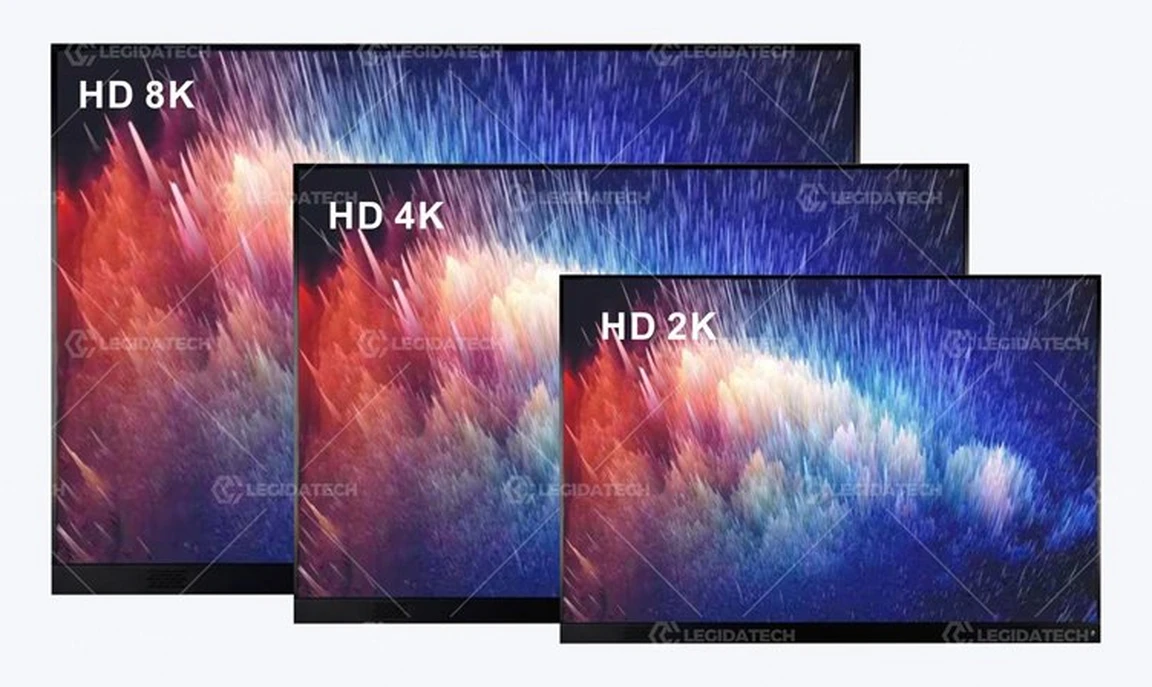
An all-in-one LED conference display is a fixed-frame LED wall with everything integrated: the controller, an operating system, wireless casting from laptops and phones, and optional camera and microphones — one device that hangs on the wall or rolls on a cart. It is the packaging that turned LED walls from a custom-installation project into an appliance, and it is the single biggest reason the market is shifting: LED Screen Trends 2026 (JLED) lists all-in-one LED dominating meeting rooms and replacing projectors and large LCDs as a headline trend, and enterprise AV guidance now treats 4K LED as the standard for larger rooms (Neat, 2026).
The two videos above show our P2.5 all-in-one units on the test bench — including the GOB-coated version that adds a protective layer for high-traffic rooms. Compared with a projector stack, the all-in-one removes the whole checklist of separate purchases: screen, mount, cabling, processor, casting dongle, soundbar. Our all-in-one LED display line covers the mainstream sizes, and the deeper background is in our guides to all-in-one conference machine basics and interactive all-in-one panels.
Which Rooms Should Stick with a Projector?
Fairness cuts both ways — projection still wins in four situations:
- Budgets under roughly $5,000. A lamp projector plus screen remains the cheapest way to a big image, and the image quality penalty in a dark room is modest.
- Dark, controlled rooms with light usage. A windowless training room used a few hours a week never triggers the TCO flip.
- Portable and temporary setups. A projector travels; an LED wall is installed. Rental fleets aside, projection owns the “present anywhere” niche.
- Truly huge images at long throw. Auditorium projection above 300 inches remains far cheaper than an LED wall at that scale — though at that size, the audience-distance argument moves back toward LED for brightness.
Vertical rooms change the math again: houses of worship, for example, run brighter stages and larger rooms, which is why our church-specific comparison lands harder in LED’s favor than this general office guide does.
How Do You Choose an All-in-One LED Display for Your Meeting Room?
If the comparison lands on LED, size the panel by the room, not the brochure:
- Pixel pitch by viewing distance. P1.2–P1.5 serves desks 3–6 meters out in huddle rooms; P1.5–P1.8 covers standard conference rooms to 8 meters; P2.5 suits larger rooms and lobbies beyond 10 meters. Our EDI small-spacing series and small pixel pitch indoor screens span these pitches, and the 4K ESL video wall series covers 4K-native rooms.
- Size by the wall, not the eye. 135–165 inches is the mainstream meeting-room range; measure the wall and keep 30+ cm clearance on each side.
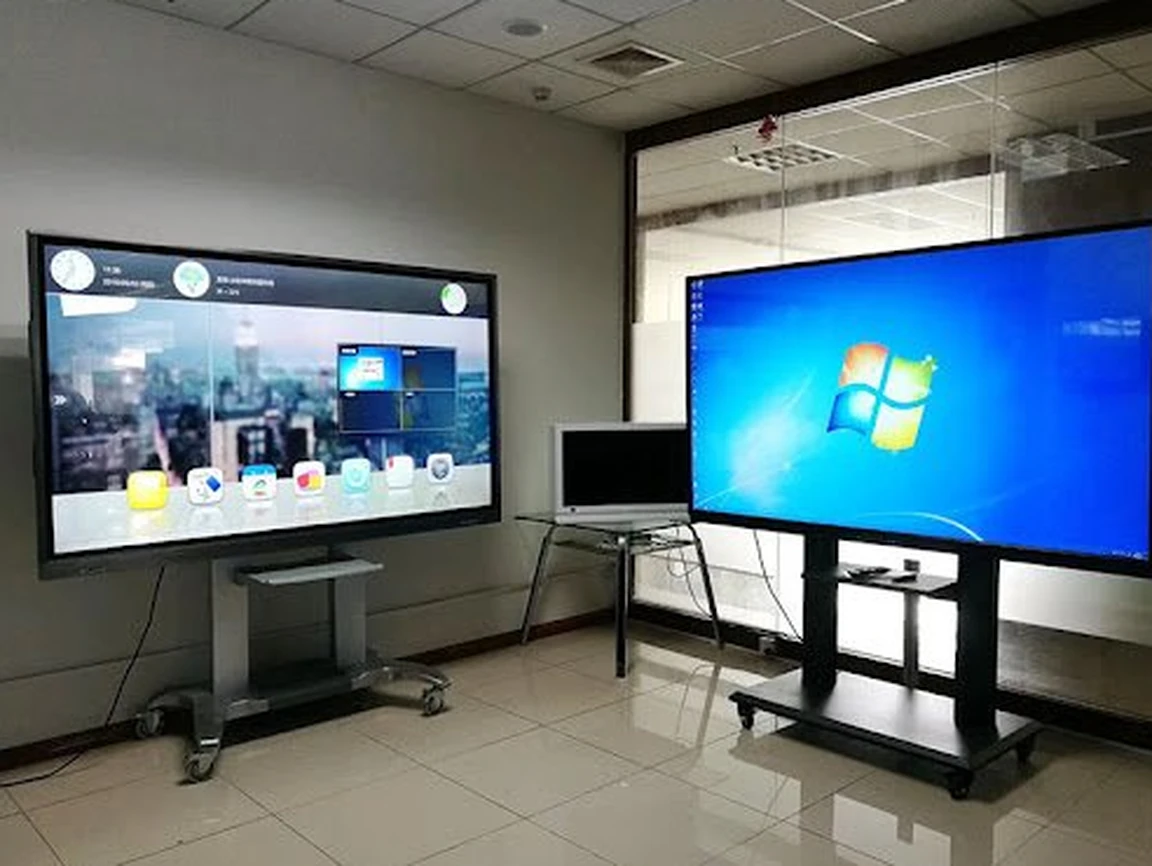
- Mounting. Wall-mounted suits fixed rooms; a mobile cart (as in the first photo) suits shared rooms and multi-building fleets. Slim builds like the EPROUND series keep the cabinet depth shallow for corridors and tight walls.
- Features that earn their cost. Wireless casting for at least 4 simultaneous laptops, 4K input handling, and — for hybrid rooms — a built-in or add-on camera/mic array. Controller matching matters for refresh and color; our 2026 controller buying guide covers the pairing.
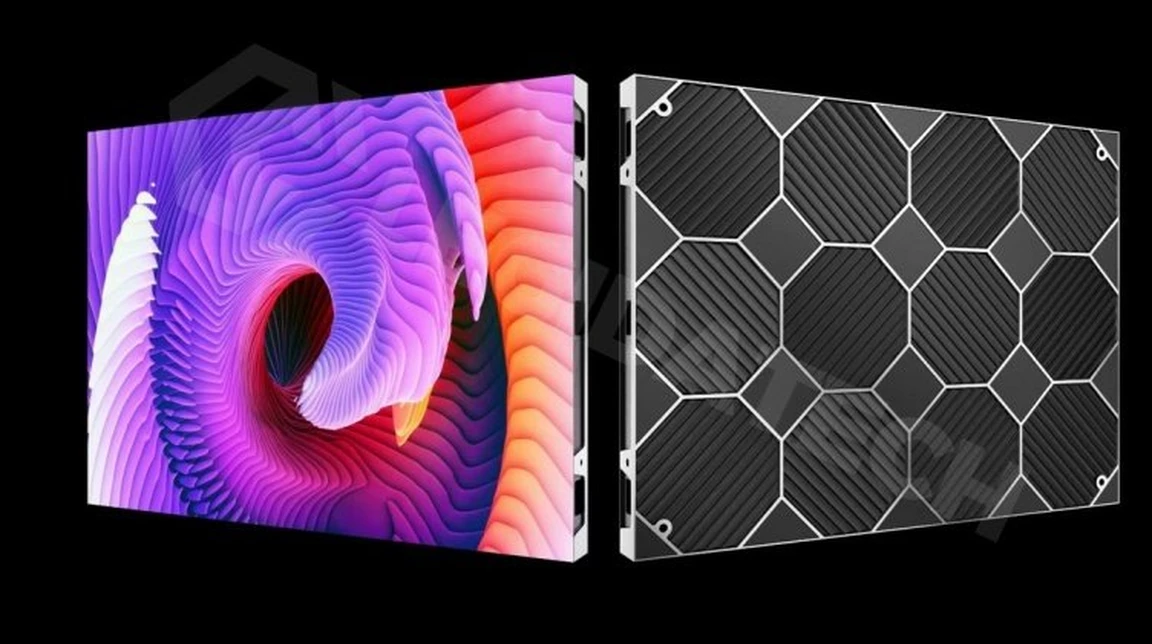
Real deployments make the checklist concrete: our P2.5 conference all-in-one installation in the Philippines walks through a full delivery from specification to commissioning. For sizing and budgeting on the wider indoor range, the LED screen price guide keeps every per-square-meter band current, and our team can quote your room directly from its dimensions and a photo.
LED Wall vs Projector for Business: Frequently Asked Questions
Is an LED wall better than a projector for business meeting rooms?
For rooms with daylight, 100-inch-plus screens or 3+ hours of daily use — yes, decisively. LED holds brightness and contrast with the lights on, needs no consumables, and all-in-one models integrate casting and conferencing. Projectors win mainly on upfront price in dark, lightly used rooms.
How much does an LED wall cost compared to a projector?
Upfront at the 100-inch class: $8,000–$18,000 installed for a P2.x LED wall versus $8,000–$15,000 for an equivalent laser projector, screen and installation. Over ten years the LED wall’s $12,000 total beats lamp-based projection’s $8,900 once lamps ($200–$600/year) and screen replacements are counted; the crossover lands around year 6.
What is an all-in-one LED conference display?
A fixed-frame LED wall with the controller, operating system, wireless casting and (optionally) camera and microphones integrated into one cabinet. It hangs on a wall or rolls on a cart and works as an appliance — the 2026 mainstream replacement for projectors and large LCD panels in meeting rooms.
How long does an LED wall last compared to a projector?
LED pixels reach about 100,000 hours to half-brightness with no lamps or filters to replace; laser projectors are rated around 20,000 hours, and lamp models far less. In a room used 6 hours a day, that is decades versus a few years of light-source life.
Can LED walls be used in bright rooms with windows?
Yes — this is their core advantage over projection. Self-emitting pixels at 500–800 nits hold contrast and color in full daylight; a projector’s reflected image needs a darkened room to look its best.
When does a projector still make sense in 2026?
Budgets under about $5,000, dark rooms used only a few hours a week, portable present-anywhere needs, and auditorium-scale images above 300 inches — in those cases projection remains the rational pick.
Conclusion: Pick by Room, Not by Habit
The LED wall vs projector decision in 2026 is a room-profile exercise: light, size, usage hours and collaboration needs decide the winner long before the invoice does. Bright, busy, 100-inch-plus meeting rooms belong to LED — increasingly in the all-in-one form that turns the whole stack into one cabinet — while dark, occasional, budget rooms keep projection rational. Score your room against the four factors, run the 10-year math, and the hardware choice makes itself.