Indoor vs Outdoor Rental LED Displays: What’s the Real Difference?
Core Technology Differences: A Side-by-Side Comparison
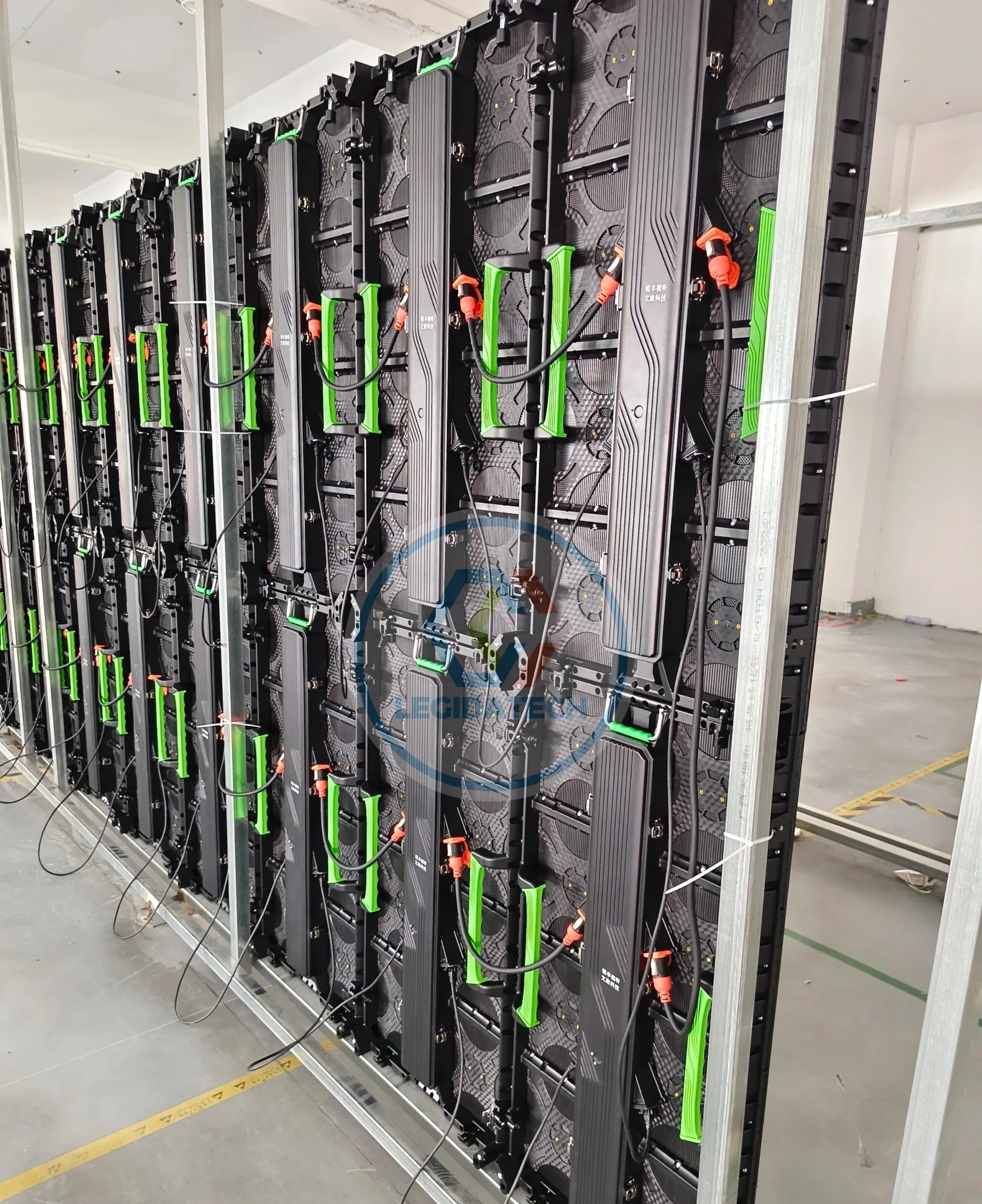
The engineering behind indoor vs outdoor LED screens diverges at the component level. Here’s what matters in the real world:
| Feature | Indoor LED Display | Outdoor LED Display | Why It Matters |
|---|---|---|---|
| Brightness (Nits) | 800 – 2,000 nits | 5,000 – 10,000+ nits | Outdoor sunlight can reach 100,000 lux — without 5,000+ nits, your content washes out completely |
| IP Rating | IP20 – IP40 | IP65 (front) minimum | IP65 = fully dust-tight + protected against water jets. Indoor panels exposed to rain fail within minutes |
| Pixel Pitch | P0.9 – P2.5 | P3.9 – P10 | Smaller pitch = sharper image up close. Outdoor screens are viewed from 5-50m away, so larger pixels work fine |
| Cabinet Weight | 7 – 10 kg/panel | 12 – 20 kg/panel | Affects rigging requirements, transport cost, and setup labor |
| Power Consumption | ~200 – 400 W/m2 (avg) | ~400 – 800 W/m2 (avg) | Outdoor screens draw 2x more power — budget for generators at outdoor venues |
| Cooling System | Passive or low-RPM fans | Active cooling (fans/AC) | Outdoor heat + sun exposure requires thermal management or LED lifespan drops sharply |
| Service Access | Front or rear | Front + rear preferred | Outdoor rigging makes rear access difficult — front-serviceable modules save hours of labor |
Where Will Your Screen Live? Matching Display to Environment
Indoor Environments — Controlled but Demanding
- Corporate Events & AGMs: Close viewing (2-10m) demands P1.5-P2.5 pitch. Flicker-free refresh rates are critical for camera feeds and livestreams.
- Trade Show Booths: Bright exhibition hall lighting means you need at least 1,200 nits. Slim cabinets save precious booth space.
- Retail & Lobbies: 24/7 operation requires reliable thermal design. Fan noise must be near-silent.
- Broadcast Studios: High refresh rate (3840Hz+) and color calibration are non-negotiable — cameras pick up flicker and color banding instantly.
- Museums & Galleries: Ultra-fine pitch (P0.9-P1.5) for immersive, artifact-quality visuals.
Outdoor Environments — Battle-Tested Engineering
- Concerts & Music Festivals: P4-P6 pitch at 5,000+ nits. Large audience distances (20-100m) mean pixel pitch matters less than raw brightness and structural integrity.
- Sporting Events: Fast-motion content demands high refresh + high brightness. IP65 front rating is minimum — rain during a match is common.
- Outdoor Advertising (DOOH): Corrosion-resistant coatings matter in coastal cities. UV-stabilized LEDs prevent yellowing over years of sun exposure.
- Public Information Boards: 24/7 reliability, vandal resistance (IK rating), and remote monitoring capability.
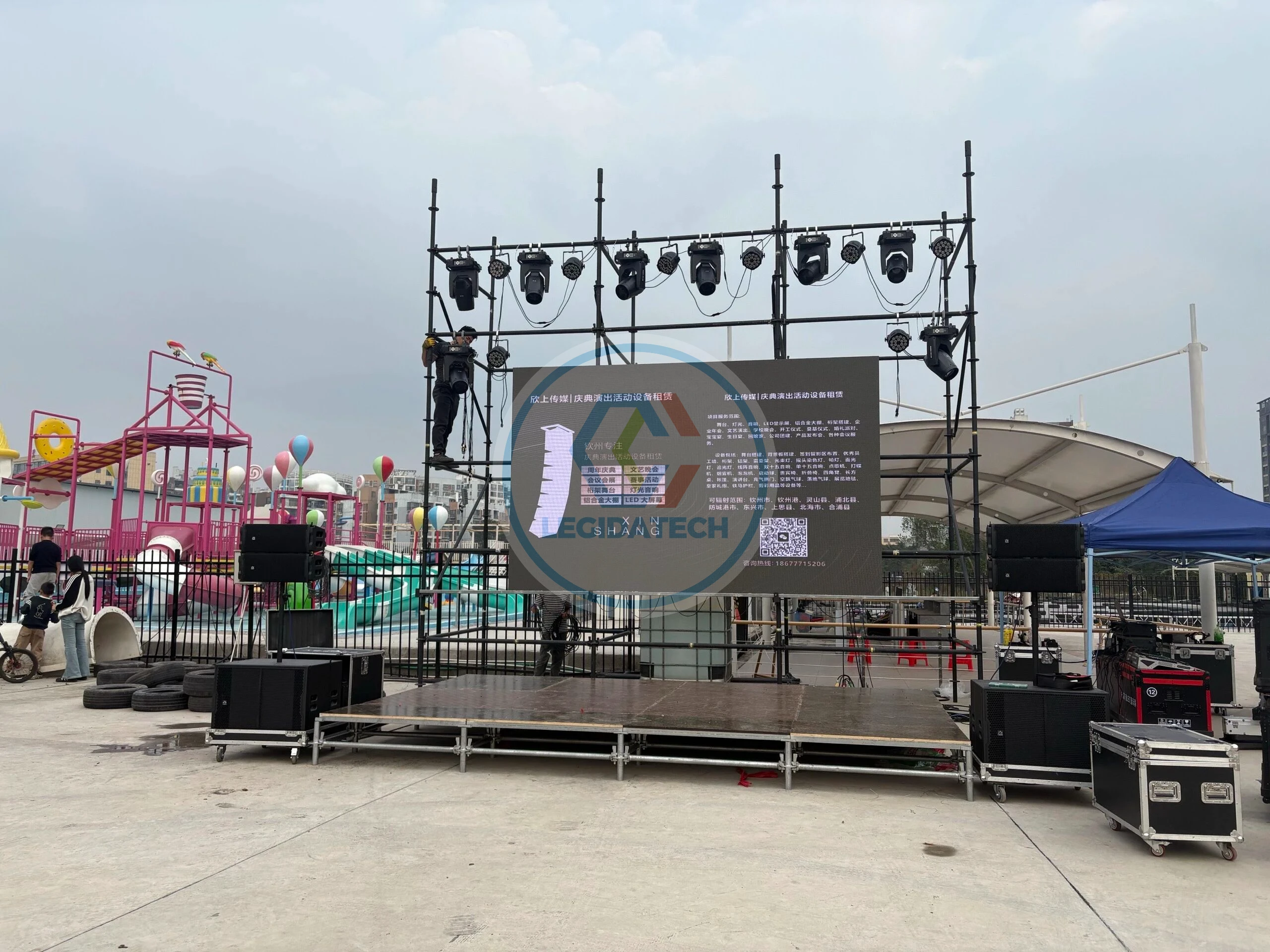
- Temporary Outdoor Events: Rental-specific designs with quick-lock rigging, touring frames, and flight cases make multi-city tours feasible.
What Are Indoor LED Screens — and When Do They Excel?
Indoor LED screens are precision display instruments. Unlike outdoor panels built to survive the elements, indoor LED displays are engineered around a single goal: delivering flawless image quality at close range.
Image Quality Deep Dive: Pixel Pitch, Resolution & Refresh Rate
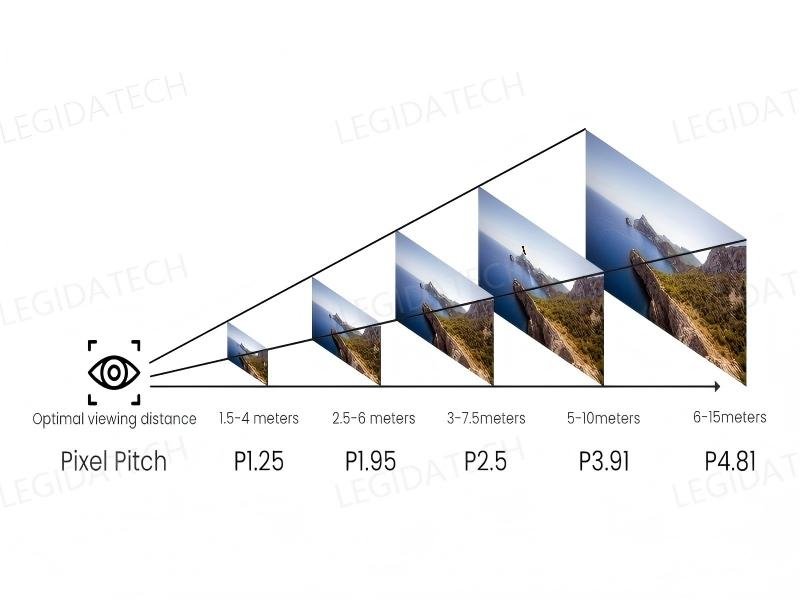
Pixel pitch is the single most important spec for indoor LED screens. Measured in millimeters between LED centers — P1.5 means 1.5mm between pixels.
Example: P1.9 screen = best viewed from 2.8m to 3.8m away. Any closer, and individual pixels become visible.
Three other specs matter equally:
- Refresh Rate (Hz): 1920Hz minimum for live events; 3840Hz for broadcast. Low refresh = visible flicker on cameras and smartphones recording your event.
- Grayscale & Color Depth: 14-16 bit processing delivers smooth gradients. Cheap 12-bit controllers create visible banding in skies and skin tones.
- Module Calibration: Factory-calibrated modules ensure panel-to-panel uniformity. After a module swap, uncalibrated replacements create obvious patchwork on the wall.
Indoor Event Applications — Beyond the Ballroom
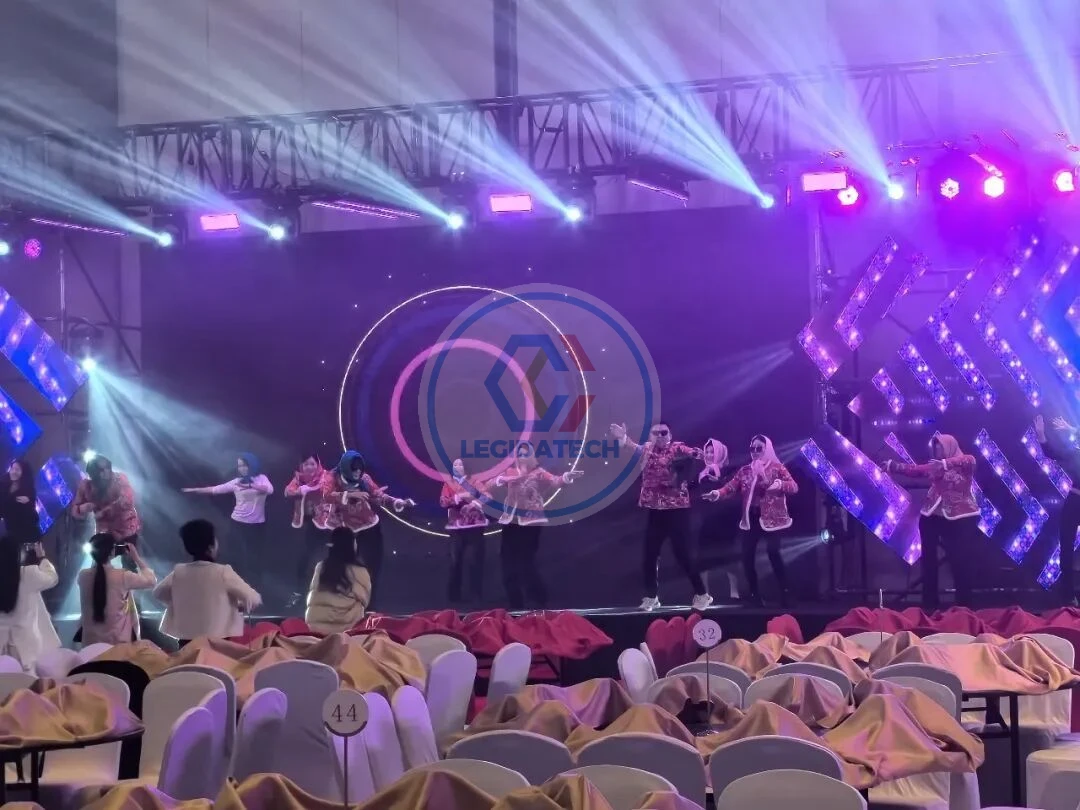
- Immersive Brand Activations: Curved and shaped LED walls (flexible modules) wrap around audience areas for 360-degree brand experiences.
- Hybrid Events: Combined in-person + virtual audiences need camera-friendly screens — high refresh + anti-moire processing are essential.
- House of Worship: LED walls replace projectors for lyrics, scripture, and IMAG (Image Magnification), solving ambient light washout.
- Esports & Gaming: Ultra-low latency processing + high refresh for real-time gameplay display without lag or tearing.
What Are Outdoor LED Screens — Engineering for the Elements
Outdoor LED screens are fundamentally different machines. The engineering challenge isn’t just “make it brighter” — it’s keep it working reliably through rain, dust, heat, cold, UV radiation, and physical stress, all while staying visible in direct sunlight.
IP Rating Explained: What IP65 Actually Means
IP ratings follow the IEC 60529 standard:
- IP65: Dust-tight (6) + protected against water jets from any direction (5). This is the minimum for outdoor LED displays.
- IP66: Protected against powerful water jets. Recommended for coastal installations or areas with heavy wind-driven rain.
- Front vs. Rear Rating: Many panels are IP65 front but only IP54 rear. If the rear faces open air or splashing, full IP65 both sides is safer.
Thermal Management: The Hidden Reliability Factor
When an outdoor LED screen runs at 5,000+ nits under direct summer sun, internal temperatures can spike to 70 degrees Celsius or higher. Without proper cooling:
- LED brightness degrades 2-3x faster (a 100,000-hour LED becomes 30,000-hour under sustained heat)
- Color shift occurs — red LEDs degrade faster than blue/green at high temperatures, causing visible yellowing
- Power supply capacitors fail prematurely, leading to module power loss
Premium outdoor rental displays use aluminum cabinets with integrated heatsinks + active fan cooling. Budget options skip thermal management — the cost savings disappear after the first summer season.
Installation Reality for Outdoor Events
Outdoor LED screen installation is more complex than indoor. Key considerations:
- Structural Engineering: A 5m x 3m outdoor wall can weigh 400-600 kg. Ground stacking needs rated base plates; hanging requires certified truss + motors.
- Power Infrastructure: Outdoor LED walls at full brightness can draw 20-40 kW for larger setups. Venue power isn’t always sufficient — generators need to be sized correctly with headroom.
- Wind Loading: A solid LED wall acts like a sail. Wind ratings must be checked against local conditions — temporary structures fail more often from wind than any other cause.
- Weather Contingency: Even with IP65, sudden thunderstorms require covered storage for spare modules, cables, and processors on-site.
Cost Comparison: Indoor vs Outdoor LED Display Rentals
Budget is always part of the equation. Here’s what drives the price difference:
| Cost Factor | Indoor Rental LED | Outdoor Rental LED | Impact |
|---|---|---|---|
| Rental Rate (per m2/day) | $80 – $200 | $150 – $400 | Outdoor is 1.5-2x more expensive per square meter |
| Transportation | Standard truck; lighter cabinets | Larger truck; heavier flight cases | Outdoor adds 30-50% logistics cost |
| Setup Labor | 2-3 techs, 4-6 hours | 4-6 techs, 8-12 hours | Outdoor requires more crew + more time |
| Power | Venue power usually sufficient | Generator rental often required | Generator adds $500-$2,000/day |
| Rigging/Structure | Standard ground support | Heavy-duty truss or ground support | Outdoor rigging 2-3x indoor cost |
| Insurance | Standard event coverage | Weather damage rider recommended | Outdoor premiums approximately 25% higher |
Quick Decision Checklist: Indoor or Outdoor?
Run through these 7 questions to confirm your choice in under 2 minutes:
- Is the screen under a roof with zero chance of rain? Yes = Indoor | No = Outdoor
- Will direct sunlight hit the screen during event hours? Yes = Outdoor (5,000+ nits) | No = Indoor may work
- Is your closest viewer within 3 meters? Indoor required (P1.9 or finer) | Outdoor OK if 5m+ away
- Does your content include detailed text, spreadsheets, or UI? Indoor strongly preferred (high resolution)
- Is the screen facing a coastal or high-humidity environment? Outdoor with anti-corrosion treatment
- Do you have reliable access to 3-phase power on-site? Yes = Good | No = Budget for generator rental
- Is setup time limited to under 4 hours? Indoor is faster to deploy; outdoor needs more time for rigging + weatherproofing
How to Choose the Right LED Screen for Your Event
We’ve covered the technical differences. Now let’s put it all together into a practical selection framework:
Step 1: Define the Environment First
Indoors or outdoors? This single question eliminates half the options. Never compromise on this — an indoor panel used outside will fail, and an outdoor panel used inside will overwhelm the audience.
Step 2: Map Viewing Distance to Pixel Pitch
Use our quick formula: Pixel pitch (mm) x 1.5 = minimum comfortable viewing distance in meters. For a P3.9 outdoor screen, the closest viewer should be approximately 5.8m away. For a P1.5 indoor screen, viewers can stand as close as 2.2m.
Step 3: Budget for the Total, Not Just the Screen
The per-square-meter rental rate is only about 60% of the total cost. Factor in transport, rigging, power, crew, and contingency. Outdoor events: add 15-20% buffer for weather-related changes.
Step 4: Vet Your Supplier
A reliable rental LED display partner does more than deliver hardware. They should provide:
- On-site technical support during setup and the event
- Spare modules and backup processors (minimum 5% spares)
- Pre-event calibration and test run
- Clear documentation on power and rigging requirements
For more in-depth selection guidance, see our Rental LED Display Detail Guide and LED Screen Cabinet Selection Guide.
Frequently Asked Questions
Can I use indoor rental LED panels outdoors temporarily?
No — this is one of the most expensive mistakes in the industry. Indoor panels lack the brightness (visibility fails in sunlight), weather sealing (even morning dew causes corrosion), and thermal management (direct sun overheats components within minutes). Even “just for an hour” can cause permanent damage. Always use outdoor-rated panels for any outdoor application.
What’s the price difference between renting indoor and outdoor LED displays?
Outdoor rental LED displays typically cost 1.5x to 2.5x more than equivalent-size indoor panels. The premium reflects weatherproof components, higher-brightness LEDs, heavier-duty cabinets, and more complex installation requirements. For a detailed breakdown, see our Rental LED Screen Price Guide.
What pixel pitch should I choose for my event?
This depends entirely on viewing distance, not indoor/outdoor labels:
- P0.9 – P1.5: Close viewing (1-3m). Ideal for retail, lobbies, broadcast.
- P1.9 – P2.5: Medium range (3-8m). Conference rooms, trade show booths, houses of worship.
- P3.9 – P5: Distance viewing (8-30m). Concerts, outdoor festivals, sports.
- P6 – P10: Long distance (20m+). Large outdoor advertising, stadiums.
Learn more in our Pixel Pitch & Viewing Distance Guide.
How long does it take to set up a rental LED display?
Indoor rental LED walls (3m x 2m): approximately 2-4 hours with a team of 2-3 technicians. Outdoor walls of the same size: approximately 6-10 hours with 4-6 techs, including rigging, weatherproofing, and power setup. These times scale with screen size — always confirm setup windows with your rental provider.
What maintenance do rental LED displays need between events?
Indoor panels: basic dusting, connector inspection, and calibration check (about 15 min per panel). Outdoor panels: gasket inspection, corrosion check on connectors, anti-rust treatment on cabinets, cooling fan cleaning, and full calibration verification (about 30 min per panel). Well-maintained rental panels last 5-8 years; neglected ones show visible degradation in 2-3 years. For a rental operator, that lifespan doubles as the depreciation schedule, and our LED screen rental business startup guide shows how to price it into day rates.
How do I know if a rental LED supplier is reliable?
Look for: (1) Verified case studies with photos from real events, not stock images. (2) Minimum 5% spare modules included in the quote. (3) On-site technical support during your event. (4) Clear SLA for fault response. (5) Panel certification (CE, FCC, RoHS). See our Top 10 Rental LED Manufacturers (2026) for a vetted list.
Conclusion: Making the Right Choice
Choosing between indoor and outdoor rental LED displays isn’t complicated once you focus on what matters: where the screen lives, how close your audience stands, and what conditions it needs to survive.
Indoor LED displays deliver stunning close-range image quality — perfect for corporate events, trade shows, and broadcast environments where every pixel counts. Outdoor LED displays are built for battle — high brightness, weatherproof construction, and thermal engineering that keeps them running through sun, rain, and everything in between.
The best choice is the one backed by a supplier who understands your event’s specific demands. Whether you need fine-pitch indoor panels for a product launch or high-brightness outdoor screens for a music festival, rental LED display technology has matured to the point where reliability is the norm — if you choose the right type for the right environment.
Ready to discuss your event? Contact our team for a customized rental LED display solution — with detailed specs, transparent pricing, and on-site support worldwide.
Recommended Reading
Main Page: Rental LED Display — Complete Product Range
Sibling Pages
- Rental LED vs Fixed LED Display: Which Is Right for You?
- How to Choose the Right LED Screen Cabinet for Events
- About Stage Rental P3.9 LED Display
- Rental LED Screen Price Guide (2026)
- Stage LED Screen Quick Guide
- LED Screen Flight Case Package Quick Guide