If NovaStar is the market leader in LED display control systems, Colorlight is the fast-moving innovator that keeps the industry interesting. Founded in 2012 and headquartered in Shenzhen, Colorlight Cloud Tech Ltd. has rapidly evolved from a niche player into the #2 brand in the global LED control system market — and in some categories like creative displays, XR virtual production, and calibration technology, it’s giving NovaStar a serious run for its money.
Backed by a team that includes alumni from STMicroelectronics, Orange, and Huawei, Colorlight’s core strength lies in its video processing algorithms and FPGA-based hardware design. In 2025–2026, the company expanded aggressively: a global network now spans 20+ countries across the Americas, Europe, and Asia, and a new full-stack AI ecosystem — covering computing power, chips, applications, and hardware — is under active development in partnership with top-tier AI scientists and universities.
This guide covers everything you need to know about the Colorlight control system in 2026: its product architecture, key technologies, software ecosystem, how it compares to NovaStar, and how to choose the right Colorlight hardware for your LED display project.
What Is a Colorlight LED Control System?
A Colorlight LED control system is an integrated hardware-and-software solution that converts video signals from your source (PC, camera, media player) into the precise digital data stream that drives every pixel on an LED display. The system is composed of five interconnected product layers:
| Layer | What It Does | Key Colorlight Products (2026) |
|---|---|---|
| 1. Video Processing | Receives, scales, and switches between multiple video inputs; applies color correction and HDR processing | X Series (X20, X16E, X12, X7, X6), Z Series (Z8t, Z6 PRO-G2, Z4F), Video Splicers (X100 PRO, D16/D9) |
| 2. Signal Transmission | Converts processed video into multi-port Gigabit Ethernet streams for distribution to cabinets | Sending Cards (S20, S20F, S6F, S4, S2) |
| 3. Signal Reception | Decodes Ethernet data at the cabinet level and drives individual LED modules via driver ICs | Receiving Cards: 5G Series, i10/i9+, i8/i5+, k10/k9+, k8/k5+, E320/E120/E80, 5A-75E/5A-75B |
| 4. Cloud & Media | Enables remote content management, scheduling, and monitoring; handles ultra-high-res playback | Colorlight Cloud Platform, C Series Cloud Players, Media Servers (CS16K, CS20-8K PRO, CS4K PRO) |
| 5. Software | Configuration, calibration, content editing, and playback control | LEDVISION, LEDUpgrade, ColorAdept, iSet, Kylin VICP, GrandShow, PlayerMaster, Assistant |
Colorlight Video Processors: The Core of the Ecosystem
Colorlight’s video processors are where the company truly differentiates itself. Unlike basic sending cards that simply forward video data, Colorlight processors perform real-time video scaling, color space conversion, HDR tone-mapping, and multi-layer compositing — all in FPGA hardware with sub-frame latency.
X Series: Professional All-in-One Processors
The X Series represents Colorlight’s flagship professional line, combining video processing + LED sending in a single chassis. Models range from the entry-level X2S/X4S to the powerful X20, with key features including:
- Multi-input support: HDMI 2.0, DP 1.4, 12G-SDI, and USB-C inputs across models
- Layer-based compositing: Picture-in-picture (PIP), fade effects, and seamless switching between sources
- TCP/IP + RS232 control: Integrates with third-party control systems (Crestron, AMX) for live event and broadcast environments
- 4K@60Hz processing: The X16E and X20 handle full 4K workflows with 4:4:4 chroma sampling
- Genlock support: Critical for multi-camera broadcast and XR virtual production stages
📖 Deep dive: Colorlight X Series Full Lineup 2026: Which LED Controller Is Right for Your Project?
Z Series: Super Processors for Creative & High-End Applications
The Z Series (Z8t, Z8i, Z6 PRO-G2, Z4F, Z5, Z4PRO, Z3) targets advanced use cases that demand multi-layer processing at extreme resolutions. Key capabilities:
- 3D display support: Frame-sequential 3D output for active-shutter stereo displays — widely used in cinema, museums, and immersive experiences
- Frame multiplexing: Outputs multiple independent camera feeds from a single video shoot, doubling the efficiency of virtual production and film-making
- Ultra-wide canvas: Some models support ultra-wide aspect ratios exceeding 7680 pixels horizontally for panoramic LED installations
Video Splicers: Ultra-High-Resolution Multi-Screen Control
For LED walls exceeding standard 4K/8K resolutions, Colorlight’s X100 PRO and D16/D9 video splicers combine the capabilities of a high-performance matrix switcher with integrated LED control. These units are used in control rooms, broadcast centers, and large-scale digital signage networks where dozens of input sources must be routed across massive display canvases.
LED Control System: Sending Cards, Receiving Cards & Software
Sending Cards (Transmitters)
Colorlight’s sending card lineup covers every scale of LED installation:
- S20 / S20F: Flagship senders with fiber-optic output options, supporting up to 2.6 million pixels. The S20F adds 5G transmission technology that increases per-cable loading capacity by 500% while reducing cabling by 80%.
- S6F: Mid-range sender with fiber output, ideal for medium-to-large fixed installations.
- S4: Compact sender for small-to-medium displays, a popular choice for indoor conference room LED walls.
- S2: Entry-level sender for simple single-cabinet or small signage applications.
Receiving Cards (Receivers)
Colorlight’s receiving card ecosystem is organized into performance tiers:
- 5G Series: Next-generation receivers leveraging Colorlight’s 5G transmission protocol. Supports 240Hz refresh rates and HDR metadata passthrough — critical for esports arenas and broadcast studios where camera flicker is unacceptable.
- i Series (i10, i9+, i8, i5+): High-performance receivers for professional rental and fixed installations. The i10 supports up to 512×512 pixels per card.
- k Series (k10, k9+, k8, k5+): Cost-optimized receivers for standard fixed installations and outdoor billboards.
- E Series (E320, E120, E80): Compact receivers designed for rental cabinets where space and weight are at a premium.
- 5A-75E / 5A-75B: Standard HUB75 interface receivers compatible with most generic LED modules on the market.
Control Software: LEDVISION & LEDUpgrade
The core software for configuring Colorlight control systems is LEDVISION — a Windows-based application that handles receiving card configuration (loading .RCFGX files), screen connection mapping, brightness calibration, and firmware management. Its companion tool, LEDUpgrade, is used for batch firmware updates across multiple receiving cards simultaneously — a major time-saver for large installations.
For integrators and technicians, LEDVISION’s intelligent settings wizard can auto-detect module parameters (scan mode, data polarity, driver IC type) by reading the module’s data signals — significantly reducing commissioning time compared to manual configuration.
Colorlight Cloud: Asynchronous Control & Remote Management
Colorlight’s asynchronous ecosystem is built around the Colorlight Cloud platform — a browser-based content management system (CMS) that lets operators remotely manage LED displays across multiple cities from a single dashboard.
The hardware backbone of this system is the C Series Cloud Player line (CPLAYER), which connects to the cloud via 4G, Wi-Fi, or Ethernet. Once deployed, you can:
- Push video, image, and text content to individual screens or groups
- Schedule playlists by time, date, and location
- Monitor screen health — temperature, voltage, signal status — in real time
- Receive automated alerts for fan failures, overheating, or signal loss
- Adjust brightness schedules based on ambient light conditions
For single-display scenarios that don’t require cloud connectivity, Colorlight also supports USB drive playback and direct PC connection via the PlayerMaster and Assistant desktop applications.
Media Servers & GrandShow: Powering the Ultra-High-Resolution Era
As LED display resolutions push beyond 8K into 16K territory, traditional PCs can no longer decode and play back video smoothly. Colorlight’s media server line — the CS16K, CS20-8K PRO, and CS4K PRO — are purpose-built hardware appliances designed to handle massive video files with hardware-accelerated decoding.
The secret weapon is GrandShow, Colorlight’s self-developed media server software that ships pre-installed on every CS-series device. GrandShow’s signature capabilities include:
- 16K native playback: Smooth, frame-accurate playback of 16K video files on a single device — no multi-PC sync required
- 3D projection mapping: Real-time warping and blending for projection onto irregular surfaces, buildings, and sculptural LED installations
- GrandShow Sync: Proprietary frame-level synchronization technology that keeps dozens of media servers locked to the same frame — essential for immersive domes, 360° LED stages, and large-scale architectural mapping
- NDI and ST 2110 support: Native integration with broadcast IP-video workflows for live production environments
Key Technologies That Define Colorlight’s Competitive Edge
5G+8K Transmission Technology (2026)
Colorlight’s most significant 2026 announcement is its 5G+8K LED display transmission solution. This technology increases the loading capacity per Ethernet cable by 500% compared to conventional Gigabit transmission, while reducing the total cabling required by 80%. For integrators, this means: fewer sending cards, simpler wiring, lower cabinet weight, and support for 240Hz refresh rates — a game-changer for fine-pitch LED walls in broadcast and esports environments.
Infi-bit Grayscale Processing
Colorlight’s proprietary Infi-bit algorithm delivers superior grayscale performance at low brightness levels — a common pain point for indoor LED displays. Where conventional controllers lose visible bit depth when dimmed below 30% brightness, Infi-bit maintains 16-bit grayscale fidelity even at 5% brightness, preserving shadow detail and preventing color banding in dark scenes. This is particularly valuable for broadcast studios, home cinema, and museum applications.
Scientific-Grade Calibration System
Colorlight has invested over 10 years of R&D into point-by-point calibration technology — the process of individually measuring and correcting the brightness and color of every single LED pixel on a display. Their calibration solution is particularly strong in:
- COB (Chip-on-Board) calibration: COB panels present unique calibration challenges due to their encapsulation layer. Colorlight’s scientific-grade solution compensates for the optical properties of the COB resin to achieve uniform output.
- Multi-batch uniformity: When a large LED wall spans cabinets manufactured in different production batches, Colorlight’s calibration can harmonize color and brightness across all units — eliminating the “patchwork” effect.
- HDR calibration: Supports calibration profiles for HDR10 and HLG workflows, ensuring accuracy across standard and high-dynamic-range content.
ST 2110 & IPMX: Broadcast-Grade IP Video
For broadcast and live production, Colorlight offers native SMPTE ST 2110 and IPMX (Internet Protocol Media Experience) support across select X Series processors and media servers. This enables direct integration with broadcast IP-video infrastructures — no external converters required — making Colorlight one of the few LED control brands with genuine broadcast-native capabilities.
Application Scenarios: Where Colorlight Excels
| Application | Recommended Colorlight Setup | Why Colorlight? |
|---|---|---|
| XR Virtual Production | Z8t processor + 5G receiving cards + CS20-8K PRO media server | Genlock, frame multiplexing, Infi-bit at low brightness, ST 2110 integration |
| Creative & 3D LED Displays | Z6 PRO-G2 + 5G Series receivers + GrandShow | 3D mapping, irregular cabinet support, multi-angle calibration |
| Broadcast Studios | X20 processor + 5G receivers + ST 2110 interface | Genlock, HDR, ST 2110 native, 240Hz refresh rate |
| Outdoor Billboards (Async) | C Series Cloud Player + k Series receivers | Cloud scheduling, auto-brightness, remote health monitoring via 4G |
| Conference Room LED Walls | X7 all-in-one + i5+ receivers | All-in-one simplicity, wireless screen sharing, USB-C input |
| Large-Scale Control Rooms | X100 PRO splicer + S20F senders + i10 receivers | Multi-source routing, ultra-high-res canvas, redundancy |
| Fine-Pitch COB (P0.9–P1.5) | S20F sender + 5G receivers + scientific calibration | COB calibration, Infi-bit, 5G cabling simplification |
Colorlight vs NovaStar: How to Choose
This is the question every integrator asks. The short answer: both are excellent, but they excel in different areas. Here’s a quick comparison:
| Dimension | Colorlight | NovaStar |
|---|---|---|
| Video Processing | ✅ FPGA-native, excellent multi-layer compositing | ✅ Strong, especially in COEX/VX series |
| Creative/3D Displays | ✅ Industry-leading (GrandShow, 3D mapping) | ⚠️ Capable but less specialized |
| Calibration Quality | ✅ Scientific-grade, COB-optimized | ✅ Pioneer, equally strong |
| Cloud Platform | ✅ Colorlight Cloud (maturing fast) | ✅ VNNOX (more mature, larger user base) |
| Broadcast (ST 2110) | ✅ Native ST 2110/IPMX support | ⚠️ Limited (relies on external converters) |
| 5G/8K Transmission | ✅ 5G+8K: 500% capacity increase, 80% less cabling | ⚠️ Traditional Gigabit architecture |
| Global Support Network | ⚠️ 20+ countries (expanding) | ✅ 37+ international branches |
| Market Share | ⚠️ #2 globally, growing fast | ✅ #1, dominant in rental & rental/touring |
| Price Point | ✅ Competitive — typically 10–20% below NovaStar | ⚠️ Premium pricing |
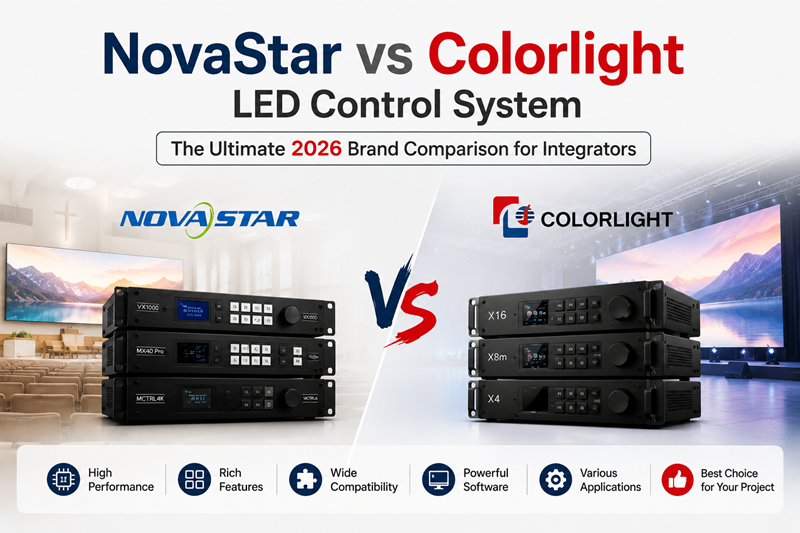
📖 Detailed brand comparison: NovaStar vs Colorlight LED Control System: The Ultimate 2026 Brand Comparison for Integrators
How to Choose the Right Colorlight Controller: A Decision Framework
- Determine your resolution: Calculate total pixels (Width × Height). This sets the minimum sending card requirement. For displays under 2.6 million pixels, an S4 or S6F is sufficient. Above that, consider the S20/S20F.
- Decide sync vs. async: Real-time video → synchronous (S series senders + processor). Scheduled content → asynchronous (C Series Cloud Player + Colorlight Cloud).
- Count your inputs: Multiple HDMI/SDI/DP sources? You need a video processor (X Series or Z Series), not just a sending card. The X7 is the sweet spot for most 3–4 input setups.
- Check for broadcast requirements: Genlock, ST 2110, or 240Hz refresh needed? Step up to the X16E/X20 or Z8t with 5G receivers.
- Consider creative complexity: 3D, projection mapping, irregular cabinets? Z Series + GrandShow is the recommended path.
- Match receivers to your cabinet type: Rental (lightweight) → E Series or 5A-75E/B. Fixed (reliable) → i Series or k Series. Future-proof (5G/8K ready) → 5G Series.
For a complete walkthrough of the X Series lineup, see our Colorlight X Series Full Lineup 2026 guide.
Frequently Asked Questions
What is the main difference between Colorlight and NovaStar?
NovaStar has the larger market share, more mature cloud platform (VNNOX), and deeper global support. Colorlight excels in video processing quality, creative/3D displays, calibration for COB panels, and 5G+8K transmission technology — often at a 10–20% lower price point. For a detailed comparison across 10 dimensions, read our full brand comparison.
Can I mix Colorlight sending cards with NovaStar receiving cards?
No. Each brand uses proprietary communication protocols. A Colorlight sending card only works with Colorlight receiving cards, and the same applies to the software. The entire signal chain must be from a single brand.
What software do I need to set up a Colorlight LED display?
For initial configuration and debugging, download LEDVISION (free) from the official Colorlight website. The admin password is “168”. For firmware updates, use LEDUpgrade. For ongoing cloud management of asynchronous displays, use the Colorlight Cloud web platform.
Is Colorlight suitable for rental and touring applications?
Yes — the E Series and 5A-75E/B receiving cards are specifically designed for rental cabinets with compact form factors. For the processor side, the X7 and X12 provide multi-input switching and PIP capabilities that touring AV companies need, while the 5G receivers reduce cabling complexity — a major advantage for fast setup and teardown.
What is Colorlight’s 5G+8K technology?
Announced in 2026, Colorlight’s 5G transmission protocol increases the pixel loading capacity of a single Ethernet cable by 500% compared to standard Gigabit Ethernet. This reduces cabling by 80% and supports 240Hz refresh rates — making it ideal for fine-pitch, high-refresh LED walls in broadcast and esports. It requires compatible 5G Series sending and receiving cards.
Where can I download Colorlight firmware and user manuals?
All official firmware, software (LEDVISION, LEDUpgrade, iSet, ColorAdept, GrandShow), driver files, and user manuals are available for free download from the Colorlight Download Center.
Conclusion: Colorlight Is the Smart Alternative — and Sometimes the Smarter Choice
Colorlight has evolved from an underdog into a genuine powerhouse. Its FPGA-native video processing, cutting-edge 5G+8K transmission, and scientific-grade calibration make it the best choice for creative displays, XR stages, COB fine-pitch walls, and broadcast environments — often at a more competitive price than NovaStar.
For simpler installations — outdoor billboards, conference rooms, standard fixed displays — Colorlight’s S Series senders and k Series receivers provide reliable, cost-effective solutions backed by the increasingly capable Colorlight Cloud platform.
As of 2026, choosing between Colorlight and NovaStar is no longer about “good vs. better” — it’s about matching the right tool to the right job. For many applications, Colorlight isn’t just the alternative. It’s the better answer.
Need help selecting the right Colorlight controller for your project? Contact our engineering team — we’ll specify the complete control system based on your display size, application, and budget, with factory-direct pricing.
Continue Reading: Colorlight & Control System Resources
- Colorlight X Series Full Lineup 2026: Which Controller Is Right for Your Project?
- NovaStar vs Colorlight LED Control System: The Ultimate 2026 Brand Comparison
- What Is NovaStar Control System? Complete Guide (2026)
- What Is Linsn Control System? Overview
- What Is Huidu Control System? Overview
- LED Video Wall Controller: Everything You Need to Know
- Synchronous vs Asynchronous LED Displays: What’s the Difference?
References: Colorlight official product documentation (en.colorlightinside.com), Colorlight 2026 product announcements, industry integrator feedback.