


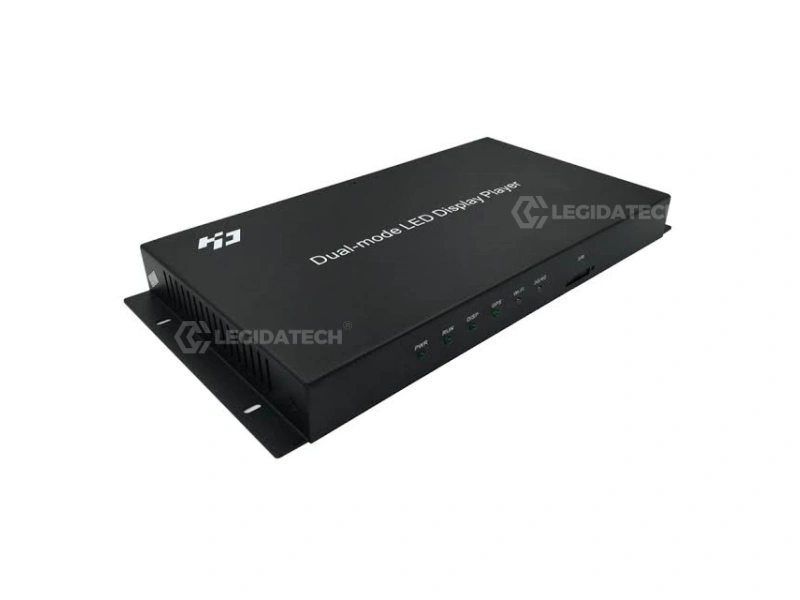
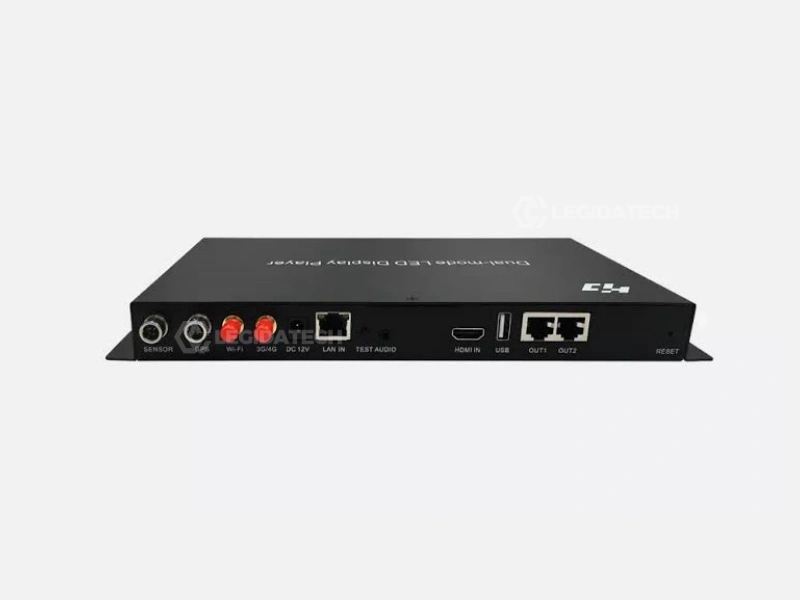
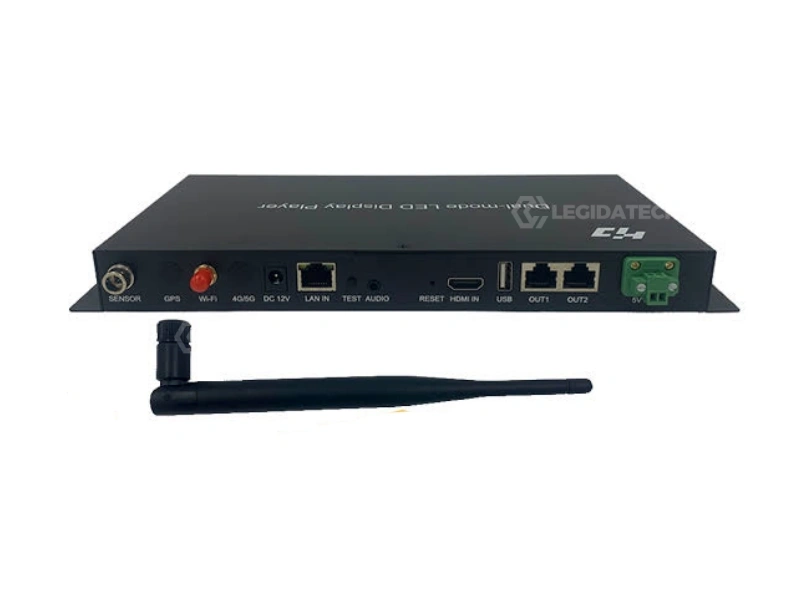
What Makes the HD-A5 Different? It Does Both.
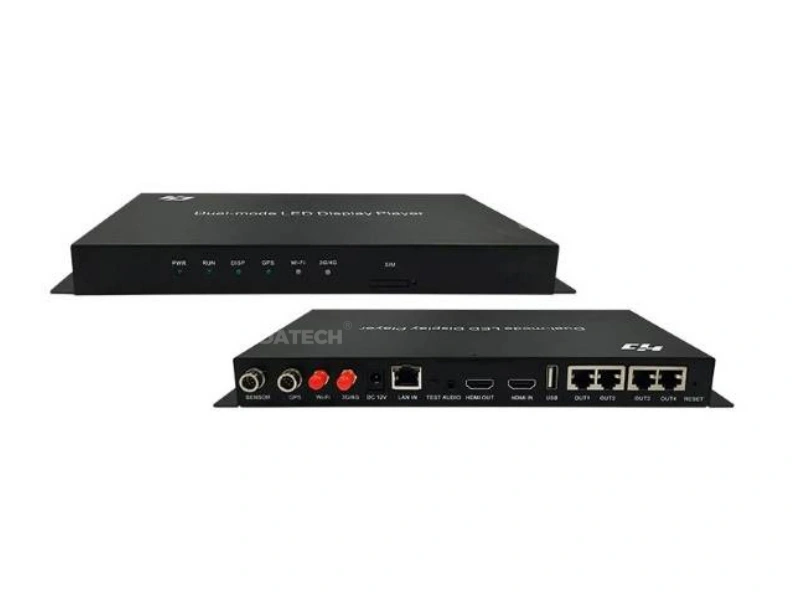
Most LED controllers force a choice: asynchronous (scheduled, offline playback from internal memory) OR synchronous (real-time mirroring from a connected PC or video source). Pick one. Buy the hardware. Live with the limitation.
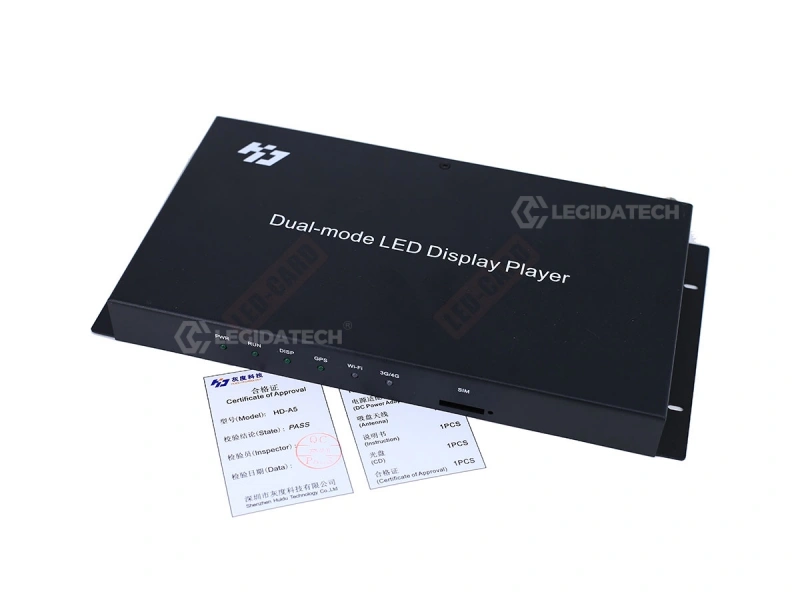
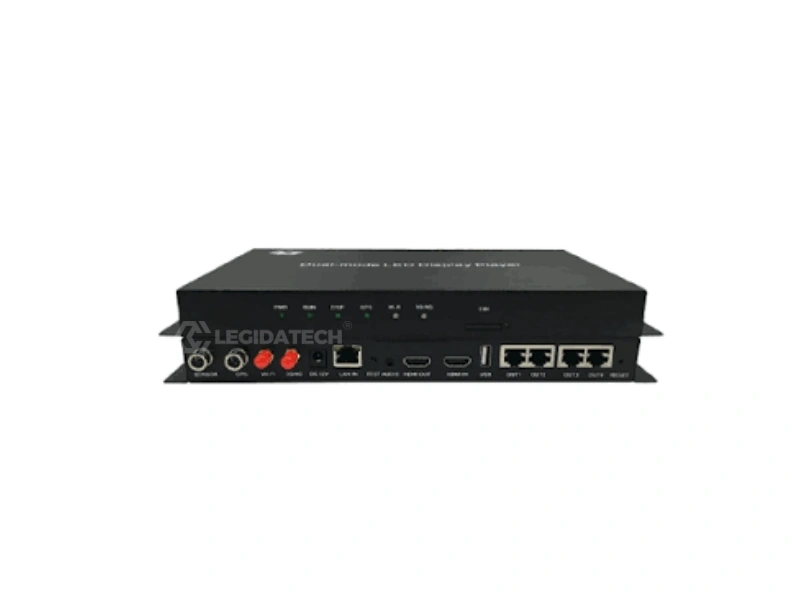
The Huidu HD-A5 dual-mode LED controller eliminates that choice. It integrates both control modes into a single 0.95 kg industrial enclosure — with automatic, no-reboot switching between them. Connect a laptop or camera via HDMI and the HD-A5 instantly becomes a real-time video processor with hardware auto-scaling. Disconnect the source and it seamlessly returns to scheduled offline playback from its 8GB internal memory. No manual intervention. No separate video scaler. No compromise.
With 1.3 million pixels of loading capacity — double the HD-A3 — and an extraordinary 16,384-pixel maximum width (4× wider than HD-A3), this controller is purpose-built for ultra-wide ribbon displays, perimeter boards, retail window signage, and any deployment where scheduled content and occasional live input must coexist. Supplied by LED screen manufacturer LEGIDATECH with full manufacturer warranty, pre-shipment HDMI verification, and 3-year technical support.
- 1,310,720 pixels — 2× the HD-A3 loading capacity
- Dual-mode: Async offline + HDMI live input in one unit
- HDMI auto-scaling saves $200-$800 on external video processors
- 16,384px max width — ideal for ultra-wide and ribbon displays
- 2× 1Gbps output ports for dual-zone or redundant configurations
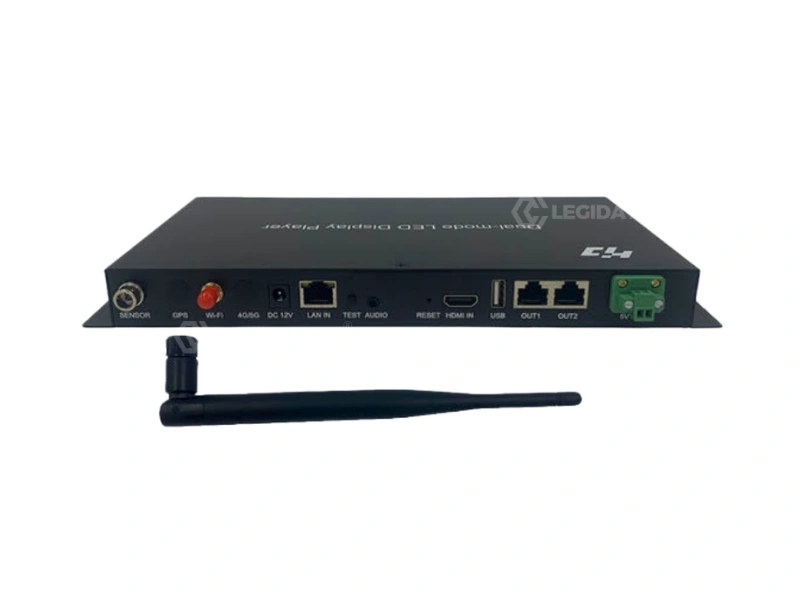
- Wi-Fi, 4G (optional), LAN, USB 2.0, GPS, Sensor — full connectivity
One Controller, Two Modes — Switch Instantly, Automatically
This is the HD-A5’s defining advantage. No other controller in Huidu’s mid-range offers seamless dual-mode operation. Here is how each mode works independently — and how they work together.
Mode 1 — Asynchronous (Offline)
Set it up. Upload your content. Walk away.
- Create multi-layer programs in HDPlayer — video, images, text, clocks, Office docs, sensor data
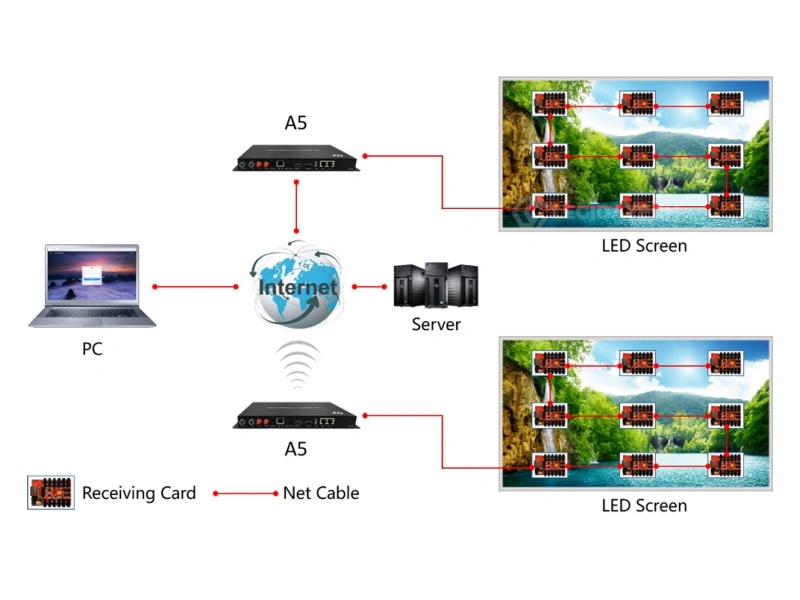
- Upload via Cloud, Wi-Fi, LAN, or USB to the 8GB internal flash memory
- Content plays 24/7 on schedule — the PC can be disconnected, powered off, or moved to another site
- Update content remotely from anywhere in the world via 4G or cloud platform
- Best for: Billboards, menu boards, price displays, information kiosks, scheduled announcements
Mode 2 — Synchronous (HDMI Live)
Plug in any HDMI source. The display mirrors it. Instantly.
- Connect any HDMI device — laptop, camera, set-top box, media player — to the HDMI IN port
- The HD-A5 auto-detects the input resolution and scales it to match your LED screen — zero configuration
- Displays the source in real time at 60Hz with hardware-level scaling latency under 1 frame
- No external video processor needed — the HD-A5 handles scaling internally
- Best for: Live events, camera feeds, presentations, TV broadcasts, interactive demos, emergency announcements
How switching works: The HD-A5 prioritizes HDMI input. When an active HDMI signal is detected → auto-switches to sync mode. When the cable is disconnected → instantly resumes async playback. No reboot. No menu. No HDPlayer intervention. The display stays live 100% of the time.
HD-A5 Technical Specifications
Complete parameters verified against Huidu Technology V2.0 specification. The HD-A5 sits between the HD-A3 (entry async) and HD-A6 (flagship dual-mode) — offering the same dual-mode architecture as the HD-A6 at a significantly more accessible B2B price point.
| Control & Display | |
|---|---|
| Maximum Pixels | 1,310,720 (1280 × 1024 typical) |
| Max Width / Height | 16,384 px / 2,048 px |
| Grayscale | 256 – 65,536 levels (software adjustable) |
| Frame Rate | 60 Hz (both async and sync modes) |
| Control Mode | Dual-Mode: Asynchronous + HDMI Synchronous |
| HDMI Input | 1 × HDMI — auto-detection, auto-scaling, up to 1920×1080@60Hz |
| Video Processor | Not required — built-in hardware scaler |
| Memory & Media | |
| Internal Storage | 8 GB flash + USB expansion |
| Video Formats | MP4, AVI, WMV, MKV, MOV, FLV, F4V, RMVB, 3GP, ASF, MPG, DAT, VOB, TRP, TS, WEBM |
| Other Media | Images (BMP/GIF/JPG/PNG), Office (DOC/DOCX/XLSX/PPT/PPTX), Text/HTML/RTF, Clocks |
| Connectivity | |
| Output Ports | 2 × 1000 Mbps RJ45 — dual-zone or redundant |
| Input Port | 1 × 100/1000 Mbps RJ45 (PC/network) |
| Wi-Fi / 4G / USB | Built-in 2.4GHz Wi-Fi + Optional 4G (SIM slot) + USB 2.0 |
| GPS / Sensor | GPS header + Sensor port (S108/S208 compatible) |
| Physical | |
| Weight / Power | 0.948 kg / 18W (12V DC, 5V backup) |
| Operating Range | -40°C to 80°C, 0-95% RH |
| Certifications | CCC, CE, FCC, RoHS, BIS |
HD-A5 vs. HD-A3 vs. HD-A6: Which Huidu Controller Fits Your Project?
All three are full-color controllers from Huidu Technology’s HD series. The right choice depends on your pixel count, whether you need HDMI live input, and your budget. This side-by-side comparison makes the decision clear.
| Feature | HD-A3 | HD-A5 | HD-A6 |
|---|---|---|---|
| Max Pixels | 655,360 | 1,310,720 | 2,300,000 |
| Control Mode | Async only | Async + HDMI Sync | Async + HDMI Sync |
| HDMI Input | None | 1× HDMI Auto-Scaling | 1× HDMI Auto-Scaling |
| Max Width | 4,096 px | 16,384 px | 16,384 px |
| Output Ports | 1 × 1Gbps | 2 × 1Gbps | 4 × 1Gbps |
| Memory | 8 GB | 8 GB | 16 GB |
| Working Temp | -40~80°C | -40~80°C | -20~60°C |
| Weight | 0.53 kg | 0.95 kg | 1.2 kg |
| Certifications | 5 (CCC/CE/FCC/RoHS/BIS) | 5 (CCC/CE/FCC/RoHS/BIS) | 3 (CE/FCC/RoHS) |
| Video Scaler | N/A | Built-in (saves $200-$800) | Built-in |
| Best For | Budget async-only | Versatile dual-mode — best value | Large-scale dual-mode |
Verdict: If you only need async, buy the HD-A3. If your project exceeds 1.3M pixels, buy the HD-A6. For everyone else — the HD-A5 delivers the dual-mode capability, HDMI auto-scaling, and ultra-wide support of the HD-A6 at a significantly lower unit cost. It is the value-maximizing choice for the majority of commercial LED display deployments.
Six Engineering Advantages That Set the HD-A5 Apart
Beyond the headline dual-mode capability, the HD-A5 incorporates several design decisions that reduce total cost of ownership and simplify field deployment compared to both cheaper async-only controllers and more expensive synchronous systems.
Hardware HDMI Auto-Scaling — Not Software Emulation
The HD-A5 uses a dedicated hardware scaling processor, not a CPU software implementation. The difference: sub-1-frame latency vs. 2-5 frames on software-scaled controllers. This makes the HD-A5 viable for live camera feeds, broadcast environments, and interactive applications where every frame counts. The scaler auto-detects source resolution up to 1920×1080@60Hz and maps it to your LED screen’s native pixel grid — regardless of aspect ratio mismatch.
16,384-Pixel Ultra-Wide Support — No Tiling Controllers Needed
Traditional controllers cap single-axis width at 2,048-4,096 pixels. The HD-A5’s 16,384-pixel width limit is 4× the industry average for this price band. For ribbon displays, LED perimeter boards, storefront tickers, and wide-format signage, this means one HD-A5 replaces 2-4 controllers that would otherwise need to be tiled together — reducing hardware cost, simplifying content management, and eliminating synchronization headaches.
Dual Independent Output Ports — Two Screens, One Controller
Each of the two 1Gbps output ports can drive a different LED display configuration — different resolution, different receiving card chain, different content. Use case 1: primary screen + secondary information ticker from one HD-A5. Use case 2: primary output + hot-standby backup for mission-critical installations where display downtime is unacceptable. No external splitter or second controller required.
Seamless Mode Switching — The Display Never Goes Dark
The HD-A5 monitors its HDMI input port continuously. When an active signal appears → instant switch to live sync mode. When the signal drops → instant fallback to scheduled async playback. No black screen gap. No manual intervention. No reboot. This automatic handoff is critical for public-facing displays where even 5 seconds of blank screen damages the viewer experience. Competitor dual-mode implementations often require manual software switching — a dealbreaker for unattended deployments.
8GB Unified Memory — Not Partitioned, Not Limited
Unlike controllers that partition storage into fixed-size segments for system, content, and cache, the HD-A5’s 8GB flash is a single unified pool. Use all 8GB for one long video loop, or distribute it across hundreds of scheduled programs. USB 2.0 expansion lets you supplement with external storage when content libraries exceed onboard capacity. This flexibility matters for deployments where content volume varies significantly across screens in the same fleet.
Die-Cast Aluminum Enclosure — Fanless, Heatsink Body, Zero Moving Parts
The HD-A5’s 0.948 kg enclosure is not just protective — it is the thermal management system. The die-cast aluminum body acts as a passive heatsink, conducting heat away from the processor and HDMI scaler chip across the entire surface area. No fan = no dust ingestion, no bearing wear, no single-point mechanical failure. This is the same thermal design principle used in the HD-A3, proven across thousands of outdoor deployments from -40°C Scandinavia to 50°C Middle East.
Where the HD-A5 Dual-Mode Architecture Shines
Six deployment scenarios where the combination of scheduled offline playback AND live HDMI input capability delivers measurable operational advantages over single-mode controllers.
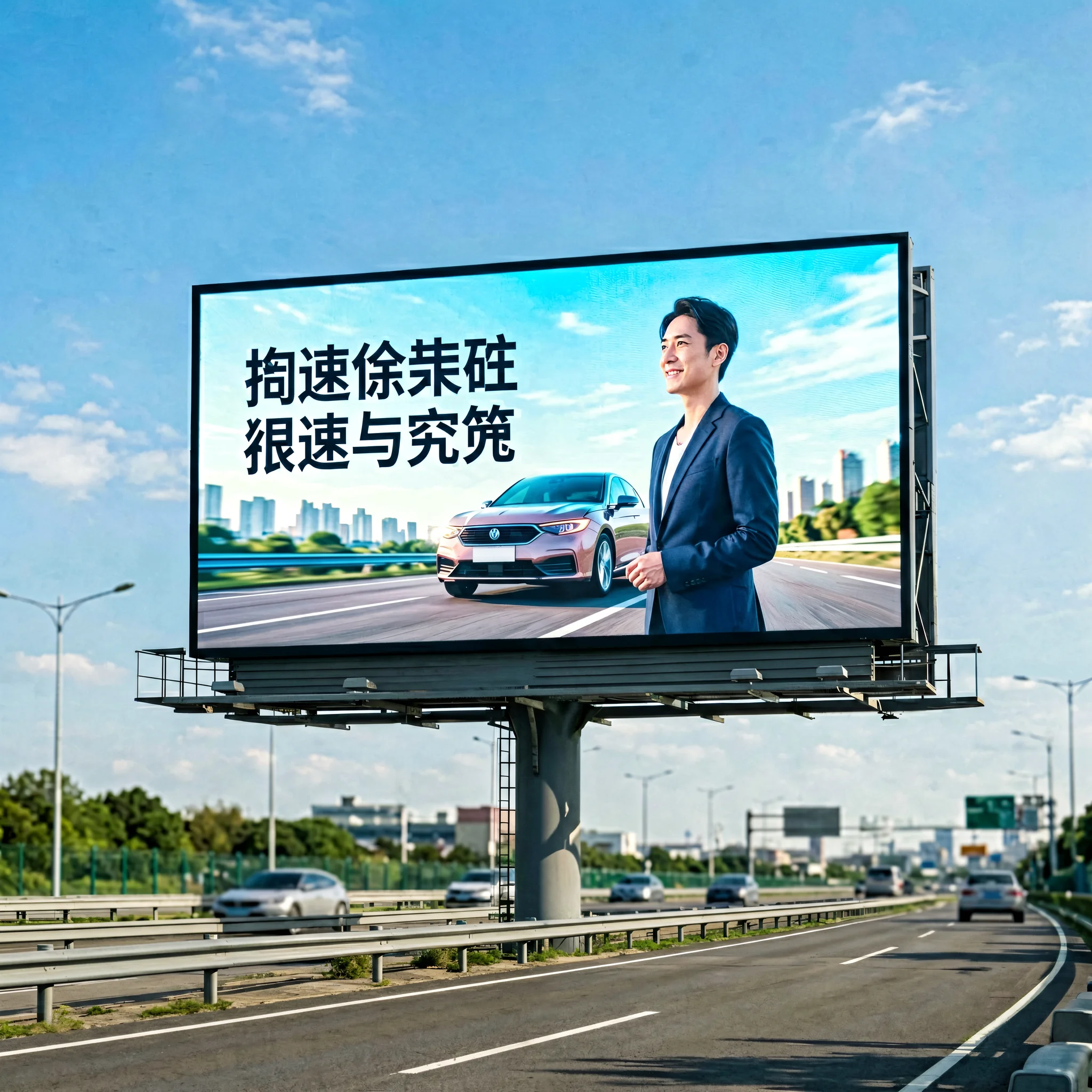
Outdoor Billboard Advertising
Run scheduled ad loops 24/7 in async mode via cloud management. When a major sports event or breaking news happens, switch to live HDMI broadcast feed — all from the same controller. The HD-A5 eliminates the need for a separate live-feed controller that sits idle 95% of the time.
Learn More →
Shopping Center & Retail Signage
Loop seasonal promotions offline during regular hours. Connect a laptop via HDMI for live product launches, fashion shows, or interactive customer events. Staff update routine content via mobile APP — no IT support needed.
Learn More →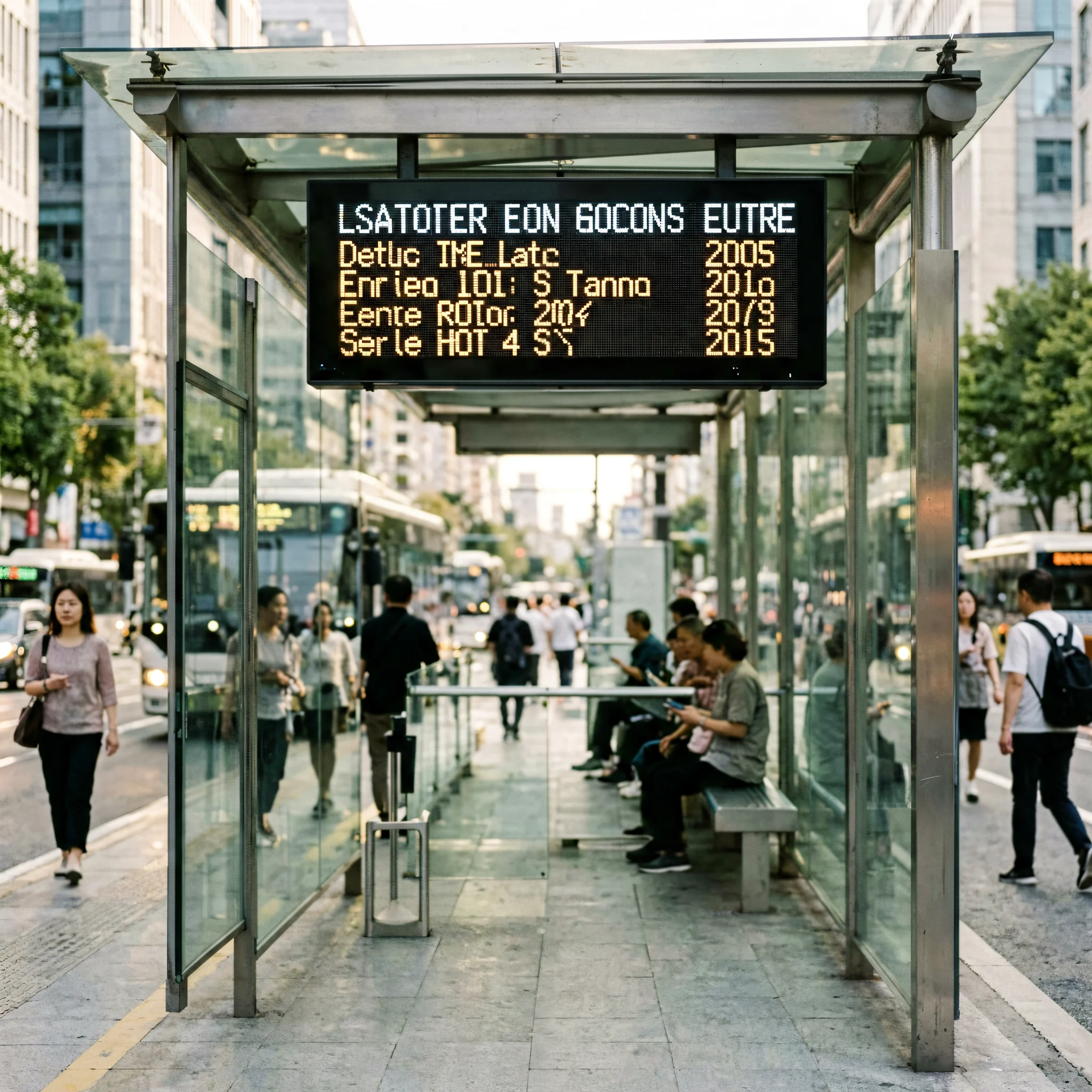
Airport & Transport Hubs
Display scheduled flight and train timetables in async mode. Operations center pushes live gate changes and emergency announcements via HDMI — the auto-scaling handles any source resolution from the control room system without configuration delay.
Learn More →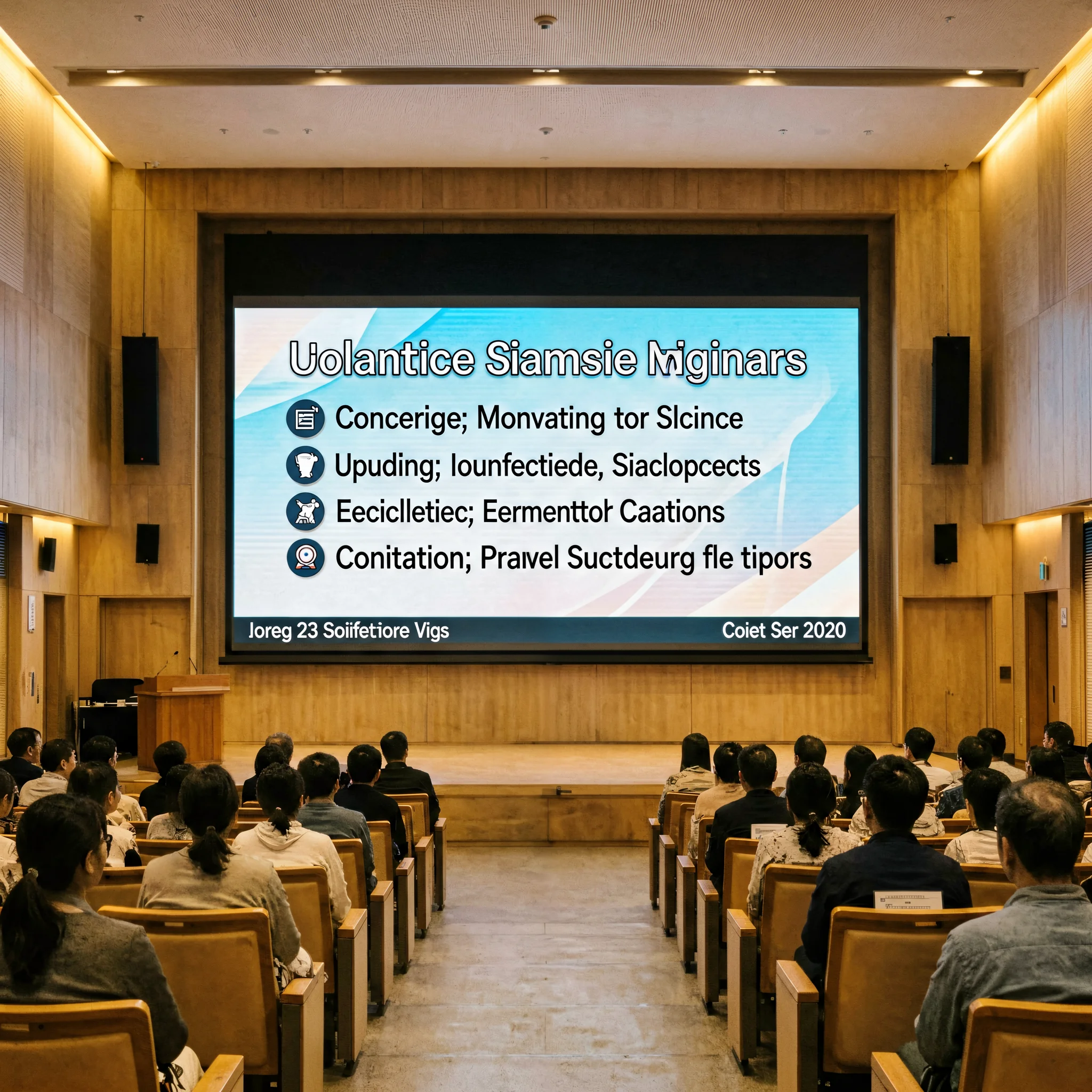
Church & Worship Venues
Auto-pilot announcements, scripture verses, and event schedules via async mode during the week. Sunday service: connect the video switcher via HDMI for live IMAG (Image Magnification) — instant switch, no AV volunteer needed to operate HDPlayer. See our church LED screen solutions for complete integration guidance.
Learn More →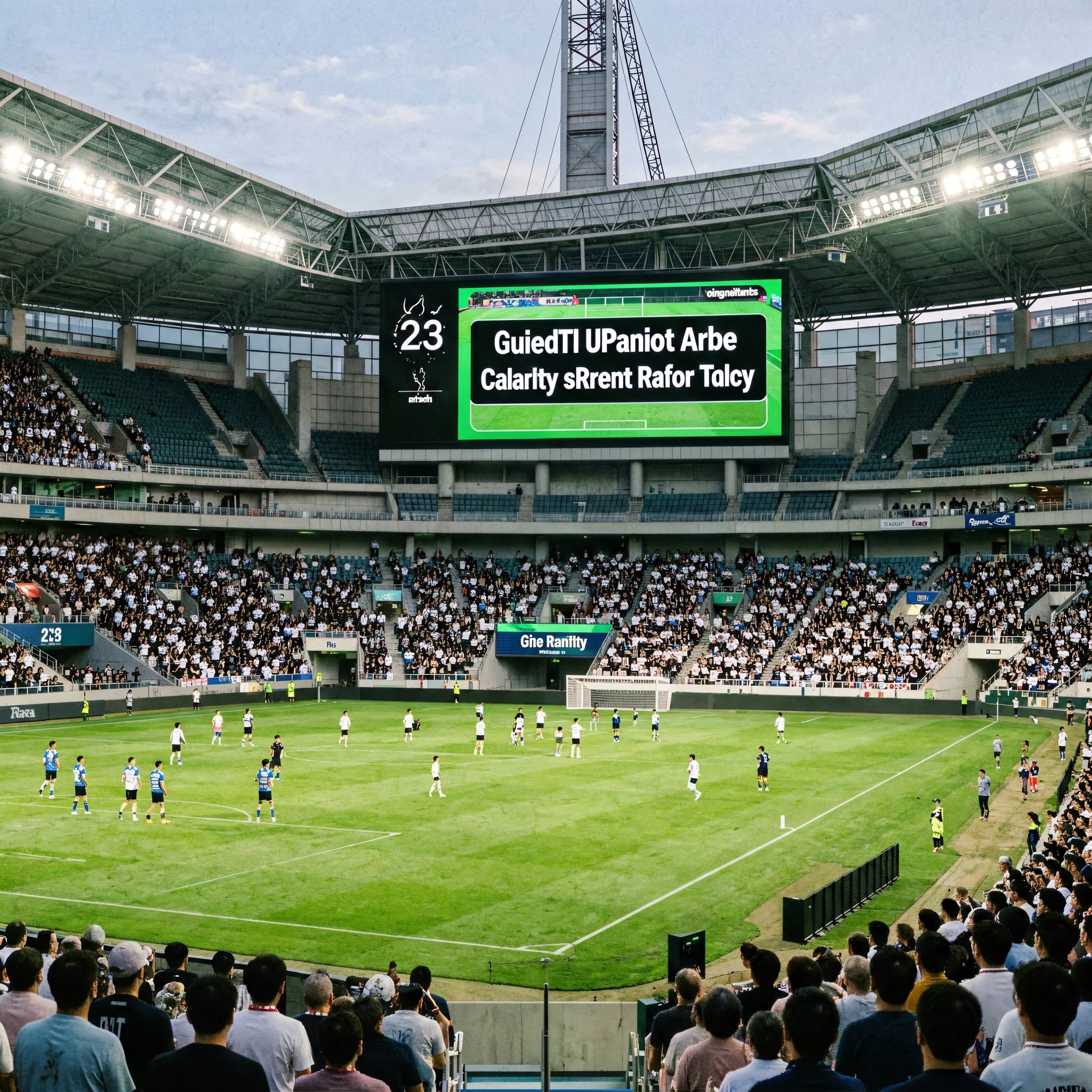
Stadium & Sports Venues
Cycle sponsor advertisements and venue information in async mode during match buildup. At kickoff, HDMI input from the broadcast truck takes over for live scores, instant replays, and fan engagement cameras — the dual-mode architecture means zero transition delay.
Learn More →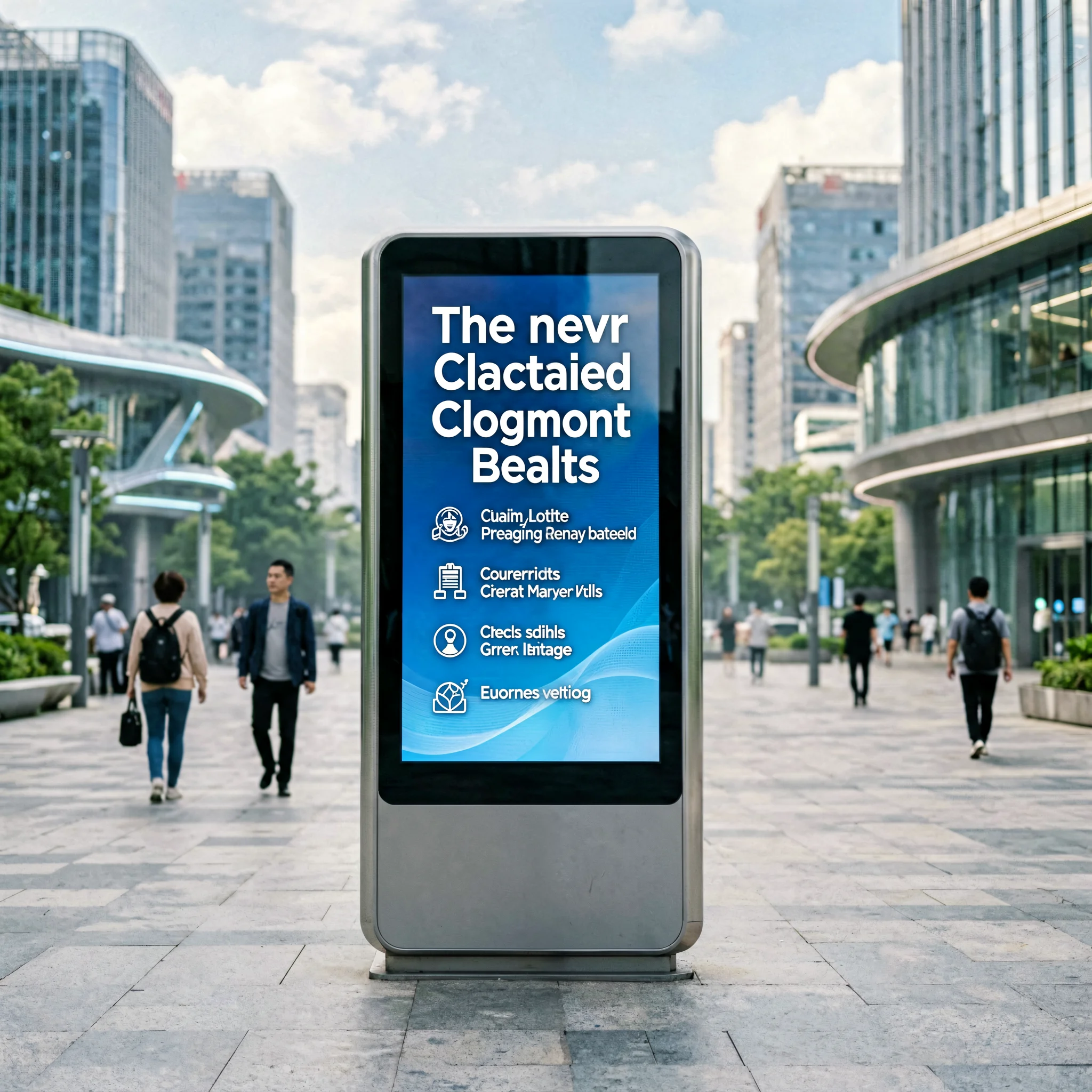
Smart City Public Displays
Run weather, air quality (via sensor port), news, and community announcements in async mode. Municipal control center pushes live emergency alerts — severe weather warnings, evacuation routes, Amber alerts — via HDMI override that takes priority instantly.
Learn More →HD-A5 Field Deployment: Quick-Start Guide
The HD-A5 uses Huidu’s proven auto-ID architecture — no IP address configuration. If you have deployed an HD-A3, the async setup is identical. The only addition is the HDMI input, which requires zero configuration. Here is the complete deployment sequence.
Connect & Power Up
Connect LAN OUT 1 to your receiving card chain (use LAN OUT 2 for dual-screen or backup). Attach Wi-Fi and 4G antennas. If using sync mode, connect your HDMI source to HDMI IN. Plug in 12V DC. Verify: PWR LED solid green, RUN LED flashing green. Press TEST button to confirm the LED module signal chain.
Configure Screen in HDPlayer
HDPlayer auto-detects the HD-A5 by hardware ID. Enter module parameters: pixel pitch, scan mode, module resolution, cabinet size. The HD-A5 supports ultra-wide configurations — if your width exceeds standard presets, use the custom width field (max 16,384 px).
Async Mode: Build & Upload
Create programs in HDPlayer: video, images, text, clocks, Office docs. Set schedules. Click Send to Device → content stored in 8GB flash. PC can be disconnected. Update remotely via cloud, Wi-Fi APP, or USB anytime.
Sync Mode: Plug & Play (Literally)
Connect any HDMI source. The HD-A5 auto-detects the resolution and scales it to your screen — no manual entry, no external scaler. The display mirrors the source in real time. Disconnect HDMI → async playback resumes instantly. That is the entire configuration process for sync mode.
Why Source Your HD-A5 from LEGIDATECH?
Authorized Distributor — Factory-Direct B2B Pricing
As an authorized Huidu Technology volume distributor, we procure HD-A5 units directly from the Shenzhen production line. No intermediate wholesalers. Competitive B2B pricing for single evaluation units through 500+ bulk orders. Every unit ships with original Huidu serial number, warranty card, and compliance certificates.
HDMI-Verified Before Shipping — Every Single Unit
Every HD-A5 undergoes a comprehensive pre-shipment bench test: latest firmware, HDMI input tested with a reference 1080p source, auto-scaling verified at multiple resolutions, both output ports validated with receiving cards. You receive a deployment-ready kit, not a box that requires hours of troubleshooting to confirm basic functionality.
Worldwide Delivery + 3-Year Engineering Support
DHL/FedEx/UPS express (3-7 days) or sea freight to 60+ countries. Every order includes 3-year English-language technical support from engineers who work with Huidu dual-mode controllers daily. Need help with a non-standard HDMI resolution or dual-zone output configuration? We can remote into your HDPlayer and assist in real time.
HD-A5 Dual-Mode Controller — Frequently Asked Questions
Q1: What does dual-mode mean, and how is the HD-A5 different from the HD-A3?
Dual-mode means the HD-A5 operates as BOTH an asynchronous controller (scheduled offline playback from 8GB internal memory) AND a synchronous controller (real-time HDMI input mirroring). The HD-A3 is async-only — it has no HDMI input and cannot display live video feeds. With the HD-A5, you get two controllers in one enclosure. The HD-A5 also provides 2× the pixel capacity (1.3M vs 655K), 4× the maximum width (16,384px vs 4,096px), dual output ports, and built-in HDMI auto-scaling that eliminates the need for an external video processor.
Q2: Does the HDMI auto-scaling require any configuration?
No. This is the feature our field engineers praise most. Connect any HDMI source (laptop, camera, set-top box) and the HD-A5 automatically detects the input resolution and scales it to match your LED screen’s configured pixel dimensions. If your screen is 960×512 and your laptop outputs 1920×1080, the HD-A5 downscales automatically. No parameter entry. No external scaler. No HDPlayer intervention. This hardware-level scaling adds less than 1 frame of latency, making it suitable for live video applications.
Q3: How does switching between async and sync modes work?
Automatic and instant — no manual intervention required. The HD-A5 continuously monitors its HDMI input. When an active HDMI signal appears → auto-switch to sync mode, displaying the live input. When the HDMI cable is disconnected or the source is turned off → instant fallback to scheduled async playback. No reboot. No menu. No black screen gap. The display stays live throughout the transition.
Q4: Why two output ports? How should I use them?
LAN OUT 1 and LAN OUT 2 are independently configurable Gigabit ports. Use case 1: Dual-zone deployment — drive a primary display and a secondary ticker from one HD-A5. Use case 2: Redundant backup — configure LAN OUT 2 as a hot-standby that takes over if the primary output fails. For standard single-screen installations, simply use LAN OUT 1.
Q5: What receiving cards work with the HD-A5?
Full compatibility with Huidu R Series: R500, R501, R50X, and newer generations. Auto-ID recognition — no IP address configuration. For the 16,384px ultra-wide capability, we recommend R501 or newer cards. Third-party receiving cards may work with standard protocols but won’t support advanced features like sensor data passthrough. LEGIDATECH supplies pre-tested HD-A5 + R Series bundles for guaranteed compatibility.
Q6: Does the HD-A5 support HDCP-protected content?
No. The HD-A5’s HDMI input does not support HDCP (High-bandwidth Digital Content Protection). Content from Blu-ray players, streaming sticks (Roku, Fire TV), and some set-top boxes with HDCP enabled will display a black screen. For commercial deployments, use non-HDCP sources (laptops, professional cameras, media servers, signage players). If you must use an HDCP source, insert an HDCP stripper between the source and the HD-A5.
Q7: Can the HD-A5 handle extreme outdoor conditions?
Yes. -40°C to 80°C operating range, 0-95% humidity tolerance. Fanless die-cast aluminum enclosure with passive cooling — no moving parts to fail. Conformally-coated PCB for condensation and dust resistance. Deployed in outdoor billboards from Scandinavia to the Middle East. For outdoor installations, house the HD-A5 in a weatherproof IP65+ electrical enclosure. The controller is CCC, CE, FCC, RoHS, and BIS certified.
Q8: How does the HD-A5 compare to the HD-A6?
Both are dual-mode (async + HDMI sync). The HD-A6 supports 2.3M pixels (vs 1.3M), 16GB memory (vs 8GB), and 4 output ports (vs 2). The HD-A5 delivers the same dual-mode architecture, HDMI auto-scaling, and industrial durability at a significantly lower B2B unit cost. If your pixel count is under 1.3M, the HD-A5 is the value-maximizing choice — you are not paying for capacity you will not use.
Q9: Can I manage multiple HD-A5 units remotely?
Yes. Huidu’s cloud platform provides centralized management for unlimited HD-A5 units across any number of locations. Push content, monitor playback status, check online/offline status, and schedule programs from a single web dashboard. Basic cloud management is free — no recurring subscription. For enterprise features like API integration and automated reporting, contact us about Huidu’s enterprise tier.
Q10: Where can I buy genuine HD-A5 controllers with HDMI verification and support?
LEGIDATECH is an authorized Huidu distributor. Every HD-A5 we ship is bench-tested with HDMI input verification, firmware updated, and serial-number verified. Full manufacturer warranty. Original compliance certificates. 3-year English technical support. Worldwide DHL/FedEx/UPS delivery (3-7 days). To request a quotation or discuss your deployment, click “Request Factory Quote” or contact our LED screen manufacturer sales team.
Ready to Deploy the HD-A5 Dual-Mode Controller?
Every HD-A5 ships HDMI-verified, firmware-updated, and bench-tested. Backed by 3-year engineering support. Worldwide delivery.
Authorized Huidu distributor
Tested before shipping
WhatsApp + Email + Remote Assist
Dual-Mode LED Controllers: Why the HD-A5 Is Changing How Integrators Design Digital Signage Networks
In This Guide
- The Controller Conundrum: Why “Pick One Mode” Was Always a Bad Trade-off
- Inside the HD-A5: Hardware Architecture That Makes Dual-Mode Possible
- The HDMI Auto-Scaling Deep Dive: Latency, Resolution Mapping, EDID
- Field Report: HD-A5 in a Dual-Use Church Deployment (Async Weekday + Live Sunday)
- Ultra-Wide Without Tiling: The 16,384px Advantage Explained
- Dual Output Ports: Practical Configuration Patterns
- Procurement Checklist: 8 Questions That Separate Dual-Mode Controllers from Marketing Claims
- The Verdict: Who Should Standardize on the HD-A5?
1. The Controller Conundrum: Why “Pick One Mode” Was Always a Bad Trade-off
For as long as LED display controllers have existed, the industry has drawn a hard line between two product categories. Asynchronous controllers — affordable, self-contained, perfect for scheduled content on billboards and menu boards, but incapable of displaying a live video feed. Synchronous controllers — powerful, real-time, capable of driving stage backdrops and broadcast walls, but expensive, PC-dependent, and overkill for a display that loops the same five ads for six months.
System integrators learned to live with this binary. They stocked both types. They explained to clients why upgrading from async to sync meant replacing the controller entirely. They designed around the limitation because there was no alternative.
The Huidu HD-A5 is the alternative. By integrating both an asynchronous playback engine and an HDMI synchronous input with hardware auto-scaling into a single enclosure, it eliminates the trade-off that has defined LED controller selection for over a decade. The technical achievement is not that it does both — it is that it does both automatically, without user intervention, at a price point comparable to async-only controllers from competing brands.
2. Inside the HD-A5: Hardware Architecture That Makes Dual-Mode Possible
The HD-A5’s dual-mode capability is not a software trick. It is the result of a dedicated hardware architecture with two independent signal paths that converge at the output stage. The asynchronous path flows from the 8GB flash storage through the media decoder to the output FPGA. The synchronous path flows from the HDMI input through the hardware scaler to the same output FPGA. An automatic signal detection circuit monitors the HDMI port and switches the output source — hardware-level switching, not software-level — which is why the transition is seamless and the latency is under one frame.
The hardware scaler deserves particular attention because it is the component that eliminates the external video processor from the BOM. Traditional LED controllers with HDMI input require the user to manually match the input resolution to the output resolution — a configuration step that, done incorrectly, results in garbled or blank displays. The HD-A5’s scaler auto-negotiates with the source device via EDID, determines the optimal input resolution, and maps it to the LED screen’s pixel grid. For the system integrator, this means one less device to purchase, cable, configure, and troubleshoot.
3. The HDMI Auto-Scaling Deep Dive: Latency, Resolution Mapping, EDID
Auto-scaling sounds simple — “it just works” — but the engineering underneath is non-trivial. Here is what happens in the 200-500 milliseconds between plugging in an HDMI cable and seeing the image on the LED screen:
EDID handshake (0-100ms): The HD-A5 presents an EDID (Extended Display Identification Data) to the source device advertising support for common resolutions up to 1920×1080@60Hz. The source selects the highest mutually supported resolution. If EDID negotiation fails — common with older laptops — the HD-A5 falls back to 1280×720@60Hz as a safe default.
Resolution detection and scaler configuration (50-200ms): The hardware scaler reads the actual incoming video timing parameters — horizontal/vertical pixel count, refresh rate, color space — and programs its scaling matrix to map the source grid to the LED screen’s configured native resolution. This is a pure hardware operation; the CPU is not involved.
First frame output (1-2 frames at 60Hz = 16-33ms): The scaled frame is written to the output buffer and transmitted to the receiving cards. Total plug-to-display latency: typically 200-500ms. Ongoing latency: under 1 frame (16ms).
For comparison, software-based scaling solutions (common on entry-level controllers and general-purpose SBCs running Linux) add 2-5 frames of latency and introduce the risk of frame drops when the CPU is under load. The HD-A5’s dedicated scaler ASIC avoids both issues.
4. Field Report: HD-A5 in a Dual-Use Church Deployment
A 2025 deployment at a 1,200-seat church in São Paulo, Brazil illustrates the HD-A5’s real-world value. The church installed a 9.6m × 3.2m indoor LED display driven by a single HD-A5 with R501 receiving cards. During the week (Monday-Saturday), the display runs scheduled async content: service times, community event announcements, scripture verses, and donation QR codes — updated weekly by a church volunteer using the Huidu mobile APP via Wi-Fi.
On Sunday, the AV team connects the church’s video switcher (Blackmagic ATEM) to the HD-A5’s HDMI input. The display instantly switches to live IMAG (Image Magnification) of the pastor, worship lyrics from ProPresenter, and sermon slides — all at 60Hz with zero perceptible latency. When the service ends, the AV team disconnects the HDMI cable and the display returns to async mode automatically.
Before the HD-A5, this church used a dedicated sync controller connected to a permanently-installed PC that ran 24/7 — consuming power, requiring Windows updates and antivirus management, and failing twice in three years (once due to a failed power supply, once due to a Windows Update-forced reboot during a service). The HD-A5 eliminated the PC, reduced power consumption by 70%, and has operated without a single failure for 18 months. The church’s AV director described the upgrade as “the most impactful $400 we spent on the entire AV system.”
5. Ultra-Wide Without Tiling: The 16,384px Advantage
Most LED controllers in the HD-A5’s price band cap single-axis width at 2,048 or 4,096 pixels. For standard 16:9 aspect ratio displays, this is fine — a 1920×1080 display only needs 1,920 horizontal pixels. But the LED display market has evolved well beyond 16:9. Retail storefront ribbon displays stretch 8-12 meters wide at just 64-128 pixels tall. Stadium perimeter boards wrap 200+ meters around the field. Transportation hub tickers span entire terminal walls.
These ultra-wide formats require either a controller with a massive single-axis limit — or multiple controllers tiled together using synchronization cables. Tiling introduces complexity: each controller needs its own content feed, timing synchronization, and network connection. A 12,000-pixel-wide ribbon display using controllers capped at 4,096 pixels needs three controllers, a synchronization hub, and a content distribution system. The same display using an HD-A5 at 16,384 pixels needs one controller, one network connection, and one program upload.
The 16,384px spec is not marketing — it is the tested, stable, single-axis output capacity verified across multiple receiving card configurations. For system integrators bidding on ultra-wide projects, the HD-A5’s single-controller capability can be the difference between a competitive quote and one burdened by multi-controller hardware and integration costs.
6. Dual Output Ports: Practical Configuration Patterns
Two Gigabit output ports sound like a minor spec bump. In practice, they enable deployment patterns that would otherwise require additional hardware. Here are the three most common configurations our integrators use:
Pattern A — Dual-Zone Independent: LAN OUT 1 drives the main LED display (e.g., a 1280×768 storefront screen). LAN OUT 2 drives a secondary display (e.g., a 512×128 informational ticker above the entrance). Same controller. Same content management. Different resolutions, different content. This pattern is popular in retail and transportation deployments where a primary promotional display is complemented by a secondary information feed.
Pattern B — Redundant Failover: Both output ports drive the same LED display through separate receiving card chains. If the primary chain fails (cable damage, receiving card failure, power loss to one cabinet section), the backup chain maintains the display. This pattern is used in mission-critical installations — airport FIDS, emergency operations centers, broadcast studios — where display downtime carries operational consequences.
Pattern C — Single Screen, Standard: LAN OUT 1 connected. LAN OUT 2 unused. Simple. Reliable. The default for the majority of deployments.
7. Procurement Checklist: 8 Questions That Separate Genuine Dual-Mode Controllers from Marketing Claims
The term “dual-mode” has become a marketing buzzword. Some controllers claim dual-mode but require manual software switching, reboot between modes, or PC-based HDMI pass-through. Here is how to verify genuine dual-mode capability before purchasing:
- “Is the HDMI input auto-detecting with auto-scaling, or does it require manual resolution configuration?” — Auto = genuine hardware integration. Manual = software workaround.
- “What is the switching latency between modes — and does the screen go black during the transition?” — Genuine hardware switching is seamless. Software switching typically has a 2-5 second black gap.
- “What happens when the HDMI signal drops — does it auto-fallback to async, or stay on a blank screen?” — Auto-fallback is the defining feature. Without it, a loose cable means a dead display.
- “Is the HDMI scaling done in hardware or software?” — Hardware scaling = sub-1-frame latency. Software = 2-5 frames, visible desync with audio.
- “Does it support HDCP?” — Most industrial LED controllers do NOT support HDCP. This is normal. If you need HDCP-protected content, verify explicitly — do not assume.
- “What is the tested maximum HDMI cable length before signal degradation?” — Passive HDMI: ~15m. Beyond that, plan for active fiber or Cat6-based HDMI extenders.
- “Are both output ports independently configurable?” — Independent configuration enables dual-zone and failover patterns. Locked-together ports are primarily for load balancing.
- “Does the supplier bench-test the HDMI input before shipping?” — A “yes” from LEGIDATECH means every unit is verified with a live HDMI source. A “no” means you are the quality control department.
8. The Verdict: Who Should Standardize on the HD-A5?
After examining the hardware architecture, field deployment data, and procurement criteria, the recommendation is unambiguous:
System integrators servicing commercial digital signage, house of worship, transportation, retail, sports venue, and smart city verticals should make the HD-A5 their default mid-range controller selection. It covers the pixel requirements of 80%+ of commercial LED display sizes. It eliminates the cost and complexity of external video scalers. It provides both scheduled offline operation AND live HDMI input — future-proofing deployments against changing client needs. And it does all of this at a B2B price point that is competitive with async-only controllers from brands lacking dual-mode capability.
The HD-A3 remains the right choice for budget-sensitive async-only deployments. The HD-A6 is the upgrade path for pixel counts exceeding 1.3 million. For the vast middle — the billboards, the church screens, the retail windows, the stadium perimeters, the airport FIDS, the smart city kiosks — the HD-A5 is the controller that eliminates compromise. One box. Two modes. Zero regrets.
To discuss volume pricing, request an evaluation unit, or get technical guidance on HD-A5 integration with your specific LED modules, contact LEGIDATECH — your factory-direct partner for Huidu dual-mode control systems. As a trusted LED screen manufacturer partner, we ship HDMI-verified HD-A5 units worldwide with 3-year support.
Explore the Huidu LED Control System Hub → Complete guide to the Huidu LED control system — product categories, HD-VP series ladder, comparison table, selection logic and applications.