


شاشة LED للفنادق
Hotel LED display and video wall solutions for lobbies, ballrooms, meeting rooms and entrances — factory-direct from a manufacturer with 13 years of export experience.
What Is a Hotel LED Screen?
A hotel LED screen is a large-format display built from tiled LED modules that is installed in hotel lobbies, ballrooms, meeting rooms, restaurants and entrances to show branding, wayfinding, event content and advertising. Unlike an LCD video wall it has no bezel seams, can be built to any size or curve, and is rated for roughly 100,000 hours of LED life.
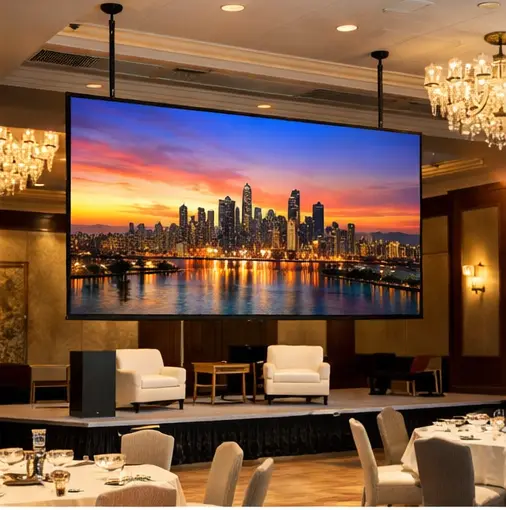
Which pixel pitch does a hotel lobby need?
P1.5–P2.5 for a feature wall viewed from 3–6 m. Use the industry rule of thumb: the minimum comfortable viewing distance in metres is roughly equal to the pixel pitch in millimetres.
How bright should it be?
600–1,200 nits for interior walls, 2,500–3,500 nits behind glazing where daylight competes, and 5,500–7,500 nits for an outdoor entrance or facade.
Indoor or outdoor?
Anything under a roof and away from direct sun is an indoor IP30-class screen. Entrance canopies, facades and pool decks need outdoor IP65 cabinets.
What does it cost?
Indoor hotel screens run $350–$1,500/m² factory-direct depending on pitch; outdoor facade screens $280–$950/م². Structure and installation add $110–$250/m².
Figures on this page follow the same factory-direct pricing basis published in our دليل أسعار شاشات LED. They are reference ranges for budgeting, not a quotation — final price depends on pitch, size, cabinet and control system.
Hotel LED Display Selection Matrix: Zone by Zone
A hotel is not one viewing environment — it is a dozen of them. A screen that looks perfect in a ballroom will look coarse in a lift lobby, and a fine-pitch lobby panel will be washed out at an entrance canopy. The table below is the single decision tool most hotel projects need: find the zone, read across for pitch, brightness, screen class and a typical build size.
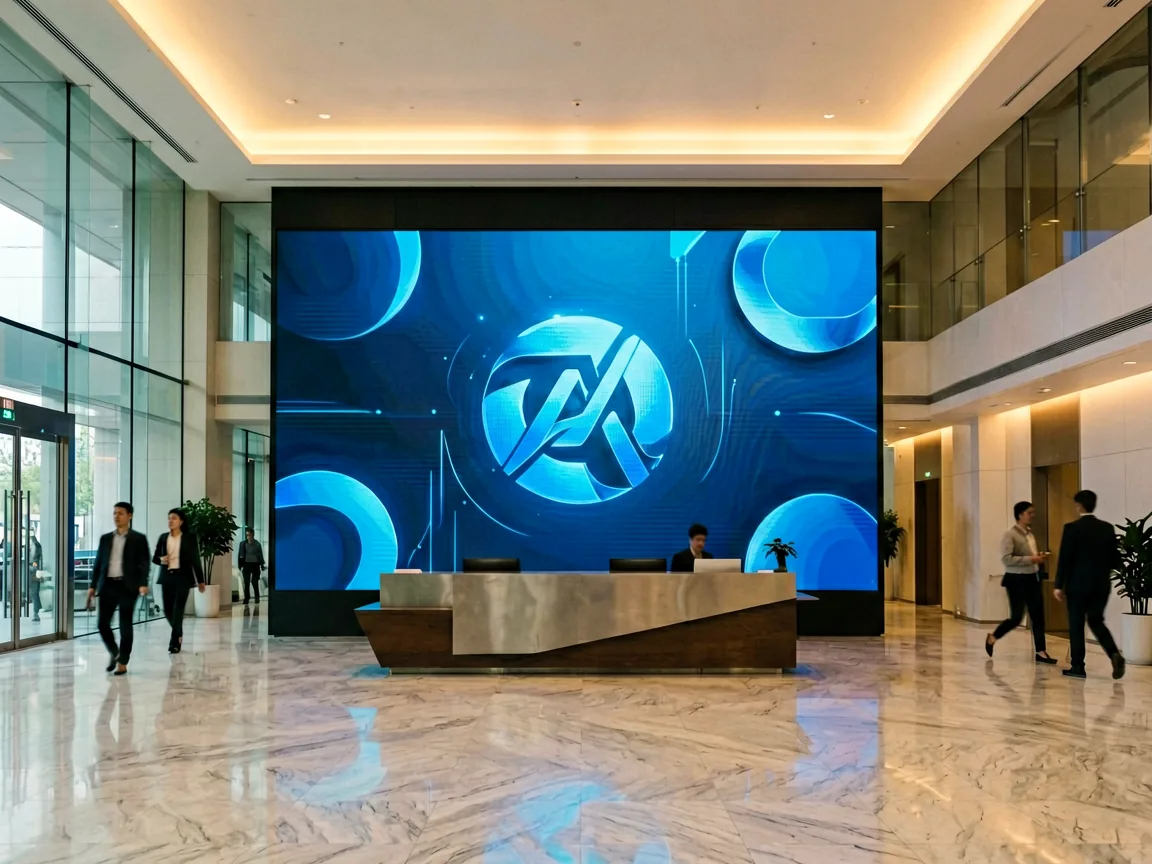
| Hotel zone | Typical viewing distance | Recommended pixel pitch | سطوع | Screen class | Typical size |
|---|---|---|---|---|---|
| Entrance canopy / building facade | 8–20 مترًا | P4–P8 | 5,500–7,500 nits | Outdoor, IP65 | 6–30 m² |
| Window-facing wall behind glazing | 3–8 م | ص2.5–ص4 | 2,500–3,500 nits | Semi-outdoor / high-bright indoor | 4–15 m² |
| Lobby feature wall | 3–6 m | P1.8–P2.5 | 600–1,200 nits | Indoor, IP30 | 6–20 m² |
| Reception / check-in backdrop | 2–4 m | P1.5–P2.5 | 600–1,000 nits | Indoor, IP30 | 4–12 m² |
| Lift lobby / elevator landing | 1.5–3 م | P1.25–P1.8 | 500–800 nits | Indoor, IP30 | 1–4 m² |
| Corridor & wayfinding | 1.5–3 م | P1.25–P2.0 | 500–800 nits | Indoor, IP30 | 1–3 m² |
| Meeting room / boardroom | 2.5–5 m | P1.5–P2.5 | 400–800 nits | Indoor, IP30 | 4–12 m² |
| Conference hall / auditorium | 5–15 m | P2.5–P3.9 | 800–1200 شمعة | Indoor, IP30 | 15–60 m² |
| Ballroom / banquet stage | 5–20 m | P2.6–P3.9 | 1,000–1,500 nits | Indoor fixed or rental | 20–80 m² |
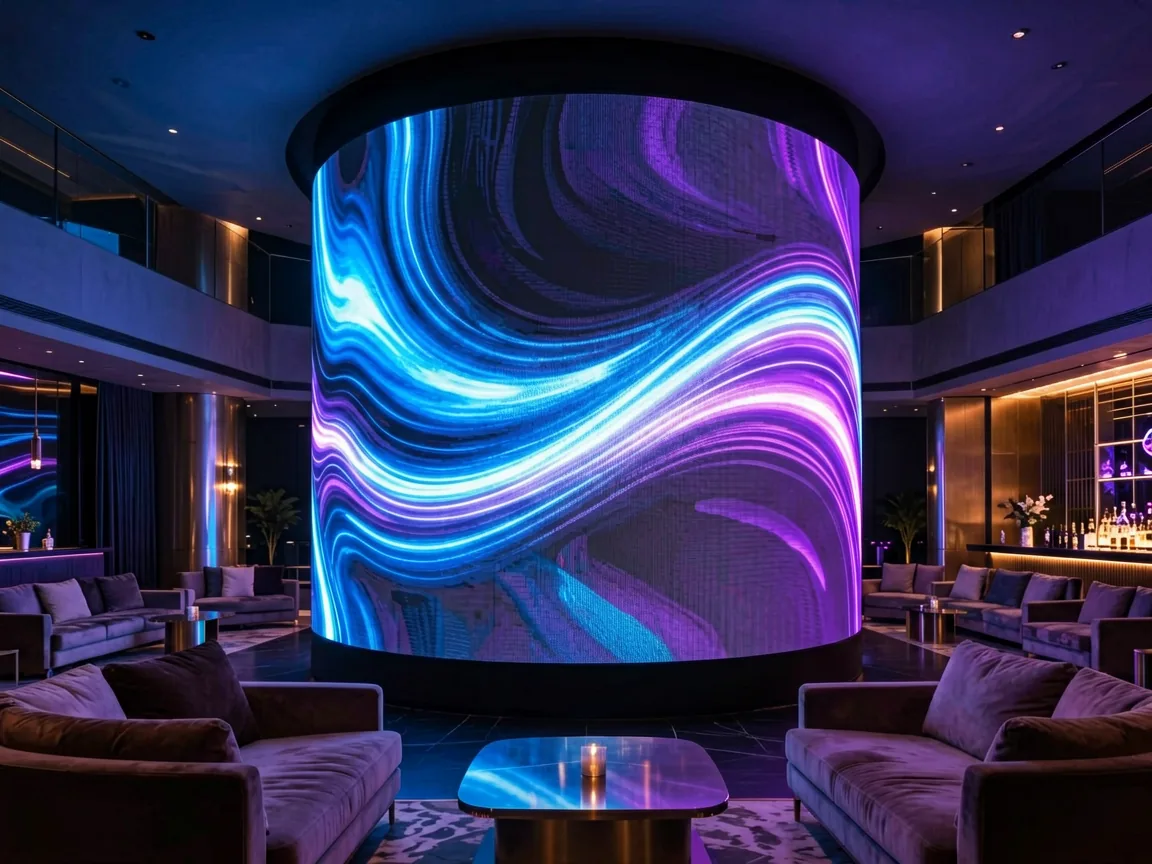
| Restaurant, bar & lounge | 2–6 m | P1.8–P3.0 | 600–1,000 nits | Indoor, IP30 | 3–15 m² |
| Pool deck / rooftop terrace | 5–15 m | P4–P6.67 | 5,500–7,500 nits | Outdoor, IP65 | 8–40 m² |
| Gym, spa & wellness | 2–4 m | P1.8–P2.5 | 500–800 nits | Indoor, IP30 | 3–8 m² |
Brightness bands follow the same specification basis used across our حائط فيديو LED range. Sizes are typical build ranges for hospitality projects, not fixed products — every hotel screen is cut to the architectural opening.
Hotel LED Screen Applications: The Six Zones That Matter Most
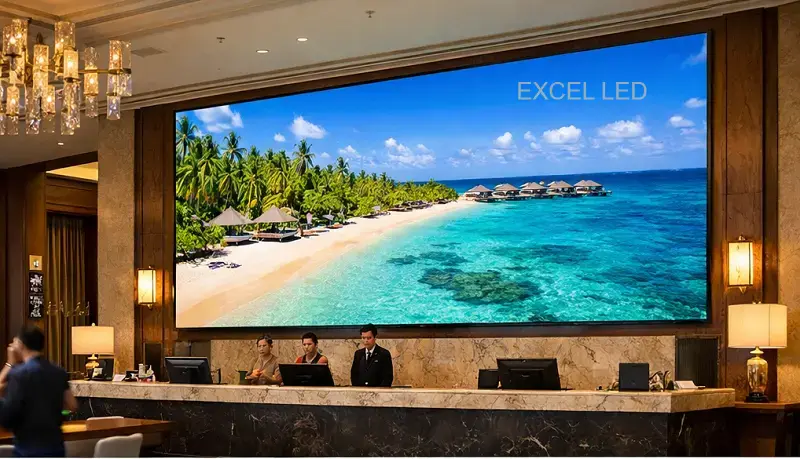
1. Lobby & Reception
The lobby wall is the screen guests judge the property by. It runs 16–24 hours a day, is viewed from 3–6 m, and sits under architectural lighting rather than daylight — so 600–1,200 nits is correct and anything brighter simply glares. Choose P1.8–P2.5: fine enough that a guest standing at the desk sees no pixel structure, coarse enough to keep the budget sane on a 10–20 m² wall.
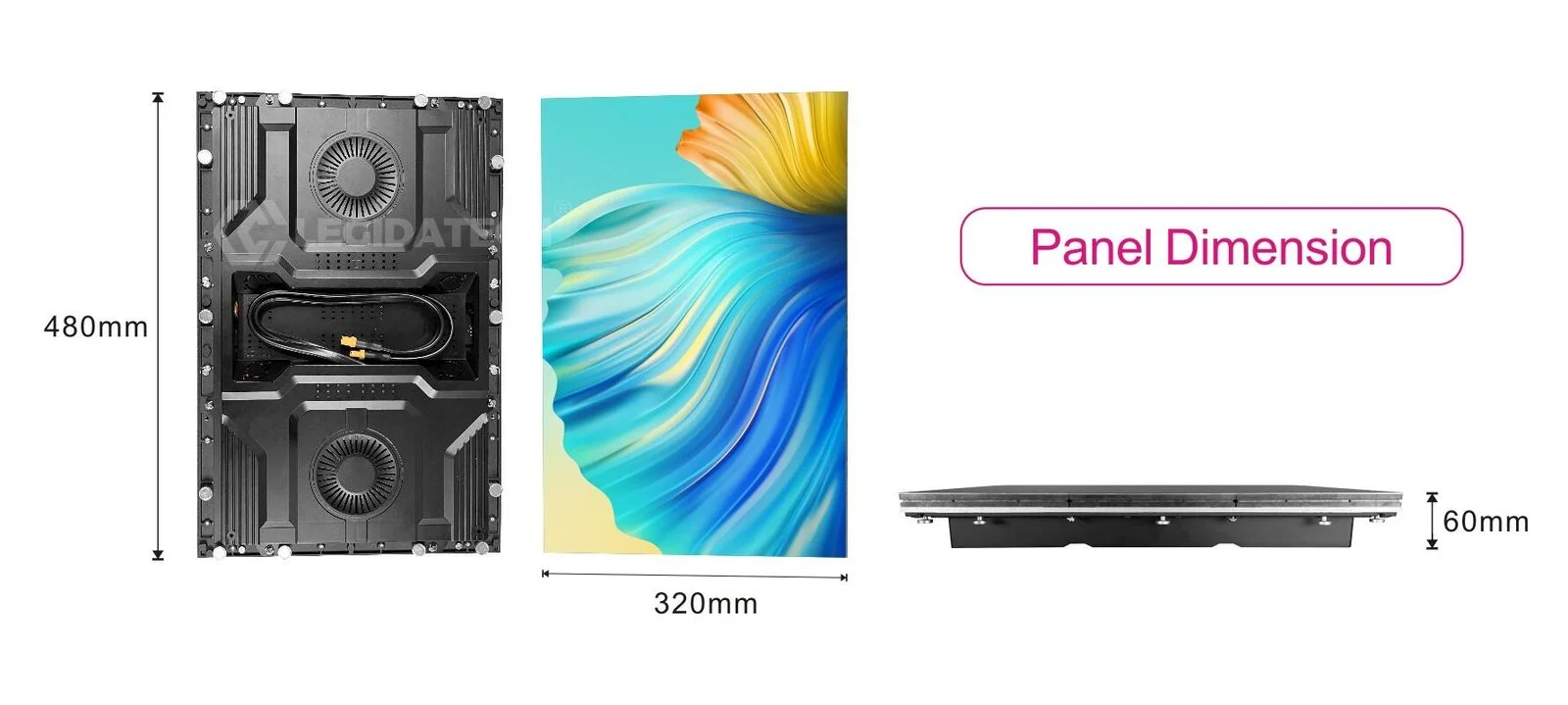
The practical constraint is depth. Behind a reception desk you rarely get rear access, so specify a front-serviceable cabinet — our Ehonor 480×320 mm panel is 70 mm deep at 2.7 kg and mounts flush to the structural wall with magnetic modules.
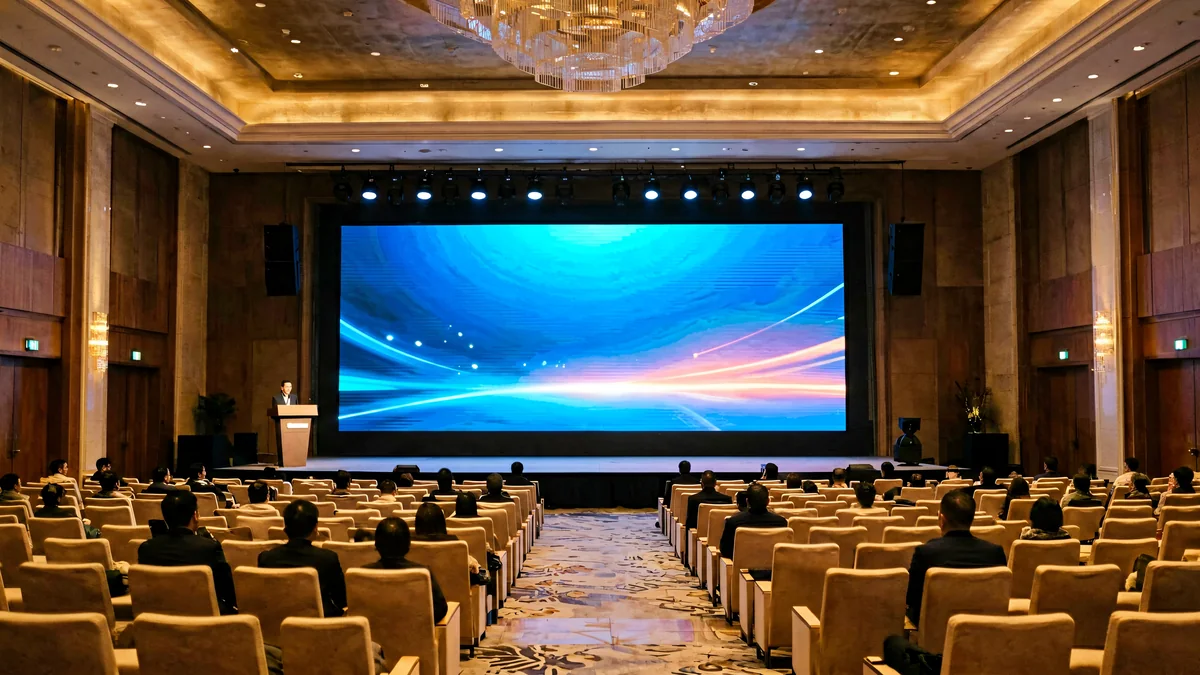
2. Conference Halls & Auditoriums
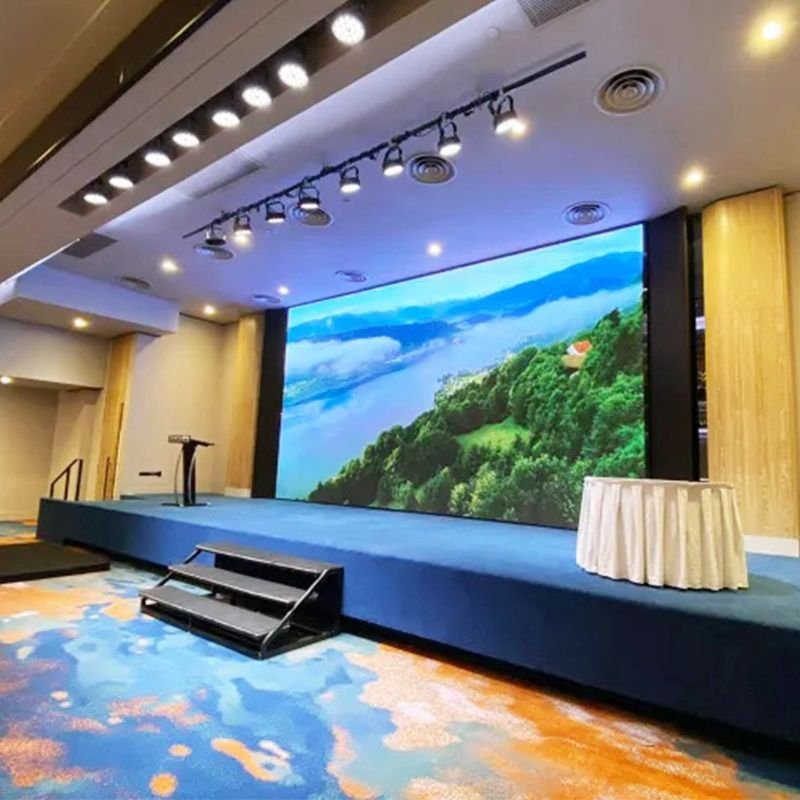
Conference space is the zone hotels monetise directly, and it is where the specification most often goes wrong. Viewing distance runs from the front row at 5 m to the back row at 15 m, so P2.5–P3.9 is the efficient band — a finer pitch adds cost that nobody in row 20 can resolve.
Two requirements are non-negotiable here: a refresh rate of at least 1,920 Hz (3,840 Hz on our screens) so that press cameras and hybrid-meeting streams record no scan lines, and a low-brightness / high-greyscale driver IC so the wall can be dimmed to the 300–500 nits a darkened conference room actually uses without banding in the shadows.

3. Ballrooms & Banquet Halls
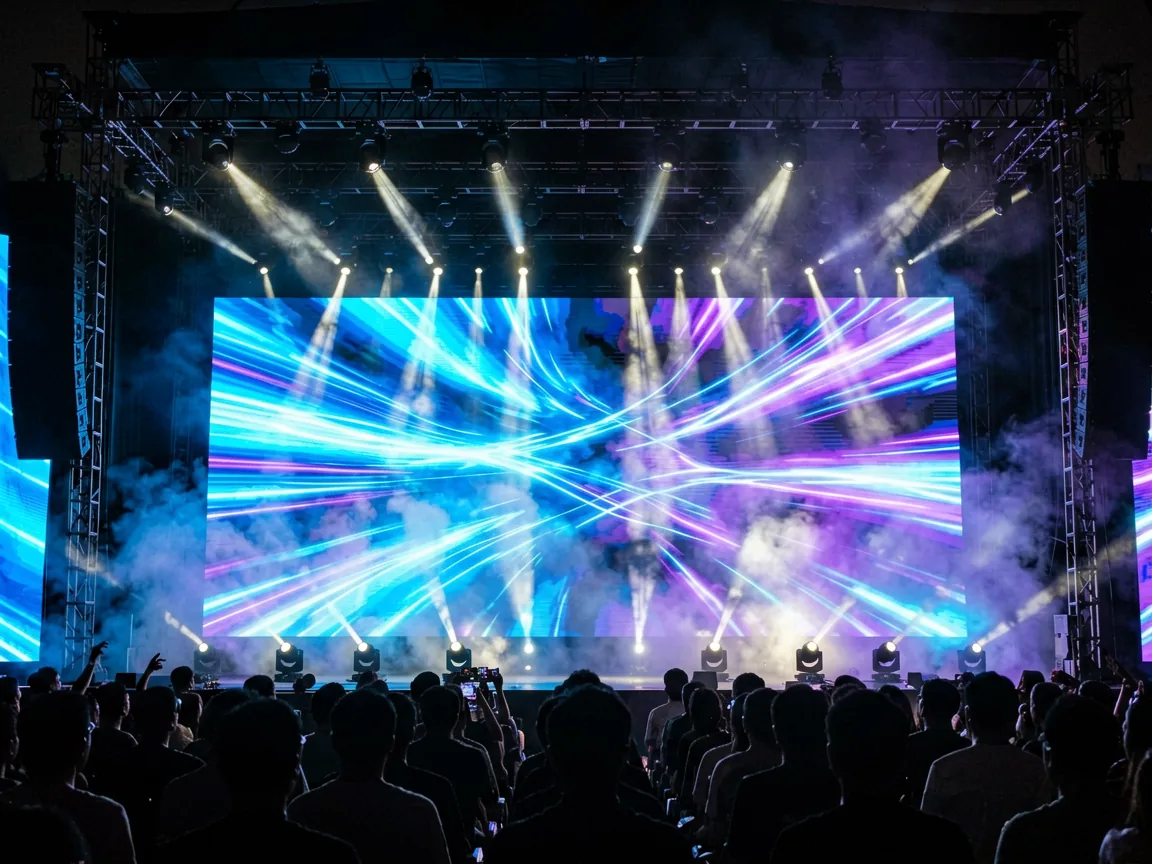
Ballroom screens are the revenue engine: they let a hotel sell a fully-dressed event backdrop instead of renting one in for every booking. Sizes are large — 20–80 m² is normal for a 300–800 seat room — and content is mostly motion, so P2.6–P3.9 at 1,000–1,500 nits is the standard band.
Decide early between fixed و الإيجار construction. A fixed wall is cheaper per m² and looks cleaner; rental cabinets with quick-locks and flight cases cost more but let the room reconfigure between a wedding, a product launch and an AGM. For a dedicated wedding venue see our wedding LED display page.
4. Meeting Rooms & Boardrooms
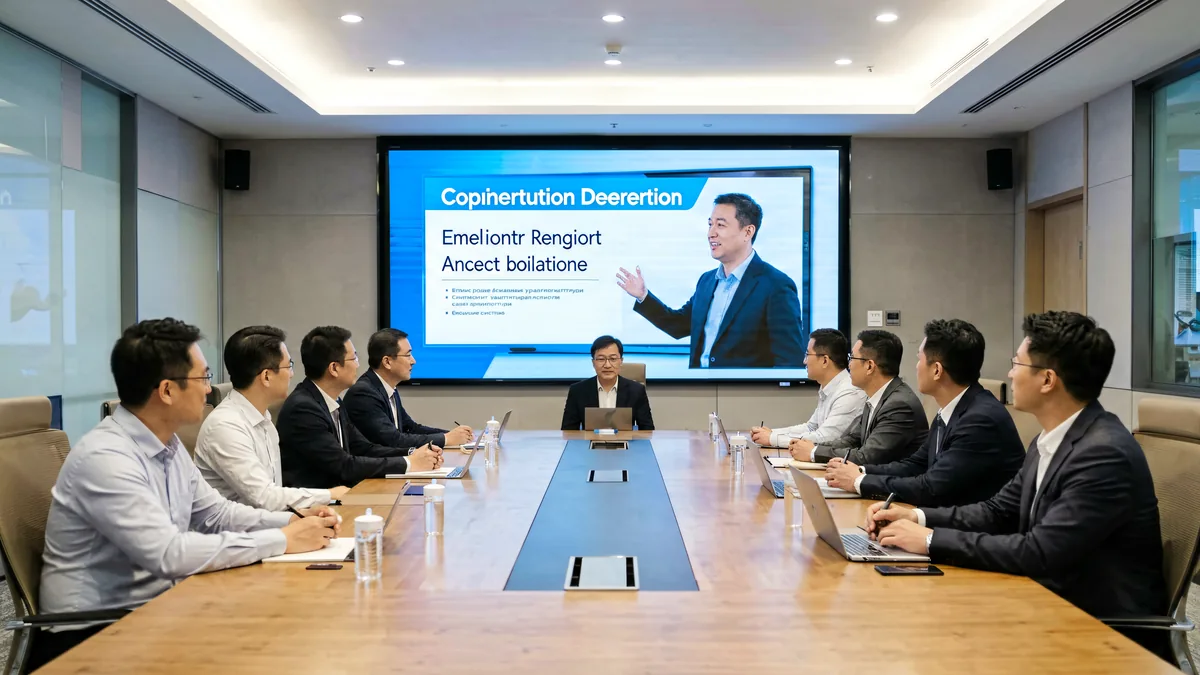
Boardrooms are the shortest viewing distance in the building — 2.5–5 m — and the content is the least forgiving: spreadsheets, 8 pt footnotes, shared documents. This is where P1.5–P2.5 earns its cost, and where an LED wall decisively beats a projector because it holds contrast with the lights on.
Size to the text, not to the wall. A 16:9 screen 3.84 m wide at P2.0 gives 1,920 × 1,080 native pixels — a true Full HD canvas with no scaling, which is why that combination recurs in hotel boardroom specifications.
5. Entrances, Canopies & Facades
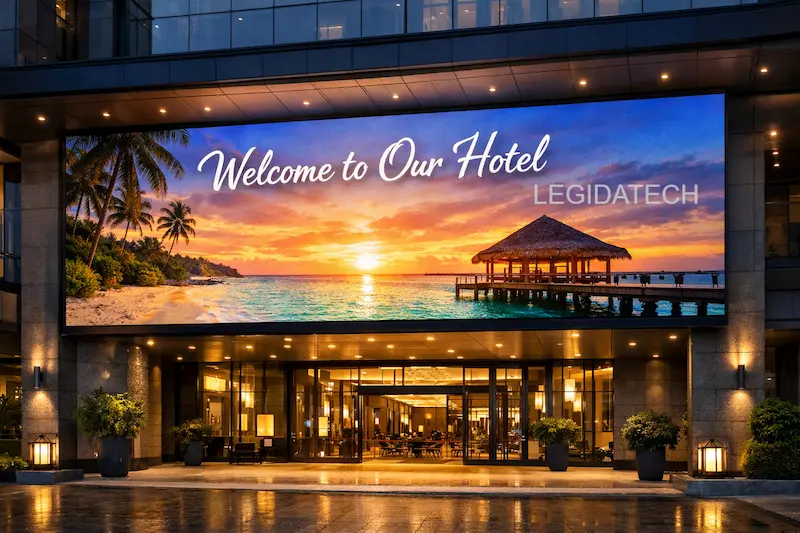
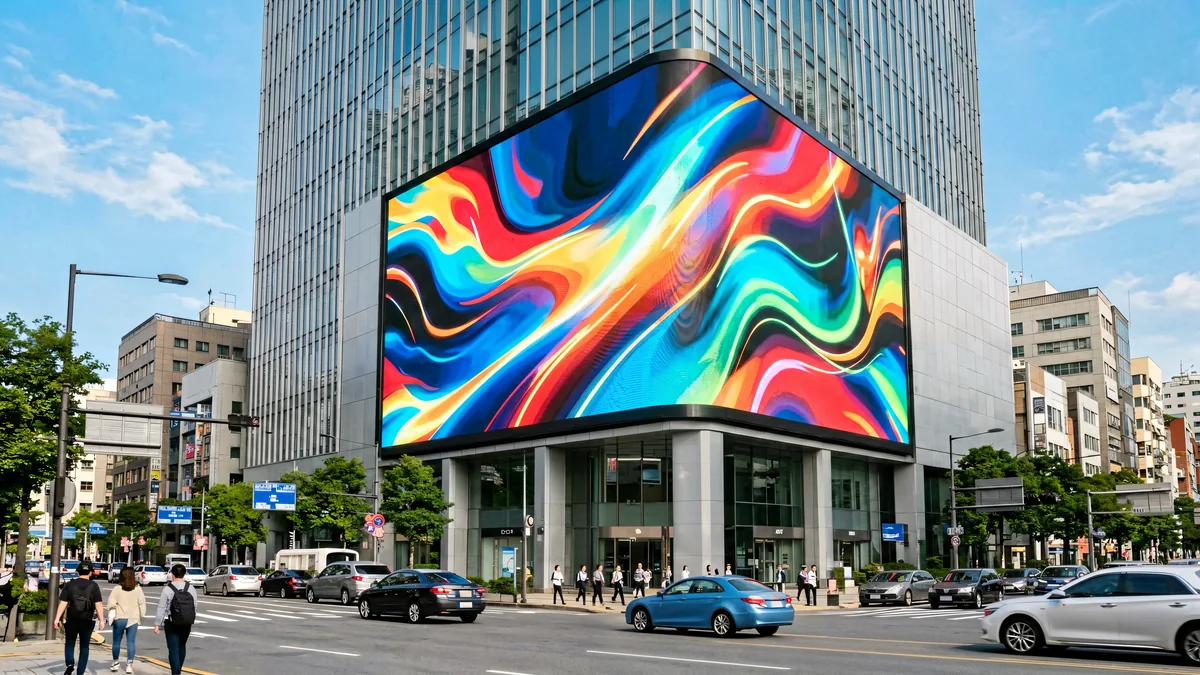
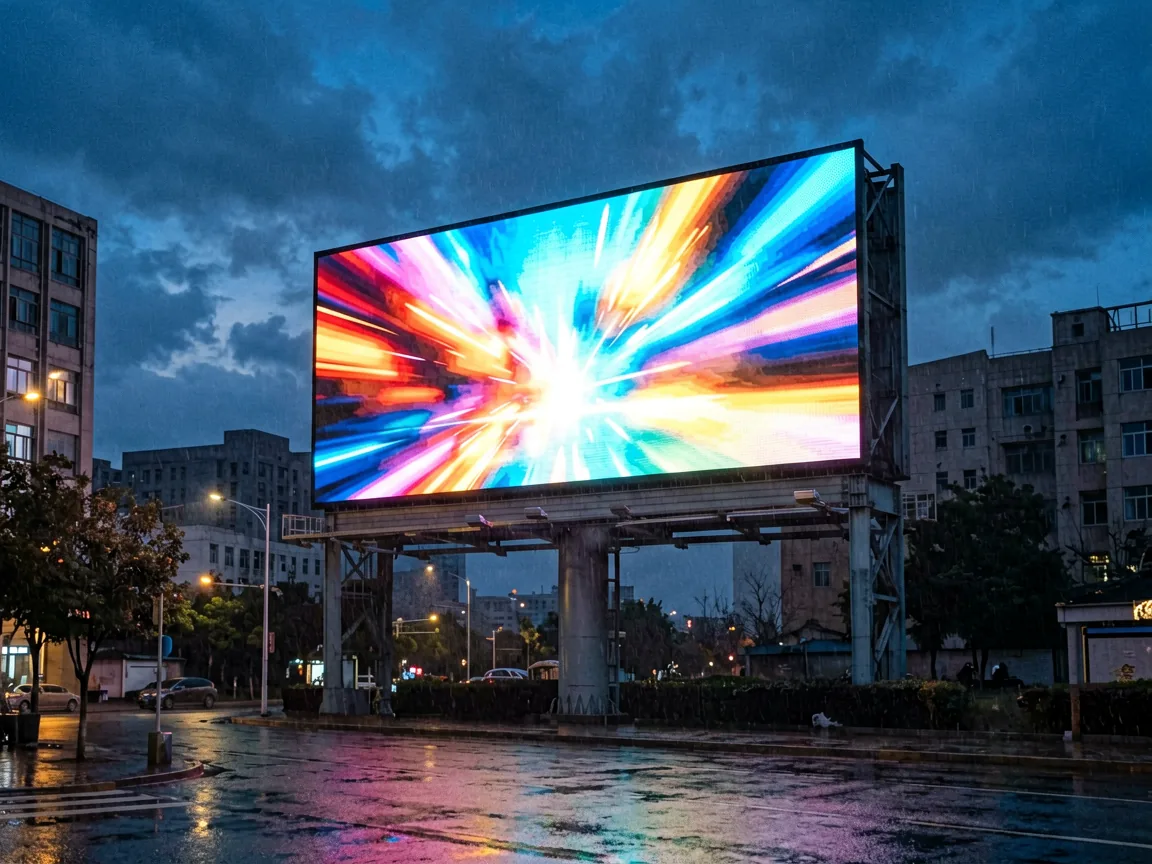
Outside the building the rules change completely. Direct sun demands 5,500–7,500 nits, weather demands IP65 sealing front and rear, and a viewing distance of 8–20 m means P4–P8 is sufficient — specifying P2.5 outdoors wastes budget on resolution nobody can see from the forecourt.
An automatic brightness sensor is essential rather than optional: a facade screen running at full output after dark is a nuisance complaint and a wasted 60% of its power draw. See the full شاشة LED خارجية range for cabinet and IP options.
6. Lift Lobbies, Corridors & Wayfinding
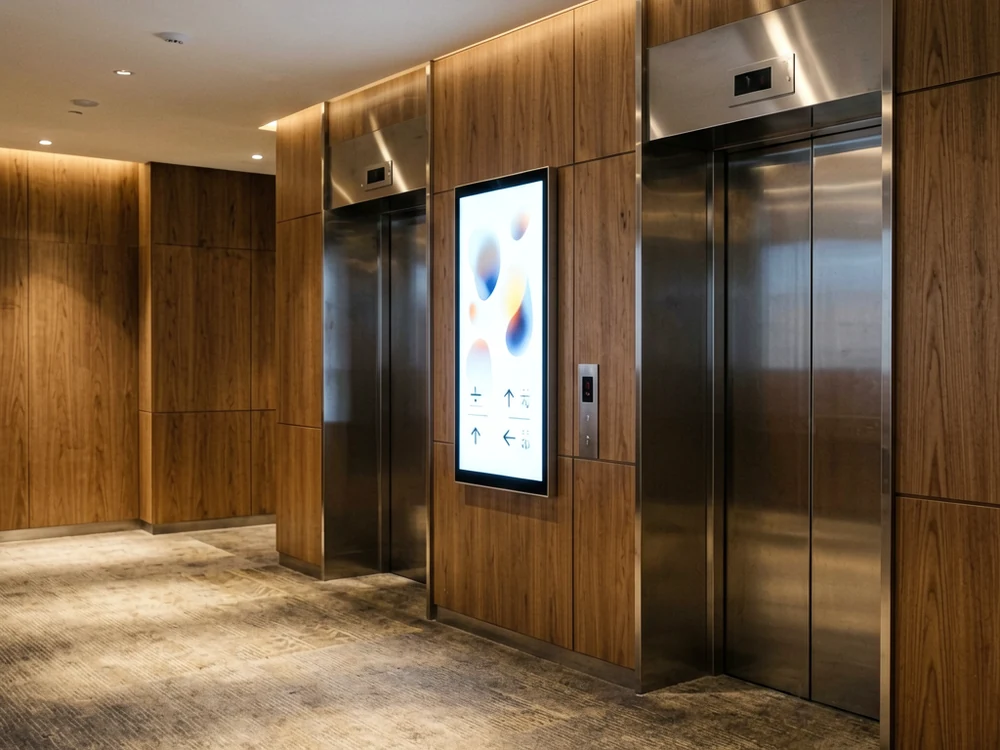
These are the small, high-frequency screens: 1–4 m², viewed from 1.5–3 m by a guest who is standing still and looking closely. Pitch has to be fine — P1.25–P1.8 — but brightness should be low, 500–800 nits, because a bright panel in a dim corridor at night is genuinely unpleasant.
Portrait orientation is usually right here, and content is scheduled rather than live: floor directories, meeting-room allocations, spa hours, weather. Where a full LED wall is over-specified, a standalone شاشة عرض الملصقات LED is the cheaper path.
Indoor or Outdoor? The Line Is Sunlight, Not Walls
Buyers often assume “indoor” means inside the building. For LED specification it does not. The dividing question is how much light the screen has to compete with, and whether water can reach it.
Indoor, IP30
Lobbies, ballrooms, meeting rooms, corridors, restaurants. Ambient light is architectural and controllable. 400–1,200 nits, lightweight aluminium cabinets 18–25 kg/m², front service, no sealing required.
High-bright indoor / semi-outdoor
Anything within a few metres of a glass curtain wall or atrium skylight. Daylight through glazing will wash out a 800-nit panel by mid-morning. Specify 2,500–3,500 nits and an anti-glare mask — this is the single most common hotel specification error.
Outdoor, IP65
Entrance canopies, facades, pool decks, car parks. Full sun, rain and temperature swing. 5,500–7,500 nits, die-cast sealed cabinets, automatic brightness control, and a structure engineered for wind load.
If the screen is behind glass but shaded, or under a deep canopy, it sits between these classes — send us the elevation drawing and we will specify against the actual light levels rather than a category name. Compare the full ranges on our شاشة LED داخلية و شاشة LED خارجية pages.
How to Choose Pixel Pitch: The Viewing Distance Rule
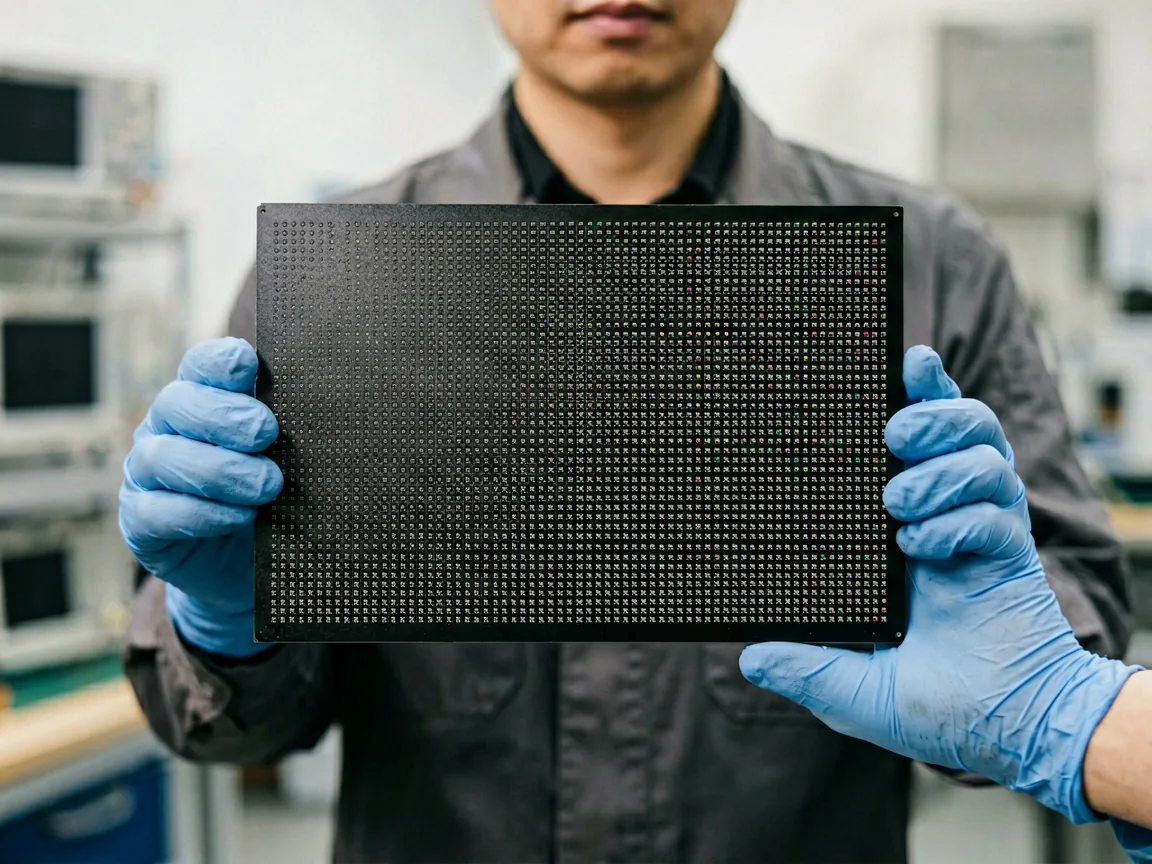
Pixel pitch is the distance in millimetres between the centres of two adjacent LEDs. It is the number that drives both image quality and roughly half of the screen cost, and it is chosen from one input: how close the nearest guest stands.
Industry rule of thumb
Minimum comfortable viewing distance (m) ≈ pixel pitch (mm)
A P2.5 screen looks clean from about 2.5 m and perfect from 5 m. Closer than 2.5 m a viewer starts to resolve individual LEDs. Some integrators use pitch × 1.5 for a stricter “retina” threshold — for hotel work the 1:1 rule is the practical starting point, then round to the pitch your budget supports.
Worked example — hotel lobby feature wall
The nearest a guest will stand is the edge of the reception desk, 3 m from the wall. Applying the rule, pitch ≈ 3 mm is acceptable, but the desk is also the position guests spend longest at, so drop one step to ص2.5 for margin. The wall opening is 5 m × 3 m = 15 m². At the factory-direct P2.5 indoor range of $400–$700/m² the panels are $6,000–$10,500, before structure, control system and installation.
| درجة البكسل | Min. viewing distance | Pixels per m² | Indoor price /m² | Best hotel use |
|---|---|---|---|---|
| ص1.25 | ~1.25 m | 640,000 | $900–$1,500 | Lift lobby, close-view wayfinding |
| ص1.56 | ~1.5 m | 410,000 | $700–$1,200 | Boardroom, reception backdrop |
| P2.0 | ~2 m | 250,000 | $500–$900 | Meeting rooms, small lobby walls |
| ص2.5 | ~2.5 m | 160,000 | $400–$700 | Lobby feature wall, conference hall |
| P3.0 | ~3 m | 111,111 | $350–$600 | Large halls, banquet backdrops |
| ص3.91 | ~4 m | 65,404 | $750–$980 (rental build) | Ballroom stage, event rental |
Prices are factory-direct reference ranges from our indoor LED screen price guide. Rental-construction cabinets carry a premium over fixed installation because of the locking hardware and flight cases.
Brightness: How Many Nits Does a Hotel Screen Need?
Brightness is measured in nits (cd/m²) and it is the specification most often copied blindly from a datasheet. More is not better — an over-bright screen in a lounge is uncomfortable, burns power, and shortens the life of the LEDs driven hardest.
| بيئة | سطوع | لماذا |
|---|---|---|
| Darkened conference room, cinema, spa | 300–500 nits | Requires a low-brightness / high-greyscale driver IC to dim without colour banding |
| Boardroom, corridor, lift lobby | 500–800 nits | Controlled architectural lighting, short viewing distance |
| Lobby, restaurant, ballroom interior | 600–1,200 nits | Standard indoor band; our indoor panels reach 1,000 nits |
| Atrium or wall behind glazing | 2,500–3,500 nits | Competing with daylight through glass; the most commonly under-specified case |
| Entrance canopy, facade, pool deck | 5,500–7,500 nits | Direct sun; pair with an automatic brightness sensor |
Two practical points. First, always specify automatic brightness adjustment for any screen that sees changing daylight — it protects the guest experience at night and cuts power meaningfully. Second, remember that rated brightness is the maximum; a well-configured hotel screen typically runs at 50–70% of rating, which is also where colour accuracy and lifespan are best.
Screen Size, Aspect Ratio and Resolution Planning
LED walls are built from cabinets, so the finished size is always a multiple of the cabinet dimension — you cannot order an arbitrary 4.37 m width. Planning runs in this order: architectural opening → cabinet grid → native resolution → content format.
Step 1 — fix the aspect ratio
16:9 is the default because it matches laptops, media players and camera output with no letterboxing. Our long-standing guidance for hotel projects is to keep the screen rectangular and not smaller than 3 m × 2 m for any room where an audience is seated — below that a large room reads the screen as signage rather than a focal display.
Step 2 — calculate native resolution
Resolution formula
Horizontal pixels = screen width (mm) ÷ pixel pitch (mm)
Example: a 3,840 mm wide wall at P2.0 = 3,840 ÷ 2.0 = 1,920 pixels wide. At 2,160 mm high that is 1,080 pixels — exactly Full HD, one-to-one, no scaling.
Step 3 — check against 4K if it is claimed
True UHD (3,840 × 2,160) is a pixel count, not a quality badge. At P2.5 it requires a wall 9.6 m × 5.4 m — 52 m², larger than most hotel ballroom budgets. At P1.56 it needs 6.0 m × 3.4 m. If a supplier offers “4K” on a 6 m × 3.4 m P2.5 wall, they are describing the input signal, not the panel. Our جدول حجم شاشة LED converts these dimensions to feet and inches.
Step 4 — reconcile with the cabinet grid
Our Ehonor cabinets are 480 × 320 mm, so widths come in 0.48 m steps and heights in 0.32 m steps. A 5 m opening becomes a 4.80 m screen (10 cabinets) with 100 mm of trim each side — which is normally the right answer, because a frame reveal looks deliberate and a forced-fit screen does not.
Refresh Rate: Why Hotel Screens Get Filmed
Refresh rate is how many times per second the LED driver redraws the image. The human eye stops noticing above roughly 1,000 Hz — cameras do not. This matters more in hotels than in almost any other venue, because hotel screens end up in wedding videos, conference livestreams, press photography and guests’ phone footage.
- Below 1,920 Hz — a camera records visible horizontal scan lines and flicker. Unacceptable for any ballroom or conference space.
- 1,920 Hz — the practical minimum for filmed environments.
- 3840 هرتز — the current standard for professional indoor work, and the rating on our indoor series. Clean on phone video and broadcast cameras alike.
- 7,680 Hz — high-end broadcast and XR studio work; rarely required for hospitality.
Refresh rate is one of the first things a low-cost supplier quietly reduces to hit a price, and it does not appear in a showroom demo — only on camera, after installation. Always get it in writing on the specification sheet.
Lifespan, Durability and What Actually Fails
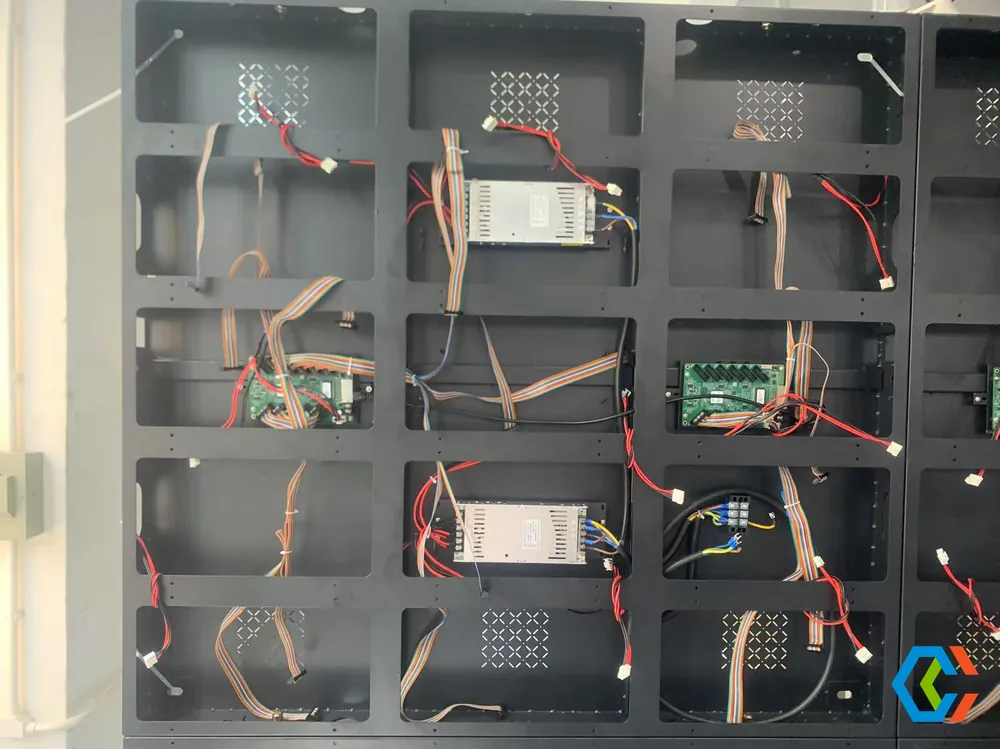
LED dies carry a rated life of 100,000 hours to L50 — the point at which brightness has declined to 50% of original. At 12 hours a day that is about 22 years, and it is the number every manufacturer quotes.
It is also not the number that determines when a hotel screen needs work. In practice the limiting components are the switching power supplies, typically rated 30,000–50,000 hours, and the electrolytic capacitors inside them. A realistic service life for a commercial hotel installation is 7–10 years of daily operation before a noticeable brightness or uniformity decline, assuming adequate ventilation and a modest spare-parts stock.
Heat is the real enemy
Every 10 °C of sustained over-temperature meaningfully shortens power-supply life. Leave the ventilation gap the drawing specifies and never box a screen into a sealed joinery recess.
Run below maximum
A screen driven at 60% brightness lasts materially longer than one pinned at 100%. Specify enough nits that you never need full output.
Stock spares at handover
2–3% spare modules and one spare power supply and receiving card per screen. Module colour batches drift over years — spares bought with the original order match; spares bought in year six may not.
Installation Methods and Project Timeline
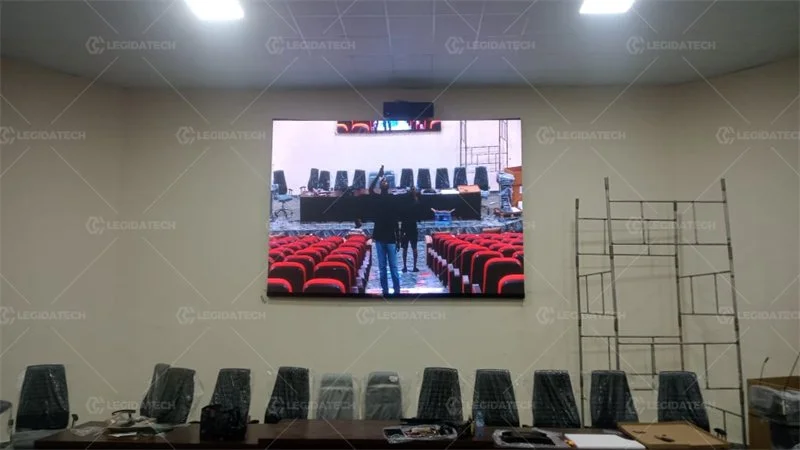
How the screen is fixed to the building drives cost, service access and how the finished wall looks. Hotels are usually finished interiors with limited rear access, which narrows the choice more than buyers expect.
Flush wall-mount
Cabinets on a steel sub-frame bolted to the structural wall. The standard for lobbies and boardrooms. Requires front-serviceable cabinets because there is no rear access.
Hanging / suspended
Hung from ceiling steelwork or truss. Used for ballroom stages and atriums. Needs a structural check on the slab and a defined load path.
Curved & creative
Cabinets on adjustable arc brackets for columns, curved reception desks and feature ribbons. See شاشات LED الإبداعية for shapes beyond flat.
Mobile / rental
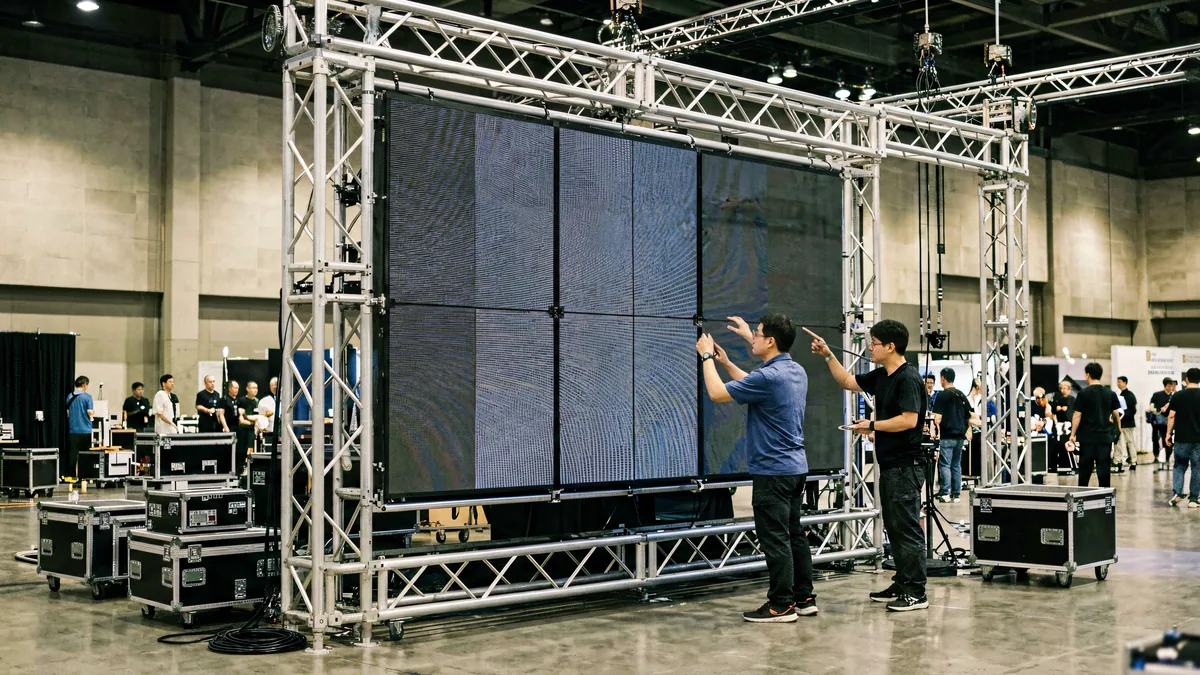
Quick-lock cabinets in flight cases, ground-stacked or hung on truss. Lets one ballroom serve a wedding on Saturday and a conference on Monday. See شاشة LED للإيجار.
Typical hotel project timeline
| منصة | Duration | What happens |
|---|---|---|
| Specification & quotation | 2–4 hours | Zone, distance, size and light level reviewed; factory-direct line-item quote issued |
| Drawings & approval | 24 hours | Cabinet layout, structure and power/signal requirements issued for sign-off |
| Production & ageing test | 7–15 days | Cabinets built, then assembled on an ageing wall and run continuously for 72 hours before packing |
| Shipping | 7–35 days | Air freight or sea freight depending on volume and destination port |
| Site installation | 1–3 days | A thin-cabinet indoor wall installs at roughly 100 m² in 3 hours once the sub-frame is up |
| Commissioning | 0.5–1 day | Brightness calibration, colour uniformity, content scheduling and operator training |
Site durations assume the sub-frame, mains power and data cabling are ready before the crew arrives — pre-installation coordination is where hotel projects most often lose a week.
Control Systems and Content Management
The screen is only half the purchase. The control chain determines who can change the content, from where, and how reliably it runs unattended overnight.
Synchronous control
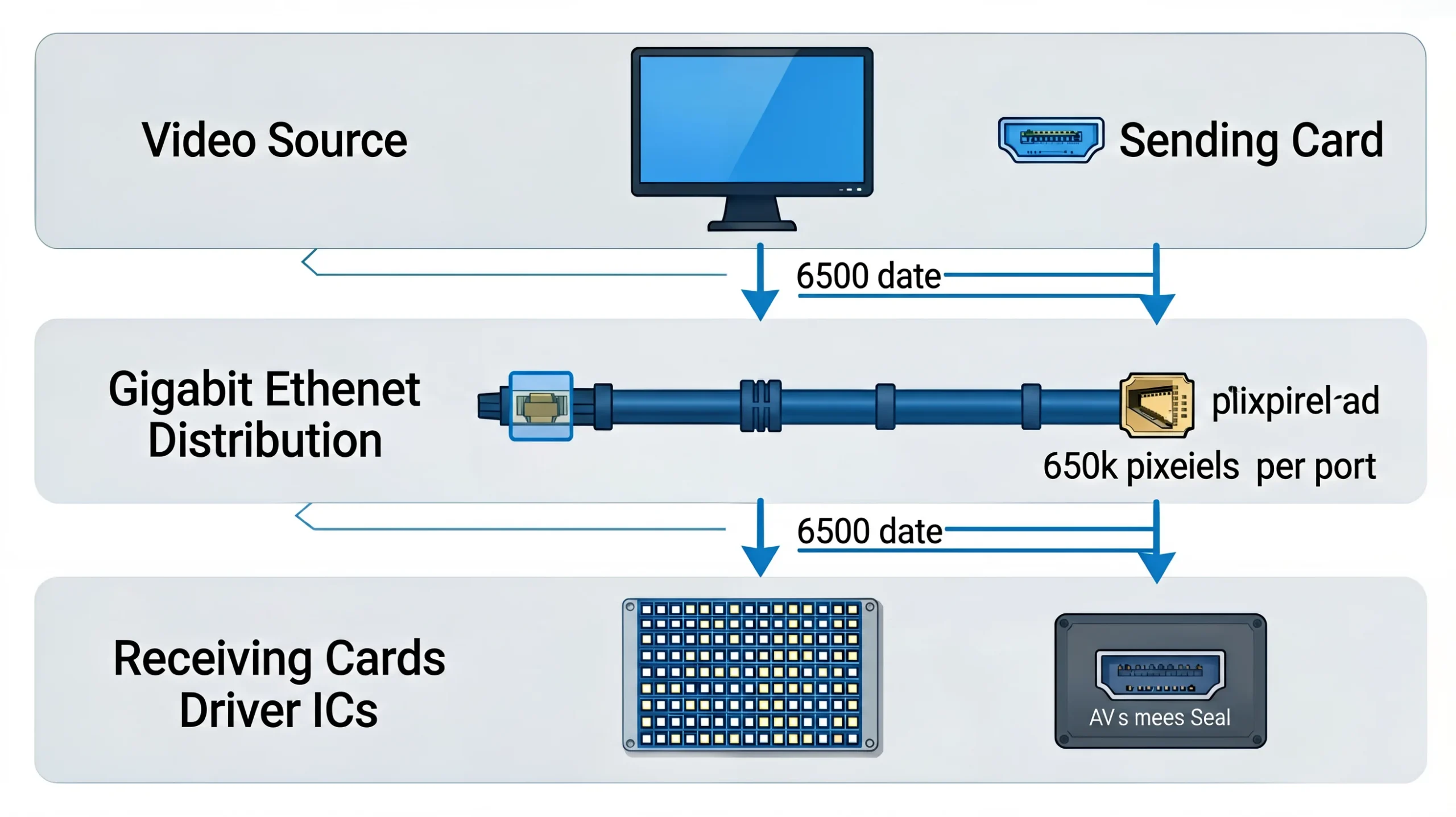
A sending card takes HDMI/DVI from a PC or media player in real time and drives receiving cards in each cabinet. Correct for ballrooms, conference halls and anywhere live content, presentations or camera feeds are shown.
Asynchronous control
Content is uploaded to an on-board player that runs a schedule with no PC attached. Correct for lobby loops, wayfinding, lift lobbies and facade advertising that repeats daily.
Hybrid
Most hotels need both: asynchronous scheduling as the default state, with a synchronous input that takes over when a room goes live. Specify the switchover method at design stage, not on commissioning day.
A complete hotel control chain is: media source → video processor (scaling, multi-window, seamless switching) → sending card → Cat-5e/fibre → receiving cards → cabinets. For multi-screen properties a networked CMS lets one operator schedule the lobby, all lift lobbies and the restaurant band from a single interface, with different content by daypart.
We supply and pre-configure NovaStar, Huidu, Colorlight and Mooncell systems — see the LED display control system hub for the full range and compatibility notes. Signal runs beyond 100 m over Cat-5e need fibre or a repeater; on a large property that is a design decision, not a site improvisation.
Maintenance: What Hotel Engineering Teams Need to Know
A hotel screen is maintained by the property’s own engineering team for most of its life, so serviceability should be specified as deliberately as pitch.
Front vs rear service
Front-serviceable modules pull off magnetically from the face — essential for any wall mounted flush or in a tight recess. Rear service needs 600–800 mm of walkway behind the screen, which most hotel walls do not have.
Routine checks
Monthly: visual sweep for dead pixels and colour drift. Quarterly: dust the module faces and check ventilation is unobstructed. Annually: verify power-supply output and re-run brightness calibration.
Spares and response
Keep 2–3% spare modules plus one receiving card and power supply per screen on site. A module swap is a 3–5 minute job with no tools once spares are held locally.
Budget guidance: for a large outdoor screen, ongoing maintenance including spare stock and periodic service runs in the region of $1,500–$2,500 per year for a 50 m² outdoor P3 wall. Indoor hotel screens in a clean, climate-controlled environment cost materially less to keep running.
Hotel LED Screen Cost: What Drives the Number
Most hotel enquiries arrive as “how much for a screen in our lobby?” — a question that cannot be answered without size and pitch, because the panel price alone moves by a factor of four across the pitch range. Here is the full cost structure.
| Component | Typical cost | ملحوظات |
|---|---|---|
| Indoor LED panels (P1.25–P3) | $350–$1,500 /م² | Factory-direct; pitch is the dominant variable |
| Outdoor LED panels (P4–P10) | $280–$950 /م² | IP65 die-cast cabinets, 5,500–7,500 nits |
| Rental-construction cabinets (P2.6–P4.81) | $650–$1,450 /م² | Quick-locks and flight cases add cost over fixed build |
| الهيكل الفولاذي والتركيب | $110–$250 /م² | Varies with region, height and structural complexity |
| نظام التحكم | Quoted per project | Sending card, processor, receiving cards, CMS licence |
| Shipping | Quoted per project | Air vs sea; destination port or door delivery |
| Spare parts & commissioning | Included in our quotes | 2–3% spare modules, calibration, operator training |
| Annual maintenance | ≈$1,500–$2,500 /yr | Reference figure for a 50 m² outdoor P3 wall |
Worked example A — lobby feature wall
A 5 m × 3 m (15 m²) P2.5 indoor wall behind reception. Panels at $400–$700/m² = $6,000–$10,500. Structure and installation at $110–$250/m² = $1,650–$3,750. Add the control system, freight and spares and a typical delivered project lands in the region of $9,000–$17,000 depending on cabinet grade and destination.
Worked example B — ballroom stage backdrop
An 8 m × 4 m (32 m²) P3.0 fixed wall for a 500-seat ballroom. Panels at $350–$600/m² = $11,200–$19,200. Structure and installation at $110–$250/m² = $3,520–$8,000. A rental-construction build of the same size at $650–$1,450/m² would put the panels at $20,800–$46,400 instead — the premium buys reconfigurability, and it is only worth paying if the room genuinely changes format.
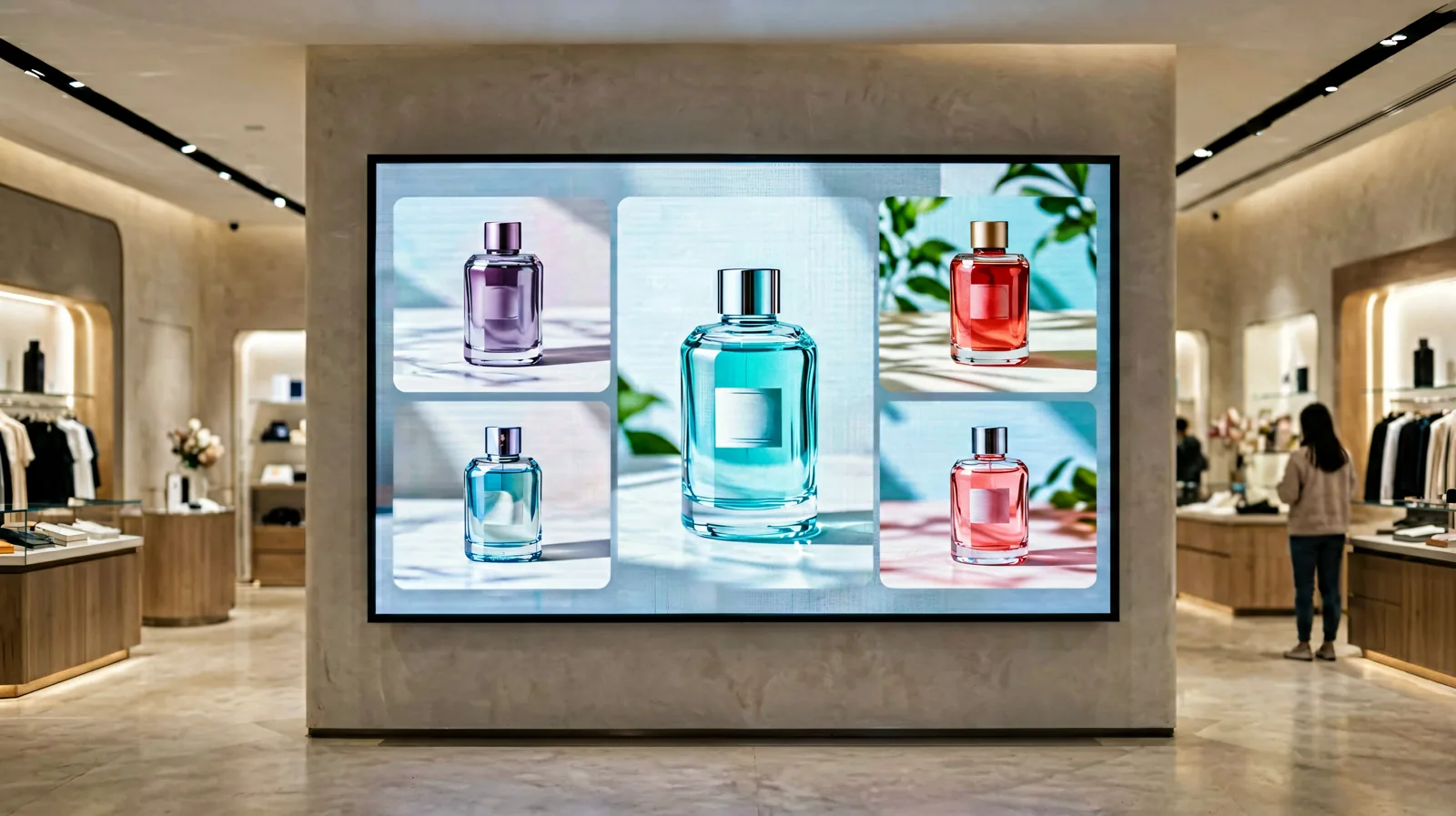
These are reference calculations from published per-m² ranges, not quotations. Currency, duty, site access and structural work vary widely by country. For the full pricing basis see the دليل أسعار شاشات LED; buying factory-direct rather than through a regional distributor typically saves 20–30%.
LED Video Wall vs Projector vs LCD Video Wall
Hotels replacing legacy AV usually compare three options. The honest summary is that projection still wins on first cost for occasional-use rooms, and LED wins everywhere the screen is on all day or the lights stay on.
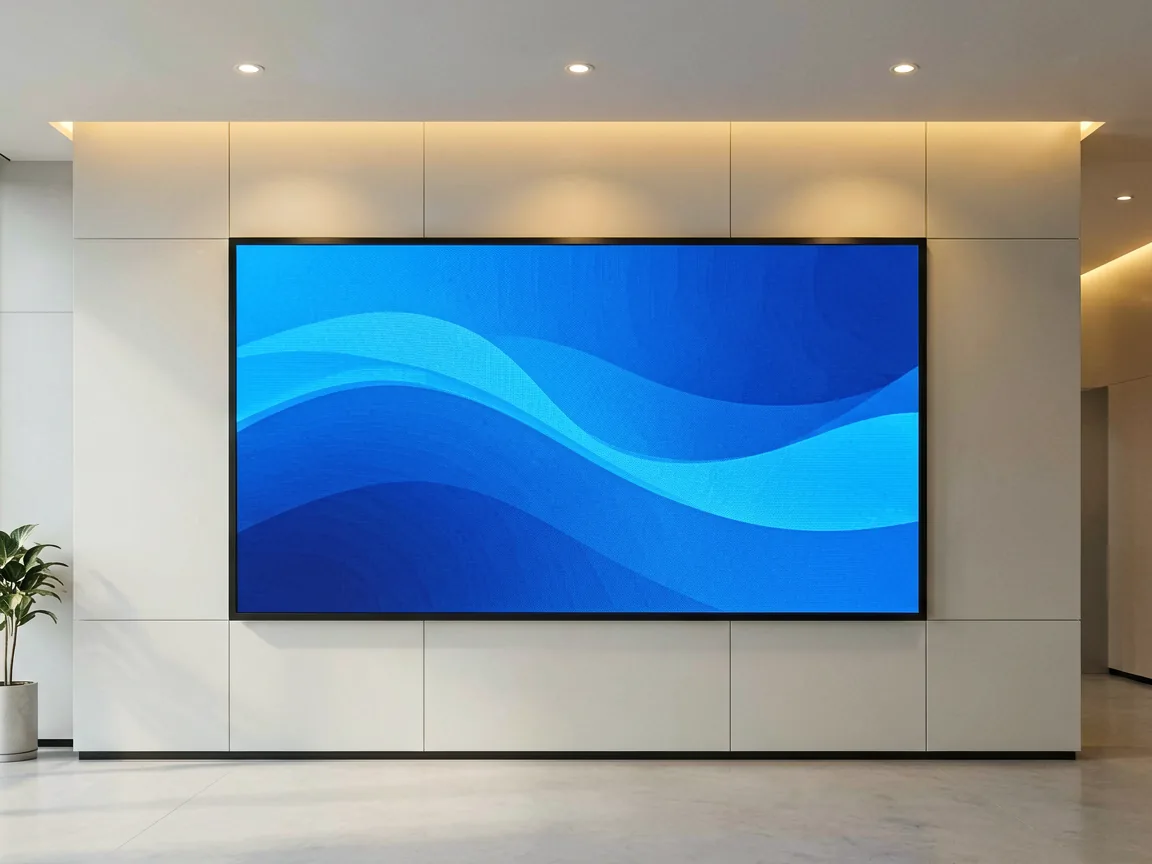
| حائط فيديو LED | Projector + screen | LCD video wall | |
|---|---|---|---|
| سطوع | 600–8,000 nits | Needs dimmed lighting | 500–700 nits |
| Seams | None — fully seamless | لا أحد | Visible bezel grid |
| Rated lifespan | 100,000 h (L50) | Lamp/laser replacement cycles | 50,000–60,000 h |
| Any size / shape | Yes — cabinet multiples, curves | Limited by throw distance | Fixed panel multiples only |
| Outdoor capable | Yes, IP65 | No | Rarely |
| Lights-on performance | ممتاز | Poor | Good |
| Best hotel fit | Lobby, ballroom, facade, all-day use | Occasional-use meeting rooms on a tight budget | Back-of-house dashboards |
For a deeper technical comparison including cabinet weights and install times, see our حائط فيديو LED مرشد.
Real Hotel and Hospitality Projects
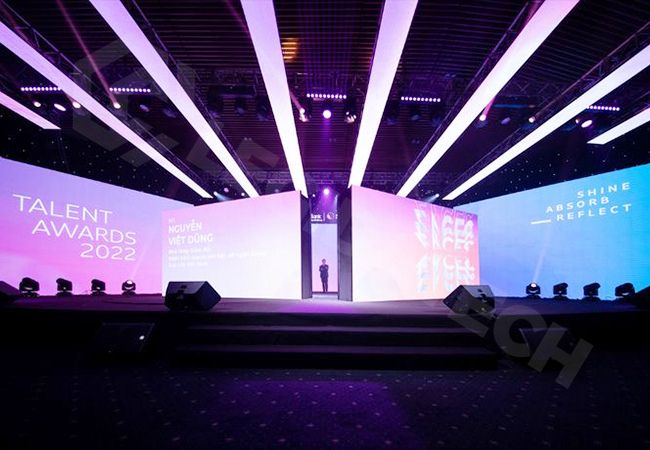
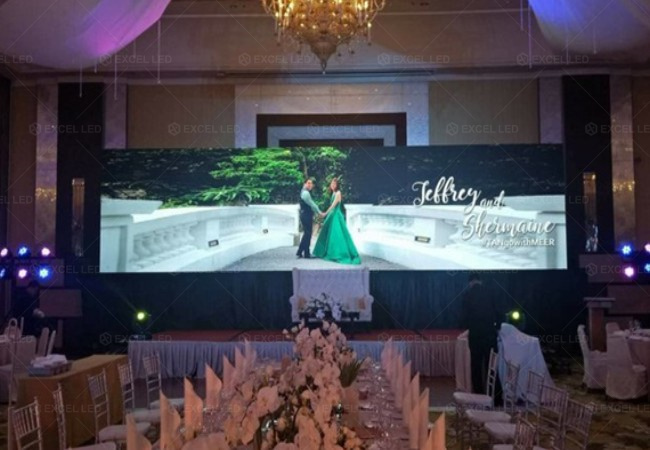
These are delivered LEGIDATECH installations in hotel and banquet environments. Sizes, series and destinations are as shipped.

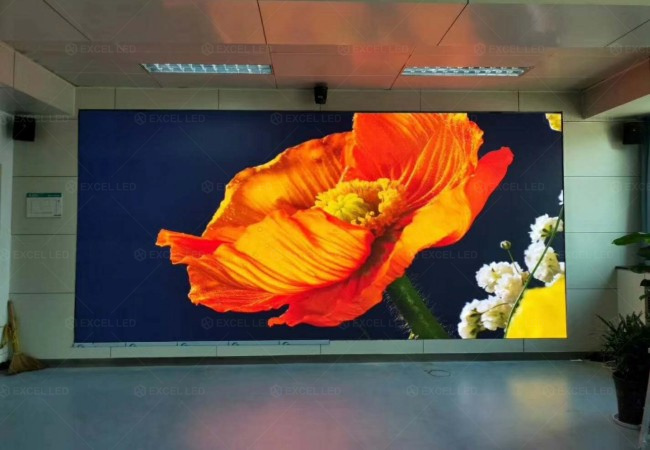
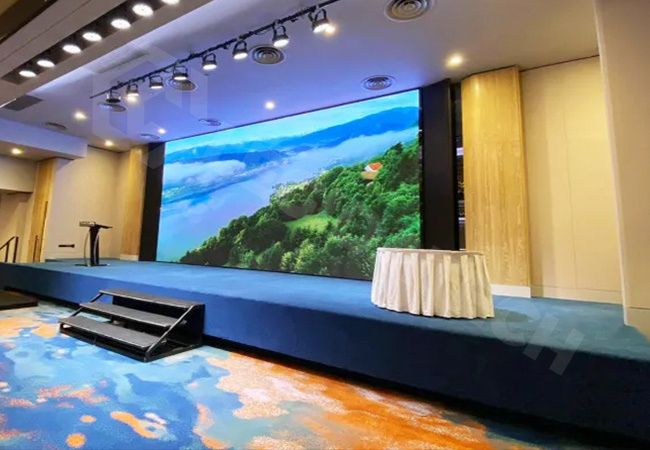
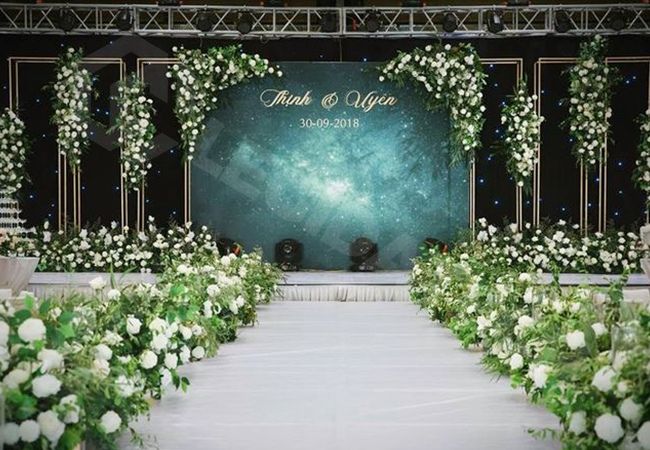
Installation and Product Videos
Real project footage from hotel-class meeting rooms and the installation features that matter in a finished interior.
Conference room solution — H Series P2.5, 3.84 × 3.2 m, Brazil
P1.87 fine-pitch fixed install — meeting room, South Africa
Flat, curved and hanging installation methods
Front-service cabinet replacement — no rear access needed
Which LED Screen Series Fits Your Hotel?
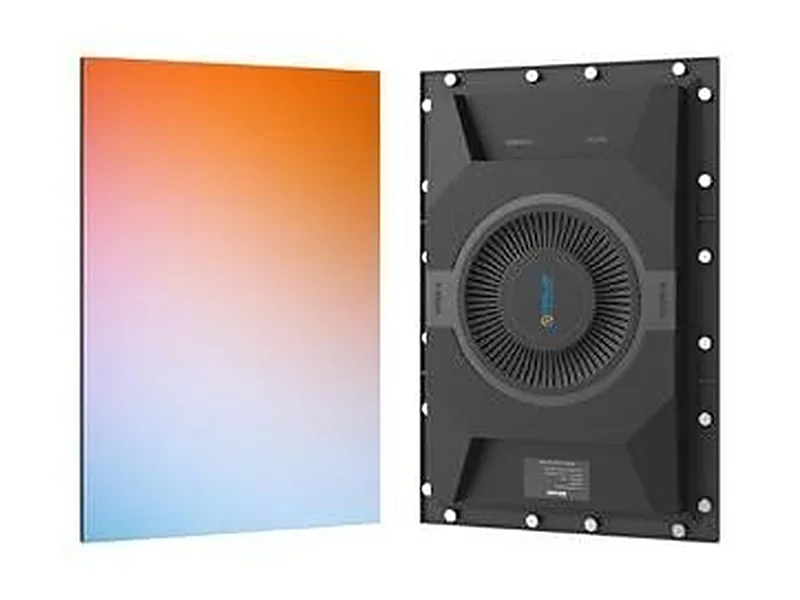
Ehonor Series — lobby & boardroom
480 × 320 mm front-service panel, 2.7 kg, magnetic modules with no screws, ≥3,840 Hz, P1.2–P2.5. The default choice for flush-mounted lobby and meeting-room walls. سلسلة إيهونور →
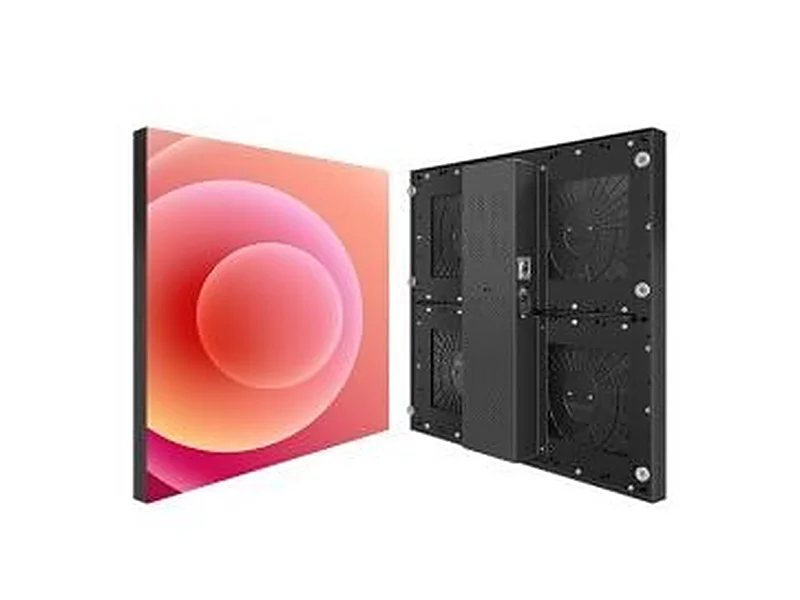
H Series — halls & large rooms
Indoor P2.6/2.9/3.9, high refresh, thin and light cabinet — installs roughly 100 m² in 3 hours. Suited to conference halls and ballroom backdrops. H Series →

Fine-pitch indoor — close viewing
P1.2–P3 on 640 × 480 mm cabinets with 320 × 160 mm modules and SMD 3-in-1 packaging, for lift lobbies and executive boardrooms. Fine-pitch range →
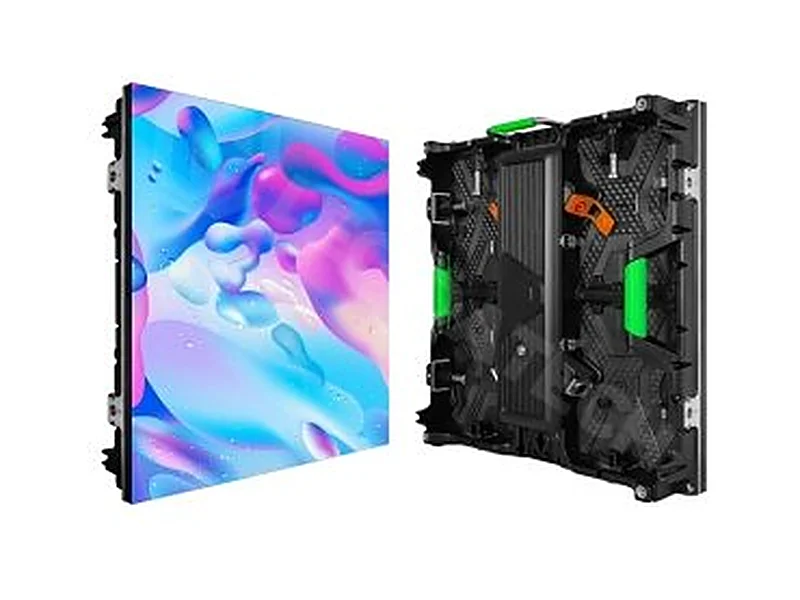
Rental series — reconfigurable ballrooms
Quick-lock cabinets and flight cases so one room serves weddings, conferences and launches. Rental LED display →
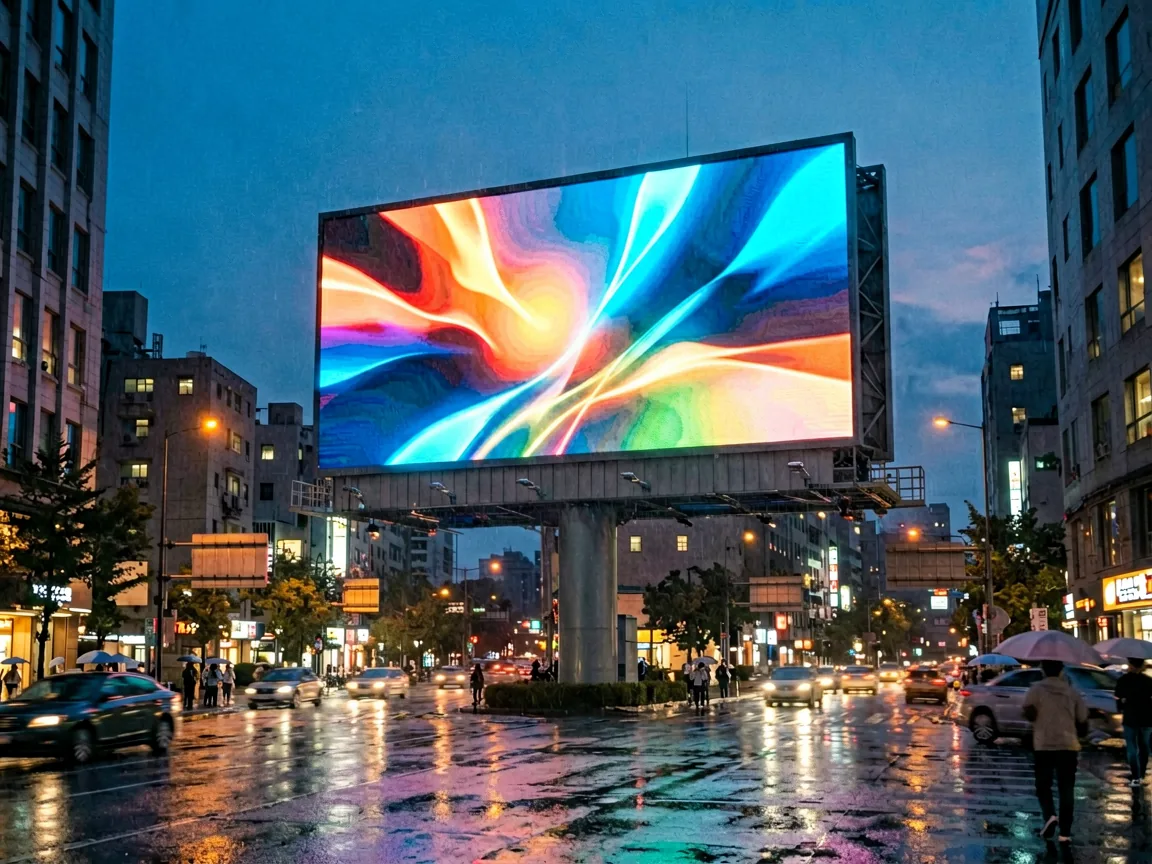
Outdoor series — facades & canopies
P4–P10, 5,000–7,500 nits, IP65 die-cast cabinets with automatic brightness control. Outdoor LED display →
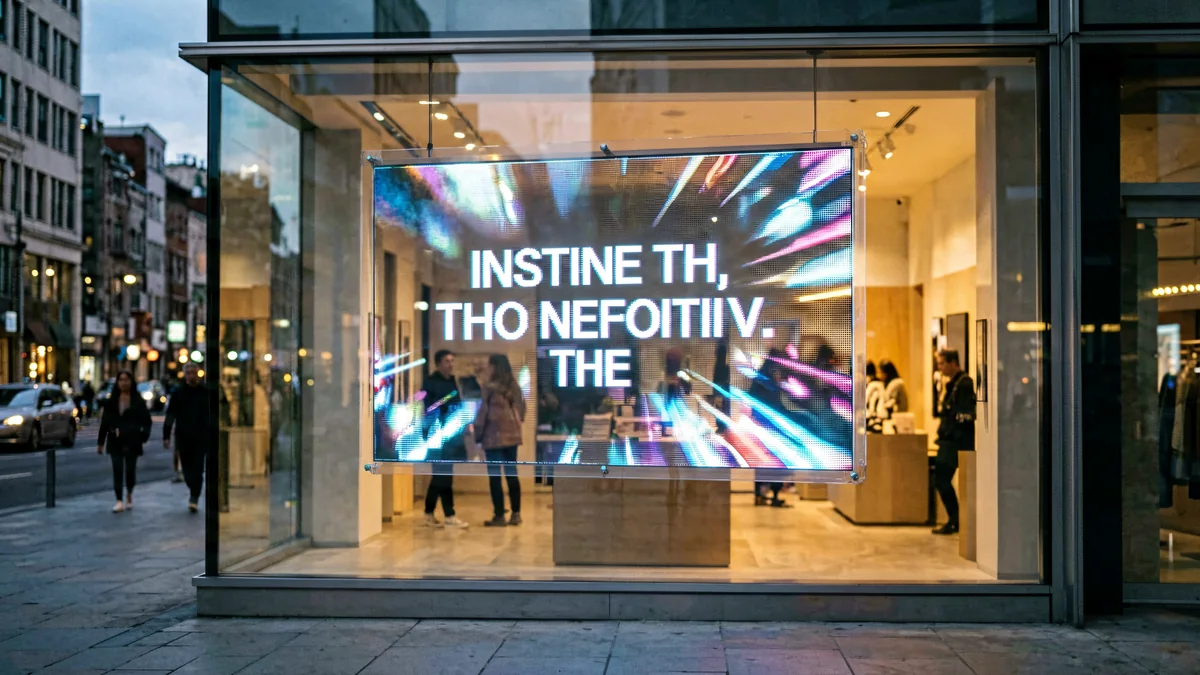
Transparent & creative
Transparent film screens for glass curtain walls that must stay see-through, plus curved and irregular builds for columns and feature ribbons. Transparent display →
Hotel LED Screen Procurement Checklist
Send these seven items with an enquiry and a manufacturer can quote accurately in one round rather than four.
- Zone and mounting surface — lobby wall, ballroom stage, entrance canopy; structural wall, plasterboard or truss.
- Opening dimensions — width × height in mm, plus a photo or elevation drawing. Note any depth restriction behind the wall.
- Closest viewing distance — where the nearest guest actually stands. This sets pixel pitch more than any other input.
- Light environment — controlled interior lighting, daylight through glazing, or full sun. This sets brightness.
- هل سيتم تصويره؟ — weddings, livestreams, press. If yes, 3,840 Hz refresh becomes a hard requirement.
- Content and control — scheduled loop, live presentation input, or both; who will operate it.
- Rear access — is there walkway space behind the screen? If not, front-service cabinets are mandatory.
Hotel LED Screen FAQ
ما هو أفضل حجم بكسل لشاشة LED في ردهة الفندق؟
تتراوح المسافة بين 1.8 و2.5 بكسل لجدار مميز في ردهة فندق نموذجية عند مشاهدتها من مسافة 3 إلى 6 أمتار. استخدم قاعدة أن الحد الأدنى لمسافة المشاهدة المريحة بالأمتار يساوي تقريبًا المسافة بين البكسلات بالملليمترات، ثم قلل المسافة بمقدار درجة واحدة إذا كان الضيوف يصطفون بالقرب من الشاشة. أما بالنسبة لردهة المصعد عند مشاهدتها من مسافة 1.5 متر، فاستخدم المسافة بين 1.25 و1.8 بكسل.
ما هو مستوى سطوع شاشة LED في الفندق؟
600-1200 شمعة/م² للردهات الداخلية والمطاعم وقاعات الاحتفالات؛ 500-800 شمعة/م² للممرات وقاعات الاجتماعات؛ 2500-3500 شمعة/م² للجدار خلف الزجاج حيث يتنافس ضوء النهار؛ و5500-7500 شمعة/م² للمدخل الخارجي أو الواجهة. يُرجى دائمًا تحديد خاصية الضبط التلقائي للسطوع عند تغير ضوء النهار.
كم تبلغ تكلفة شاشة LED في الفندق؟
تتراوح تكلفة الألواح الداخلية من $350 إلى $1500 وحدة/م² مباشرةً من المصنع، وذلك حسب دقة البكسل. أما الألواح الخارجية فتتراوح تكلفتها من $280 إلى $950 وحدة/م²، وتضيف تكلفة الهيكل الفولاذي مع التركيب من $110 إلى $250 وحدة/م². ويبلغ سعر جدار ردهة بمساحة 15 م² من نوع P2.5 عادةً ما يتراوح بين $9000 و$17000 وحدة شاملة التوصيل والتركيب، ويختلف السعر باختلاف الوجهة ونوع الخزانة.
ما هو حجم شاشة LED التي تحتاجها قاعة احتفالات الفندق؟
تتراوح مساحة قاعة الرقص عادةً بين 20 و80 مترًا مربعًا، وتتسع لما بين 300 و800 مقعد، وتكون نسبة العرض إلى الارتفاع فيها 16:9، مع استخدام وحدات عرض مدمجة. يُنصح بأن تكون أبعاد أي شاشة عرض أمام الجمهور 3 أمتار × 2 متر أو أكبر. أما بالنسبة لقاعة تتسع لـ500 مقعد، فيُعدّ جدار بمقاس 8 أمتار × 4 أمتار ومستوى إضاءة P3.0 من المواصفات الشائعة.
هل أحتاج إلى شاشة LED داخلية أم خارجية لمدخل الفندق؟
إذا تعرضت الشاشة لأشعة الشمس المباشرة أو المطر - كواجهة مظلة أو عمود في ساحة أمامية أو واجهة مبنى - فيجب أن تكون خزانة خارجية بمعيار IP65 وبإضاءة تتراوح بين 5500 و7500 شمعة/م². أما الشاشة الموجودة داخل أبواب المدخل مباشرةً ولكن خلف الزجاج، فهي حالة خاصة: إذ تحتاج إلى إضاءة تتراوح بين 2500 و3500 شمعة/م² للتغلب على ضوء النهار، على الرغم من أنها موجودة فعليًا في الداخل.
ما هو معدل التحديث الذي أحتاجه إذا تم تصوير الأحداث؟
يُعتبر معدل التحديث 1920 هرتز على الأقل، و3840 هرتز هو المعيار الاحترافي. أما الكاميرات التي يقل معدل تحديثها عن 1920 هرتز، فتسجل خطوط مسح أفقية واضحة، مما يُفسد فيديوهات حفلات الزفاف، والبث المباشر للمؤتمرات، والتصوير الصحفي. يُعدّ معدل التحديث وسيلة شائعة لخفض التكاليف بشكل غير مباشر، لذا تأكد من ذكره في المواصفات المكتوبة.
كم يدوم عمر شاشة LED في الفندق؟
تُصنّف رقائق LED بعمر افتراضي يصل إلى 100,000 ساعة عند سطوع 50%، أي ما يعادل 22 عامًا تقريبًا عند تشغيلها 12 ساعة يوميًا. أما الحد العملي فهو لوحدات التغذية الكهربائية التي تعمل بتقنية التبديل، حيث يتراوح عمرها بين 30,000 و50,000 ساعة. لذا، يُنصح بالتخطيط لاستخدامها لمدة تتراوح بين 7 و10 سنوات من التشغيل التجاري اليومي قبل ملاحظة أي انخفاض ملحوظ في الأداء، مع توفير تهوية جيدة ومخزون صغير من قطع الغيار.
هل يمكن صيانة الشاشة دون الوصول إلى ما وراء الجدار؟
نعم، إذا حددت خزائن قابلة للصيانة من الأمام. تُزال الوحدات مغناطيسيًا من الواجهة وتُستبدل في غضون 3-5 دقائق دون الحاجة إلى أدوات. هذا ضروري للجدران المدمجة في ردهة الاستقبال، حيث تتطلب الصيانة الخلفية ممرًا بعرض 600-800 مم، وهو عرض نادرًا ما يتوفر في الفنادق.
كم تستغرق عملية التركيب؟
يتم تركيب جدار داخلي رفيع بمساحة تقارب 100 متر مربع في غضون 3 ساعات بمجرد تجهيز الإطار الفرعي الفولاذي وكابلات الطاقة والبيانات - لذا فإن معظم شاشات الفنادق تستغرق من يوم إلى ثلاثة أيام في الموقع بالإضافة إلى نصف يوم للتشغيل. يستغرق الإنتاج واختبار التقادم لمدة 72 ساعة من 7 إلى 15 يومًا قبل الشحن.
هل يمكن لنظام واحد التحكم في الشاشات في عدة مناطق من الفندق؟
نعم. يتيح نظام إدارة المحتوى الشبكي لمشغل واحد جدولة جدار الردهة، ولوحات ردهة المصعد، وجهاز الموسيقى في المطعم، وشاشة الواجهة من واجهة واحدة، مع محتوى مختلف حسب أوقات اليوم. تعتمد معظم المنشآت جدولة غير متزامنة كإعداد افتراضي مع إدخال مباشر متزامن لمساحات الفعاليات.
هل يُعد جدار LED أفضل من جهاز العرض في قاعة اجتماعات الفندق؟
نعم، بالنسبة لأي غرفة تُستخدم بانتظام مع تشغيل الإضاءة، فإن جدار LED يحافظ على التباين في الإضاءة المحيطة، ولا يحتاج إلى استبدال المصباح، ولا يتطلب ضبط مسافة العرض. يبقى جهاز العرض الخيار الأرخص في البداية للغرف التي تُستخدم بشكل متقطع ويمكن تعتيمها. كما أن جدار LED خالٍ من فواصل الحواف، على عكس جدار فيديو LCD.
ما الفرق بين شاشة قاعة الرقص الثابتة وشاشة قاعة الرقص المستأجرة؟
تُعدّ الخزائن الثابتة أرخص سعرًا للمتر المربع، وتُضفي لمسة نهائية أنيقة ودائمة. أما الخزائن المُؤجرة، فتُضيف أقفالًا سريعة وحقائب نقل بسعر يتراوح بين 650 و1450 جنيهًا إسترلينيًا للمتر المربع، مما يُتيح إعادة تهيئة القاعة لتناسب مختلف أنواع الفعاليات. يُنصح باختيار التأجير فقط في حال تغيير تصميم قاعة الاحتفالات فعليًا؛ وإلا فإن الخزائن الثابتة تُعدّ خيارًا أفضل من حيث القيمة.
هل يمكنك بناء حاجز لجدار منحني أو عمود؟
نعم. تُركّب الخزائن على دعامات قوسية قابلة للتعديل لتناسب مكاتب الاستقبال المنحنية والأعمدة والشرائط المميزة، كما تُصنع الأشكال غير المنتظمة وفقًا للرسم المعماري. أرسل لنا الارتفاع ونصف القطر، وسنرسل لك تصميمًا للخزائن خلال 24 ساعة.
ما المعلومات التي تحتاجها لتقديم عرض سعر لشاشة LED في فندق؟
المنطقة، وعرض وارتفاع الفتحة بالمليمتر، وأقرب مسافة للمشاهدة، وبيئة الإضاءة، وما إذا كان المكان مُصوَّراً، وما إذا كان هناك مدخل خلفي، والبلد المقصود. بناءً على هذه المعلومات السبعة، نُقدِّم عرض أسعار مُفصَّلاً من المصنع مباشرةً خلال 2-4 ساعات، ورسم تخطيطي للخزانة خلال 24 ساعة.
Specifying a Hotel LED Display: The Longer Explanation
Hotel display projects fail in predictable ways, and almost all of them trace back to a specification written from a product catalogue rather than from the room. It is worth walking through why, because the same three mistakes account for most of the disappointing installations we are asked to replace.
Mistake one: choosing pitch by budget instead of by distance
Pixel pitch is not a quality tier where more expensive is better. It is a match between LED density and how close the viewer stands. A P1.5 screen in a 500-seat ballroom is money burned — nobody past the third row can resolve the extra pixels, and the same budget spent on a larger P3.0 wall would have transformed the room. Equally, a P4 panel behind a reception desk where guests wait 90 seconds at a metre and a half looks visibly coarse no matter how good the content is. Start with the closest realistic viewing position, apply the distance rule, then size the wall with whatever budget remains. Doing it in the other order produces a screen that is either too small or too coarse.
Mistake two: ignoring the light the screen has to fight
The single most common specification error in hospitality is a standard 800-nit indoor panel installed within a few metres of a glass curtain wall or under an atrium skylight. It looks superb during the factory demonstration and during the evening handover. By ten the next morning it is grey. Daylight through glazing is an order of magnitude brighter than the architectural lighting the panel was specified against, and no amount of content grading recovers it. Any screen that can see the sky, even indirectly, needs 2,500–3,500 nits. This costs more per square metre, and it is not optional.
Mistake three: forgetting that hotels get photographed
A ballroom screen is in the background of every wedding photograph and every conference livestream taken in that room for the next decade. A panel running at 1,000 Hz refresh looks perfect to the eye and produces rolling horizontal bands on camera. Couples notice. Event planners notice, and they book elsewhere. Refresh rate does not appear in a showroom demonstration and it is one of the easiest specifications for a low-cost supplier to quietly reduce, which is exactly why it belongs in writing on the purchase specification alongside pitch and brightness.
Why hotels are moving from projection to LED
The economics changed as fine-pitch LED prices fell. A projector needs a darkened room, a protected throw path, a screen surface and periodic lamp or laser replacement; it also loses the room to daylight the moment anyone opens a curtain. An LED wall holds full contrast with the house lights up, which for a hotel means the same ballroom can run a daytime AGM and an evening gala without a lighting compromise. It has no bezel seams, unlike an LCD video wall, so a 30 m² backdrop reads as one continuous image rather than a grid. And because it is built from cabinets it fits the architecture instead of forcing the architecture to accommodate a fixed panel size.
The operational argument is often stronger than the visual one. A lobby screen replaces printed signage that has to be reprinted for every event, a lift-lobby panel replaces a directory board that goes out of date, and a ballroom wall replaces a rented backdrop on every single booking. Those are recurring costs that stop, which is what makes the capital case work in properties that would never buy a screen purely for appearance.
Planning a multi-zone property
Hotels rarely buy one screen. The pattern that works is to specify the whole property once — lobby, lift lobbies, meeting rooms, ballroom, restaurant, facade — then phase the purchase, because a single specification keeps the control system, cabinet family and spare-parts pool common across every zone. Buying zone by zone over three years typically produces four incompatible control systems, four spare-parts inventories and no single operator who can schedule content across the building. The screens themselves can be installed whenever the refurbishment programme allows; it is the control architecture that has to be decided at the start.
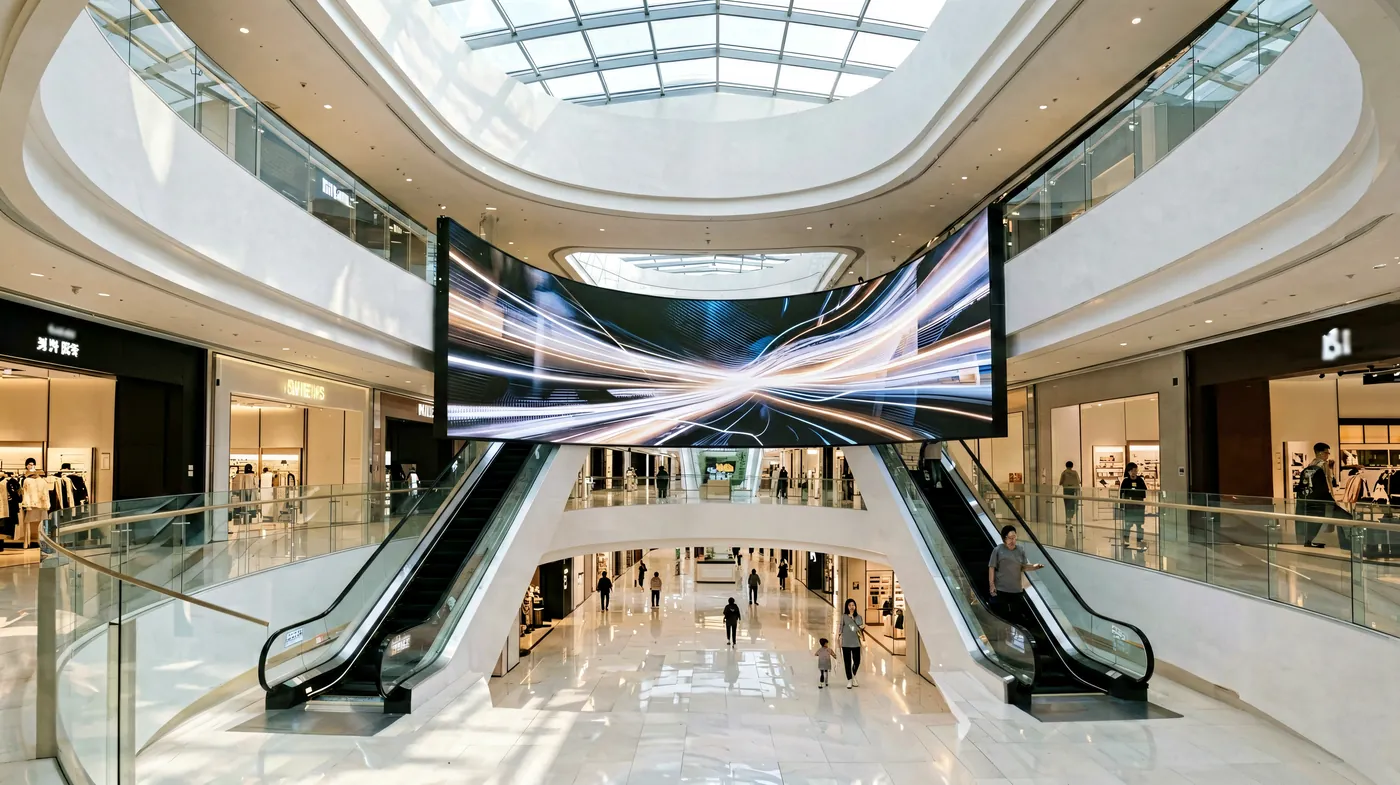
If you are at that stage, send the floor plans rather than a screen size. We will return a zone-by-zone specification with pitch, brightness, cabinet type and control architecture for the whole property, and you can phase it however the capital programme requires. Related solution pages: حلول شاشات العرض LED by market, KTV and club LED displays for hotel entertainment venues, shopping centre LED screens for retail podiums, and airport LED displays for transport-hub properties.
Get a Factory-Direct Hotel LED Screen Quote
Tell us the zone, the opening size and how close guests stand. We reply within 2–4 hours with the right series, pixel pitch, brightness and a line-item factory-direct quotation — and a cabinet layout drawing within 24 hours.